KUCB - Unalaska

KUCB is our partner station in Unalaska. KTOO collaborates with partners across the state to cover important news and to share stories with our audiences.
Airlines work to fill gaps in Alaska flight service after RavnAir shutters

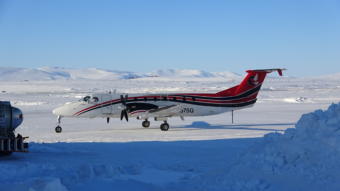
A Ravn Alaska Beechcraft airplane in Nome, March 21, 2016. (Creative Commons photo by Quintin Soloviev)

As all RavnAir Group operations grind to a halt, other air carriers around the state say they are looking at ways they can step in.
Alaska Airlines sent a statement Monday that promised, among other things, to maintain service to the 19 communities it currently serves; to start normal seasonal summer service to King Salmon and Dillingham earlier; and finally, despite a hiring freeze due to uncertainty in the industry surrounding COVID-19, to hold a job fair for Ravn employees.

Alaska Airlines does not have any planes in its fleet equipped to land at Unalaska’s Tom Madsen Airport. But spokesperson Tim Thompson said the Seattle-based airline is “looking to ramp up operations in Cold Bay at some point, and other carriers can provide flights between the airports.”

That flight will operate between Anchorage and Cold Bay. While Alaska Airlines does not have a specific start date for the route, they “are working quickly,” said Thompson.

RavnAir was the sole airline provider to two Essential Air Service, or EAS, communities: McGrath and Saint Paul. The federal Department of Transportation subsidizes air carriers under the EAS program.

“From my understanding, they should still be flying (the EAS) routes,” said Phillip Zavadil, city manager of Saint Paul.

Zavadil said he reached out to DOT and is waiting to hear back on whether the remote island will regain air service.

It is unclear how the DOT and Ravn will proceed. Though, in an unsigned agency statement, the department has confirmed that it is “working through the effects of Ravn’s public announcement.”

State leaders reacted to the news saying there was hope that other carriers would step in as quickly as possible.

“As everyone in the community knows so painfully well, the issues with Ravn have been around some time now,” said Bryce Edgmon, an independent state representative from Dillingham and speaker of the Alaska House of Representatives. “There’s a lot of concern and a lot of effort in the aviation industry in terms of coming in and picking up the slack.”

Unalaska was once a designated EAS community, though it last participated in the program in the late 1990s. After a fatal plane crash left the city without air service last year, the city began looking into joining the program again.

Despite losing its only commercial airline provider, the city still retains mail and cargo service through ACE Air Cargo.

Campaign to recall Dunleavy provides at-home petition signing during COVID-19 pandemic

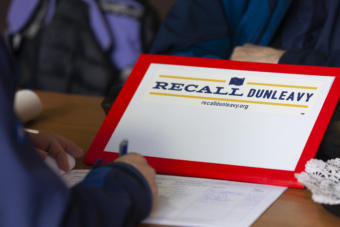
Residents gather on Saturday, February 29, 2020 at a kickoff event for organizers of an effort to Recall Gov. Mike Dunleavy in Juneau, Alaska. (Photo by Rashah McChesney/KTOO)

It may not be the most prominent item in the news cycle, but Governor Mike Dunleavy is still facing a statewide recall. The campaign to remove him from office is in the second of three phases. Right now, the group is trying to gather enough signatures for a special election.

Earlier this month, the Recall Dunleavy followed guidelines from the Centers for Disease Control and Prevention and suspended all signature gathering events.
Volunteers were still allowed to do one-on-one signings, but even meeting just one person could put volunteers’ health at risk.

On Friday morning, the Recall Dunleavy campaign announced that Alaskans can now mail in their signatures. Campaign manager Claire Pywell says this way, both volunteers and signers can stay healthy.

“Given the pandemic in front of us, the recall had to meet people exactly where they are,” Pywell said. “And right now that’s at home.”

Registered voters can go online to the campaign’s website, request a personal booklet and have it sent to their houses.

Sharon Svarny-Livingston is in charge of the recall effort in Unalaska. Before Friday, she was offering to meet people for individual signatures, but requested that they bring their own pen. With the new measures, she can stay safely at home and focus on her family.

“I think it’s probably best for everybody. I know it was giving my daughters a little bit of stress,” she said. “I want to eventually be able to go visit my mother again, so this is one reason why I really couldn’t.”

As of Friday afternoon, the campaign had gathered over 30,000 signatures. It needs 71,252 signatures to move on to the next phase of the recall.

Supporters of the governor have suspended their Keep Dunleavy campaign, by the request of Dunleavy himself. Instead, he asks that volunteers focus on supporting their family and community.

Next week, the Alaska Supreme Court will hear oral arguments in the case the state has with the Recall campaign.

Dutch Harbor remains nation’s top fishing port for volume

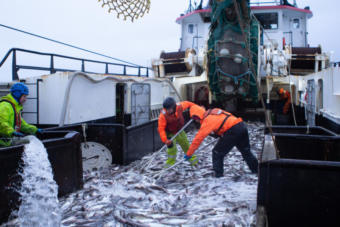
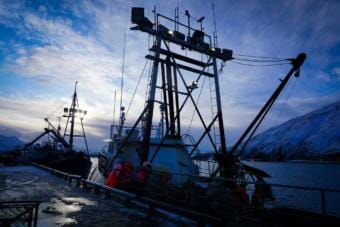
Dutch Harbor and New Bedford, Massachusetts, continue to dominate the list of top fishing ports in the nation, in terms of volume and value. (Photo by Hope McKenney/KUCB)

Dutch Harbor has been named the nation’s top fishing port in terms of volume for the 22nd consecutive year. But the port dropped from second to third place in terms of value.
According to an annual National Oceanic and Atmospheric Administration report released last month, the Port of Dutch Harbor led the nation with 763 million pounds of seafood landed in 2018, worth $182 million. But the value of landings in Naknek, Alaska, rose to $195 million.

(Graphic by NOAA Fisheries)

Julie Speegle, a public affairs officer with NOAA Fisheries’ Alaska regional office, said Dutch Harbor slipped to the third spot not because of a decline in value of landings, but an increase in the value of landings in Naknek.

“The key is primarily the different species composition at the port,” said Speegle. “For instance, landings at Naknek are primarily sockeye salmon, and at Dutch Harbor, it’s primarily pollock and crab.”

In fact, Speegle said Dutch Harbor’s value for fish landings went up by $9 million between 2017 and 2018. But it went up by $41 million in Naknek.

Although the port’s value ranking went down, she said Dutch Harbor and New Bedford, Massachusetts, continue to dominate the list of top ports in the nation.

“The fact that Dutch Harbor has held that rank for 22 consecutive years is a testament to the health and stability of the fishing industry in Dutch Harbor,” said Speegle.

The NOAA Fisheries report compiles key fisheries statistics from the previous year into an annual snapshot that’s provided to Congress, documenting fishing’s importance to the nation.

U.S. fishers landed 9.4 billion pounds of seafood, valued at $5.6 billion, in 2018. Alaska took in 58% of the nation’s landings.


When the Scandies Rose sunk, he survived. Now he’s grappling with losing his crewmates.

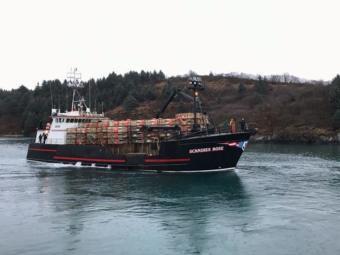
The F/V Scandies Rose, a 130-foot crab fishing vessel based in Dutch Harbor, sank on Jan. 31, 2019, with seven crew members aboard. (Photo by Gerry Cobban Knagin)

It’s been just over a month since the F/V Scandies Rose sunk west of Kodiak.

Two fishermen were rescued from a life raft. They were wearing “gumby” survival suits. The other five crew members — as well as their 130-foot crab boat — were never found.

Dean Gribble grew up in Washington. He began salmon tendering when he was 11 years old, and he’s spent the past 21 years crab fishing.

“I was born a commercial fisherman,” said Gribble. “It’s in my blood. My dad and my family have all been in it. Other kids grew up having football or baseball players as their heroes, and I had crabbers as mine.”

On New Year’s Eve 2019, Gribble hadn’t planned to be on the Scandies Rose, which is based in Dutch Harbor, but a crew member quit in late December, and his friend, John Lawler, asked him to fill in.

“John called me the 28th,” said Gribble. “I flew up the 29th. We left the 30th, which is my birthday. We sank the 31st. I was home on the 1st.”

Gribble describes it as a “whirlwind” — everything that happened between 10 p.m. on Dec. 31, when the crew hit the mayday button, and 2 a.m. on New Year’s Day, when he and Lawler were rescued by a U.S. Coast Guard swimmer.

Gribble was woken up by Lawler yelling that the boat was going down. He said the vessel was taking on ice and listing to the side amid 30-foot seas, well-below-freezing temperatures and 40 mph winds.

“I started passing out the suits to everybody,” said Gribble. “We’re listing really hard at this point. I tried to get my suit on on the ground, and I couldn’t because I kept sliding down towards the starboard side. I jumped up in the bench and used the armrests as a foothold, and I was able to get my suit on about halfway. The armrest I was using broke, so I started sliding down.”

He finally got outside on the deck on his fourth try, and then the generator shut off and the lights cut out.

“Now it’s just loud,” said Gribble. “All you hear is the creaking of the steel — the waves slamming into the boat. And it’s sinking. It’s going fast.”

Gribble helped Lawler get his survival suit on, and they tied themselves together with a rope.

“I’m screaming at these other guys,” he said. “I’m screaming at them to get out of the boat, and they were trying. I was trying to find something to throw back in so they could use it to climb out. I couldn’t find anything, because everything was so icy. I just couldn’t get anything, and the boat was going down.”

Gribble said he’s been involved in searches for lost crews before, and he didn’t have any hope that he and his crew mates would survive.

“I knew I was going to die,” said Gribble. “My main concern was just trying to get out so maybe they could get my body or something for my family to get closure.”

At that point, Gribble and Lawler jumped off the deck and into the water as the rest of the crew remained on the boat.

“Now I’m alone in the dark, floating in 20, 30-foot seas,” said Gribble. “Just any fishermen’s nightmare. I see the boat penciled — straight up and down in the air. The bow was straight up in the air, and then it sinks. My heart drops. I tried to do everything I could to get those guys out. I tried everything. I was screaming at them, ‘You’ve got to get out of the boat!'”

Gribble saw a fluorescent life raft about 500 feet away, and he and Lawler swam to it.

Once inside, they bailed water and waited in the dark for about four hours. Then, a crew from Coast Guard Air Station Kodiak found them and transported them to a hospital in Kodiak, where they were treated for hypothermia.

The rescuers said Gribble and Lawler wouldn’t have survived if it wasn’t for their suits and the life raft.

The search for the Scandies Rose and her remaining crew was suspended less than 24 hours later. It spanned more than 1,400 square miles and included four MH-60 Jayhawk helicopter crews, two HC-130 Hercules airplane crews and the Coast Guard Cutter Mellon.

The five missing fishermen are Gary Cobban, Jr., David Lee Cobban, Arthur Ganacias, Brock Rainey and Seth Rousseau-Gano.

Gribble is currently home with his family. He said it’s going to be awhile until he gets back out on a boat.

Meanwhile, Coast Guard officials said they don’t know yet how long it’ll take to complete their investigation into the cause of the sinking.

The loss of the F/V Scandies Rose marks the Bering Sea crab fleet’s deadliest accident since the 2017 capsizing of the F/V Destination, in which all six crew members died.

6.2 magnitude earthquake felt in Adak

A magnitude 6.2 earthquake struck 50 miles from Adak around 9 p.m. on Wednesday, Jan. 22, 2020. (Map by U.S. Geological Survey)

A magnitude 6.2 earthquake struck Wednesday night about 50 miles from Adak. There is no tsunami threat expected.

Ken Macpherson, a seismologist for the Alaska Earthquake Center, said this was a “crustal earthquake,” meaning it was relatively shallow, at a depth of about 10 kilometers (6.2 miles).

Houses built for military families on the north side of Adak, before the Base Realignment and Closure Act in 1995 led the Defense Department to shutter operations on the island by 1997. (Photo by Zachariah Hughes/Alaska Public Media)

“To give you an idea of how large that is, you get only about 100 magnitude 6 earthquakes on the globe annually,” said Macpherson. “So that’s a fairly significant earthquake.”

Adak residents felt the shallow earthquake, which followed a series of smaller quakes in the same area.

Macpherson also said there have been dozens of aftershocks.

“Some of them are in the magnitude 4 range,” he said. “We could see up to a magnitude 5. A general rule of thumb is that the largest aftershock will be about one whole magnitude less than the main shock.”

Macpherson said the activity is nothing out of the ordinary in the seismically active Aleutian Islands.

The quake struck near the Takawangha and Tanaga volcanoes. While there’s no evidence the event was volcanic in origin, the Alaska Volcano Observatory said scientists are monitoring for signs of unrest.

As of Thursday afternoon, the observatory has listed the alert levels for Takawangha and Tanaga volcanoes as “normal.”

Medevac plane removed from Unalaska Bay following crash

The Resolve Marine small boat crew deployed a tag line over the tail of the aircraft to aid in a smooth and controlled transition of the plane onto the barge on Monday, Jan. 20. (Photo courtesy of Aleutian Aerial)

Divers, a tug vessel and a crane barge crew from Resolve Marine were able to remove a LifeMed medevac plane from Unalaska Bay on Monday. It had been in the water since it crashed near the airport last week.

The three-person air ambulance crew was en route to pick up a medevac patient in Adak when the Beechcraft King Air aircraft went into the water about 100 feet northwest of the end of the Unalaska Airport runway on Jan. 16.

The pilot, paramedic and nurse were all rescued from a life raft and sustained no serious injuries. There were no patients on board.

Resolve Marine was contracted by Aero Air — the aircraft owner — to recover the plane.

Resolve Alaska General Manager Edgar A.W. McAfee said a nine-person crew secured and pre-rigged the plane on Saturday so it would be ready to lift out of the bay.

“We put our divers in the water from the Makushin Bay (salvage vessel) and we assessed the plane, where it was and its level of stability,” said McAfee. “After that, we were able to close up the fuel vents to prevent any spillage of fuel into the water. We wanted to isolate that and secure that first. And after that, we started to deploy rigging to the divers and pre-rigged the plane.”

The crane barge they used to lift the aircraft required shutting down the airport runway. Rather than disrupt a number of scheduled flights over the weekend, the salvage company worked with the airport and decided to wait on removal until Monday, according to McAfee.

It took the Resolve Pioneer and a crane barge, with an eight-person crew, four divers and a salvage master to remove the 16-foot plane from Unalaska Bay on Monday. (Photo courtesy of Aleutian Aerial)

The whole process took approximately 12 hours, from the time the crew left the facility, lifted the plane and transported it back to the dock. It took the Resolve Pioneer — a tug supply vessel — and a crane barge, with an eight-person crew, four divers and a salvage master to remove the approximately 16-foot plane.

“It’s remarkable how fast everybody reacted and got out,” said McAfee. “There were no injuries in the plane going down and no injuries in the operation, and that’s very important to us. And we were also able to minimize whatever hydrocarbon release was there. So all that’s good news, and it was a successful operation.”

The plane had been sitting in 50 feet of water and released an unknown amount of Jet A fuel into the bay, according to the Alaska Department of Environmental Conservation.

Officials determined there were approximately 440 gallons of fuel on board at the time of takeoff. They will be assessing how much was released now that the plane is on land.

The Alaska Department of Fish and Game determined no animals appeared to be affected by the fuel release, and McAfee said there was no visible sheen on the water as of Monday’s plane removal.

Unalaska Bay is home to several federally-listed endangered species, including Steller sea lions, Northern sea otters and Steller’s eiders.

Resolve Marine is set to lift the plane from the barge and transport the plane back to the airport today.

The National Transportation Safety Board is still investigating the cause of the crash.

Site notifications
Update notification options
Subscribe to notifications