KUCB is our partner station in Unalaska. KTOO collaborates with partners across the state to cover important news and to share stories with our audiences.
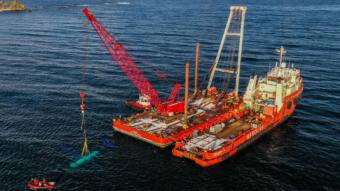
A small launch from the Resolve Magone Marine salvage vessel Makushin Bay returns to the ship after placing a marking buoy at the fuel sheen from the submerged wreckage of a LifeMed Alaska King Air plane which crashed during takeoff around 8 a.m. on Jan. 16. (Photo by KUCB)
A LifeMed medevac flight crashed into the water Thursday morning near Unalaska shortly after taking off from the island’s airport. No one was seriously hurt.
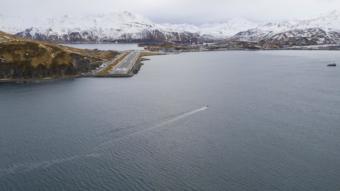
The air ambulance was headed to Adak to medevac a patient. It went into the water about 100 feet northwest of the end of the airport runway.
Unalaska Acting City Manager Marjie Veeder said city rescuers responded after a 911 call came in at 8:04 a.m.
“Our dispatchers immediately dispatched the ports vessel Tidebreaker to the scene, and the three persons on board the plane … had self-evacuated to a life raft. They were transferred to the Tidebreaker at 8:24 a.m.,” Veeder said.
LifeMed CEO Russ Edwards said he’s grateful the crew escaped serious injury. He said the cause of the mishap wasn’t immediately clear.
“Factors we’ve checked into as far as weather conditions were VFR weather conditions, a little wind, some gusts,” Edwards said. “But nothing unusual for Dutch Harbor this time of year.”
Edwards said a different air carrier was able to pick up the Adak patient.
State environmental regulators responded to a potential spill of hundreds of gallons of fuel. The Alaska Department of Environmental Conservation said the plane spilled jet fuel into Unalaska Bay, which is home to several federally-listed endangered species, including Steller sea lions, Northern sea otters and Steller’s eiders.
DEC said divers were unable to reach the submerged plane on Thursday.
The National Transportation Safety Board is investigating the crash.
Thursday’s crash was the third air ambulance crash in Alaska in less than a year. Nearly a year ago, a Guardian Flight plane crashed in Southeast Alaska, killing the three-person crew. And in November, a Security Aviation ambulance crashed while en route to Seward. Three people were killed in that crash as well.
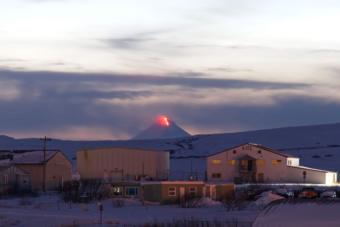
Shishaldin Volcano in eruption, Jan. 6, 2020, as seen from Cold Bay, about 58 miles northeast of the volcano. (Photo courtesy of Aaron Merculief via Alaska Volcano Observatory)
Seismic activity at Shishaldin Volcano is back down after an eruption Tuesday caused flights to be cancelled out of Cold Bay. The volcano has been active since July and has had two ash eruptions in the past week. (Read more.)
Original story
Ash eruption at Shishaldin Volcano in the Aleutian Islands has intensified, triggering aviation warnings in the region.
Hans Schwaiger, a geophysicist with the Alaska Volcano Observatory, said the volcano — 58 miles southwest of Cold Bay — began erupting again this morning, sending an ash cloud 27,000 feet in elevation that is drifting to the east and northeast as of early Tuesday afternoon.
“At about 5 a.m. this morning, there was an increase in the seismicity at Shishaldin,” said Schwaiger. “Seismicity then dropped a bit but has been ramping up recently. And since then, the high-level meteorological clouds have moved to the northeast, and we can see that there is a volcanic cloud that has been continuous, likely since that event this morning.”
The AVO alerted the aviation community about the potential hazard of volcanic ash in the atmosphere. There has been no impact on aviation thus far, but the National Weather Service issued a SIGMET warning.
Schwaiger said there is some ash fallout potential near the volcano.
“There’s possibly a little bit of trace ash that might fall in the coastal area to the north of the volcano,” said Schwaiger. “So the National Weather Service is putting out a marine advisory for that area. But at this point it doesn’t look like any communities will be impacted by the fallout. But the eruption is ongoing, so that could change if the weather or the winds change direction.”
The AVO said there are trace amounts of ash fall in Cold Bay.
The AVO is monitoring the volcano closely, and while there are no indications of a major eruption, Shishaldin is a volcano with an ability to ramp up quickly. According to AVO, it has had at least 64 episodes of unrest, including over 24 confirmed eruptions since 1775.
“In the late 1990s there was an eruption that sent a plume quite high, and then (Shishaldin Volcano) was quieter for a while,” Schwaiger said. “But every few years it seems like it’s becoming a bit active. So we’re in the middle of an eruptive sequence right now, and it will likely continue for a bit. We don’t know for how long, but this isn’t anything outside of its normal behavior.”
The AVO said it is possible for the current activity to intensify or decrease with little warning.
The Coast Guard Cutter Douglas Munro sits moored in its homeport in Kodiak, June 22, 2019. (Public domain photo by Ensign Jacob Marx/U.S. Coast Guard)
The U.S. Coast Guard says a seaman will face a court martial on murder and other charges in the death of a fellow seaman.
Ethan Tucker is charged in the January 2019 death of 19-year-old Seaman Ethan Kelch of Virginia Beach, Virginia, while their vessel — the Kodiak-based Cutter Douglas Munro — was stopped in Unalaska for repairs last winter.
Military prosecutors allege the 21-year-old Tucker, of Ludington, Michigan, beat Kelch and dragged his body to the water where he was left to drown.
During an October hearing, Tucker’s defense attorney, Navy Cmdr. Justin Henderson, painted a very different picture of what happened. Henderson said a bystander took video that night showing Tucker’s efforts to get Kelch out of the water, before he collapsed, exhausted and intoxicated.
According to a Coast Guard spokesperson, the decision to proceed to court martial was made last week.
Tucker is charged with six violations of the Uniform Code of Military Justice — including murder, aggravated assault and involuntary manslaughter.
He is currently restricted to the Coast Guard base in Alameda, California. The court martial is expected to take place in 2020.
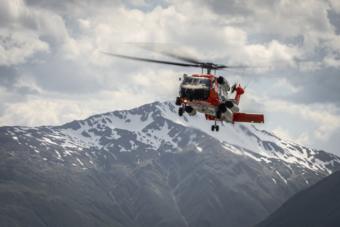
An aircrew aboard an MH-60 Jayhawk helicopter makes an approach on their return to Coast Guard Air Station Kodiak, June 5, 2019. (Public domain photo by Petty Officer 1st Class Bradley Pigage/U.S. Coast Guard)
The U.S. Coast Guard has released the names of the crew members of the FV Scandies Rose.
The five missing are Gary Cobban Jr. (Master), David Lee Cobban, Arthur Ganacias, Brock Rainey and Seth Rousseau-Gano. The two survivors are Dean Gribble Jr. and John Lawler. They were treated for hypothermia at a hospital in Kodiak, but sustained no other serious injuries. (Read more.)
Original story
The U.S. Coast Guard suspended its search on Wednesday evening for five people feared lost after their 130-foot fishing boat sank on New Year’s Eve near Sutwik Island, off the Alaska Peninsula.
The Coast Guard rescued two people and have suspended the search for the rest of the FV Scandies Rose’s seven-person crew.
According to the Coast Guard, the search spanned over 20 hours, 1,400 square miles, and included four MH-60 Jayhawk helicopter crews, two HC-130 Hercules airplane crews, and the Coast Guard Cutter Mellon.
Rear Adm. Matthew Bell, 17th District Commander, said Wednesday evening that after exhausting all leads and careful consideration of survival probability, the Coast Guard decided to suspend its active search pending new information or developments.
“The decision to suspend an active search-and-rescue case is never easy, and it’s only made after careful consideration of a myriad of factors,” said Bell. “Our deepest condolences to the friends and families impacted by this tragedy.”
Rescuers on scene said the elements were against them: 40 mph winds, well-below-freezing temperatures, and high seas as they searched for the boat and crew.
Petty Officer Evan Grills is the rescue swimmer who rescued two crew members from a life raft.
“When we were down there, it was pretty wild,” said Grills. “It was 20-30 foot seas, and tremendously cold, so the dexterity in my hands was starting to go. And just trying to battle keeping situational awareness between the helicopter, table management, keeping the survivor’s face out of the water, and making sure we both didn’t get tumbled in waves … it was definitely challenging.”
Coast Guard spokesperson Melissa McKenzie said the pair that was rescued at about 2 a.m. New Year’s Day were wearing Gumby survival suits.
“When our helicopter crew arrived on scene, they found two life rafts in the search area,” said McKenzie. “One had two survivors (in it) and the other one was empty.”
The 34-year-old and 36-year-old survivors reportedly had spent four hours in the life raft. They were hypothermic and admitted into a Kodiak hospital but had no other injuries.
Lt. Jon Ardan, co-pilot on the MH-60 Jayhawk helicopter, said the life raft was within 10 miles of the Scandies Rose’s last known position. No wreckage or debris had been found as of Wednesday evening.
“We landed back in Kodiak with not a lot of fuel, so we didn’t have very much time to search for additional survivors, or even to search for the (two we rescued),” said Ardan. “So it was truly a miracle that we found them so expeditiously, that we were able to pick them up without incident, and that we started making our way back home with a good tailwind to push us.”
The Coast Guard has not determined the cause of the incident off the Alaska Peninsula, about 170 miles west of Kodiak Island.
The Scandies Rose is homeported in Dutch Harbor. Its website describes the 41-year-old ship as a steel-hulled crabbing vessel that works in a number of fisheries, including as a summer salmon tender in Southeast Alaska and Bristol Bay.
The City of Unalaska could get broadband if GCI gets the permits and funding for a project that would bring cable from Kodiak. (Photo by Berett Wilber/KUCB)
GCI has applied to bring broadband communications to communities along the Aleutian chain.
The proposed project would bring fiber optic cable from Kodiak to Unalaska, spanning approximately 860 miles.
Dan Boyette, Vice President and General Manager of GCI, said getting the financing arranged and support from the business community for this project has been challenging.
“We’ve been working on the business case to bring fiber optic services to Unalaska along with all the communities on the southern side of the Alaska Peninsula and the Eastern Aleutians for a couple years,” Boyette said. “So that cable would originate in Kodiak and terminate in Unalaska and make stops in a total of 11 communities.”
The fiber optic cable would be loaded onto a ship that’s specifically constructed to do undersea fiber optic installations, and would be laid over 800 discontiguous miles, 400 of which are on state-owned, Department of Mining, Land, and Water-managed tide and submerged lands, according to Boyette.
“And that ship starts in Kodiak and works its way out of Kodiak through Whale Pass through Shelikof Strait and so on and makes all the stops along the way,” Boyette said. “So [the ship] is specially designed to essentially roll the cable out the stern of the ship and plow it into the undersea floor.”
Boyette said the company has been working its way through rural Alaska trying to build better communications facilities, and that it’s really time for communities throughout the Aleutian chain to get better connectivity.
“If you look at a map of Alaska with the terrestrial broadband facilities that people can rely on, the one blaring gap on that map is the Aleutian chain,” Boyette said. “It’s the biggest part of Alaska that’s still on satellite services.”
City Manager Erin Reinders said it has been a state and federal lobbying priority to get improved internet services and fiber optic for the City of Unalaska. She said more and more operational programs are internet-based, which poses a challenge to the city as well as local organizations and businesses.
“I think it impacts every aspect of our life in the community,” Reinders said. “So with the clinic, [fiber optic] would definitely help connect us to medical professionals off the island. Being able to do some of that remotely would be a wonderful benefit to our community members. The fact that lots of testing requirements for our public schools is internet-based poses a challenge with our current internet at times. Public safety and the fire department right now can’t fully utilize all the internet systems that Lower 48 folks are using for connectivity and communications while responding to critical incidents…In order to keep progressing, we are going to need improved internet.”
Boyette said the business case has not yet been approved, but that GCI is committed to this project. The company has gone ahead with the permitting process through the U.S. Army Corps of Engineers, which is currently pending.
“We have also already received a license from the Federal Communications Commission, as well as Department of Homeland Security, and have gotten the go-ahead from the Fish and Wildlife Service and National Marine Fisheries Service and so on,” Boyette said. “So really the last in the permitting process is this U.S. Army Corps of Engineers permit.”
But this doesn’t necessarily mean the project will move forward. According to Boyette, it will cost about $70,000 per mile to install the fiber optic cable, and this project spans over 800 miles.
He also said some uncertainties with the FCC in regards to rural health care and school services right now, make it difficult to invest that much money. But GCI is pursuing a grant from the Rural Utilities Service — part of the U.S. Department of Agriculture — that works to expand broadband throughout rural America, that could help them move forward with the project.
Right now, the company is waiting for permit approval from the Corps of Engineers. Then, they would need to get the business case approved by GCI leadership.
If everything is approved, there is about a two-year process to establish and initiate broadband services in Aleutian communities.
After decades of false starts, geothermal power may be coming to Unalaska.
The Ounalashka Corp. and Fairbanks-based Chena Power LLC have formed a company to develop a geothermal project at Makushin Volcano.
At a recent Unalaska City Council meeting, Ounalashka Corp. CEO Chris Salts said the company’s goal is to reduce the city’s consumption of fuel, as well as lower and stabilize utility costs for residents and businesses.
“We don’t intend to replace the city’s utility. We just want to supply power to it,” said Salts. “We plan to eliminate the city’s reliance on fossil fuels to generate electricity and heat.”
This attempt at geothermal energy marks the latest effort in a long history of companies trying to develop the resource about 14 miles from Unalaska’s current power grid. For three decades, the plans of private developers have fallen through, largely due to high startup costs. The last attempt was abandoned in 2015.
Unalaska City Manager Erin Reinders said the city supports the new project. The City Council has also identified alternative energy as one of its federal lobbying priorities.
“The city continues to look for support with reliable and cost-effective alternate energy sources for the community, including geothermal and wind,” said Reinders.
With city backing, Ounalashka and Chena Power are pursuing a U.S. Department of Energy loan worth between $350 million to $500 million.
Salts said that funding would allow the project to move forward at no expense or risk to the city. He also said the company will use existing research performed at Makushin over the last 60 years, meaning further feasibility investigations aren’t necessary.
A test well drilled in the 1980s revealed a hot-water reservoir that could generate at least 12 megawatts of electricity, or enough to heat around 10,000 homes.
Salts said leaders of the new company will attend the City Council’s meeting on Jan. 14. That’s when they’ll ask the city to sign a formal power purchase agreement — a deal that would have the city agree to buy geothermal energy from their operation.
“Once we do have a PPA in place, I think it’s important to point out when we might be enjoying this diesel-free and clean energy,” said Salts. “We would target commercial operations to commence before the end of 2022, if everything works out well.”
The company will present more information on its proposal, including its costs and technical aspects, at the upcoming meeting. Salts said he’s hoping to win a city agreement by the end of January.