KUCB is our partner station in Unalaska. KTOO collaborates with partners across the state to cover important news and to share stories with our audiences.
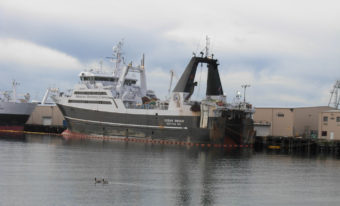
The Ocean Rover is tied up in port in Seattle on Jan. 1, 2008. It’s one of six American Seafoods Co. factory trawlers. (Creative Commons photo by J Brews)
86 crew members of an American Seafoods trawler have tested positive for COVID-19, according to a press release from the seafood company Sunday night. Nine tests are still outstanding.
The American Dynasty — a 272-foot trawler whose home port is Seattle, WA — had previously reported one crew member tested positive and was admitted to the hospital on Friday, May 29, for treatment. As a result, the company decided to test the entire crew.
The factory trawler was most recently in Bellingham, WA, and has returned to the Port of Seattle where it is currently under lockdown. All crew members are being quarantined and monitored by medical personnel, the press release said.
“The crew has access to any required medical care, and we are thrilled with the support that the agencies we are working with have provided,” said American Seafoods CEO Mikel Durham. “We have also put in place preparedness procedures in the event of a virus outbreak. Those plans are being fully executed right now.”
According to Durham, all crew members were screened and tested for COVID-19 antibodies and viral infection before they boarded the vessel. Only those who tested negative for the virus were cleared to board.
The company is cooperating with the U.S. Coast Guard, the Centers for Disease Control and Prevention (CDC), the Seattle/King County Health Department, Whatcom County Health Department, and the Port of Seattle, according to Durham.
American Seafoods is based in Seattle and Dutch Harbor and maintains a fleet of six vessels that fish for pollock, hake, and sole out of both the North Pacific Ocean and the Bering Sea. The American Dynasty can carry a crew of 142, according to the operator’s website. It was last in Dutch Harbor for one day on March 31 and is set to return for pollock season, according to American Seafoods spokesperson Suzanne Lagoni.
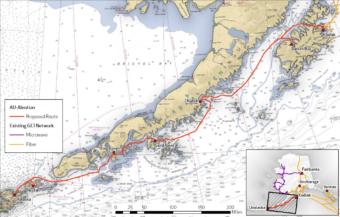
GCI’s proposed project would bring undersea fiber optic cable from Kodiak to Unalaska, spanning approximately 860 miles. (Photo courtesy of GCI)
GCI said it won’t move forward with bringing broadband communications to Unalaska at this time unless they receive a large grant from the USDA.
The company has put in an application for a $25 million grant from the U.S. Department of Agriculture’s Rural Utilities Service (RUS) to bring fiber optic broadband connection to communities along the Aleutian Island chain, where connectivity and bandwidth can often be unreliable or difficult to come by.
The proposed project would bring undersea fiber optic cable from Kodiak to Unalaska, stopping in six communities, and spanning approximately 860 miles.
“Our general plan is to bring an undersea fiber optic cable out to Unalaska that would hook into our existing undersea fiber optic infrastructure in Kodiak,” said Dan Boyette, vice president of GCI. “We then would circle through Whale Pass on the north end of Kodiak Island and go into Larsen Bay, and then from Larsen Bay to Chignik Bay, and then on down the chain making stops in Sand Point, King Cove, Akutan, and then finally Unalaska.”
The company plans to install some branching units to extend service to other places along the way like False Pass and Perryville – which aren’t in the initial project scope, but have potential for fiber optic in the future.
Boyette said GCI has been working on the proposed project for a number of years, and the overall cost is high, coming in at $60 million. He said this high cost makes the business case difficult for them to follow through on, as they are a private corporation, which has a responsibility to its shareholders.
“In order to get the return on the investment down to what’s appropriate for a company like ours, the [USDA’s ReConnect Loan and Grant Program] really fit quite well,” said Boyette. “So we applied for a grant of $25 million from that. And that takes the payback, or the return on investment, down to a period of years that’s acceptable to us and our parent corporation.”
He said he expects to hear if they’ve received the $25 million award sometime between June and September. There are seven applicants in total from Alaska competing for a pot of $200 million.
If they receive the grant, GCI plans to pay for the remainder of the project – $35 million – with it’s own capital.
“But if we don’t get the grant award, we won’t move forward at this time,” said Boyette. “That’s not to say that we won’t apply again in round three. I know that there will be future rounds because the federal government is very determined to use this program to get broadband throughout rural America, just like they did in the 1920s and ’30s, when they used the same program – the Rural Utilities Service – to get electrification throughout rural America.”
Boyette said the company is in the final stages of the permitting process with the U.S. Army Corps of Engineers. And in anticipation of receiving the grant award, they are already assembling a project team, working with an undersea engineer, and working to get the permitting process in Unalaska underway as soon as possible.
If all goes according to plan, Boyette said he anticipates the company will begin the project “in earnest” in January of 2021, and will be able to initiate service in Aleutian communities towards the end of 2022. It will be roughly a two-year process.
Boyette said the company has been working its way through rural Alaska trying to build better communications facilities, and that it’s really time for communities throughout the Aleutian chain to get better connectivity.
“The Aleutian chain is the last part of Alaska that does not have terrestrial broadband service,” he said. “And in today’s world, remaining on satellite service tends to hold back the business community. By bringing fiber optic terrestrial-style broadband, all those barriers go away. So I think that the ability for Unalaska’s economy – as well as the economies of King Cove, Sand Point, and so on – to grow and help those communities become more thriving places, I think is a very real thing. We believe it’s going to be transformational.”
Improved internet services and fiber optic has long been a federal and state lobbying priority for the City of Unalaska, as more and more operational programs are internet-based, posing a challenge to the city as well as local organizations and businesses.
And while many Unalaskans look forward to a broadband fiber optic connection, local internet provider, OptimERA, could be in trouble. But CEO Emmett Fitch, who said the company has looked at bringing fiber optic, as well as a microwave link, to the community in the past, said he’s optimistic.
“If GCI is successful in their application, and are able to get the service in place, then hopefully we can buy capacity from them and continue to do what we’re doing,” said Fitch. “You can’t compete with satellite versus fiber, for the most part. If the fiber lands, whoever controls that fiber is going to pretty much own all of the communications, or has the ability to.”
Fitch said that GCI has communicated in the past that they want to work with other providers in the area. If GCI is successful in bringing fiber optic service to the Aleutians, he said the two companies will hopefully find a way to collaborate so that OptimERA will be able to continue providing service to Unalaska.
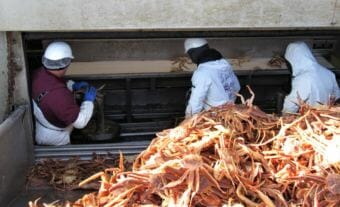
Workers sort opilio crab at the UniSea plant in Unalaska. Company officials have said they’re hoping to employ four inmates during the winter fishing season. (Photo by Laura Kraegel/KUCB)
In response to the coronavirus pandemic, Unalaska’s onshore processing plants have chosen to keep seasonal employees on the island between fishing seasons.
In the rural Alaskan town of 4,500 year-round residents, an influx of about 1,000 international workers, who are looking for ways to keep busy, is quite a change.
UniSea is keeping plant security tight. In order to enter, everyone must pass through a checkpoint and show a company ID or be placed on a list of expected visitors.
That check-in is one of many strategies the plant is employing to keep the virus out. Another strategy is keeping workers on the island in between fishing seasons.
Usually, processors come from all over the world to this island town. They stay from January to April, for what’s known as “A” season, then leave to go home. Many come back for “B” season, from June until September.
But this year, UniSea required that anyone who wants to work the “B” season stay on-island for the several weeks between seasons. That way, no one travels and risks bringing COVID-19 back to the plant.
It’s easiest to think of a processing plant almost like a college campus. Everyone eats at the same dining hall. Everyone sleeps in shared bunkhouses. If the virus enters, it could spread like wildfire.
Now Unalaska’s plants, and the island, have an odd problem on their hands: how to keep roughly a thousand workers occupied while they wait for the next fishing season to begin.
Todor Gjokov is from Macedonia, where he’s finishing up a Master’s degree. He came here for the “A” season and decided to stay longer.
Usually, he works 12-hour days in the plants as a processor. But in the off-season, he’s making sure UniSea’s common areas are clean and not overcrowded.
“I am the one that is coordinating the recreational area,” said Gjokov. “I am the one who is responsible for making sure we have no more than six people in the pool room.”
There’s a gym, a couple of pool tables—even a movie room, with chairs carefully spaced 6 feet apart.
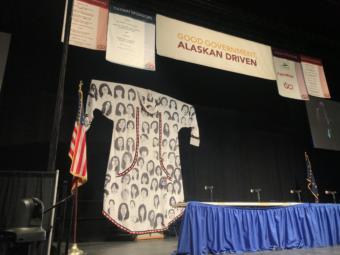
A 12-foot-tall kuspuk featuring portraits of 250 missing or murdered Indigenous women is presented on stage at the Alaska Federation of Natives convention in Fairbanks, Oct. 17, 2019. (Photo by Casey Grove/Alaska Public Media)
May 5 is National Day of Awareness for Missing and Murdered Native Women and Girls.
The missing and murdered Native women epidemic is an issue affecting Indigenous people in the United States, Canada and around the world.
In the U.S., there is no official federal database on the issue, and many members of the movement argue that law enforcement has not done enough to investigate the women who’ve gone missing.
The little available data is grim: According to the U.S. Department of Justice, nearly half of all Native American women have experienced intimate partner violence, and on some reservations women are murdered at a rate 10 times higher than the national average.
Indigenous activists and other nonprofits have created a movement in the U.S., working to raise awareness of the issue through organized marches, community meetings, the building of databases and domestic violence trainings for police.
While in-person events weren’t happening Tuesday because of the coronavirus pandemic, many will wear red to remember the women and girls affected by the epidemic. The goal is to honor those who have been lost, and hold people in power accountable for investigating those losses.
Crew members shovel pollock off the deck of a Bering Sea fishing boat earlier this year. (Photo by Nathaniel Herz / Alaska’s Energy Desk)
Alaska health officials have allowed fishing companies’ workers to wait out a two-week post-travel quarantine in close quarters on their fishing boats, even after authorities denied a similar proposal by a North Slope oil company.
At stake is the health and safety of the hundreds of crew members who work onboard vessels in the Bering Sea. The protective measures vary from company to company, and the state has not explained its criteria for approving or denying plans across different industries, or even between separate fishing companies. It’s also refused to release mitigation plans to the communities affected by them.
In Unalaska, dozens of vessels plan to follow state guidelines and ask their crew to quarantine in their places of origin for two weeks before traveling to Dutch Harbor and boarding their boats. Once onboard, they’ll quarantine for 14 more days.
Those “pre-quarantine” plans are modeled off widely-disseminated guidelines suggested by the state.
Yet some health experts say pre-quarantining is riskier than asking workers to quarantine themselves after they travel to an isolated Alaska community.
While 14 days of isolation can protect workers from COVID-19 before traveling, there’s still a risk of catching the virus between their homes and their destinations. Many fishing industry workers come from outside Alaska and have to take more than one flight to get to Dutch Harbor.
After boarding, vessels often depart the harbor shortly after. And successfully quarantining and socially distancing at-sea—hundreds of miles from shore, on crowded vessels that can carry dozens of crew—is very difficult, experts say. Crews risk contracting COVID-19 while fishing with anyone who has recently traveled.
“Once you get on a plane—or multiple planes—and transport through airports, you have now increased your risk,” said Megan Sarnecki, medical director at Iliuliuk Family and Health Services.
If one crew member catches COVID-19 while traveling, then gets on a boat, “you’re all going to get it,” she added. “You’re all going to live with that.”
In Alaska, only essential businesses can seek exemptions to a requirement that employees arriving from Outside observe a two-week quarantine at home. Essential employees are allowed to return to work during that two-week period, but their employers must submit plans explaining what protective measures they’ll take to reduce the risk of spreading COVID-19 to other workers and surrounding communities.
For fishing companies, “having the incoming crew self-quarantine on the vessel is a perfectly acceptable plan,” Tom Koloski, a top state emergency management official, wrote in an email published by the Bristol Bay Borough.
“In fact it is probably preferred,” Koloski said. “Once they are all on board, they can set sail and start fishing while still self-quarantining.”
State health officials rejected a similar “pre-quarantine” plan from multinational oil company BP, which proposed to have its Outside workers quarantine in their homes before flying directly to the North Slope, bypassing Anchorage. Instead, all of the company’s Outside workers are required to spend two weeks in quarantine inside Alaska before flying to the remote North Slope oil fields.
Asked why the two industries are being treated differently, Health and Social Services Commissioner Adam Crum said the BP decision was “based on the critical structure of where they’re at and what the rest of their peer groups were doing.”
On the North Slope, Crum said, workers from multiple companies mingle in the same area.
“You’re going to have a lot of different groups coming back and forth,” said Crum. “Alaskan residents and out-of-state workers together going back and forth. And we looked at that and realized that the best way to protect Alaskans was to quarantine everybody first in Alaska.”
He added: “In each one of these situations, we’re looking at what makes the most sense for the area, what’s our chance for cross contamination, and how are these groups going to actually work out together.”
Last week, Gov. Mike Dunleavy issued his 17th mandate—one that covers independent boats. The mandate was directed at smaller fishing vessels operating throughout Bristol Bay, the largest sockeye salmon run in the world. Local leaders had called for more clarity from the industry as to what their safety plans are. Some demanded that the governor shut down the fishery altogether, citing health concerns for vulnerable rural clinics and communities.
At the heart of the debate is how to balance public health measures with economic need. And in fishing—particularly seasonal fishing—there is a limited window of time where crew can actually work. If fishermen miss the season, they can miss an entire year’s worth of income. In the end, crews weigh the risk of infection with the very real need to make money.
Many vessels operating out of Dutch Harbor have already submitted their protective plans through trade organizations, companies, or other fleet representatives.
Two trade organizations—United Catcher Boats, which represents trawlers that target cod and pollock, and Groundfish Forum, a trade association of five companies that fish for yellowfin sole, Atka mackerel, Pacific Ocean perch and cod, among others—confirmed that at least some of their members are relying on pre-quarantines as part of their strategy. Another industry group that fishes for cod, the Freezer Longline Coalition, is making decisions on a “company-by-company basis,” said Executive Director Chad See.
Groundfish Forum, United Catcher Boats and the Freezer Longline Coalition all signed a recent open letter to the City of Unalaska that said “the safety of the residents of Unalaska is of the utmost concern.”
Other signees included the At-sea Processors Association and Alaska Bering Sea Crabbers. Neither group responded to requests for comment on their pre-quarantine plans.
Unalaska Community Likely Not At Significant Risk, But Crew Are
A state public health nurse who works in several Aleutian Chain communities said that pre-quarantines like the ones proposed by the fishing companies carry “lots of unknown risks,” given the potential for exposure while traveling.
“If there’s any sort of public transit where you’re sitting and sharing air with people for longer than ten minutes, that’s where there would be the risk of exposure,” said Donna Bean, who provides public health guidance to the clinic and city. “So airplanes, buses, vans—any location where they’re in proximity with other people is a risk.”
She added: “For best public health practice, there is no replacement for a 14-day quarantine set to begin once an employee arrives at their destination.”
Unalaska is Alaska’s largest rural community without a Critical Access Hospital. The clinic has no intensive care unit and must medevac any critically ill patients nearly a thousand miles east to Anchorage. The clinic is also relatively small: If one health-care worker contracts COVID-19, there’s little backup.
Sarnecki, the medical director and a doctor at the clinic, said that fishing companies’ plans sound like “the best [industry] could come up with to mitigate risk.”
From a community perspective, she added, that risk is fairly small.
If someone—or several people—from a crew falls ill, they will likely be transferred off the boat and to the nearest medical facility. Clinic staff have worked to develop testing and treatment protocols that limit possible exposure to the disease for both themselves and the community. They decided that if a crewmember is well enough, they can remain on board while waiting for testing. In one recent scenario, a crewmember suspected of having COVID-19 met clinic staff at the dock. There, he was swabbed for testing by staff wearing personal protective equipment. He waited for the results on board his vessel, and not in town. A few days later, he and the clinic heard back from the lab. His test was negative.
Sarnecki said the clinic has received access to only one fishing company’s plan submitted to the state, and clinic employees don’t know which companies have submitted the required plans.
The Dunleavy administration has refused to release companies’ protective plans to local governments, according to Alaska Public Media. KUCB’s request for them is pending.
Unalaska’s pollock industry is winding down “A” season before beginning to prepare for “B” season, which starts in June. There are several currently active fisheries in the Bering Sea/Aleutian Islands region, including yellowfin sole, flatfish, Atka mackerel, snow crab, golden king crab, sablefish and jig-caught pacific cod.
Six cruise ships have canceled their visits to Unalaska in the wake of the coronavirus pandemic. Those cancellations represent a loss of about 3,000 passengers and at least $50,000 dollars in combined revenue for various services. (Photo by Berett Wilber/KUCB)
With 20 cruise ship visits scheduled, Unalaska had been preparing for a record number of visitors this year. But the industry has been dealt a series of blows in the wake of the coronavirus pandemic.
There have been port closures in Canada and Seattle, a federal “no sail” order, and several outbreaks of the disease on cruise ships in the past two months.
So far, six of the sailings that would have come to Unalaska this year have been canceled due to the COVID-19 pandemic. But there are still 14 planned visits, at least for now.
Anntouza Sedjo, cruise ship coordinator for the Unalaska Visitors Bureau, said the loss of 30% of scheduled visits is a blow to the city. But, she said, at least the community is not in the same dire situation as other coastal communities that rely more heavily on the visitor sector.
“Unlike Southeast Alaska, our community is not dependent on (tourism) income. Having this many cruise ships is relatively new,” she said.
The state’s tourism economy accounts for as much as 1 in 10 jobs throughout the state and more in the regions surrounding Anchorage and Juneau. It represented more than $4 billion in total spending in 2017, and that number is only growing.
“But I don’t want to downplay it at all,” Sedjo said. “This is a huge blow with even six cancellations, because people plan and they budget.”
“But fortunately for our community, it’s not going to be a devastating blow like it is to somewhere like Skagway or Ketchikan or even Juneau, where they are highly dependent on cruise ship income,” she said.
Even so, those six cruise ship cancellations to Unalaska represent a loss of about 3,000 passengers and at least $50,000 in combined revenue for various services, according to Sedjo. It will impact local businesses and artists who rely on cruise ship visitors for support during the summer months.
But Unalaska doesn’t tend to get many large cruise ships. In general, the community sees ships with less than 200 passengers, which means they aren’t included in the “no sail order” from the Centers for Disease Control and Prevention that limits sailings of ships with more than 250 passengers. However, there’s still a warning that even smaller ships pose a risk to both the passengers and to the ports they come into.
In the meantime, the visitors bureau is working with city officials on safety protocols for when and if cruise ship passengers do arrive. Sedjo said that could include mandating cruise ships screen passengers before they get off their boats and enter a community, among other requirements.
The island’s first cruise ship is still scheduled to visit in late June, but as uncertainties over the coronavirus continue, Sedjo said she expects to see more cancellations.