KUCB - Unalaska

KUCB is our partner station in Unalaska. KTOO collaborates with partners across the state to cover important news and to share stories with our audiences.
A string of volcanoes in the Aleutian Islands might actually be one mega volcano, scientists say

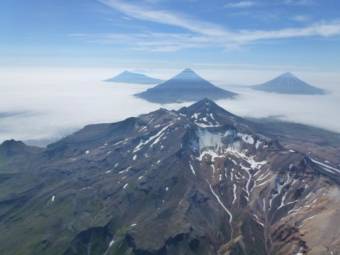
Aerial photograph of volcanoes of the Islands of Four Mountains. Mount Tana is in the foreground and Mount Herbert, Mount Cleveland and Mount Carlisle are shown left to right in the background. (Photo courtesy of John Lyons/USGS)

In a new study, scientists say a group of volcanic Aleutian Islands could be part of a massive, single, undiscovered volcano.

While scientists have been compiling their research for six years, there’s still a lot to piece together, according to Diana Roman, a volcanologist with the Carnegie Institution for Science in Washington, D.C.

“This is a little bit like trying to put together a 2,000-piece jigsaw puzzle, where half of the pieces are missing, and you don’t have the box, so you don’t know what it’s going to look like,” she said.

Roman is one of a number of scientists from across the country studying whether a giant volcano is hiding beneath the Islands of Four Mountains — a string of eight volcanic islands in the central Aleutians, about 170 miles west of Unalaska.

Map of the Aleutian Volcanic arc showing the positions of volcanoes (black triangles) and the location of the Island of Four Mountains. (Image courtesy of The Alaska Volcano Observatory)

On Monday, researchers presented their findings at the American Geophysical Union’s fall meeting.

John Power is a geophysicist with the U.S. Geological Survey at the Alaska Volcano Observatory, who also led the presentation at the virtual conference this week. He said the research in the Islands of Four Mountains started in 2014 because of the frequent eruptions at Mount Cleveland, which occupies the entire western half of Chuginadak Island.

“Mount Cleveland, over the last 20 years, and perhaps much longer, has been the most persistently-active volcano in North America,” Power said.

Scientists at the AVO have struggled with how to do a better job of warning people about potential eruptions at Mount Cleveland because it is so active, according to Power. But after studying the large stratovolcano and the other five located nearby, multiple pieces of evidence led them to the conclusion that there might be a 12-mile-wide caldera — a large volcanic crater — or a number of calderas, hidden underwater beneath the group of islands, which might help explain the frequent explosive activity seen at Cleveland.

Power said the evidence includes a type of rock scientists found there — called ignimbrites — that’s formed from large, catastrophic caldera-forming events, a slight change in gravity where they think the caldera might be, the extensive geothermal and hot springs throughout the islands, the earthquake activity there — and most notably, he said, the semi-circular arrangement of the islands which might form the caldera’s rim.

“There are multiple pieces of evidence that have come together, that make us think that this is also a very large, caldera-type volcano, which was previously unrecognized for two reasons. One is that we all know the Islands of Four Mountains are very remote, and the volcanoes there have not received a lot of prior study,” Power said. “And, in this case, much of the caldera structure is likely under the Bering Sea, so it’s been hard for people to identify.”

But Power and Roman say the caldera’s existence is not yet proven. To find out if the islands form one big caldera or whether there are multiple calderas side by side, or even if there’s a caldera there at all, they’ll have to return to the Islands of Four Mountains to gather more evidence to fully test their hypothesis.

Former Carnegie postdoc Amanda Lough inspects a seismic station on Cleveland Volcano. (Photo courtesy of Carnegie Institution for Science)

If the researchers’ suspicions are correct, the newfound volcanic caldera would become the first caldera to be discovered in the Aleutians that is hidden underwater. It would also belong to the same category of volcanoes as the Yellowstone Caldera and others that have had super-eruptions with profound global consequences.

One of those, Power said, was the eruption of the Aleutian volcano, Okmok, in the year 43 B.C., which was recently implicated in the fall of the Roman Republic.

“If you look at some of the other large caldera-forming eruptions — such as Okmok  — you do see that these have resulted in cooling of the climate,” Power said. “In 1815, there was a very famous eruption at [Mount] Tambora in Indonesia, about this size, that resulted in what’s called the ‘year without a summer’ — there were crop failures, pandemics.”

According to Power, understanding where and when large volcanic eruptions occurred is important in understanding the global impacts they can have.

But, he said, there’s no immediate cause for concern that there will be a super-eruption at the site of the caldera in the Islands of Four Mountains. Rather, he said, knowing that there is potentially a caldera system there will help agencies such as the AVO anticipate eruptive activity moving forward and identify the types of hazards it may pose to overflying aircraft, fishermen and nearby communities such as Nikolski and Unalaska.

“It does not mean that there will be a huge eruption coming from this caldera anytime soon,” Power said. “It may be thousands of years or potentially never.”

Scientists are currently planning their next expedition to the Islands of Four Mountains, which could be several years out, Roman said. The last major expeditions to the islands were in 2014, 2015 and 2016.


During final trip of the season, nearly entire fishing boat crew tests positive for COVID-19

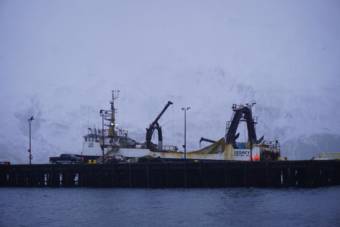
The F/T Legacy at North Pacific Fuel's dock on Captains Bay Road in Unalaska
The F/T Legacy at North Pacific Fuel’s dock on Captains Bay Road in Unalaska on Friday, Dec. 4, 2020. All but one of crew on board tested positive for COVID-19. (Hope McKenney/KUCB)

While wrapping up their season fishing for Pacific Ocean perch in the Bering Sea, nearly the entire crew of a United States Seafoods trawler tested positive for COVID-19, marking the first cases of the coronavirus for the Seattle-based company.

Two crew members of the trawler Legacy tested positive for the virus on Thursday, according to the City of Unalaska, prompting providers from the local Iliuliuk Family and Health Services clinic to test the rest of the 25-person crew. When the results came back on Friday, they showed that 22 more individuals were also positive.

All crew members remain on board, with the one negative individual segregated from the remaining crew, the city said in a statement.

“This is quite a disappointment to have weathered storms of COVID all year, and to literally have this trip us up on our last day of the last port call of the season — it takes the wind out of your sails,” said Dave Wood, chief operating officer of U.S. Seafoods.

The 132-foot catcher-processor was last in Unalaska about two weeks ago and a small number of crew members left to go home, while a few new crew members joined the boat, Wood said.

“When the boat was in town and picked up those folks awhile back — since then it’s been completely at sea,” said Matt Upton, an attorney who manages vessel operations for the fishing company.

In advance of the summer fishing season in Alaska, seafood companies developed rigorous mitigation plans to prevent the spread of COVID-19 as it swept across the globe.

U.S. Seafoods was no exception. The Seattle-based processor filed a plan with the State of Alaska in March covering all seven of its vessels,  according to Mark Fina, a fisheries analyst for the company.

“Each crew member quarantines for 14 days prior to travel,” he said. “Very near the end of the quarantine, they do a COVID-19 test. Then they travel to Dutch Harbor. And then once they’re on the boat, we do twice-daily screenings for the new crew for the first 14 days.”

Those screenings involve a symptom check and a temperature check, Fina added.

Public health officials in Unalaska warn that the upcoming winter fishing season will likely cause a surge in COVID-19 cases, as the population of the island doubles from the influx of fisherman and seafood processing workers.

As U.S. Seafoods prepares to bring its fleet back to the Bering Sea in January, the company is thinking about ways to improve their ability to keep the virus off their boats.

“We’re definitely trying to talk with other folks and think of what the best practice is, as we learn more about the transmission, and think about if there’s any changes to how we’re approaching screening, or having people on the boat when they’re working,” said attorney Matt Upton. “Those are all things that we’re looking at. Probably the single biggest thing that we’ve been focusing on is just trying to keep the people on our boats safe and the communities that we work with safe. I think besides this incident, we’ve done pretty well this year. But at the same time, we always have to still be vigilant.”

U.S. Seafoods, clinic personnel and the State of Alaska Public Health are planning next steps for the F/T Legacy, the city said in a press release on Friday evening.

After ‘potential widespread exposure,’ Unalaska closes schools and considers hunkering down

The first cruise ship of the 2019 season is scheduled to arrive in Unalaska on May 6.
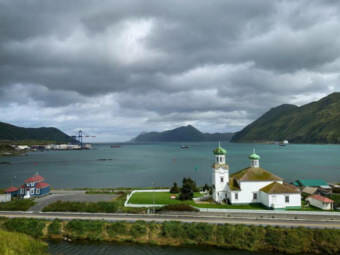
Unalaska on May 6, 2019. (Berett Wilber/KUCB)

Unalaska’s classrooms will close Tuesday as the district moves to distance learning.

That’s after city officials confirmed two new COVID-19 cases from community spread Monday and said there’s “potential widespread exposure” to the virus in the community.

The city has also raised the COVID-19 risk factor to “high.”

Two unnamed people arrived in Unalaska last week and tested positive Monday at the local clinic, according to City Manager Erin Reinders. One had direct contact with multiple other people in the community over the holiday weekend, Reinders said.

“That creates a situation of potential widespread exposure, and that’s where we triggered that higher risk level,” she said.

Authorities are now tracing the infected people’s contacts, she added, but declined to say how many close contacts they’ve identified.

Now that the community is at the high risk threshold, its next step is twofold, Reinders said: Organizations and city facilities will enact their COVID-19 mitigation plans, and the City Council will consider imposing additional health mandates.

City facilities like the parks and recreation building and the library will close to the public, and departments will be open by appointment only, Reinders said. The landfill will remain open, and the police and fire departments’ 24-hour operations will continue as well, she added.

The city is planning a special city council meeting Tuesday at 6 p.m. Reinders is recommending that councilors consider three additional health measures.

“Specifically, we’ll be looking at a community hunker down order — basically staying at home as much as possible,” she said. “We’ll be looking at limiting the size of public gatherings — so keeping your meetings small, and that sort of thing. And then also looking at temporarily closing in-person services at bars and restaurants and really stressing the curbside pick up or takeout orders. We’re trying not to close everything, but kind of limit that face-to-face contact as much as possible.”

Unalaska City School District Superintendent John Conwell announced the closure of local schools in an email to families Monday afternoon, a measure triggered by the community’s high risk threshold.

School staff will be calling or emailing students and families to discuss schedules and expectations, Conwell added.

“We sure hoped to have made it all the way to Christmas break. I’m feeling a little disappointed that we’re having to do this,” he said. “But we’re ready and we’ve been planning for it, and we appreciate people’s patience.”

The district is still in the process of putting modems in students’ homes so they can access the school’s network, with about 75% of installations completed as of Monday, Conwell said.

He said he hopes Unalaska will follow public health advice to help get students back to their classrooms.

“I’m hoping that we can get back on track,” he said. “That we can get folks to follow quarantine, wear masks, regularly wash their hands, keep their distance and we can tamp this down.”

Conwell recommended that students and families remain flexible, calm and patient as they start with distance learning, and he asked that they wait for teachers to reach out with further instructions.

Reinders echoed Conwell’s recommendation to follow local protective measures and CDC guidelines to reduce the spread of the virus.

“I think it’s important to remain calm, and to recognize that we are really positioned well, and we have been behaving in a safe way for a long time now,” she said. “We really have protective measures in place that I think have served our community well, and now is the time to really remember that and fully embrace them and to remain diligent in doing them.”

Monday’s announcement comes as cases surge across the state and hospital capacity runs tight. It’s important that Unalaskans remain diligent and remember that Unalaska is the largest community in the state without a critical access hospital, Reinders said.

“We’re all connected here, throughout the state and, frankly, the nation and the globe,” she said. “So when there’s a real draw on the health care system in Anchorage — which includes the hospitals, which includes the medevacs — that has a trickle down impact on all of us that are more remote and need to depend on some of the services that Anchorage provides.”

Unalaska confirmed its first case of community spread earlier this month, which would have triggered a move to the high risk threshold under the community’s original response plan.

But Unalaska’s Unified Command chose to stay at a medium risk level and adapted its risk thresholds because they determined that the positive case was an isolated event.

The city will consider stepping back down to the medium risk level once two weeks go by without a new COVID-19 case stemming from community spread, Reinders said.

Largely insulated from COVID-19, Unalaska is watching its wastewater for signs of trouble

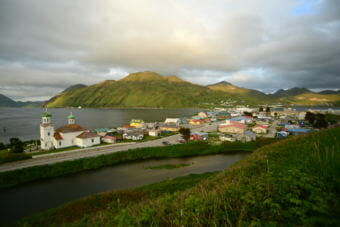
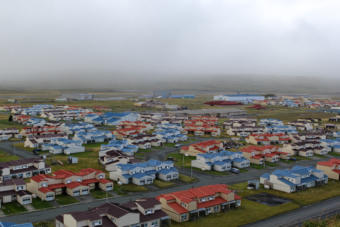
Unalaska pictured on August 30, 2020. (Hope McKenney / KUCB)

Unalaska and Dutch Harbor sit 800 air miles away from Anchorage. And the community of about 4,500 year-round residents more than doubles during peak fishing seasons.

It’s one of few places in the state that has been largely untouched by the coronavirus. Since the onset of the pandemic, the community has only recorded 107 cases, 85 of which were from one factory trawler.

As part of its mitigation strategies, in July the island began testing its wastewater for traces of COVID-19, mirroring efforts by universities and municipalities across the country. And despite the island’s first case of community spread two weeks ago, the virus is still below the detection level to identify it in Unalaska’s waste.

At Unalaska’s wastewater treatment plant, about 350,000 gallons of waste and greywater run through the facility every day. That’s about 70 gallons per Unalaskan per day.

“If somebody has COVID-19, they’re shedding this virus in fragments,” said Karie Holtermann, lab manager at the plant. “It’s in their GI tract, they’re shedding it into their feces, into their urine. And so we’re trying to pick that up in our testing here.”

Holtermann has lived in Unalaska for about two years. Her background is in the public health sector as a microbiologist in Los Angeles and the San Francisco Bay Area, and she’s worked as a research technician and engineer in oceanography labs in San Diego, Seattle and on the Red Sea in Saudi Arabia.

She said sewage testing has been successfully used as a method for early detection of other diseases, such as polio. And at the start of the COVID-19 pandemic earlier this year, she saw a Netherlands-based study that concluded that wastewater serves as an early warning system for viral spread because it can detect virus in people who haven’t been tested or who have mild or no symptoms.

“What they’ve all seen is that wastewater monitoring can predict an outbreak a week before showing up at the clinic,” Holtermann explained. “And once it is shown that COVID-19 is in a community, it’s able to show the beginning, the tapering and the resurgence of an outbreak.”

About 77 universities in 27 countries are doing this testing — including University of Alaska Anchorage, which is partnering with communities around the state, according to Holtermann. To help Unalaska track community spread of the coronavirus, she got permission from the city to purchase the appropriate equipment, developed a method and then began testing Unalaska’s waste.

“The equipment that you need to be able to test for COVID-19 is a high speed centrifuge, a vortex mixer, micropipettes, a [quantitative PCR] machine, a spectrophotometer and consumables,” she said.

Every week since July, Holtermann has taken two to three wastewater samples from around Unalaska during peak flow times, dipping a bucket hanging from a rope down into a few of the 10 lift stations located around the island.

“We go all around the clock,” she said. “So, at midnight, three o’clock in the morning — it’s a very interesting view of Unalaska.”

Then Holtermann concentrates the samples in her lab using a high speed centrifuge, extracts RNA and turns it into DNA, and puts it in a quantitative PCR machine to make billions of copies of viral DNA. After about 24 hours, she tests the samples for SARS-CoV-2, the virus that causes COVID-19.

“But we haven’t gotten positives in the community yet,” Holtermann said.

And that’s good news, she said, because it means the levels of the virus in the community are still too low to detect. But she said that could change. If it does, this testing could be used to try to pinpoint where the positive cases are coming from.

“So you can’t target it to a certain house, by any means,” explained Holtermann. “But you can definitely look at a part of town — it may be on the Unalaska side, or it may be coming from the UniSea side, or it may be from the spit. So you could probably target which area it’s from.”

While the island has yet to see widespread transmission of the virus, local health officials say they anticipate more positive cases with the upcoming influx of workers for the winter fishing season. In the meantime, Holtermann said she’ll continue to test Unalaska’s wastewater every week and do her part to keep the island safe.

Cold Bay COVID-19 outbreak leaves Unalaska without flight service

The runway at the Alaska Peninsula village of Cold Bay is long enough for jets to land — unlike the airstrip at the nearby fishing town of King Cove.
A 2007 photo of the runway at Cold Bay. (U.S. Fish and Wildlife Service)

Scheduled air service to Cold Bay has been canceled through Dec. 1. That’s expected to also disrupt service to Unalaska, where the only commercial flight option requires a connection in the Alaska Peninsula village.

This is the first closure of its kind during the pandemic at any State of Alaska airport, according to Sam Dapcevich, a public information officer with the Alaska Department of Transportation.

The flight cancelations are due to an increase in the number of cases of COVID-19 in Cold Bay, a community of roughly 50 people, Dapcevich said. Over the last week, 11 residents have tested positive for the virus.

“We worked with local entities and we coordinated with airlines and decided that the safest path forward, at this point, is to cancel scheduled large air carrier service to Cold Bay Airport through Dec. 1,” Dapcevich said.

The airport is expected to remain open with reduced Aircraft Rescue and Fire Fighting (ARFF) capabilities, he added.

Unalaska City Manager Erin Reinders said the DOT’s action specifically applies to Alaska Airlines’ jet service between Anchorage and Cold Bay. But, she said, Grant Aviation — which serves as a kind of “shuttle” between Unalaska and Cold Bay, has also canceled service to the Alaska Peninsula village.

“It’s my understanding that both Alaska Airlines and Grant Aviation are coordinating with their current ticket holders, on either rescheduling their flights or reimbursing,” she said.

It’s startling to hear DOT would cancel flight service, Reinders added.

“But given the positive COVID cases in Cold Bay, it’s probably the most responsible move,” she said. “I’m not going to pretend to know all the details of what Cold Bay is experiencing, nor the decision making process that DOT went through, but it seems like the right move at this point.”

The DOT’s decision canceled flights scheduled for Wednesday and this coming Saturday.  The airlines are expected to resume service next Wednesday, Dec. 2.

In the meantime, Reinders suggested Unalaskans look into some of the local charter flight options to get on and off the island.

Russian and American Scientists say warming water is pushing Bering Sea pollock into new territory

Crew members shovel pollock on the deck of a Bering Sea trawler last year. (Nathaniel Herz/Alaska’s Energy Desk)

In a new study, scientists have linked warming Arctic temperatures, changing wind patterns and shifting currents to movement of commercially valuable Alaska pollock in the Bering Sea.

The Bering Sea has seen the loss of a summer cold water barrier in recent years, which used to keep pollock from spreading out and moving north.

But while scientists are seeing drastic shifts in pollock movement patterns, further research needs to be conducted to know what the changes mean for communities like Unalaska and Dutch Harbor and the billion-dollar pollock industry.

“This research is really critical because pollock are a key ecological component of the Bering Sea shelf food web supporting the largest commercial fishery in the U.S. by biomass,” said Robert Foy, NOAA’s Alaska Fisheries Science Center director. “To get an accurate assessment of pollock abundance so that resource managers can set sustainable catch limits, we have to be able to understand pollock distribution, which certainly looks different under a warm water regime.”

While the implications of changing pollock distributions in the Bering Sea are not yet known, this study marks the first time American and Russian scientists have been able to work together to look at why the groundfish species has shown up in new places in recent years.

By looking at historical and recent data, they’ve been able to confirm both a northward shift of the species and a long-suspected movement of fish between U.S. and Russian waters.

“We were trying to compare what was driving those changes,” said Lisa Eisner, a NOAA Fisheries oceanographer and lead author of the study. “And also if it was possible for some of the fish from the eastern shelf to mix with the fish on the western side of the Bering Sea.”

While scientists have been surveying Bering Sea fisheries for nearly four decades, Eisner said this specific study was born out of the unusual warming events they’ve seen in recent years, and it also drew on historical datasets from both the U.S. and Russia.

According to Stan Kotwicki, program manager for NOAA’s Groundfish Assessment Program, pollock generally have a north-south migration. Typically, as ice comes down from the Arctic over the course of the winter, it pushes fish south to feed in warmer areas.

“And, of course, then during the spring, summer and fall, when the ice is melting, pollock move back north,” he said.

But as winters warm and sea ice melts, Kotwicki said the pollock can migrate much further north and stay there for longer. That’s in part because of a shrinking cold pool — an area of frigid water left behind by melted ice that fish don’t like to swim through. According to the study, with declines in the cold pool, there appears to be more intensive mixing between the Russian stock as it moves north and eastward and the U.S. stock as it moves north and westward.

Lyle Britt leads a team of NOAA Fisheries scientists who do yearly surveys of the eastern Bering Sea shelf and northern Bering Sea to track fish stocks.

Britt said studies like this one often worry people in communities like Unalaska and Dutch Harbor, where the economy is dependent on the commercial fishing industry. He said people can interpret these studies as saying that all pollock are moving north and to Russia.

But, he said, that’s not the message here. It’s much more about understanding pollock movements and behavior than it is an alarm bell that all the pollock are swimming out of reach of fishing boats.

“We are now just starting to fully understand really what their migration pattern is and how they interact with going into Russian waters, or staying in U.S. waters, being constrained by a cold pool or less constrained when there’s a limited or even no cold pool,” Britt said.

The change in temperatures and shifting sea life has happened very rapidly in recent years throughout the eastern Bering Sea ecosystem, according to Britt. And for him and fellow scientists, the big question is how these environmental changes will affect pollock over the long term.

“Science for us is only as good as the number of observations we have,” he said. “And in this case of unprecedented warming, and we really only have a couple of years [of data], it’s really hard to draw really large scale conclusions at this point.”

But he said scientists are planning an array of studies on how whole ecosystems are changing. Not just on pollock movements, but on how they follow prey like plankton or smaller fish and how they interact with bird and marine mammal migrations.

“All of these are questions that are ramping up within our research community,” Britt said. “And we realize it has to ramp up very quickly because of the amount of change we’re seeing.”

Site notifications
Update notification options
Subscribe to notifications