KUCB - Unalaska

KUCB is our partner station in Unalaska. KTOO collaborates with partners across the state to cover important news and to share stories with our audiences.
Unalaska warns of possible community spread after COVID-19 spike among seafood industry workers

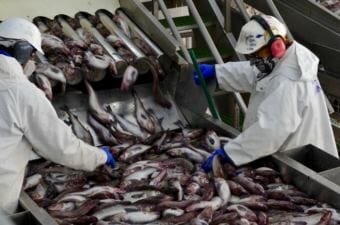
Workers inspect pollock offloaded at Unalaska's UniSea processing plant.
Workers inspect pollock offloaded at Unalaska’s UniSea processing plant in 2018. (Photo by Sarah Hansen/KUCB)

The City of Unalaska warned residents Thursday of possible transmission of the coronavirus between seafood industry workers and the larger Unalaska community.

“The community is most definitely at a high local risk factor for COVID-19, in fact, more serious than at any time since the start of the pandemic,” the city said in a statement. “The vaccine provides hope, but vaccine supply has limited our ability to vaccinate everyone who wants to receive it.”

The news release from the city came one day after they reported 109 new cases of COVID-19 — the island’s largest daily case count since the pandemic began, and nearly a fifth of all local positive cases reported to date.

The recent cases are considered industry-related, which means they are people employed at local seafood processing plants or on vessels in port. The category also includes incoming industry workers and cases where transmission of the virus likely occurred within the workplace, according to the city.

But they added that many of the recent cases aren’t workers testing positive during their mandated two-week travel quarantine after arriving on the island. Instead, they’re primarily industry workers who have tested positive during surveillance testing at local processing plants.

The majority of Wednesday’s cases are linked to a COVID-19 outbreak at Alyeska Seafoods, according to the city. Officials at Alyeska and their parent company, Westward Seafoods, did not respond to a request for comment.

Three out of four of Unalaska’s fish processing plants, including Alyeska, don’t operate as closed campuses and many employees have families who live or work in the community.
“We must assume that some of the people with positive tests have been out and about in the community, with multiple contacts,” the city said.

Only Icicle Seafoods’ Northern Victor facility — a 380-foot processing vessel permanently docked at Unalaska’s spit — operates as a closed campus, where employees live in facility housing without their families and are restricted to company property to prevent the spread of COVID-19.

“Having a closed campus can definitely provide some benefits when it comes to preventing the spread of COVID,” said Julianne Curry, public affairs manager for Icicle. “But really, we’re still learning more about this virus every single day. And that’s certainly true for both open campuses and closed campuses.”

Curry added that everyone in the seafood industry and processing sector in Unalaska has gone “above and beyond” to help prevent the spread of the virus.

“And sometimes, the virus still gets into the facility anyway, no matter how many precautions and protocols that you put in place,” she said.

To date, the city has reported 627 cases of the coronavirus in Unalaska. 191 of those are currently active and all but two are considered industry-related. The city’s risk level remains high.

Warm, wet February in the Aleutians linked to warming ocean temperatures

In Unalaska, it’s also been the rainiest start to February since 2004. So far, the island has recorded more than eight inches of rain this month, with more than a week left to go. The normal February precipitation for Unalaska is six and a half inches. (courtesy of Tacho)

While much of Alaska has been bitterly cold this month, the Aleutian Islands and Alaska Peninsula have been extraordinarily mild.

It’s part of the recent warming pattern in the Bering Sea, and communities along the Aleutian Chain can expect a similar trend moving forward, says Rick Thoman, a climate specialist with the University of Alaska Fairbanks.

“Because the oceans are warming, and the climate of the Aleutians is so dominated by the oceans — unless the atmosphere does something particularly unusual, we’re aiming for a warmer than what used to be considered normal February,” Thoman said.

Much of Interior Alaska has been cooler than normal this month because of cold air coming out of Northwest Canada or down from the high Arctic, he said. But the lower Alaska Peninsula and Aleutians Islands haven’t seen a similar trend, and it’s shaping up to be one of the mildest Februaries on record for the region.

“There really hasn’t been a push of colder air from Siberia across the Bering Sea,” Thoman said. “That’s how the Aleutians can get their cold weather, and that just has been completely lacking so far in February.”

At Unalaska’s Tom Madsen Airport, temperatures haven’t dropped below freezing yet this month. And in Cold Bay, the average temperature is running more than eight degrees Fahrenheit above normal, making this the second warmest start to February since World War II.

“The only warmer start to February was in 2019,” he said. “And the third warmest is 2018. So three of the last four years in Cold Bay have been exceptionally mild — far above normal. And that is undoubtedly related to the large scale warming of the oceans that we’ve seen in recent years.”

In Unalaska, it’s also been the rainiest start to February since 2004. So far, the island has recorded more than eight inches of rain this month, with more than a week left to go. The normal February precipitation for Unalaska is 6.5 inches.

Atka, Nikolski and St. George almost completely vaccinated against COVID-19

Atka seen from the air on July 27, 2011. (courtesy of Ian Dickson)

Unalaska’s neighboring communities of Atka and Nikolski — as well as St. George in the Pribilof Islands — are almost completely vaccinated against COVID-19 through the tribal vaccine rollout.

“We’ve got enough vaccines to get everybody completed,” said Lori Jackson, a nurse practitioner and medical director for the Aleutian Pribilof Islands Association, which operates the tribal community clinic in Unalaska.

James ‘William’ Merculief of St. George Island received the first dose of the COVID-19 vaccine on Jan. 22. (courtesy Lori Jackson/APIA)

The Oonalaska Wellness Center is acting as a “vaccine hub” to get doses out to those communities in the Aleutians and Pribilofs that APIA serves. Jackson said that’s anywhere between 450 and 490 people across the four communities.

“I have honestly been a pest, in a lot of people’s words,” Jackson said. “I have advocated, advocated, advocated over and over for our population as a whole in Unalaska, and our surrounding villages.”

According to Jackson, Indian Health Services has allocated 1,100 doses of the Moderna vaccine to the region, to date. Seven hundred have arrived, and 400 are still on the way.
“To be clear, this is first and second doses,” Jackson said. “So really 1,100 sounds like a lot, but that is only 550 [doses] to cover our tribal members in our region.”

Once APIA completes vaccinations for tribal members who want it, the Qawalangin Tribe will determine who’s eligible next for the vaccine, Jackson said.

“Our Alaska Native and American Indian population has a much, much higher risk of contracting COVID and a much worse outcome, should they have it,” she said.

Hertha Kashevarof of St. George Island was vaccinated by APIA staff on Jan. 22.
(courtesy of Hertha Kashevarof)

She says it’s her responsibility to provide health care to the Native population, but it’s also important to protect others in the community.

“I continue to advocate for our entire population of Unalaska, not only the Native population,” Jackson said. “We have an entire fishing industry that we need to get [vaccinated] because we’re surrounded all the time by people, by our neighbors, our friends, our family, regardless if they’re beneficiaries to the Indian Health Services or not.”

Vaccine eligibility has recently been opened up to non-Natives who live with tribal members, according to Alysha Richardson, emergency response and community safety coordinator for the Qawalangin Tribe.

For the next distribution, she said the tribe is discussing prioritizing community service organizations with congregate living, as well as workers at organizations and businesses that interface with the public, “such as certain city departments, grocery stores, the airport, KUCB, the Museum of the Aleutians, etc.”

APIA has been allocated just 100 vaccine doses so far for the month of February, according to Jackson, but she said she will continue advocating for more.

That’s what we were allotted in January too,” she said. “So I’m going to keep pestering people, and hopefully the door will open and more will come on in.”

The tribe is conducting outreach to tribal households to make sure everyone that currently qualifies is made aware and to prepare for the next prioritization, Richardson said.

New Coast Guard cutter named for sailor buried in Unalaska

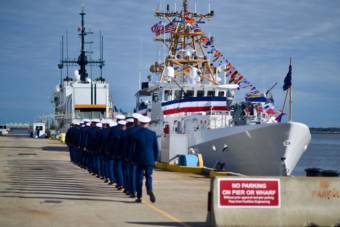
The U.S. Coast Guard Cutter Charles Moulthrope was commissioned into service in Portsmouth, Virginia in late January. (Photo courtesy of U.S. Coast Guard)

Near the base of Mount Newhall in Unalaska, among several weathered Russian Orthodox crosses, a tall stone marks the grave of seaman Charles Moulthrope.

Moulthrope was buried in Unalaska in 1896, at the age of 23, after he died during service in nearby waters. But 125 years later, his name lives on, as a recently commissioned U.S. Coast Guard cutter now carries the name Charles Moulthrope.

This will be the first modern Coast Guard cutter named for an enlisted member of the Revenue Cutter Service. The ship is meant to bring recognition to the sacrifices made by Moulthrope and other sailors who served in this precursor of the U.S. Coast Guard, according to Senior Chief Petty Officer Sara Muir.

“The first ten revenue cutters were ten oceangoing cutters,” Muir said. “We’re talking about wooden vessels with sails that were built at the behest of the United States Congress in the early 1790s, largely to crack down on smuggling.”

Moulthrope is recognized for heroically saving his crewmates, while they were serving off the Oregon coast.

“They encountered a storm and several shipmates went overboard,” Muir said. “And he saved them almost single-handedly, diving over the side of the ship with a rope, while his shipmates on the vessel towed them back aboard.”

Not long after this heroic act, Moulthrope died near Unalaska, after he fell from the rigging of the ship to the deck, while trying to unfoul a flag.

The cutter named for him is part of a group of Sentinel-class 154-foot fast response cutters, Muir said. It is the first of six of these ships that will be homeported in Bahrain to support the U.S. Naval Forces Central Command, and which will replace older, smaller cutters.

“It’s designed for multi-missions, including drug and migrant interdiction ports and waterways, coastal security, fisheries patrol, search and rescue and national defense,” Muir said. “We are acquiring these to replace the 1980s-era, Island-class, 110-foot patrol boats.”

Charles Moulthrope was buried in Unalaska in 1896, at the age of 23, after he died during service in nearby waters. (Photo by Maggie Nelson/KUCB)

According to Muir, when those vessels are decommissioned, they can be used for a variety of things.

“Some of them have been used as artificial reefs,” Muir said. “Some of them have been used as training vessels or have been transferred to other U.S. government agencies and some have been sold through the Excess Defense Articles Act through the State Department to navies and coast guards of other nations.”

There are currently 40 fast response cutters, like the cutter Charles Moulthrope, in service, two of which have homeports in Alaska.

Muir said the Cutter Charles Moulthrope will be escorted to Bahrain with its sister ship, the Robert Goldman, which will be commissioned next month in Florida.

Unalaska fish processing plant reopens after COVID-19 outbreak forces monthlong shutdown

UniSea is one of three onshore plants in the Aleutian Islands that COVID-19 outbreaks have shut down this year. (Hope McKenney/KUCB)

Unalaska’s largest fish processing plant reopened Monday after a COVID-19 outbreak forced it to shut down for almost a month.

UniSea closed its doors Jan. 5 after a handful of workers tested positive for the virus, following a New Year’s gathering in company housing.

Since then, 66 of UniSea’s more than 900 workers tested positive for the virus, according to UniSea President Tom Enlow. Seventeen of those were during their two-week entry quarantine, and 49 were non-travel related cases, he said.

“The virus has not been eliminated just yet,” Enlow said in an email. “We have active cases in isolation that we are monitoring and close contacts in quarantine that we are continuing to test. But we feel very good about our response to the outbreak and containment thus far.”

The reopening is a bright spot for the Bering Sea fishing industry, which has been hampered by COVID-19 outbreaks at multiple boats and onshore plants.

UniSea’s processing plant has a year-round workforce, and its facility handles multiple species from cod to crab. The shutdown came just as it was gearing up for one of its busiest times of the year — the lucrative winter fishing season for pollock, which goes into products like fish sandwiches, fish sticks and sushi.

The pollock season opened Jan. 20 but the 11 boats that typically deliver their catch to UniSea have been able to hold off, Enlow said.

That’s because the pollock fishery operates as a cooperative, where vessels have a fixed quota of fish they can catch and deliver to a specific plant. Crews that don’t catch their quota now can still catch it later in the season, industry officials say.

“Our fleet have been extremely supportive of our situation and patient with our reopening schedule,” Enlow said. “But they, like UniSea, are anxious to get the season started.”

Enlow said despite “gaining ground on containment” and restarting operations, UniSea will continue to test its workforce every three days until no one tests positive for the virus. It will also continue to limit access to the UniSea complex, which is “challenging,” according to Enlow.

That’s because UniSea is not a completely closed campus like some other plants, and many employees have families who live or work in the community.

“The community risk level remains at ‘high’ with community cases popping up every day,” Enlow said. “As much as we don’t want to be responsible or the source of a spread into the community, we don’t want the community impacting our workforce either.”

While UniSea’s “hunker down order” is in place, the company is helping with the delivery of homework packets to the 46 students who live in facility housing, Enlow said. Students living at UniSea will continue home-based schooling, despite local schools returning to a modified in-person learning platform Monday.

“The school district appreciates and supports UniSea’s efforts to contain the spread of the virus through their hunker down orders,” said Unalaska City School District Superintendent John Conwell. “Once the hunker down is lifted, we will look forward to welcoming students from UniSea back at school.”

The financial impact from the plant closure has been “substantial,” according to Enlow. Outside of the company’s big hotel and restaurants in Unalaska, he said UniSea only makes money when it’s processing fish.

“The costs related to COVID mitigation are substantial and are only exacerbated when trying to manage an outbreak,” he said.

Onshore processing plants in the Aleutians were largely successful in keeping COVID-19 out of their facilities last year. But this year appears to be posing more of a challenge, as companies contend with much higher rates of COVID-19 in Alaska and the Lower 48, where many workers come from.

UniSea is one of three onshore plants in the Aleutians that COVID-19 outbreaks have shut down this year.

Alyeska Seafoods in Unalaska shut down a week ago after the city said that a cluster of workers tested positive for COVID-19. And Trident Seafoods’ huge plant on the remote island of Akutan, about 35 miles northeast of Unalaska, remains closed after more than a third of its workforce contracted the virus. Health officials said Monday that 302 of 701 workers had tested positive at the Akutan plant, and the company confirmed Tuesday that a worker died there over the weekend. The cause of death is under investigation.

“The pressure on processors to prevent or contain the virus is immense,” Enlow said. “There is so much at stake in our ability to open up to take and process deliveries of fish and crab.”

While Alaska’s seafood industry has lobbied for early vaccine access for workers, Alaska chose to vaccinate its elders before starting the process for essential workers outside of health care.

Enlow said that it’s “nerve-wracking” to see the virus get into Aleutian processing plants despite strict mitigation measures.

He said he thinks the state and federal government should prioritize vaccination of essential industry workers “regardless of their state residency status,” particularly in Unalaska, which is located 800 air miles from Anchorage and is the largest community in the state without a critical access hospital.

Forty-two of UniSea’s 930 workers have already received the first dose of the Moderna vaccine, according to Enlow. They have been people 65 and over considered “high risk” or company medical personnel, he said. Another 10 high-risk workers are slated to get their first dose in the next few days.

COVID-19 hits second Trident plant in Aleutians as original outbreak grows to 266 cases

Akutan Volcano overshadows the village of Akutan and the Trident seafood plant, which has nearly 1,000 workers (Courtesy Helena Buurman/Alaska Volcano Observatory)

COVID-19 has hit another processing plant operated by fishing giant Trident Seafoods — this time aboard one of the corporation’s massive factory trawlers, the Island Enterprise.

Trident announced Thursday that five workers on the football field-length ship tested positive for the coronavirus after it arrived in the Aleutian port of Dutch Harbor for the winter fishing season.

The news comes amid a still-growing outbreak that’s already shut down Trident’s massive processing plant on the Aleutian island of Akutan, just as the lucrative Bering Sea pollock fishery was set to ramp up. That outbreak has infected 266 of Akutan’s 700 plant workers, Trident announced Thursday.

COVID-19 has also closed two other major processing plants in Unalaska, threatening to derail the pollock season. Trident, in a prepared statement, said it was mystified about how the virus evaded the ship’s quarantine protocols and infiltrated the campus of the isolated Akutan plant.

“We’ve reviewed our quarantine strategy and other prevention protocols throughout our closed-campus and vessel operations,” said Stefanie Moreland, a Trident executive. “We have not detected a gap that would explain how the virus entered, so are consulting with our medical partners on additional testing options to supplement current strong prevention measures.”

The Akutan plant shut down a week ago after a handful of workers tested positive for COVID-19, just as the billion-dollar pollock season kicked off.

Bad weather delayed shipments of the supplies and the arrival of medical workers Trident needed to conduct mass testing of its large Akutan workforce. But company officials said Thursday that nearly all of the plant’s workers have now been tested, and it should be able to continue testing every one-to-three days.

“This will allow us to be confident in assessing and reporting on our progress toward recovering from this outbreak,” Moreland said.

Workers who tested positive in Akutan are isolating in company housing and have been separated from individuals who tested negative, Trident’s statement said. Some 100 workers considered “high-risk” have been taken to Anchorage to quarantine.

“Our people are safe, supported, and have been cooperative through the disruption necessitated by isolation efforts to eliminate the virus from their living and working quarters,” Moreland said.

Onshore processing plants in the Aleutians were largely successful in keeping the virus out of their facilities last year, despite flying hundreds of workers from around the world to process Bering Sea pollock, Pacific cod and crab each year.

But this season is proving to be more of a challenge, as COVID-19 has become more rampant in Alaska and Outside.

The Island Enterprise arrived in Dutch Harbor on Wednesday with two workers showing COVID-19 symptoms, and testing subsequently revealed the five total cases onboard.

Trident said it believes the virus was detected early, but due to the close quarters on the boat, it plans to re-quarantine the full workforce for at least two weeks, Moreland said.

Neither the Akutan plant nor Island Enterprise are currently operating, Trident said. The company is focusing its efforts on eliminating the virus to support a safe return to work, its statement said.

Site notifications
Update notification options
Subscribe to notifications