KYUK - Bethel

KYUK is our partner station in Bethel. KTOO collaborates with partners across the state to cover important news and to share stories with our audiences.
3 people die in Bethel apartment fire

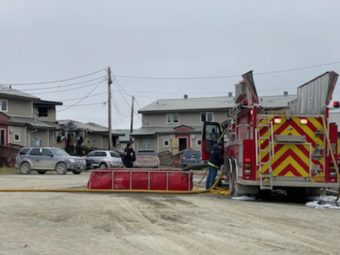
Three people died in a fire at an Association of Village Council Presidents Regional Housing Authority apartment complex in Bethel on Friday, Aug. 12, 2022. (Photo by Olivia Ebertz / KYUK)

Three people died early this morning in a fire in a low-income rental unit in Bethel, according to Bethel Fire Chief Daron Solesbee.

“There were reports of people who were entrapped,” Solesbee said. “We were not successful getting anybody out.”

Solesbee said that he could not publicly identify the victims. He also said that an additional two people were taken to the hospital. He said that he could not comment on their current condition.

The fire took place at an Association of Village Council Presidents Regional Housing Authority apartment complex at 409 Ptarmigan St.

Solesbee said that the fire is still smoldering. So far, it has destroyed two units in a building that he said has six units in total.

“We’re trying to overhaul it right now and find all the hidden fires,” Solesbee said. “There’s a lot of cracks and stuff in the walls and up in the ceiling and that kind of stuff, and we have some floor collapse and roof collapse issues.”

Solesbee said that all of the people who died in the fire were in one unit, and that the second unit that burned was unoccupied. He said that he and his staff responded to the fire at 4 a.m. on Aug. 12 with several fire trucks and ambulances. He and his staff remain on the scene addressing hot spots.

The president and CEO of AVCP Regional Housing Authority said that the apartment complex is known as the Bethel Low Rent Units. He said that the building is likely at least three decades old, and that the larger complex contains 31 units.

Solesbee said that state fire marshals are on their way to investigate the cause of the fire and will be on the scene by late morning. The fire department is understaffed right now, and he said that his firefighters are working hard on putting out the rest of the fire.

“We’re all pretty tired; we’ve been here since early this morning and we’re probably going to be here most of the day,” Solesbee said. “We’re just trying to get through it and just keep focusing on the task. We’re just trying to just deal with the situation that we have.”

Solesbee asked the public to be careful when driving near the apartment complex since there are lots of people and parked cars at the scene.

How people on the Lower Yukon River are faring 2 years into the chum crash

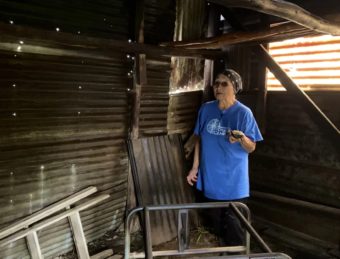
A woman stands inside an empty smokehouse
St. Mary’s Elder Sophie Beans stands inside her empty smokehouse. (Photo by Olivia Ebertz/KYUK)

At the AC store in Emmonak, near the mouth of the Yukon River, Maggie Westlock was picking up a few things for dinner. In her cart she had grapes, coleslaw, sandwiches and some canned ham.

These are not the foods she and her family of 8 prefer to eat. During a normal summer, Westlock would be filling her family’s dinner plates and chest freezers with lots of wild chum and chinook salmon they catch themselves. But fishing for those two species on the Yukon has been closed for two summers because of a sudden and severe collapse.

That means Westlock’s diet is changing. Her family is relying more on store bought food. Her grocery bill has gone way up, and inflation is making things far worse.

Westlock rolled her cart over to the freezer section.

“I’ll show you something,” she said.

Westlock picked up a small pack of ribs, less than 2 pounds worth.

“This one is $37.10,” Westlock said.

On the other side of the store, things were even more dire.

“The detergent is very expensive! $62.99, that’s Tide and that Kirkland is $55.99. Expensive I tell you. And look at these pampers, huggies: $84.99. One box,” Westlock said.

The final damage was $81.81 for five items.

Residents are feeling the loss 100 miles upriver in St. Mary’s too. Elder Sophie Beans lives on the banks of the Andreafsky River, one of the Yukon’s salmon-spawning tributaries. She says when there was fishing, her whole block would be orange and smoke-filled.

“Full of kings and fish,” Beans said.

And now?

“Nothing! Nobody’s cutting,” Beans said.

Beans stood inside her empty smokehouse. The leftover smell lingered in the wooden walls, but it’s been two years since her smokehouse held fish. Both of those years, managers closed subsistence fishing for both chum and chinook to try to protect their dwindling numbers.

gyDow-yukon-river-summer-chum-run.png

Last summer, the Yukon’s summer chum run sank to just a tenth of its average size. This year numbers ticked up slightly for chum but collapsed even more for chinook, the Yukon’s most prized species. Normally, families would put away hundreds of both species to get through the winter.

“My son when he went drifting one time he caught 700 chums and it took us three days. Seven totes!” Beans said.

And that wasn’t even including the kings.

Beans uses every part of the fish from the head to the tail. She makes culunaq and egamaarrluk.

Beans usually keeps three chest freezers full of salmon, but now only one has salmon. It’s about a third full. That fish is from two years ago, when fishing was still allowed. She and her husband are now rationing, taking fish out for special occasions only.

Scientists point to warming seas

Scientists have been scrambling to figure out why western Alaska chum and chinook stocks are crashing. They’re starting to hone in on one primary cause for the chum collapse: recent marine heatwaves in the Bering Sea and Gulf of Alaska. Dr. Katie Howard from the Alaska Department of Fish and Game says that’s linked to climate change. There have always been marine heatwaves, but the recent ones are different.

“They were just bigger, they were geographically larger, they were more intense. And they lasted over a much, much longer period of time than is typical. And so that is what has been tied to a changing climate — that it’s more extreme when it happens. And the other expectation is that they may occur more often,” Howard said.

But Howard says they’re not exactly sure what’s impacting wild chinook, and that species has been on the decline in many Alaska rivers for a decade now.

Many residents also point to another driver behind the low returns of both species: commercial fisheries in the Bering Sea. State and federal managers have allowed these commercial fisheries to continue to operate, even as they have placed more stringent measures on Yukon River subsistence users.

The bow of a boat filled with white cardboard boxes
Frozen donated salmon coordinated through the state is some of the only fish people on the lower Yukon river will eat all year. (Photo by Katie Basile/KYUK)

The state says it wants to keep studying the fish before it takes action against commercial fisheries, but most subsistence users say they don’t have time for years-long scientific studies. Many want the state and the feds to more strictly manage the commercial fisheries now.

Some scientists argue that the numbers are now so low that getting each and every spawner back to the Yukon River matters. Dr. Howard says she is getting concerned, and this issue will only get more urgent as time goes on.

“If, over the course of more than five years, you’re not getting enough fish to the spawning grounds to replenish the population, you really start to become very concerned,” Howard said.

The low chinook runs are well past that five year mark.

Higher grocery bills, less protein

Across town in St. Mary’s, in a small house with a view of the Andreafsky and Yukon rivers, Jolene Long and Troy Thompson live with their six young children.

Thompson used to work as a commercial fisherman and has now been out of work for two years. He says they’re relying much more on the store and are spending two or three times as much on groceries compared to when the salmon ran abundantly.

To feed their family of 8, they spend $400 to $600 per week. They don’t eat much protein these days.

“When they do get a little bit of fish, they just gobble it up,” said Long.

Children cutting salmon
11-year-old Nicole Long practices cutting fish for the first time in two years with her mother, Jolene Long. (Photo by Katie Basile/KYUK)

The salmon crash means it’s become more difficult for parents to pass on their Yup’ik culture to their kids. Long used to cut fish with her oldest daughter every summer. Now her daughter barely remembers how to cut.

She did get a little practice after most tribal members in St. Mary’s received a couple of donated salmon each from the state.

For many in St. Mary’s, that small amount of donated salmon is the only taste they’ll get all year.

‘People are running out of food’: Subsistence closures leave Yukon River residents with few options

Salmon filets hanging from a drying rack
Yukon river residents are not able to make dry fish from chum and chinook for the second year in a row. (Photo by Shane Iverson/KYUK)

Each week during the summer, subsistence users and managers up and down the Yukon meet on a teleconference to share fish news and reports. On last week’s call, Anvik First Chief Robert Walker said that people are hanging on by a thread.

“These people are running out of food, basically,” Walker said.

That’s because there’s not much food swimming up the river. As the summer salmon runs finish up, counts are once again at record lows. Chinook runs had been dwindling for years, but last year the region suffered an unexpected chum salmon crash, too. Now, no one has been able to subsistence fish for either species in two years.

When the chum ran abundantly, they provided subsistence users with a buffer zone against the low chinook counts. With that buffer gone, salmon conservation scientist Peter Westley said that the record low chinook run has become glaringly obvious.

“There are no chinook in the Yukon. They’re at 40,000. Remember how last year was like this terrible year, there was 150,000. This year, there’s 40,000. That’s my point. I’m not trying to be dramatic, but there are no chinook,” Westley said.

He said that last year, he was optimistic chinook could bounce back. This year, he’s not so sure.

“I thought all these things, like, if we did X, Y, and Z, they’ll come back. I think I might be wrong. It’s a collapse. I mean, it’s heartbreaking,” said Westley.

The Yukon River is not the only river system with low chinook runs. Other parts of the state are suffering low runs, too. The state says that Bristol Bay is likely having some of its lowest chinook runs yet, and the Kenai River is also set to miss its escapement goal. Most scientists point to something in the ocean causing the low chinook runs.

Subsistence users on the Yukon River say they’re going broke trying to replace the salmon.

“We’re spending more money on food than we ever did before because we don’t have that bump of salmon to ease the price,” said Anvik’s First Chief Robert Walker.

Walker said that they’re having to rely on government subsidies.

“We don’t want more food stamps, we just want our way of life, good lord,” Walker said.

Walker said that people are not the only species being impacted by the low runs.

“Since there’s no fish coming up the Anvik River, we had grizzly bears coming through our dump. This is really early. It doesn’t usually happen until October,” Walker said.

Normally this time of year, bears would be filling their bellies with river fish, and people would be preparing for the fall chum run. But that won’t be an option this year either.

“We’re looking at a critically low fall chum run again this year,” said Christie Gleason, the fall manager from the Alaska Department of Fish and Game, who said she expects subsistence fishing for fall chum will remain closed on the whole Yukon for the second season in a row.

Gleason said that fall chum have begun to enter the river, and they expect to start seeing coho salmon in a few weeks. Last year was the worst year on record for coho salmon on the Yukon too, so this year the department has implemented a new project to try to understand that crash. They’ll begin radio tagging coho salmon in August to track their movements up the river.

In a bit of good news, Basil Larson from Russian Mission reported that the pink salmon run is strong this year.

“The humpies are running pretty thick. I get probably 50 of them in no time,” Larson said.

Plus, he said, there’s an odor that makes him think the chum may, at least, be reproducing well.

“The mud is pretty stink, which kind of indicates that there’s some local spawners in the creeks,” Larson said.

Chum fishing will remain closed on the Yukon amid projections for another low fall run

""
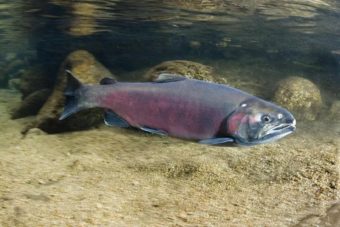
Chum salmon (NOAA photo)

Fall chum are expected to begin entering the Yukon River soon, and the Alaska Department of Fish and Game is projecting another low run for the species after 2021’s record low return. To conserve the salmon, government fishery managers will keep fishing for fall chum closed unless an unexpected surge of the species arrive.

Fish and Game is projecting that less than 300,000 fall chum will return to the Yukon River. That’s fewer than the state’s drainage-wide escapement goal of 300,000 to 600,000 fall chum reaching the spawning grounds. On average, 1 million of these fish return to the Yukon River each year.

To help the fraction of fall chum expected to arrive have a chance to spawn, managers are keeping chum fishing closed.

“I just want to let fishermen know that we’re really sorry that we don’t have better news,” Fish and Game fisheries manager Christy Gleeson said during a weekly teleconference about Yukon salmon hosted by the Yukon River Drainage Fisheries Association. ”These fish counts are devastating for people trying to live along the Yukon River. We know that it’s been a really difficult fishing season so far with these salmon closures. But we really appreciate everyone coming together and doing continued cooperation during these times of salmon conservation.”

That conservation has led to no salmon fishing for chinook or chum along the river for the second year in a row.

2021 saw the lowest fall chum run on record. This year’s chinook and summer chum runs have continued the same trend from last year. Neither are expected to meet escapement goals set by state and federal fishery managers. The continued closures are economically and culturally straining Yukon River residents.

“We long to taste our fish that we smoked and dried. This is our food, our livelihood,” Russian Mission resident Sandra Kozevnikoff said during the Yukon River salmon teleconference.

Fishing will remain open for other species on the river, including red, pink and coho salmon, along with non-salmon fish.

Another Russian Mission resident, Basil Larson, said during the teleconference that pink salmon are passing by in “full force.” In a six-hour stretch, he and his brother caught enough pinks to feed their dogs for three to four days.

“There’s some pretty good, healthy looking ones that we’re taking and eating, along with the whitefish,” Larson said.

Upriver in Huslia, Lisa Bifelt said that local fishermen were making a 75-mile round-trip to a slough to target sheefish.

“People were having some luck down there, not much though. I think seven was the most caught,” Bifelt said.

But when she boated there with her mother, she said that they didn’t catch anything.

Meanwhile, other callers said that berry picking season had begun, a hopeful abundance of local food amid the historic declines of salmon.

Area M: Where Alaska commercial and subsistence fishing interests collide

Two people in a skiff picking salmon out of a net
Fritz Charles’ family picks a chinook salmon from the net. (Photo courtesy of Sharon F. Charles)

There have been clashes over regulating Area M for decades, but the battle heated up after the Yukon-Kuskokwim chum crashes began. This is the first in a three-part series.

Kuskokwim fisherman Fritz Charles grew up in Tuntutuliak, on the lower river. There were so many fish then that his parents would put away literal barrels of them. His job as a child was to pack the dry fish tight in the barrels using a special method.

“Somebody would put me in the drum and start stomping on the fish so they can pack more in there. They put away two drums of salmon. One drum would mainly be king slabs, and the other one would be chums and reds. And that was our main diet for the winter back then,” Charles said.

Nowadays, there’s no more stomping on dry fish. There aren’t enough to put away a whole barrel.

“There’s hardly any fish, and we can’t fish anymore to support our subsistence lifestyle,” Charles said.

Chinook runs have been low in the Yukon-Kuskokwim Delta region for a long time. And chum runs have been faltering as well, though they stayed dependable until 2021.

In 2021, chum runs took a sharp downward turn. It was the worst year on record for them on the Yukon River, and it’s the same story on the Kuskokwim. This year, the runs on both rivers are at their second lowest.

strips of salmon drying on a drying rak
Fritz Charles’ fish rack is filled only with reds and kings. This year he didn’t even catch one chum. (Photo courtesy of Sharon F. Charles)

There are many theories behind the salmon crash. Most scientists have attributed it to issues out at sea. Many have theorized that climate change is negatively impacting the salmon’s ocean environment.

Subsistence fishermen say that salmon fishing in the ocean is hurting their chum run

Charles and many other local fishermen have another theory as to why the chum are crashing.

“They’re being slaughtered out at sea,” Charles said.

They’re concerned about one part of Alaska waters in particular, called Area M. Area M is a state-managed section of water along the western Alaska Peninsula and eastern Aleutians. It’s called an intercept fishery because most fish caught there originated elsewhere. They must pass through Area M on the way back to their spawning grounds.

In June, oceangoing vessels there scoop up fish bound for coastal western Alaska. The fishermen primarily target sockeye, but they also catch and sell chum and chinook salmon. Area M fishing is different from bycatch, where commercial fishermen targeting non-salmon species discard incidental salmon catches.

There have been clashes over regulating Area M for decades, but the battle heated up after the chum crashes started.

A map of the Alaska Peninsula showing area m labeled on either side
Map of Area M. (Alaska Department of Fish and Game)

In 2021, 153,497 summer chum salmon swam up the Yukon River. That’s compared to an average of about 1.7 million summer chum. The river was missing about 1.5 million fish.

At the same time, Area M commercial fishermen caught 1,168,601 chum at sea while subsistence fishing on the rivers was closed. In the midst of the smallest chum run western Alaska subsistence users had ever seen, Area M fishermen were catching more than ever before.

Even the Alaska Commissioner of Fish and Game, Doug Vincent-Lang, who has been hesitant to over-restrict the Area M commercial fishery, acknowledged last year’s record high numbers.

“We got surprised, as it got added up at the end of the season, just how large that harvest was,” Vincent-Lang said.

Charles and other subsistence users say that Area M commercial fishermen are stealing their livelihoods, taking food that they believe belongs in their rivers and their freezers. The Bethel and Kusilvak Census Areas, where the Yukon and Kuskokwim Rivers flow, are some of the poorest regions in the United States, and people depend on fish to feed their families.

But the Area M fishermen believe they have a claim to the fish, too.

This brings us to the crux of this decades-long dispute: to whom do these fish belong?

Charles said that the fish belong to the Yup’ik people. The Yupiit have been stewards of the fish for thousands of years. Plus, he said, he only takes what his family needs to survive on the land.

“We need our fish, and we’re the end-users. They’re there just for the money,” Charles said.

He said that fishing for salmon is his culture. And with the low runs, it’s been harder and harder to pass his traditions on to his children.

Commercial fisherman say that without Area M’s June fishery, they’d have little income

Over in Area M, Safron Kusnetsov surveys the scene from his 50-foot Polar Marine.

“I’m fishing in the Ilnik section, near Stroganoff Point. Today looks like the sun’s out,” Kusnetsov said.

Kusnetsov is a fisherman from Voznesenka, a town near Homer. He said that like Charles, his culture depends on fishing too. Like Charles, he grew up fishing.

Two people celebrating on the deck of a boat filled with salmon
Crew from Kusnetsov’s boat survey their catch. (Courtesy of Safron Kusnetsov)

“I am an Old Believer. Culturally, gillnetting is a way of life for Old Believers,” Kusnetsov said.

Old Believers are from a branch of Russian Orthodoxy that fled persecution in Russia long ago and eventually ended up in Alaska.

“They came to Alaska mostly because it was a lot like Russia. A lot of culture and heritage is still very Russian here. They felt connected to that. And they were looking for a similar climate to grow traditional foods and someplace with the ability to live off the land,” Kusnetsov said.

Kusnetsov said that if the June fishery were to be shut down or more tightly regulated, it would be a devastating blow to his community and to his livelihood.

“There’s a saying here that 90% of our annual income is earned in two weeks when the hot run hits,” said Kusnetsov.

Kusnetsov mainly targets sockeyes, but he sometimes catches chums and chinook, too.

Do the subsistence fishermen in the Y-K Delta or the commercial fishermen in Area M have a greater claim to the chum? About a decade ago, a comprehensive salmon genetics study of the Area M fishery confirmed that most of the chum caught in the region, around 60%, are bound for coastal Western Alaska. But when you start to break that number down further, that’s where things get complicated.

In part two of the series, we’ll look at what science can tell us about whether commercial fishing in Area M is truly taking a toll on Western Alaska salmon populations. 

Amid lowest chinook run ever, no end in sight for Yukon River subsistence closures

""
Skiffs line the Yukon River bank near the Kwik’Pak fish plant in Emmonak, Alaska on June 15, 2019. (Photo by Anna Rose MacArthur/KYUK)

Subsistence fishing for Yukon River chinook and summer chum salmon will likely remain closed through the end of the season.

It’s a possibility that fishery managers had warned could happen since before the salmon arrived.

Now, with both runs past their midpoints, fisheries officials say there’s no indication that there will be enough fish to meet the goals managers set for fish to escape to their spawning grounds.

“So unless these runs are abnormally, exceptionally, extremely late, it’s unlikely that we’ll get enough fish coming in the last part of this season,” said Alaska Department of Fish and Game Yukon River Fishery Manager Deena Jallen. Jallen gave the update during a weekly salmon teleconference hosted by the Yukon River Drainage Fisheries Association.

Only about 20% of the average amount of chinook and summer chum have returned to the lower river, according to data from the Pilot Station sonar. It’s the lowest chinook run ever, and the second lowest summer chum run, just barely more than what returned last year.

“So we know that it’s incredibly disappointing,” said Jallen. “It’s extremely hard to see these runs come back so low. It’s hard to have fishing be closed, but that’s unfortunately what we have to do when the runs are this small.”

A caller who identified herself as Ruby in Eagle said that she couldn’t provide a subsistence report during the teleconference since no one had been fishing.

“It’s very, very quiet at the public boat landing in town,” she said. “Almost eerily quiet.”

The community is facing other challenges as wildfires burn across the Alaska Interior.

“Very dry, very hot, lots of smoke. We haven’t had any measurable rain for a very long time, probably a month,” Ruby said.

Downriver, in Russian Mission, a caller who identified herself as Olga said that an elder has been asking her for a taste of fish.

“Then I told her that it’s not us that’s saying that they can’t fish; it’s just a regulation from way up high. And then she was practically crying and said, ‘Well, tell those people not to go shop for four weeks in their store. They have it easy to go to the store to get what they want to eat,’” Olga said.

Pink salmon counts are picking up in the lower river. Subsistence users can target pink and red salmon with 4-inch mesh set nets, 60 or fewer meshes in length, along with other gear types.

U.S. Fish and Wildlife Service Fishery Manager Holly Carroll asked fishermen to move their nets if they’re catching a lot of summer chum or chinook. She said that it’s important that each of those fish makes it to the spawning grounds.

“We have had years like this before, certainly for chum in 2000 and 2001, and we recovered. And I have faith that we can recover again and we’ll be fishing that species again, but just not this year,” Carroll said.

She also referenced the moratorium in 2013 and 2014, prohibiting all chinook harvest, and the rebound that followed. She acknowledged that prohibiting fishing for both summer chum and chinook is a compounded hardship.

“So while it may be hard right now, I’m just trying to put out a message for hope that if we let these fish go by now, we will be fishing on them again in five years time, four years time for the chum. That’s my hope. Maybe even less for the chum; maybe two or three years we could see these runs rebound,” Carroll said.

In the meantime, fishing for summer chum and chinook remains closed on the Yukon River for the second consecutive year.

Site notifications
Update notification options
Subscribe to notifications