KYUK - Bethel

KYUK is our partner station in Bethel. KTOO collaborates with partners across the state to cover important news and to share stories with our audiences.
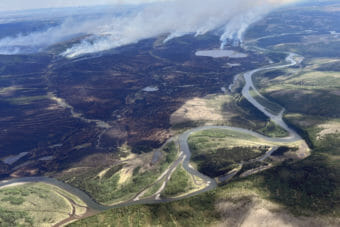
A large tundra fire is burning 12 miles away from St. Mary’s

An aerial photo of a large tundra fire
A photo of the St. Mary’s fire from June 4. (BLM Fire Services)

A large tundra fire is threatening the village of St. Mary’s. The fire has been burning since the tundra was struck by lightning on May 31, and it is now within 12 miles of the community. Federal entities sent in more firefighters on June 7, and some residents are thinking about preparing their go-bags.

Elder George Beans, Sr. lives on a hill in midtown St. Mary’s. He’s been smelling smoke ever since the fire began on May 31.

“It was a little uncomfortable and hard to breathe,” Beans said.

On June 7, the wind switched and gave the village a short reprieve from the smoke. But Beans can still see it, and it’s getting worse.

“There’s a lot of smoke. It’s thick over up north of us. Real thick, and it seems to be getting closer, too,” Beans said.

The fire is getting both closer and larger. What the Bureau of Land Management first reported as an 1,800 acre fire around 25 miles from the village on June 3 had grown by June 7. The fire is now estimated at 30,000 acres and is just 12 miles from the village.

“It’s been hot, it’s been dry, and it’s been windy. And those winds gusts of 20 miles per hour, it’s kind of funneled through the Andreafsky River drainage,” said Beth Ipsen, a spokesperson for the Bureau of Land Management’s fire service.

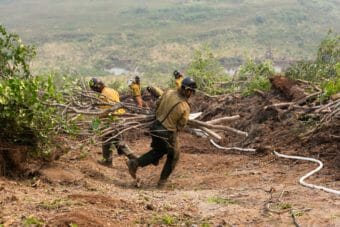
Ipsen said that the conditions and the proximity of the fire to the village prompted officials to send in more smokejumpers and the BLM’s Chena Hotshot firefighters on June 7. Eight smokejumpers had been there since June 3. Now there are over 40 fire fighters in St. Mary’s.

The firefighters are setting up camps in town and will hike up to the site of the fire each day. The weather forecast looks hot and dry for the next few days, but Ipsen said that she hopes that changes.

“We’re trying to stall this fire. The weather is not cooperating. We’re hoping that some of the forecasted cooler temperatures pan out this weekend. And we’re hoping that Mother Nature will help us out with this,” Ipsen said.

Ipsen said that she’s not worried yet, but Beans said that he is concerned. Beans has been living in St. Mary’s for most of his life, and said that this is the biggest and most dangerous fire he had ever seen.

He said that June 7 was the first day he considered stocking an emergency bag with essentials that he can quickly take with him if he needs to leave the village in a rush.

“I instructed my family, ‘We need to get something ready here just so we can grab and go,’” Beans said.

He said that he lives just a short distance from the boat harbor, and that he plans to take his family to another village on the Yukon by boat if the fire reaches St. Mary’s.

Bea Kristovich, first woman traditional chief of Association of Village Council Presidents, has died

Bea Kristovich is the first woman Traditional Chief of AVCP. (Photo by Anna Rose MacArthur / KYUK)

Bethel and Napaimute elder Bea Kristovich died Thursday at the age of 83. The Association of Village Council Presidents elected Kristovich as their first woman traditional chief in 2015. Kristovich spoke with KYUK the day of that historic election.

“Women were always left out over the years,” Kristovich said. “The men were the leaders. But over the years, there’s been more people, or more ladies, more women getting more active, going into active roles as leaders from the villages. And they’re still silent. But I think being the first one, it will show these other younger generations that they can do it.”

That day Kristovich shared her vision for the Yukon-Kuskokwim Delta tribes.

“I want them to be united,” Kristovich said. “You know, there’s 56 villages, and they’re still separated by Yukon, Kuskokwim, and our area. And I think if we were all united, we’d be so strong. We could stick together and fight for issues that are very important for our people and our villages. It would work.”

Kristovich wanted younger people to lead the region. She resigned as traditional chief after one year.

Kristovich was Athabascan and a member of the Native Village of Napaimute. She was born in Napaimute and lived most of her life in Bethel. During her multiple careers, she worked for the Bureau of Indian Affairs, the Alaska Court System, and the Lower Kuskokwim School District.

Her family said that Kristovich died in Anchorage at the Alaska Native Medical Center following a long illness. The family will hold a viewing in Anchorage, a Catholic funeral in Bethel, and then a burial for the former traditional chief in Napaimute.

Scientists want samples from the beluga whales that swam up the Kuskokwim River to Bethel

People onshore watch a beluga whale swimming in a large river
Onlookers gather to watch a beluga whale swimming in the Kuskokwim River near Bethel, Alaska on May 26, 2022. (Photo courtesy of Anne Kosacheff)

In an unusual event, a pair of beluga whales swam about 60 miles up the Kuskokwim River to Bethel. After word got out, boaters pursued the belugas and took at least one of them. Now, an official is working to collect samples of the animal to better understand where it came from.

Anne Kosacheff lives along the Kuskokwim River in Bethel. Last Thursday, around 6 p.m., she and a friend were sitting outside when they saw something white in the river below.

“Initially I thought they were swan, because what else is bright white and big across the river?” Kosacheff said.

But no, she realized, they weren’t birds. Still, they were too far away to see. Kosacheff went inside for a bit, and then shortly after stepped back out.

“And there was this beluga whale turning around literally at my feet. I mean, 30 feet away, but at my feet,” Kosacheff said. “And I was stunned.”

She ran to get her camera and then ran down the hill to the seawall to get closer.

“It came up for air literally 10 feet in front of me. There were two of them,” Kosacheff said.

More people began gathering to watch the whales.

“They swam around in front of Bethel maybe 30 minutes, and there was a crowd of us just oohing and ahhing and taking pictures. And it was really quite an amazing thing,” Kosacheff said.

Jennifer Hooper also lives along the Kuskokwim River in Bethel. Her friend told her about the beluga, and she walked to the seawall to watch them.

“After a good half hour or so, maybe even an hour, it was obvious that some boats were heading out and were actively going to be looking for them and pursuing them,” Hooper said.

At least six boats began hunting the whales. Hooper watched them take at least one of the belugas near the island across from the Bethel riverfront.

Alaska Native people can legally take beluga whales under the Marine Mammal Protection Act.

Hooper works as the Natural Resource Director for the regional Tribal nonprofit, the Association of Village Council Presidents. The association is part of the Alaska Beluga Whale Committee, which co-manages beluga stocks in Western and Northern Alaska. The committee encourages hunters and scientists to work together to collect samples of harvested beluga to better understand and manage them.

Hooper is trying to track down the hunters so she can collect samples. There’s not much data on where the beluga are migrating from that swim along the region’s coast.

“We’re trying to get more samples from whales that are harvested from our region to know more succinctly whether they’re whales that are migrating north or back south,” Hooper said.

This work includes collecting a skin sample to gather genetic data, salvaging its lower jaw bone to look at its teeth for signs of aging, and observing health indicators like its stomach contents to see what it was eating.

Hooper noted that pursuing food could be the reason why the beluga swam about 60 miles up the river to Bethel. The first king salmon have begun running up the river, and more are expected to follow.

Kasigluk fire destroyed 3 buildings on campus but spared the school

Smoking rubble, including twisted sheets of corrugated roofing
Fire damage at the Akiuk Memorial School campus in Kasigluk, Alaska on May 27, 2022. (Photo courtesy of Kimbery Hankins/Lower Kuskokwim School District)

More is now known about the extent of the damage from the fire that burned on May 26 at the Akiuk Memorial School campus in Kasigluk. The fire did not damage the school building. However, three other school structures were destroyed.

Lower Kuskokwim School District Superintendent Kimberly Hankins visited the Akiuk Memorial School the day after the fire on May 27. In an email to KYUK, she wrote that the three buildings that burned included a teacher housing unit, an old utility building and the school’s current utility building. All three structures were completely destroyed. Pictures from the site show collapsed, charred remains.

Hankins said that the teacher who had been living in the now destroyed housing unit had already moved out of the building before the fire began. The semester ended last week, and many teachers had left the village for summer break.

Though the school building itself stands undamaged, Hankins said that she could smell smoke inside the school gym and kitchen. Both are located near the utility building that burned.

Tununak residents share what it’s like to live in rural Alaska without internet

Tununak, Alaska (Andrew Banas/Creative Commons)

When a fire ripped through Tununak’s laundromat in February, it left people without an easy place to wash clothes. The fire also damaged the community’s internet infrastructure, causing outages for half of the village.

Without internet, residents say it’s been hard to carry out everyday tasks like uploading documents or ordering necessities online. And it’s making it harder for people to do their jobs.

“I don’t have internet access or email access,” said Alvina Whitman, who started a new job in March as an Indian Child Welfare worker. “I feel like I’m missing out on a lot.”

Whitman said that she has missed important meetings and trainings for her new job. And it’s impacted the children she is working to protect.

She’s missed out on Office of Children’s Services hearings, where decisions are made about whether a child should be removed from the care of their guardians. She said that because of the outages, she can only find out about the hearings through the mail.

Whitman has not only lost internet in her office, she’s lost it in her home, too. She can access the internet through her phone’s data plan, but she said that service is spotty and slow. She said that makes it more difficult for her to order necessities online.

“Sometimes I forget to order or end up not ordering because the internet’s so slow,” said Whitman.

Once, she wasn’t able to order diapers for her baby. She ran out and ended up having to buy a pack from Bethel, which was around $60 more expensive than online.

According to GCI, The internet outage has impacted five businesses and 12 homes in Tununak. But Tununak’s tribal administrator, Xavier Post, said that it has actually affected around 45 homes. That’s more than half of the community.

The internet is also out in the tribal administrator’s office. It’s making his job a lot harder. He spends a lot of time using the internet to file financial reports and apply for grants, but he said that the Tribe has possibly missed grant deadlines.

“We’re delaying our reports. It’s very frustrating. The internet we have right now, is takes up most of our day,” said Post.

Each task takes him double or triple the usual amount of time. He gets around not having internet at work by texting photos of the Tribe’s financial documents to a consultant in Fairbanks, or by lugging his work computers home and using his personal internet.

GCI spokesperson Heather Handyside said that she gets where Post is coming from.

“I definitely can understand why folks are frustrated. I know that connectivity is, you know, a need. It’s not a nice to have, it’s a must have,” she said.

She says that the company is working to restore the internet, and workers could be in Tununak by the end of the week. But Post said that GCI has been telling them they’ll get there by the end of the week since February.

Handyside said that the company had been waiting for a cable to arrive for months. Now they’re waiting on specialized technicians to install it. She said that both slowdowns are caused by general supply chain issues and an increased demand for broadband.

“Unfortunately, a big piece of this which is, you know, key equipment that we needed — it was just out of our hands,” Handyside said.

Handyside said that the residents without internet have not been charged during this time period. She said that if there are residents without internet who have been charged, they should get in touch with GCI.

In addition to waiting on internet, Tununak is also still waiting on a temporary washeteria from the State of Alaska. Internet outages have made communications with the state slow. Tribal Administrator Xavier Post said that’s delayed the process of getting the washeteria, but he still hopes they’ll have it at some point this summer.

Fire in Kasigluk damages school facilities

Smoke billowing from a group of buildings seen from across a body of water
School facilities burn in Akiuk Kasigluk, Alaska on May 26, 2022. (Photo courtesy of Natalia Brink)

School facilities burned at Akiuk Memorial School in Kasigluk on Thursday. No injuries or deaths have been reported, but multiple buildings were damaged as local and state agencies worked to suppress the flames.

The fire started around 10:30 a.m. on May 26. Third and fourth grade teacher Laura Spence was inside her home. She lives with her husband and their dog in a teacher housing unit next to the school.

“What I saw was dark black smoke,” she said.

The building that housed the old generator for the school was on fire. Her husband came in from outside.

“He just told me to get up and get our stuff, and get our dog and get out,” Spence said.

She grabbed the dog but was not able to gather many belongings before evacuating.

The fire spread to the principal’s housing unit and then to the teacher housing. The school semester ended last week, and classes were not in session.

Kasigluk Tribal Council President Natalia Brink said that the principal had already left for the summer, and so had several teachers. Other teachers who had planned to leave had already packed their belongings and were able to move them out of the houses before the fire reached the units.

After the fire overtook the teacher housing, Brink said it spread beneath the school.

“Holy cow! It’s getting worse. Under the school and teacher quarters are on fire, and it’s getting really smoky,” she said, observing the fire around 12:30 p.m., two hours after it began.

Brink said that volunteer firefighters were using hoses to spray the buildings with water from the Johnson River. She said that the water pump initially did not work in Kasigluk, but volunteer fire fighters from the nearby community of Nunapitchuk quickly boated over with their equipment to help.

“They’re splashing water with hoses. They’re spraying along the ground because it’s really dry,” Brink said.

The Alaska Division of Forestry sent smokejumpers and two airplane tankers filled with fire retardant to the site.

Division spokesperson Kale Casey said that the fire spread to five acres, but it’s now contained after a tanker released two-thirds of its load. The other tanker flew back to McGrath without needing to deploy its retardant. Two smokejumpers remain in Kasigluk.

The division said that dry conditions are a concern across much of Alaska this year. In April, a wildfire in the region grew to 10,305.5 acres over 12 days. It did not reach any villages or private property and eventually burned out on its own. It was Alaska’s largest April wildlife in 25 years.

Alaska State Troopers are also responding to the Kasigluk fire. Trooper spokesperson Austin McDaniel said deputy fire marshal will investigate its origin and cause.

Lower Kuskokwim School District Superintendent Kimberly Hankins said that she was in contact with community members in Kasigluk, who were updating her as the fire progressed.

If a new school is needed, constructing one before the fall semester is unlikely. In Bethel, a fire destroyed two schools in 2015. Their replacement is being constructed this year, seven years afterwards.

This is the second large fire in the village in recent years. In September 2020, the only store in Kasigluk burned down and has not yet been rebuilt.

Site notifications
Update notification options
Subscribe to notifications