KYUK - Bethel

KYUK is our partner station in Bethel. KTOO collaborates with partners across the state to cover important news and to share stories with our audiences.
Mayor of Pilot Station dies after falling through Yukon River ice on a snowmachine

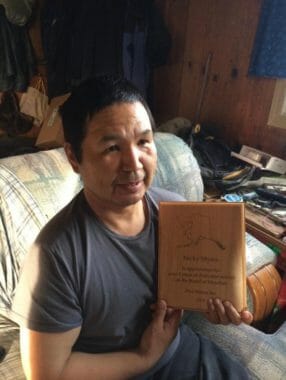
A man holding a plaque recognizing his service to Pilot Station
Fifty-nine-year-old Nicky Myers was mayor of Pilot Station when he died. (Photo courtesy of Dwayne Myers)

On April 29, 59-year-old Nicky Myers of Pilot Station fell through the ice on the Yukon River on his snowmachine and died. He was the mayor of Pilot Station, proto-deacon of the Russian Orthodox church, a crew boss for local wildfire firefighters, a member of search-and-rescue, and a family man.

It’s the first river death in the Yukon-Kuskokwim Delta this year.
Myers set out on the Yukon River from Pilot Station to St. Mary’s by snowmachine on the afternoon of April 26. His son, 30-year-old Nikiefer Myers, had just landed after a vacation. Nikiefer thought a friend was going to pick him up, but instead it was his dad.

“It was a surprise. I was surprised to see him there,” Nikiefer said.

The two headed upriver towards Pilot Station for what is normally about a 40-minute snowmachine ride. His dad told him that the ride downriver had been good. But by evening on the way back, it started to get bumpy.

“There was lots of dark spots, lots of water,” Nikiefer saud.

Then, suddenly, the ice turned needle-y. The snowmachine stopped and started to sink. They jumped off and started to swim.

“I looked back. I saw my dad struggling to swim. He had all his winter gear on. I grabbed him and helped him swim,” Nikiefer said.

Nikiefer was holding onto his dad and trying to find solid ice to hang onto. The first piece broke off, but he finally found a solid patch and pulled his dad onto it. His dad was weak and cold. He wanted his son to stay safe. His dad told him to leave.

“I heard my dad: ‘You gotta go, you gotta go, just go without me,’” Nikiefer said.

His dad was starting to slide back under the ice. Nikiefer pulled him out again.

“His eyes were closed. He wasn’t moving. I still stayed there for a little bit with him. And in my head I heard another time, ‘You gotta go, you gotta go, you gotta go without me.’ I really didn’t wanna leave,” Nikiefer said.

But he left to go get help. He made it to shore and shed his wet clothes. He was amazed when his phone still worked. But he had to walk, possibly a couple miles, until he found service.

He called for help and the local search and rescue mobilized. Someone called Nikiefer’s mother, Judy, and told her that her son and husband had fallen through the ice. They asked her to gather warm blankets for the rescue effort.

“So I got everything ready,” Judy said.

She prepared two of everything, but only her son walked through the door.

“And he came in and dropped to the floor crying and said he couldn’t wake up papa,” Judy said.

Myers was dead by the time search and rescue pulled him out of the river. The Alaska State Troopers came the next day to take his body to Anchorage for autopsy. Now his family will wait for his body to return so they can hold a funeral.

In the meantime, they’re spending time with one another, sharing memories.

Myers was born almost 60 years ago in Pilot Station on May 12. He was the third youngest of eight children in a big Russian Orthodox family.

“We had a real good childhood. It was fun. We didn’t have much toys. But we had food, we had shelter, clothes, we had each other. We lived a subsistence lifestyle. We would go out with our parents, or fishing or berry picking, logging,” Wassillie Myers said.

Wassillie was always close with his older brother.

“He was my best friend,” Wassillie said.

A group photo of wildland firefighters
Nicky Myers, pictured third from the left in the middle row, fought wildfires for more than three decades. (Photo courtesy Of Nikiefer Myers)

Wassilie followed Myers into firefighting. The two traveled all over Alaska and the lower 48 fighting fires together. Nicky was the crew boss, and Wassilie was the squad boss. The two looked and acted so alike that the other firefighters would get them confused.

Myers had lots of adventures at home on the Yukon too. His wife Judy was often by his side. They’d go boating or berry picking together. They’ve known each other their whole lives and had been together since high school. They married nearly 40 years ago, in 1984.

“I don’t know how he asked me out. We knew each others as we grew up. Just kind of happened. Yeah,” said Judy.

Nicky Myers was a deacon for more than 15 years. (Photo courtesy of Wassillie Myers)

Judy said that life with Myers was a happy one. He was a good husband and father. He played lots of other roles in the community, too. He served as the mayor of Pilot Station on and off for years. He was mayor when he died.

Myers also served as Pilot Station’s Russian Orthodox deacon for 15 years. He went to college, and later attended Saint Herman’s Seminary in Kodiak. He spoke fluent Yup’ik and helped conduct the liturgy in Yugtun, in English and in Church Slavonic. His family says that his talent for languages came from his love of talking with people.

Myers died at the end of Bright Week. It’s the week after Orthodox Easter, or Pascha. His brother Wassillie said that in a way, it’s a blessing for an Orthodox person to die during this week.

“We’ve spoken several times where, if it’s ever our time to pass away, that we hope to go during Pascha, or during the season, so that we will be accepted into heaven quickly,” Wassillie said.

Wassillie said that the whole family is still in shock. Myers was a mayor, a deacon, a father, a grandfather, a husband, a firefighter and a search and rescue member. A death like Myers’ leaves a hole in a community that can’t quite be filled.

A spokesperson for the National Weather Service said that the Yukon River River Watch team is expected to start flying the upper Yukon around May 6 to look at ice conditions.

New album from Yup’ik artist Byron Nicholai is a mix of emotions and genres

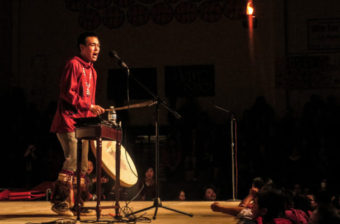
Byron Nicholai sings and drums at the 2016 Cama-i Dance Festival in Bethel. (Photo by Laura Kraegel/KNOM)
Byron Nicholai sings and drums at the 2016 Cama-i Dance Festival in Bethel. “Having that one single rhythm while we are yuraqing and dancing helps in creating these songs,” he said. (Photo by Laura Kraegel/KNOM)

Alaska Native singer-songwriter Byron Nicholai has a new album out. “Ayagnera” was released on March 25. Two days later, it ranked among the top 10 new albums in the worldwide genre on iTunes.

Back in 2016, Nicholai was dubbed “the Justin Bieber of Alaska” a year after he released his first album, “I am Yup’ik.”

Nicholai has since moved to Anchorage from his home in Toksook Bay, a Bering Sea coastal village on Nelson Island. He works with a producer remotely.

“One of the main reasons I moved from Toksook [Bay] to Anchorage is so I could get faster internet,” he said. “I feel like it would mess with my momentum a little bit, ’cause sometimes I’d be excited to work on a track, but then having internet problems would just kind of wash that away.”

""
The cover of “Ayagnera,” Byron Nicholai’s new album.

It took Nicholai more than two years to lay down the 13 new tracks for “Ayagnera.” He recorded it entirely in his Anchorage bedroom. The album has garnered international attention from Rolling Stone India’s website, which recently featured the album alongside four others by young global artists.

The songs are almost entirely in Yugtun, the Indigenous language Nicholai grew up speaking. He also uses traditional Yup’ik music for inspiration.

“I’ve always grown up drumming and dancing,” Nicholai said. “And just the song behind the drum, where it’s just that one singular beat, you can transfer that into a whole different song just as long as you keep that rhythm. And having that one single rhythm while we are yuraqing and dancing helps in creating these songs.”

Music is Nicholai’s way of keeping his Alaska Native language alive, and he said it’s also an experiment in modernizing traditional Yup’ik music and dance. He said that much of the album involves a mix of emotions. He sings about his own struggles, the struggles of others, and about his family. The genres he uses to express his feelings in the songs are just as mixed as his emotions.

“Throughout the time that I was making it, I would record a song depending on how I was feeling at that moment,” Nicholai said. “I’ve got a few rap songs in there, I’ve got a couple R&B songs. I’ve got songs in there that sound like pop, and I’ve got a song in there that sounds like electronic dance music.”

Nicholai will perform for fans in Bethel this weekend.

Alaska’s isolated wetlands could soon lose their protected status

The Yukon Delta National Wildlife Refuge. At least 20% of the refuge is isolated wetlands. (Photo by Olivia Ebertz/KYUK)

Last week, the State of Alaska sent a friend-of-the-court brief weighing in on an important environmental case before the U.S. Supreme Court.

Sackett v. Environmental Protection Agency could determine how much of Alaska’s wetlands are subject to federal regulation under the Clean Water Act. If the ruling goes the way the Dunleavy administration would like, the Environmental Protection Agency will no longer have oversight over pollution and contaminants in Alaska’s isolated wetlands. The State of Alaska will.

Isolated wetlands are wetlands that are not right next to large bodies of water. They cover much of the Yukon-Kuskokwim Delta and other parts of Alaska.

“If you look at the tundra habitat all along the coast and the marshes, there are thousands, and thousands, and thousands of little isolated wetlands,” said Boyd Blihovde, the refuge manager for the Yukon Delta National Wildlife Refuge, which encompasses most of the Y-K region.

Blihovde said that at least 20% of the refuge is isolated wetlands. Under the 1972 Clean Water Act, the EPA has regulated pollutants and toxins in the country’s waters, including these isolated wetlands. What Sackett vs. EPA will decide is if isolated wetlands count as “waters of the United States.”

In a 2006 case, Rapanos v. United States, the Supreme Court decided that all wetlands next to a “navigable” waterway counted as water of the United States and would be protected under the Clean Water Act. The idea was that if pollutants go into the land near a large river, they’ll make their way to the river. What the justices didn’t agree on was what to do about isolated wetlands not close to a navigable waterway.

In general, the EPA has been claiming jurisdiction over isolated wetlands and things like bodies of water that are dry part of the year. The State of Alaska is asking for the court to take a narrower view of the Clean Water Act.

The state’s brief says that leaving the EPA in charge impedes the state’s ability to develop its own resources and build rural infrastructure. It cites the community of Chefornak, which needs a new sewer system. To build one under EPA oversight would cost $8 million.

The state says that it would rather build an “economical lagoon.” Sewage lagoons are among the cheapest available options to treat raw sewage, but they do come with risks. Recently, a sewage lagoon burst open in the Y-K Delta community of Hooper Bay, dumping the entirety of the town’s sewage into protected wetlands.

These isolated wetlands are important stopover points for migratory birds, Blihovde said.

“That’s why the refuge was established because it’s good for waterfowl,” he said.

In the brief, Alaska Attorney General Treg Taylor also asks the Supreme Court to consider exempting frozen permafrost from protection under the Clean Water Act.

Janette Brimmer, a lawyer at the environmental law firm Earthjustice, said that frozen water is still water.

“It’s weird to me that Alaska thinks that permafrost wetlands are somehow different just because it’s frozen,” Brimmer said.

Twenty-six other states, most of them run by Republican governors, are also asking the Supreme Court to end federal Clean Water Act protection of isolated wetlands.

Robert Glennon, a professor of water law and policy, said that there is no way to predict how the Supreme Court will rule.

“Many members of the court are from the eastern part of the United States, a whole bunch from the metropolitan New York area. And they’re just not aware of or sensitive to Western land issues,” Glennon said.

The brief is just part of Gov. Mike Dunleavy’s fight against what he considers to be federal overreach that limits Alaska’s development. He is trying to pass a bill in the Legislature that he says would give Alaska greater control over riverbeds and other submerged lands. He has also proposed that the state take over the water quality permitting process in federal waters. All of these actions could open up the state to more development and less federal oversight over contaminants in public land.

Alaska’s largest April wildfire in 25 years could be done burning

An aerial view of a brown tundra landscape with a large burned area in the middle
The Kwethluk Fire has mostly burned out, leaving charred tundra in its place. (Photo by Matt Snyder/Alaska Division of Forestry)

Alaska’s biggest April wildfire in 25 years might be done burning. Damage to the permafrost from the tundra fire is unlikely, but the local ecosystem could still see signs of disruption.

The Kwethluk Fire began burning on April 16 near the communities of Kwethluk, Bethel and Napakiak. The fire was around 650 acres the first day and grew to more than 10,000 acres over the course of 12 days. Now, the Alaska Division of Forestry says the fire has mostly burned out.

That’s according to the Alaska Division of Forestry. Pilot and firefighter Matt Snyder flew over the fire on April 26 and took infrared video showing it had died down considerably.

“The infrared is showing white hot, and that’s showing the solar radiation in the fire, not actual heat,” said Snyder

The video showed that there was no more smoke emitting from the fire. But Alaska Division of Forestry spokesperson Kale Casey said that doesn’t mean they can consider the fire completely extinguished just yet.

“We don’t want to play the game of calling it out. We know that it’s not moving. We know that it has no heat showing. But just like every other wildfire, is there a tiny bit of heat that might linger a few more days? Sure. Absolutely. That’s why we’re going to end up keeping an eye on it in the next couple of days in monitor status,” said Casey.

Climate specialist Rick Thoman said it’s Alaska’s largest April wildfire in 25 years.

Spring tundra fires in general are common. When the winter snow melts and exposes the brown vegetation on the tundra, that vegetation can quickly dry and ignite, sparking fires that can spread far and wide. But a large tundra fire this early is abnormal, according to Thoman. That’s because normally in April there is more snowpack, which prevents fires from starting or spreading.

Tundra and permafrost scientist J.J. Frost watched the Alaska Division of Forestry’s flyover video. Frost said that he has worked in the Y-K Delta over the years. He said that it is possible to see if there’s damage occurring from flyover video’s like Snyder’s, but he didn’t see any. Frost said that tundra fires are sometimes concerning because they can cause damage to the permafrost, but in the early spring they don’t burn deep enough to melt it.

Frost is concerned about something else, though.

“Lichens are not — they’re not tolerant of fire really at all,” said Frost.

He said that lichens take a long time to grow back, which can be a problem for animals who graze on lichen.

“There’s a potential the Mulchatna [Caribou] Herd might utilize that area. And so if those lichens are gone, that is a habitat impact for caribou in particular,” Frost said.

The Mulchatna Caribou Herd is already threatened. Its population size has dropped dramatically since the mid 1990s, hitting a low point of 12,850 animals in 2021. Hunting for the species has been extremely limited since, and closed entirely last year.

Frost said that early season tundra fires do offer some regeneration for non-lichen plants.

“That burn material is releasing nutrients that are going to be available for plants to take up later on in the summer. And potentially, in essence, fertilize them,” Frost said.

Frost said that we could see a lush tundra bloom in the early summer in the area where the fire burned.

The largest April wildfire in Alaska in a quarter century is burning near Kwethluk

An aerial photo of a large fire burning in brown tundra
The Kwethluk Fire on April 22, 2022, when it was estimated at 9,693 acres. (Alaska Division of Forestry photo)

The largest April wildfire in Alaska in a quarter century is burning near the community of Kwethluk on dry tundra along the lower Kuskokwim River. The fire still is not threatening the community of Kwethluk or any Native allotments.

The Alaska Division of Forestry’s most recent estimate put the fire’s size at 9,693 acres.

The tundra fire is burning 25 miles southeast of Kwethluk, according to satellite imagery collected by the Alaska Division of Forestry on April 21. It’s spreading away from the community across brown tundra to the southwest.

“I do see it. I see smoke. It’s visible at times,” Kwethluk resident Boris Epchook said.

He said that a northerly and easterly wind has mostly kept that smoke away from the community. He could only smell smoke the first day of the fire, April 16. Otherwise, he said that it has not disturbed the village.

“It hasn’t really affected us,” Epchook said.

Climate specialist Rick Thoman said that the fire is the largest April wildfire in Alaska in 25 years. A variety of conditions have converged, making the area dry and ripe to burn.

Less snow than usual fell in the area this winter. It melted early, exposing the tundra. A steady wind has dried the vegetation, and hardly any precipitation has fallen since early March. Thoman said that with no rain and abundant sunshine, the tundra has remained brown and dry.

“It’s not like dry Aprils are unusual; this is the dry season. But typically you would expect there would still be enough snow around that, even if a fire got going, that it would, within yards, run into snow,” Thoman said.

The forestry division expects the fire to continue burning until it runs out of dry brush and grasses for fuel, or until it rains. A tiny bit of rain is forecast for this weekend, according to wunderground.com. Otherwise, there is no rain on the 10-day forecast.

The fire has been burning for at least seven days, since it was first reported to the division on April 16. At the time, they estimated the fire at 650 acres. It’s grown every day since, now reaching approximately 9,693 acres.

Alaska Division of Forestry spokesperson Kale Casey said that the fire is likely human caused. There has not been any recent lightning, and the area is a travel corridor for ATVs and snowmachines. The decision whether to investigate the cause of the fire will be up to the local land managers. In this case, that’s the Yukon Delta National Wildlife Refuge. Casey said that because the fire is burning in a remote area and not threatening people or private property, an investigation is unlikely.

“We’re trying to not just be putting people in harm’s way. Any time you land a resource out in a remote area of Alaska, there’s potential for incidents with aviation having problems, with people themselves having animal encounters. So there’s a big picture here,” Casey said.

The forestry division is not taking any action to suppress the fire at this time. Casey encourages everyone in Alaska to prepare their property for fire season.

Alaska’s first large wildfire of the season is burning near Kwethluk

A large tundra fire, seen from the air
The Kwethluk Fire (40,48 acres) photographed during a flyover on Monday Afternoon, April 18, 2022. (Photo by Matt Snyder/Alaska Division of Forestry)

Alaska’s first large wildfire of the season is burning 25 miles east of Kwethluk. Officials said on Monday that the fire was not threatening villages, but it was threatening the Kwethluk fish weir and two Native allotments.

On Monday evening, April 18, the Alaska Division of Forestry said the fire had grown to 4,048 acres.

According to forestry division spokesperson Kale Casey, it’s the state’s largest wildfire so far this season. The cause is unknown, but Casey said tundra fires in April are not uncommon.

“When you have a long, big, deep winter, like we had in Alaska, areas are dried out and getting these 16 hour days and 17 hour days of sunlight, that you’re gonna have that possibility,” he said.

Casey said that as the spring snow melts, the sun dries out the dead, brown vegetation, turning it into kindling. That kindling can quickly ignite and become a tundra fire.

The Alaska Division of Forestry said it plans to investigate the cause of the fire.

Commercial pilots first spotted smoke from the tundra blaze on April 16 at noon and reported it to the state. A pilot and firefighter from the Alaska Division of Forestry’s fire prevention branch flew over the fire on April 16 and April 17.

Casey said that although the fire is threatening two Native allotments and a fish weir, it is not expected to endanger villages or lives. After hearing reports that the fire was moving westward toward Three Step Mountain, the division flew over the fire again on April 18.

Site notifications
Update notification options
Subscribe to notifications