KYUK is our partner station in Bethel. KTOO collaborates with partners across the state to cover important news and to share stories with our audiences.
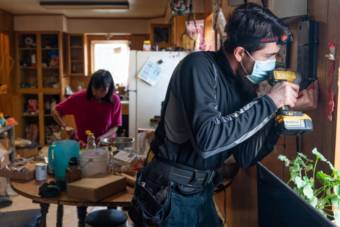
An engineer installs an antenna receiver on October 19, 2021 in a home in Akiak, Alaska. (Katie Basile/KYUK)
On Friday, a bill that would pave the way for improved and equitable high-speed internet in rural Alaska passed out of its final House committee. Next, the bill will head to the House floor for a vote. Its Senate counterpart is still in committee.
Earlier this year, the U.S. passed a federal infrastructure bill that set aside $65 billion for broadband projects in the U.S. It prioritizes unserved and underserved communities. This state bill sets up systems that would make Alaska eligible for that funding.
The representative who wrote the bill, Bryce Edgmon, said that Alaska stands to gain at least $1 billion to $2 billion in federal funding for broadband infrastructure. He said that when you account for broadband dollars headed to tribes, that actual amount will likely be much higher.
Edgmon’s bill does three main things. First, it creates a broadband office. Second, it sets up an advisory board. And third, it sets up a broadband “parity fund” to equalize costs.
The broadband office would be in charge of applying for, receiving and distributing federal dollars. But first, it will have to create a map that shows where Alaskans have limited or no access to high-speed internet.
The advisory board would include nine governor-appointed members. Two of them would have to come from unserved or underserved communities.
The bill also aims to make high-speed internet affordable for all Alaskans. It would set up a broadband parity fund that would keep costs in rural areas similar to the costs in urban areas. Edgmon said that the money for this program would come from the federal government.
This would be a change from how things are now. In rural areas of Alaska, residents with low-speed internet can pay hundreds of dollars per month on their bills. Alaskans in urban areas pay far less for high-speed internet.
The bill also requires that the office be “technologically neutral.” That means they can’t favor one type of internet technology over another, like satellites over fiber-optic cables. As long as the technology is high-speed, it’s good to go.
Two callers from the Yukon-Kuskokwim Delta called in to provide public testimony on the bill: Chief Mike Williams Sr. of Akiak, from the Kuskokwim Tribal Broadband Consortium, and Mark Springer, a consultant for the same organization. Both advocated for the bill.
“We want to allow everyone to have equal access to the funds, especially our tribes,” Williams Sr. said.
Akiak is the first community with high-speed internet in the Yukon-Kuskokwim Delta, having set up satellite internet over the summer.
The House vote for the broadband bill is not yet scheduled.
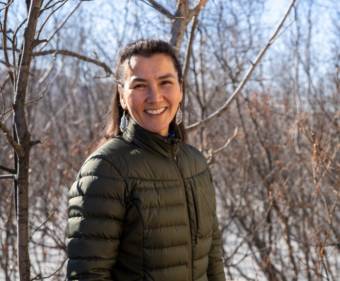
Mary Peltola is one of 48 candidates whose names will appear on the June 11, 2022 primary ballot for a special election to fill Alaska’s only U.S. House seat. Pictured April 1, 2022 in Bethel, Alaska. (Photo by Elyssa Loughlin/KYUK)
Former Rep. Don Young’s death on March 18 triggered the need for a special election to fill the rest of his term.
Peltola, age 48, is running as a Democrat, one of only six in the sprawling field. She identifies as a moderate and has supported Republicans in past elections, including Sen. Lisa Murkowski and the late Rep. Don Young, whose seat she is campaigning to fill.
Peltola says she knew Young from her earliest years. Her parents were friends with him and helped him campaign. She ate Thanksgiving dinner with him in high school. As an adult, she would raise her political concerns with him.
The last time Peltola saw Young was in November 2021 when she was testifying in D.C. on the Magnuson-Stevens Act fishery legislation. She says did not completely agree, but they had a laugh.
“When I went to his office to give him dry fish and visit with him and talk about the legislation, I told him I have often thought about running for his seat,” Peltola said. “We laughed, because I said I would tell everyone, ‘I’m just doing this for name recognition, but vote for Don.’”
That’s a reference to the first time Young ran for the U.S. House with the idea of gaining name recognition for a future run for governor, which never came. He ended up in Congress for the rest of his life.
Peltola has served in public office before. At age 24, she was elected to represent the Bethel region in the state House of Representatives. She served in that seat for a decade, from 1999 until 2009. She and Lisa Murkowski entered the state legislature the same year, and Peltola said that she’s respected Murkowski ever since.
“She really is a national leader, and she is a moderate person who is a free-thinker, and I have tremendous respect for that,” Peltola said.
Peltola praised the times Murkowski has brokered bipartisan support on contentious issues that otherwise would have left the U.S. Senate gridlocked. and she says she would seek to work across the political aisle, too. Peltola says her history in the state Legislature shows she can do that — she chaired the bi-partisan Bush Caucus of rural representatives for eight years.
“I’m very proud of the work that the Bush Caucus did. We coalesced, there were 10 of us out of 40, and we were able to get critical issues addressed for all regions of rural Alaska. And we had incredible cohesion, despite being a bipartisan group,” Peltola said.
After leaving office, Peltola worked for Donlin Creek Mine as manager of community development and sustainability from 2008 to 2014. She served one term on Bethel City Council from 2011 to 2013. Then she worked as a state lobbyist from 2015 to 2017.
For the past five years, she’s led the Kuskokwim River Inter Tribal Fish Commission as its executive director. The group advocates for Kuskokwim River Tribal interests on fishery management and salmon conservation. She says she would seek to advance that work in the U.S. House.
For her campaign, Peltola said that she is still crafting her platform, but she knows that she wants to elevate issues related to Alaska subsistence fishing and food security. She said that she would work to reauthorize and amend the Magnuson-Stevens Act, which governs fishery management in federal waters. The act was last reauthorized in 2007, before the widespread decline in salmon runs across Alaska.
“Clearly, there needs to be changes in terms of exporting the vast majority of seafood from our state when our own Alaska citizens are having severe food insecurity issues,” Peltola said.
Subsistence salmon fishing in the Yukon-Kuskowkim Delta, where Peltola lives, has become increasingly restricted as chinook and chum salmon runs have dropped, cutting off a primary food source for residents.
Peltola wants to amend the Magnuson-Stevens Act to protect subsistence and personal use fishing. She also wants to impose stricter limits on bycatch in trawl fisheries.
The Kuskokwim River Inter-Tribal Fish Commission, which Peltola serves as Executive Director, formed a coalition with 118 tribes across Western Alaska that petitioned the U.S. Department of Commerce to eliminate Chinook salmon bycatch in the Bering Sea and to cap Chum salmon bycatch. The department denied the petition.
Peltola also wants to amend the Magnuson-Stevens Act to make federal fishery managers more responsive to ecosystem changes.
“If you are a person that believes that we are witnessing an ecosystem collapse both in the Bering Sea and our river system, we do feel there is a need for adaptive management and pivoting when we need to pivot,” Peltola said.
Peltola is Yup’ik and one of four Alaska Natives running for the U.S. House seat. The others are Laurel Foster, Cup’ik; Emil Notti, Koyukon Athabascan; and Tara Sweeney, Inupiat. In her interview with KYUK, Peltola did not emphasize her heritage. But she did emphasize multiple times that she is Alaskan — she was born, raised and has lived her adult life in the state.
“I really feel that as an Alaskan, that we need to have representation at all levels, and that’s not to say that you have to be born here to represent anyone. It’s just there are a lot of us who are very sensitive about being a colony and that perpetuating,” Peltola said.
She said that as an Alaskan she’s highly aware of Alaskans’ relationship with the land.
“I feel that for many Alaskans, so many of the places where we hunt and gather are sacred places to us. They are like another entity in our life. They are like another person,” Peltola said.
She said that her strongest tie in this world is to an area of the Kuskokwim River where her grandparents lived. Pelota grew up in the Kuskokwim area communities of Kwethluk, Tuntutuliak, Platinum, and Bethel, where she fished commercially and for subsistence.
Her ties are to the Kuskokwim, but as a statewide candidate, she said that she would work to understand issues across Alaska and to find solutions.
“Each region is so unique, and so many of the issues aren’t necessarily transferable. I’m going to be very interested to learn what the issues are in the other five regions of our state and talk with as many people as I can,” Peltola said.
The special primary election date is June 11. It will be Alaska’s first state-wide by-mail election. Alaskans have until May 12 to register or update their mailing address to receive a ballot. The top four candidates who receive the most votes will appear on the August 16 ballot for the special general election.
Joel Isaak, Tribal Liaison for the Alaska Department of Education and Early Development, testifying on Senate Bill 34 in the Senate Education Committee. (Photo by Olivia Ebertz/KYUK)
On Monday, the Alaska Senate passed its version of a bill that would clear the way for the state and tribes to begin work on education compacting.
In tribal education compacting, tribes can tailor their students’ education to their own needs and hopefully address low rates of graduation and attendance in Alaska Native students. The Senate’s bill has been updated to give tribes more time to plan out pilot projects and will now head to the House.
Senate Bill 34 was originally written to authorize the Alaska Department of Education and Early Development to allow a series of pilot project schools. Under this version, the schools would have opened as soon as the fall of 2023.
The Senate Education Committee substituted it with another bill that gives the state education department and tribes more time to flesh out what the pilot projects will look like.
The bill also establishes a firm deadline for tribes to sign up to be a part of the pilot program. Once the schools and tribes have plans in place, the education department will have to present its final plans to the next Legislature.
Joel Isaak, the department’s tribal liaison, said that this extra time is critical for the tribes to plan the schools they want, and to get legislators on board.
“The immediate effect is the time to scope, the time to come up with a plan, and it brings tribes directly into the process,” said Isaak.
The bill says that five schools will be chosen for the pilot projects and, if all goes well, they could open as soon as fall 2025.
Tribal-education compacting in Alaska is based on the success of tribal-compacted schools in Washington state. According to a study done by Evergreen State University, students at three compacted schools in Washington showed improvement in the following areas: graduation and retention rates; reputation; enrollment; teacher recruitment and retention; and student connection to culture.
The Alaska Senate’s tribal education compacting bill is part of a larger effort this year by the Legislature to tackle poor student outcomes in the state.
This legislative session, House and Senate committees have considered improving student achievement through secondary trade schools, bilingual education and reading standards.
The Senate passed Senate Bill 34 with only one nay vote from Eagle River Sen. Lora Reinbold. Reinbold said that she opposed it on the grounds that she doesn’t understand how tribes get their members.
“The head of AFN tried to define how tribal members are brought into a tribe, and no one could give me clear guidelines,” Reinbold said.“I guess each tribe gets to bring in members how they wish. When they want sovereignty and when they wanna create their own schools, we need to know exactly what the Tribe is, what they stand for, who’s allowed to be in, etcetera.”
Several tribes from the Yukon-Kuskokwim Delta have expressed strong interest in tribal education compacting. Isaak said that list includes, but is not limited to: Hooper Bay; Akiak; Akiachak and Tuluksak. He said the that Association of Village Council Presidents is also interested.
The Senate bill will now head to the Alaska House of Representatives where it will meet up with its House counterpart, House Bill 351. The House version differs from the Senate version, but the two will likely be reconciled in the House.
Both the Alaska Federation of Natives and the Alaska Department of Education support the Senate’s version of the bill.
Napaskiak Dancers at Cama-i Dance on March 27, 2022. (Photo by Katie Basile/KYUK)
For many Yup’ik dance groups in the Yukon-Kuskokwim Delta, the pandemic limited their ability to gather together and perform traditional dance. Some groups are just beginning to dance together again after two years, but the village of Napaskiak remembers a longer period without the drums.
“It’s an old one. It’s about when the birds return, like the Canada goose, the crane, and then the famous crow or the raven,” said Julia Sipary, the leader of the Napaskiak Dance group, describing one of the village’s oldest songs.
It’s one of the few that remain from before the missionaries stopped yuraq in Napaskiak. That was in the 1930s. For 70 years, the drums fell silent.
Sipary was born during that time. She first saw Yup’ik dancing on television while watching a Native arts festival.
“And I wanted to start it too,” Sipary said. “I knew we were missing out.”
Her great-grandfather had been part of the last generation in the village to drum in the 1930s. She wanted to continue that tradition. When she was a young teacher at the Napaskiak school, she got her chance.
It was the year 2000. The principal asked Sipary if she would begin a dance group, but she couldn’t do it on her own. She and a group of others asked the two churches in the community, the Russian Orthodox Church and the Moravian Church, for approval first; they both said yes.
“It was surreal. Like we were able to breathe again,” Sipary said.
Sipary and another teacher, Rachael Nicolai, met with an elder who remembered Napaskiak’s dances. The elder’s name was Emma Clark. However, Clark did not want to be seen dancing.
“Tamani wani record-allraku Emma-m iirluni pilallruuq yugnun tangercecuumiinani aturpallrani wall’u yurallrani, aliingellrullilria-wa wall’u caperrsullruuuq akaarnun Napaskiarmi yuraayuirutellruata,” Sipary said speaking in Yugtun, describing how Clark taught the dances.
“So she requested a closet, and we’d be in the closet, and she would teach and record then,”Sipary said, choking up as she remembered Clark. “But I guess she felt scared or something. She didn’t want people to see her drumming, or singing and dancing.”
In all, Clark passed down six songs and dances to the community. A group from Bethel also came to Napaskiak and helped teach them to dance, sing, and drum again. Many people in Napaskiak were apprehensive about joining in after seven decades without the tradition. But, Sipary said, eventually that apprehension gave way to joy.
“Looking back, the people that were excited about it kind of spread throughout the community,” she said. “If they could do it, ‘Wow, and they’re so happy.’ They saw that, so they wanted to join,” said Sipary.
Napaskiak has been dancing now for over 20 years. Sipary has remained its main singer, drummer, and composer. It’s unusual for a woman to lead Yup’ik drumming. Sipary has also written most of the village’s songs. Many are inspired by watching her children. She’s written songs about hunting, playing basketball, and subsistence projects. One of the group’s favorite songs is about collecting punk fungus from birch trees.
The Napaskiak group consists of around 30 dancers. However, some members did not perform this Cama-i, and instead took advantage of the sunny day to go ice fishing. The group is multigenerational. Most of the members are students at the Napaskiak school where Sipary still works as a Yugtun and English teacher. She says that it’s important to pass the traditions to younger generations.
“If our kids aren’t dancing, if the kids aren’t singing, it will stop,” Sipary said.
Ishmael Hope, left, and other Alaska Native representatives at the 2013 Choose Respect rally in Juneau, Alaska, asking legislators to address issues with the Violence Against Women Act. (Photo by Heather Bryant/KTOO)
A new provision introduced with the reinstated federal Violence Against Women Act allocates funds to empower tribal governments to exercise jurisdiction on tribal land.
On March 15, President Biden signed into law a $1.5 trillion omnibus spending package that included the reauthorization of the Violence Against Women Act. The law makes it clear that Alaska tribes can act to protect women at risk in their communities.
“Alaska tribes deserve the same kind of protections and resources that other communities in Alaska and the lower 48 receive and don’t even think about it,” said Association of Village Council Presidents spokesperson Joy Anderson. “So this is really pretty historic.”
With the strong backing of Alaska Sen. Lisa Murkowski, the reauthorization made it through the Senate long after it was passed by the House. She said that there is plenty of evidence that the current system is not doing the job of protecting rural Alaska women and children.
“One out of five Native young people has suffered from PTSD due to childhood exposure to violence; we know that the status quo is not working,” said Murkowski. “And when one in three Native villages lacks any law enforcement presence, we know that something has to change.”
Nationally, the act would allocate $5 million for the Bureau of Indian Affairs to address missing and murdered Indigenous women. But an additional $3 million was provided for some states, including Alaska, to provide for training and the needs of tribal courts. Alaska will receive the bulk of this funding through the Alaska Tribal Public Safety Empowerment Subtitle.
The provision includes two sections with significant changes to tribal jurisdiction. The first part offers clarification.
“Pprior to VAWA passing, if you had asked, ‘Do Alaska tribes have criminal jurisdiction over Alaska Natives or American Indians within village boundaries?’ you probably would have gotten a variety of answers,” said Anderson of the Association of Village Council Presidents.
Congress has now provided that answer.
“What this part of the bill does is clarify that tribes do have criminal authority over Natives within their village boundaries,” Anderson said. “And that’s not dependent on whether or not there’s Indian Country.”
The bill also establishes a pilot program for tribes to exercise what’s called special domestic violence criminal jurisdiction. This recognizes the authority of tribes to exercise criminal jurisdiction over non-Native people who commit certain crimes against a Native victim on tribal land. These crimes include stalking, domestic violence, and sexual assault.
The tribes now await the details on how to apply, according to Winter Montgomery, Tribal Justice Attorney for the Association of Village Council Presidents.
“We’re in the beginning process,” said Montgomery. “So when the U.S. Attorney gives us the full criteria, we’ll provide that to the tribes.”
But the pilot program does have stipulations.
“The pilot would be for five tribes. And that would include a group of tribes that could apply as a consortium,” said Anderson. “So five would initially be able to begin exercising that special criminal jurisdiction. And then each year, while VAWA is authorized, an additional five could be added each year.”
According to Murkowski’s deputy communications director, Hannah Ray, the U.S. Department of Justice is required to prioritize tribes that occupy villages where the population is predominantly American Indian/Alaska Native and that lack a permanent law enforcement presence. They must also make a determination that the tribe has adequate safeguards in place to protect the rights of defendants.
Hooper Bay’s sewage lagoon was leaking onto the surrounding tundra. (Photo courtesy of Paul Galvez/Lower Yukon School District)
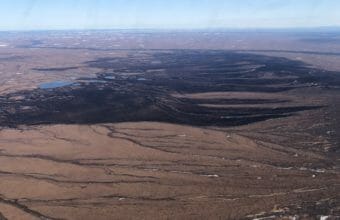
After nearly a month, Hooper Bay’s sewage lagoon has finally stopped leaking out onto the tundra. Hooper Bay City Administrator Sandra Tall-Lake said that by March 21, city workers had put enough sand into the hole in the sewage lagoon to stop the flow of sewage leaking out.
It’s taken so long because the hole is large — 40 feet wide by 15 feet tall — requiring a lot of sand to fill it. Plus, city employees had trouble plowing a path through heavy snow to the beach to get enough sand.
Hooper Bay workers have stopped the flow of sewage onto the surrounding tundra. (Courtesy of Sandra Tall-Lake/City of Hooper Bay)
Hooper Bay residents have also continued to run water and flush their toilets in the last month because, as Tall-Lake pointed out, the community’s pipes would freeze if residents stopped using them.
The sewage has been flowing into a slough, an important subsistence location for the coastal community. But because of that, the city administrator said that the spill on the tundra hasn’t gotten bigger. Tall-Lake said that city workers will continue placing sandbags in the hole this week. It won’t completely fill the hole because the community doesn’t have enough sand.
Hooper Bay’s long-term solution will be to build a new sewage lagoon, which is expected to be completed in around three years. Tall-Lake said that the city did not yet have a plan for what to do with the existing lagoon in the meantime.
Close
Update notification options
Subscribe to notifications
Subscribe
Get notifications about news related to the topics you care about. You can unsubscribe anytime.