KYUK - Bethel

KYUK is our partner station in Bethel. KTOO collaborates with partners across the state to cover important news and to share stories with our audiences.

Western Alaska companies say the region should brace for high fuel prices

""
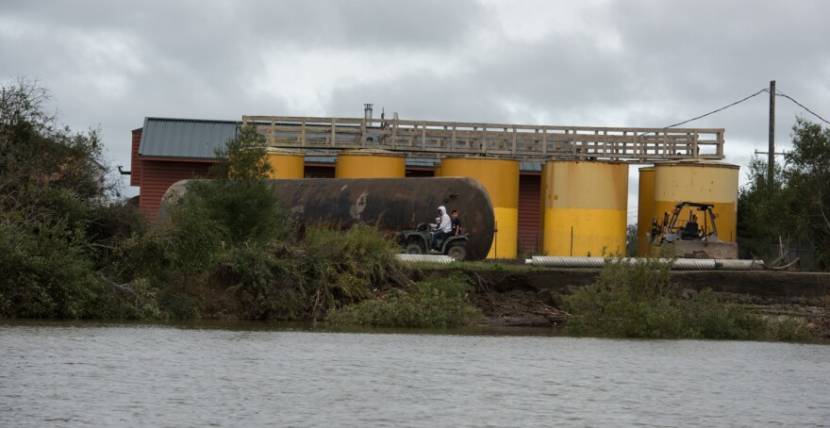
Companies and communities that buy fuel in bulk could be locked into a higher fuel price for the rest of the year. (Photo by Katie Basile/KYUK)

Russia’s war against Ukraine is pushing crude oil prices up. That means residents of Western Alaska bush communities could see an increase in the price of gas, stove and heating oil. And that price may not come down any time soon.

Mike Poston, marketing director of Vitus Energy, which services much of the Yukon-Kuskokwim Delta, said recent events have driven the price of oil up a wall. He said that soon, customers could be paying up to $1.50 more per gallon compared to last year. He also said the price change will be swift.

“Dramatically, in an instant. It’ll be like flicking the light switch after the barge comes in,” Poston said.

Poston said two factors contributing to that hike are the Russian invasion of Ukraine and the recent federal ban of Russian oil sales in the U.S.

Poston says Vitus will purchase fuel for its first fuel barge shipment to Western Alaska soon. And as fuel prices trend upwards, Poston said customers will be locked in at a higher rate. That’s because many local companies buy from Vitus in bulk, so what they pay up front is the price they’re locked into for the rest of the year.

Poston said that communities on the road system won’t see high prices locked in for as long because those communities buy fuel in smaller amounts and more frequently. Instead, he said, road system gas stations experience shifts in prices at the pumps as market trends change.

Vitus customers can expect to see those high prices reflected in stove and heating oil, as well as in gasoline for the rest of the year. Poston said that key companies that Vitus services in the Yukon-Kuskokwim Delta include many Native corporations, tribes, and businesses.

And Poston said the price hikes won’t just be at the pump. Higher fuel prices also mean more expensive barging and shipping.

“It’s not just the fuel you consume. It’s every other good. Western Alaska is gonna see this, these costs impacted,” said Poston

And fuel price hikes could be reflected in energy bills, too. The Bethel operations manager of Alaska Village Electric Cooperative, Lenny Welch, said all AVEC customers will likely see a price increase.

“The way the war and stuff is going, I can’t imagine it not increasing this summer,” Welch said.

Welch said customers will probably see their bills go up starting in September, and that rate will last until they get a new fuel barge next year. Welch said that AVEC buys from Crowley Fuels at a set rate, so as with Vitus, that price will be locked in.

For customers purchasing fuel from Crowley directly, pricing isn’t as clear cut. A spokesperson from Crowley Fuel said that the price of fuel can still fluctuate after the barges come in. He said that Crowley’s prices are tied to several factors, including inflation and COVID-19.

The higher prices will be especially deeply felt for rural residents, who already pay far more for energy, fuel and food. And those who live in areas where the Power Cost Equalization program is applied will still see their energy prices rise.

At a press conference on March 8, Gov. Mike Dunleavy said the permanent fund dividend check was the best way to mitigate against fuel price hikes in rural Alaska. But that check would be the same for rural and urban Alaskans.
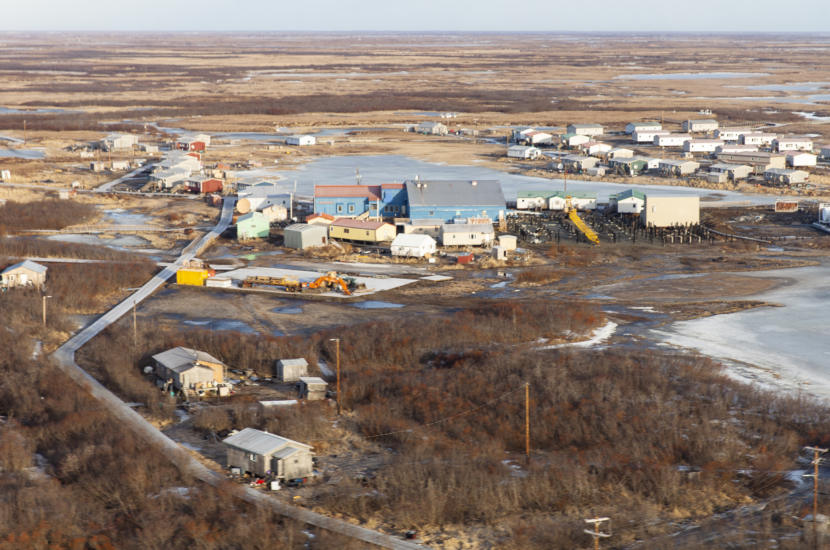
Officials believe Hooper Bay’s sewage lagoon broke open due to cold followed by rain

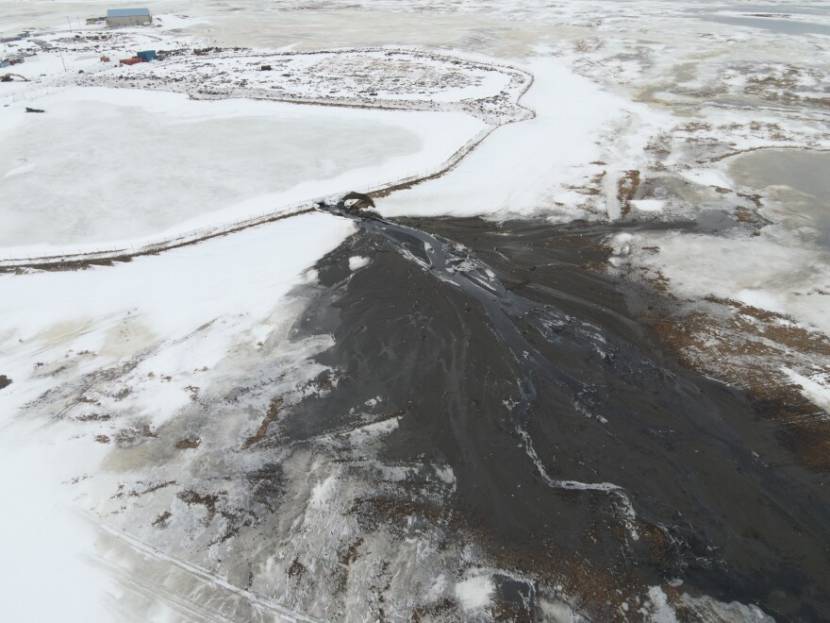
An aerial photo of a brown area downhill of a breach in the wall of an ice-covered lagoon
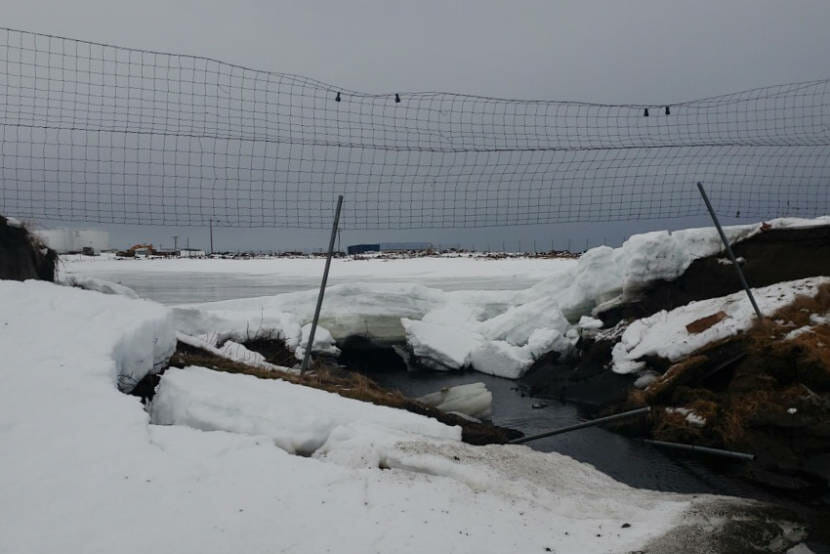
Hooper Bay’s sewage lagoon is leaking onto the surrounding tundra. (Photo courtesy of Paul Galvez/Lower Yukon School District)

Officials say they now better understand how the Hooper Bay sewage lagoon broke open on Feb. 25. The breach seems to have occurred due to an extreme shift in the weather.

A Yukon-Kuskokwim Health Corporation remote maintenance worker was in Hooper Bay this past week to help the community respond to the sewage lagoon break. According to YKHC spokesperson Mary Horgan, the worker said that extreme cold temperatures in February caused a crack in the berm that surrounds and contains the lagoon.

It was a small crack, which the remote maintenance worker said is not unusual to see. What was unusual was the weather that immediately followed the extreme cold.

Just two days after temperatures dipped below -5 degrees Fahrenheit in Hooper Bay, they shot up above freezing, and it started to rain. That caused the water level in the lagoon to rise, and water started to flow through the crack, eroding the lagoon wall.

After several days of rain, the sewage lagoon wall completely broke open.

The Y-K Delta has gotten used to sudden shifts in weather this year. After the second coldest November on record, Bethel saw two weeks of rain in December. Climate change is known to cause extreme weather events, but Alaska climate specialist Rick Thoman said that it does not explain sudden shifts in temperature like the one in Hooper Bay before the sewage lagoon broke open.

“We wouldn’t want to attribute it to a changing climate,” Thoman said.

He said that while climate change explains warmer temperatures overall, there is no evidence that the range between high and low temperatures is growing in Alaska. Instead, he said that these sudden changes in temperature are better understood as random variability in the atmosphere.

The hole in Hooper Bay’s sewage lagoon remains open. As of March 4, the community was still trying to plow through heavy snow to the beach to get sand to fill the hole.

Hooper Bay’s city administrator, Sandra Tall-Lake, said that the nearby village of Scammon Bay was in the process of sending sandbags and transmission oil for heavy equipment.

Federal government to fund relocation projects for 6 Alaska communities

The Lewis Angapak Memorial School stands above other buildings on Wednesday, April 3, 2019, in Tuntutuliak, Alaska. (Photo by Rashah McChesney/Alaska’s Energy Desk)

The federal government will fund relocation efforts for six Alaska communities threatened by erosion and flooding. Most are in the Yukon-Kuskowkim Delta, where erosion and flooding are pervasive problems. The projects will play out over time, and other threatened communities can still apply for funding.

The U.S. Department of Agriculture announced on March 4 that it will pay for Alaska communities to relocate buildings and infrastructure. The communities with projects that have already been funded include Kotlik, Alakanuk, Kwigillingok, Golovin, Tuntutuliak, and Tununak.

What do they have in common? They’re all threatened by erosion and flooding — problems made worse by climate change.

“We are very excited,” said Brett Nelson, a conservation engineer for the USDA.

His team has worked to provide flood and erosion mitigation around rural Alaska for years. He knows the communities and their needs.

Nelson said that this type of federal funding is a big deal because it’s a first. Usually the federal government only funds his department to relocate buildings when there’s an emergency, like when a home or building is about to fall into a river.

But this funding will be preventative so that communities can begin their relocation efforts before it’s too late.

“This was a new thing for up here,” said Nelson.

Nelson said that the entire process will take about five years. It involves multiple stages of planning before they can move into actual construction and relocation. But he said that if any one building in those communities becomes urgently threatened, they can speed up the process for those structures.

The application is still open for villages. Any village with an erosion, flooding, or permafrost issue is eligible to receive funding. Nelson can be reached at 907-761-7717 or Brett.Nelson@usda.gov.

Education committee considers bill banning transgender girls from female sports in Alaska

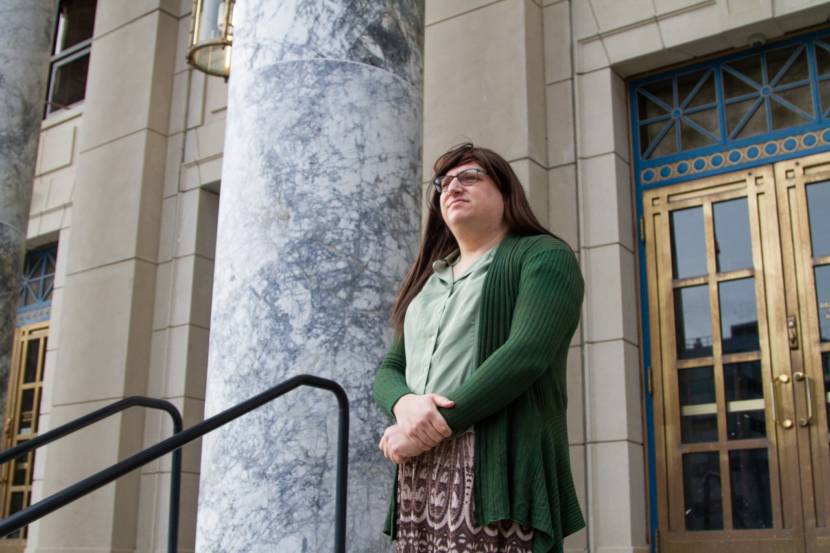
Emily Mesch stands outside of the Alaska State Capitol. Mesch chairs Southeast Alaska’s gay, lesbian, bisexual, transgender and queer alliance, called SEAGLA. She is against a bill Republican Alaska Sen. Shelley Hughes that would prevent transgender female athletes from competing in school sports against other female athletes. (Photo by Olivia Ebertz/KYUK)

A state senator has proposed legislation that would prevent transgender female athletes from competing against other female athletes in school sports. Supporters of the bill say they’re trying to protect girls’ sports. But others say it unfairly penalizes transgender female athletes and could have drastic consequences for their mental health. 

Republican Sen. Shelley Hughes is the leader of the Senate majority. Her new bill had its first hearing in front of a Senate Education Committee in early March. 

Hughes told that committee that trans female athletes are bigger and stronger than cisgender females.

A cisgender person identifies with the gender they were assigned at birth. A trans person does not. Hughes says trans female athletes have an unfair advantage. 

“Girls and women should not be robbed of the chance to be selected for a team to win a championship or to be awarded a college scholarship,” Hughes said. 

The person who oversees high school sports competitions in Alaska says the idea that someone will be robbed of a scholarship by a trans athlete isn’t accurate. 

“This is a solution looking for a problem,” Billy Strickland said.

Strickland spent most of his career at the Lower Kuskokwim School district. He lives in Anchorage now, where he’s the executive director of the Alaska School Activities Association. He says he only knows of one trans female athlete in all of Alaska’s history and she’s already graduated. 

He says she came in second in one big track and field race and third in another. But her success didn’t prevent any other athletes from getting scholarships or making it onto a college team. 

“Your numbers are your numbers. You’re not recruited because you’re a state champion in Alaska, you’re recruited because you run a 10 second 100-meter dash,” Strickland said.

But Sen. Hughes says that just because a trans female athlete hasn’t beaten out a cis female for a scholarship yet doesn’t mean it won’t happen. She says her bill protects against that possibility.

Trans woman Emily Mesch says that school sports should be about education and inclusion. 

“When you’re not allowed to socialize with the group of people that you think you belong to, that hinders your development, that hinders your ability to be a part of society,” Mesch said. 

Mesch chairs Southeast Alaska’s gay, lesbian, bisexual, transgender and queer alliance, called SEAGLA.

She’s also a member of the Juneau Human Rights Commission. She’s against Hughes’ bill. One reason is that it’s not clear how it would be enforced or how an athlete’s birth-assigned gender would be determined. The thought leaves Mesch uncomfortable. 

“I don’t even want to list the possibilities of how you would check that, like, it’s not a comfortable thing,” Mesch said.

Sen. Tom Begich had a similar view.

“You’d have to examine them, you might be able to test for chromosomes, you might be able to do that. But listen to what I’m saying. These are all extraordinarily invasive things,” Begich said.

Begich is a Democrat, he sits on the education committee with Hughes. He said he doesn’t support the bill and questions whether it’s constitutional. 

Hughes agreed that, as written, the bill leaves its enforcement open to interpretation by the state’s Department of Education. But she said the committee could choose to amend it to be more specific about enforcement. This bill looks similar to an Idaho law that was passed but didn’t go into effect. A federal judge considering the bill has said it’s likely unconstitutional.

Begich points out that transgender kids have a higher rate of suicide than cisgender kids. And this type of legislation would hurt them more.

Hughes says that hurting trans kids is not her intention. She says she wants to provide them with essentially a separate but equal playing field.

“I am not transphobic. I love people, no matter what their choice, as far as their identity, I have value for them,” Hughes said.

But Emily Mesch says that Hughes’ actions speak differently than her words.

“Sen. Hughes might believe that she’s not transphobic but her actions are transphobic in the extreme, so that makes her transphobic,” Mesch said. 

For his part, ASAA Executive Director Billy Strickland said he prefers ASAA’s policy to this bill. That policy allows individual schools to determine an athlete’s gender. Under this policy, girls must play against girls’ teams and boys’ and co-ed teams must play against boys’ teams.

Strickland says this bill was written without input from the Alaska School Activities Association.

The Senate committee considering the bill will hear public testimony on Senate Bill 140 on Saturday, March 12.

Senators hope new bill can keep public safety officers in rural Alaska

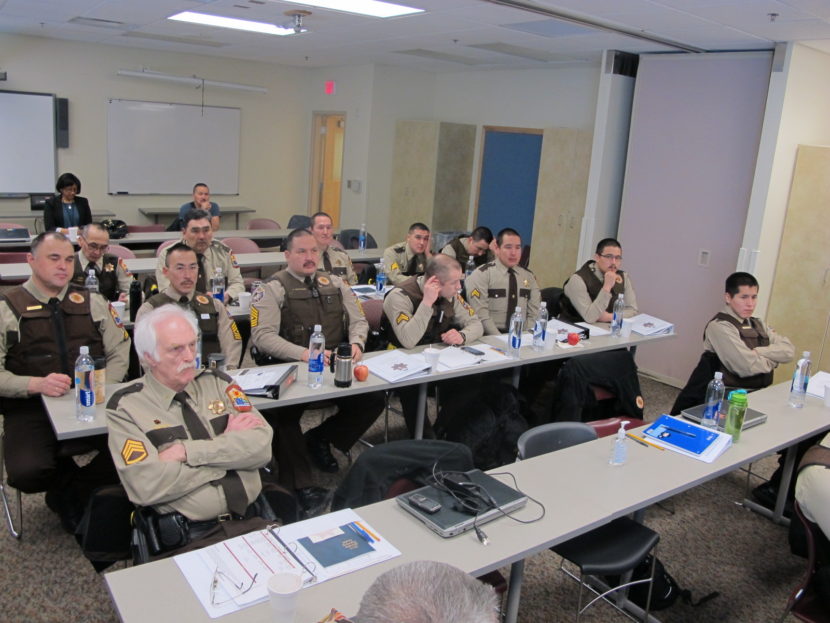
YK Delta VPSOs spoke with DPS officials about the process of arming VPSOs during training in Bethel. (Photo by Ben Matheson / KYUK)
Village public safety officers in Yukon-Delta Kuskokwim during training in Bethel in 2015. At the peak of the VPSO program, there were 113 officers. Now there are 51, according to the program director. (Photo by Ben Matheson/KYUK)

A new public safety bill is making its way through the Alaska Legislature. The bill’s authors want to improve village public safety officer retention in Alaska.

The Alaska VPSO Program was created to help tribal communities hire local public safety officers. VPSOs are more highly trained than tribal police officers or village police officers. They require background checks and training on par with Alaska State Troopers.

But the program has been on the decline. In the Yukon-Kuskokwim Delta alone, the program has shrunk by about 90%. 

According to Joel Hard, the director of the state’s VPSO program, there were once over 30 VPSOs in the region. Now there are four. This creates a big public safety gap in the region. Only eight villages have either a VPSO or Alaska State Trooper post. Hard said that the problem with the program isn’t with hiring new officers, it’s with retaining them. The program has not only shrunk in the Y-K Delta but statewide.

“At the peak of the program, we had 113 officers. And today, we have 51,” Hard said.

That peak was in 2014. The new bill was created to help reverse those numbers. It’s currently in the Senate Finance Committee.

The committee members have two ideas why the retention is so poor: the pay is too low and the working conditions are tough.

“We all recognize that when you’re an officer in a small community or village, it’s a very difficult job. It’s your friends, your relatives, your neighbors, you know, the people that you have to go knock on the door and deal with it personally,” said committee co-chair Sen. Bert Stedman from Sitka.

Village public safety officers are hired by regional tribal nonprofits but paid for by the state. In the Y-K Delta, that nonprofit is the Association of Village Council Presidents.

Another committee member, Bethel Sen. Lyman Hoffman, added that the way the state’s funding rules are now, the tribal nonprofits don’t have enough leeway to improve the working conditions for their VPSOs.

“That doesn’t give the grantees the flexibility to increase salaries or to provide housing,” Hoffman said.

This bill would grant that flexibility. It would allow the regional tribal nonprofits, which manage the VPSO programs, more space to spend their funds as they see fit. They would be able to increase the starting salary for an officer if they wanted, have more than one officer per village, and hire roving officers who could travel between villages.

Former VPSO Ben Beaver Sr. worked in Atmautluak, Akiak, Napakiak and St. Mary’s. He said that it’s helpful for crime prevention when a community has a locally hired VPSO.

“They know more about culture — our culture,” Beaver Sr said.

Beaver Sr. said that when he made an arrest, he would often sit the person down and talk to them about why what they did was wrong. He said that’s a crucial part of Yup’ik culture and can help prevent crime in the future.

The bill does not fund new VPSO positions. But if the governor’s proposed budget passes as is, the state would fund 10 more VPSO positions. And according to an AVCP spokesperson, the state promised to fund all the positions that AVCP can fill.

There is a mirror version of the Senate’s VPSO bill that is currently in the House Committee for Tribal Affairs. The bill must make it out of committee before it can be voted on in the House and Senate floors.

Editor’s note: A previous version of this article included a photo of village police officers, not village public safety officers. Village police officers are not as highly trained as village public safety officers.

Hooper Bay’s sewage lagoon has failed, spilling onto an area vital to local subsistence

Water flowing from a breach in an ice-covered sewage lagoon
A leak in the Hooper Bay sewer lagoon caused it to spill out onto the surrounding land on Feb. 25, 2022. (Photo courtesy of Sandra Tall-Lake/City of Hooper Bay)

The sewage lagoon in Hooper Bay began leaking early on the morning of Feb. 25. By the afternoon, the entirety of the community’s sewage had poured onto the surrounding tundra, threatening an important subsistence location for the coastal village. Community leaders are worried it could spread further and are calling upon the state for help.

The spill followed a sudden rise in warm temperatures in recent days. Hooper Bay Mayor Sandra Hill said the thaw and rain had melted the previously frozen land surrounding the sewage lagoon, causing a wall of the lagoon to cave.

Hill said that the sewage spill is around 500 feet north of the nearest resident’s home, in an area that is a vital source of subsistence foods for Hooper Bay’s approximately 1,100 residents.

“North of the village sits a slough where we usually fish. We go and gather greens from north of the village back there,” Hill said. “I’m worried about food security for our village.”

City employees were busy on Feb. 26 plowing the roads leading to the sewage lagoon to allow heavy machinery to reach the spill. But Hill said the city is unsure how it will fix the lagoon or clean up the spill once the machinery gets there.

“We are not engineers. We need engineers to help us,” Hill said.

The day of the spill, the City of Hooper Bay declared a state of emergency and reached out to the Alaska State Emergency Operations Center for assistance.

The following day, Gov. Mike Dunleavy issued a state disaster declaration for the village of Hooper Bay, which Alaska Division of Homeland Security and Emergency Management spokesperson Jeremy Zidek said would allow Hooper Bay to get reimbursed for their response efforts.

Zidek said that the Yukon-Kuskokwim Health Corporation would be working with the community to fix the broken walls of the lagoon. He said cleaning up the spill could take months, and that Hooper Bay will have to try to deal with the situation locally before the community can turn to the state for help.

But Hill said it was already clear that Hooper Bay would not be able to clean up the spill on its own. And she was worried it could spread quickly with temperatures above freezing this week.

In addition to cleaning up the spill, Hooper Bay will also need to stop it from getting bigger. As of Feb. 26, Hill said that the breach in the sewage lagoon had not been fixed, and any resident that flushed their toilet or ran their faucet would likely add to the spill on the tundra.

Hill said half of Hooper Bay is connected to piped water and sewer, and she said that city officials are considering asking those residents to stop running their water and switch to using honey buckets until the breach in the lagoon is contained.

This is the second disaster declaration the governor has issued this month to aid a Yukon-Kuskokwim Delta community. In mid-February, the governor issued a disaster declaration to make state funding available to help the coastal community of Tununak after its washateria burned down.

Site notifications
Update notification options
Subscribe to notifications