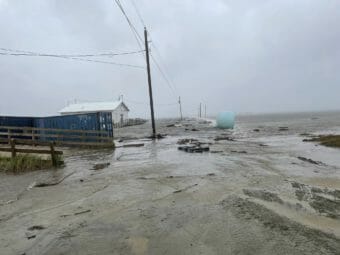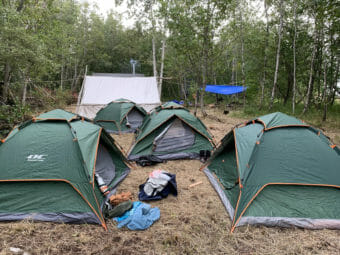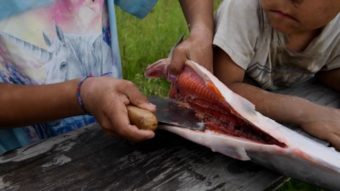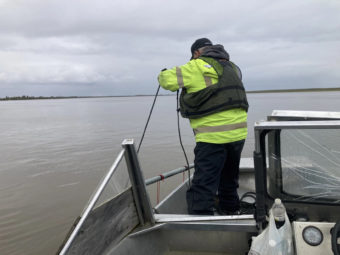
For the second year in a row, a severe and sudden salmon collapse has affected Indigenous residents on the Yukon River. Subsistence fishing for the two main salmon species, king and chum, has been closed for two summers due to record low runs. Residents of traditional villages are now facing food insecurity because of the collapse. Now, the Indigenous communities on the river whose ways of life have revolved around the fish for thousands of years are also facing a devastating loss of culture. Olivia Ebertz reports from the Lower Yukon.
KYUK - Bethel
KYUK is our partner station in Bethel. KTOO collaborates with partners across the state to cover important news and to share stories with our audiences.
Search for moose hunters missing near Bethel is a test of hope and endurance

Bethel Search and Rescue is still searching for a group of moose hunters missing for a week and a half near Bethel — and for another hunter missing for over a week near Kalskag.
On day eight of the search, about a dozen volunteers headed toward their boats after a morning briefing. It was raining, as it has been for much of the time since Justin Crow, Shane McIntyre, and Carl Flynn went missing. Mike Riley, the longtime president of BSAR, drove toward the harbor.
“It being so close to home with three people involved, it’s hard,” Riley said. “We know that is someone’s loved one out there. People depend on you to look for them and bring them home for closure.”
At the harbor, Riley checked his gear. BSAR has been working under the assumption that the boat sank in rough waters after the men dropped off equipment at their hunting camp upriver.
After leaving the harbor, Riley headed toward Straight Slough. Six boats were there, searching for the missing hunters. Riley pulled up beside one.
“I’m sorry it took so long to come out here, but I was told something that I think will enlighten us,” Riley said.
Riley said he got a tip that two people were coming home to Bethel the day after the hunters were reported missing. Apparently they saw an aluminum pole bobbing upright in the water about 20 feet from shore, a few hundred yards upriver of Straight Slough. They had to swerve to avoid it. Riley thought it could be a clue.
“So that’s that side of the river, coming up,” Riley said. “That side of the river has never really been dragged.”
After hours of scanning sonar and dragging lines, hoping to catch something, even just this little piece of information seemed like a burst of energy.
Searching the river is a test of endurance. A few of the boats scan the search area with sonar, slowly making a grid of each section of the river. The rest use drag bars, which are long ropes attached to a metal bar. Each of the lines have a weighted hook at the end. The idea is that if there’s something underwater, the hooks will catch on it. Hope, Riley said, is the name of the game.
He dragged the bottom of a 100-yard portion of the river. The tide was slack, so he kept one hand on the rope and the other on the steering wheel. Nothing. He tried again. Nothing. It started to rain. Riley tried again.
“The majority of the people that are out here have been out here since day one,” Riley said. “It’s a lot of stress and frustration, you know. We’re working in the dark.”
So far, the main clues BSAR have are debris from the missing boat that turned up near the head of Straight Slough, but there’s still so much river to cover. BSAR has never given up on a search, and there are no plans for them to give up on this one.
“That was the question: how long are you going to search,” Riley said. “As long as someone is willing to come out here, we’re going to continue.”
Climate change has made fuel safety inspections in the Y-K Delta more important than ever

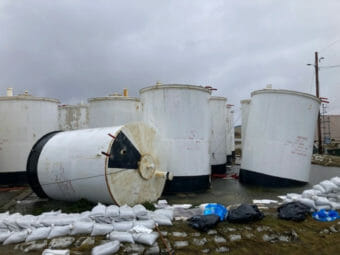
The U.S. Coast Guard recently completed a series of fuel tank safety inspections in communities across the Yukon-Kuskokwim Delta. In the face of climate change, these checks are becoming all the more important as the land beneath the tanks melts.
The goal of the fuel inspections is simple: prevent a catastrophic oil spill that would make its way into Y-K Delta rivers, devastate the ecosystem and threaten a subsistence lifestyle.
In large part, villages were found to be following best practices to prevent oil spills. Most of the issues that the inspectors identified were administrative, like having a written plan for how to respond to a potential oil spill.
“Staying in compliance with things like paperwork may seem extremely tedious, and it is, but it’s really not about the paperwork,” said Petty Officer 1st Class Nate Littlejohn, who works with the Coast Guard’s Anchorage sector. “It’s about getting together and talking about how you would respond to a spill with your community.”
The coast guard conducts semi-annual checks of bulk fuel facilities in Bethel and surrounding communities. In their most recent deployment during the last week of August, Coast Guard and EPA inspectors visited two dozen communities.
The investigators check to make sure that fuel storage facilities have the right containment measures in place, that there’s a system to respond to a spill, and that communities have appropriate equipment to do so. These failsafes are becoming increasingly important as the land that fuel tanks sit on becomes more unstable.
Climate change is creating a series of long term problems that threaten the security of fuel tanks and could cause spills down the line. As the region warms and permafrost begins to melt, the foundations upon which many of these fuel storage tanks sit have begun to slowly sink. According to Littlejohn, in some cases they are already seeing fuel tanks sitting at an angle because of permafrost thaw.
“The aging infrastructure combined with a changing climate is continuing to be a problem,” Littlejohn said. “And we’re absolutely going to see more spills if a solution isn’t provided.”
As the foundations of these storage facilities shift, Littlejohn said that it’s all the more important for communities to inspect them regularly, work to keep them level, and develop design adaptations that take climate change and permafrost thaw into account.
The region is not equipped to handle a catastrophic spill. If that were to happen, it wouldn’t just take an environmental toll. It would also immediately put human lives at risk.
“If thousands of gallons of heating oil are lost in the dead of winter, we have to come up with a solution for how that heating oil is going to be replaced,” Littlejohn said. “How are these folks going to heat their homes? That’s a big concern.”
The Coast Guard intends to return for another round of inspections next year.
Aniak Traditional Council rescinds its support for the Donlin Gold mine

The Aniak Traditional Council unanimously voted to rescind its support for the proposed Donlin Gold mine over concerns about increased barge traffic on the Kuskokwim River. The tribe’s withdrawal removes a longtime pillar of support for the project. The mine’s landowners say they see the repeal as an opportunity to better understand and address community concerns.
The council’s repeal vote on Aug. 30 revokes its 2016 resolution to support the mine. But council Chief Wayne Morgan said that the body had unofficially supported the project for over a decade before that, since 1995. It wanted the potential jobs and economic benefits that the mine could bring. Now, Morgan says, that desire is overridden by concerns over the mine’s barge traffic.
“I really believe our river, Kuskokwim River, it’s a scenic river. It’s a wild river. And with the increased traffic on the river, I’d call it industrializing the river, it’s going to take away the wild and scenic part of that,” Morgan said.
Aniak is the largest community in the middle Kuskokwim. The town of about 500 people sits about 70 miles downstream from the proposed mine. To operate, Donlin would need a steady stream of materials, equipment, supplies, and diesel fuel.
From early June to early October, when the river is ice-free, much of those resources would arrive by barge, traveling 190 miles of river. Donlin plans to send one to two barges per day along the Kuskokwim River between Bethel and the mine, increasing summer barge trips by almost 200%. The traffic would last the length of the mine’s lifespan, projected at about 30 years, but it could run longer if more gold is found and as mining technology advances.
For Morgan, age 57, that’s longer than he expects to be alive.
“That’s too much to give and sacrifice on our end,” Morgan said.
Morgan predicts that the barge traffic will disrupt subsistence activities, jeopardizing people’s abilities to feed their families. For example, it’s currently moose hunting season, and Morgan said that the barge traffic could spook off moose before hunters can see them. Fishing is also a concern. The river narrows upstream, and to catch salmon, most people use gillnets stretched across the water.
“We’d have to wait until a barge passes and then try and fish. It’s going to put a burden on fishermen trying to get their subsistence foods in a limited amount of time,” Morgan said.
Also, he said, the wake caused by barges makes the river more difficult and more dangerous to navigate in small skiffs. Another concern for Morgan is any contamination the barges could cause if an accident, like a fuel spill, occurs. If the mine begins operations, he expects the barges to become many people’s main experience of it.
“Some people will never get to see the mine, but they’ll see it every day for 30 plus years on the river with the barges,” Morgan said.
The mine would be built on Native corporation land. The Kuskokwim Corporation owns the surface rights. Aniak is one of 10 middle and upper Kuskokwim River village corporations that compose The Kuskokwim Corporation and the first to take this type of action. The Kuskokwim Corporation President and CEO Andrea Gusty is an Aniak tribal member and said that she welcomes her tribal council’s concerns.
“It’s concerns that make the project better. It’s being skeptical, and diving into the details, and doing due diligence, and doing research,” Gusty said. “I mean, there’s a reason that development like this takes years and years and decades and decades.”
Calista Corporation is the other land owner. It owns the sub-surface rights. Vice President of Corporate Affairs Thom Leonard also framed Aniak’s concerns as a positive.
“If everyone was in support of the project, then I would be more worried, because then we wouldn’t be getting the feedback we need to make improvements and support our people,” he said.
Donlin External Affairs Manager Kristina Woolston pointed out how Donlin has adapted to address concerns about barge traffic in the past.
When an Aniak resident shared concerns over the traffic impacting smelt, Donlin began researching the fish and its habitat. When residents shared concerns over the number of daily barges transporting diesel fuel, Donlin proposed a plan to reduce the number by constructing an over 300-mile natural gas pipeline from Cook Inlet to the mine. Also, Donlin formed a Subsistence Community Advisory Committee and is accepting applications for the group.
Woolston sees Aniak’s repeal as another way the mining project can adapt while continuing to move forward.
“We appreciate the feedback, and we feel this is an ongoing opportunity to continue our robust discussion with the community of Aniak and its leaders, and throughout the region,” she said.
Though the Aniak Traditional Council rescinded its support for the Donlin Gold mine, it did not vote to oppose it. Fourteen tribes in the Yukon-Kuskokwim Delta have issued resolutions of opposition, along with tribal organizations that include the Yukon-Kuskokwim Health Corporation, the Association of Village Council Presidents, and the National Congress of American Indians.
Mother Kuskokwim Tribal Coalition is a new organization that formed this summer to advance tribal opposition to Donlin. When Director Sophie Swope heard that the project landowners were characterizing Aniak’s repeal as an opportunity to address concerns, she pushed back on that framing.
“Them talking about how it’s going to bring more robust and clear conversations, I don’t believe that is what it will bring. I just think it makes it more clear that they do not have the social license,” Swope said.
Morgan said that he could not predict if the Aniak Traditional Council would again support the mining project if it reduced its projected barge traffic.
Mary Peltola talks salmon, bipartisanship and winning US House race

Former Bethel legislator Mary Peltola has won election to the U.S. House of Representatives to fill the remainder of Don Young’s term. Peltola, who is Yup’ik, will be the first Alaska Native person to serve in Congress and the first woman to serve as Alaska’s U.S. Representative. Peltola, a Democrat, beat Republican Sarah Palin by three percentage points to win the seat. KYUK’s Nina Kravinsky spoke with Peltola by phone shortly after the election results were announced on Aug. 31.
Listen:
This interview and transcript have been edited for length and clarity.
Peltola: He [Don Young] has a tremendous legacy. And it will be a real challenge to fill his shoes. And I don’t think anybody really could ever fill his shoes, but I’m going to try my hardest. And we have seen that his office has been closed for a number of months, and we want to open back up the congressional office in Alaska and make sure that constituent services are being addressed.
Kravinsky: You received really huge support from communities in this region: over 68% of votes from the Bethel House District 38. In Kwethluk you received 93% of votes. What does it mean to you to get that amount of support from your home?
Peltola: Well, it means the world to me to have the support of my friends, and family and neighbors. They’re the people who know me best. They know my work ethic, they know my commitment to really serve all people. And honestly, the support that I got from the community of Kwethluk is just very heartwarming, and it just means the world to me.
Kravinsky: There are a lot of headlines, I’m sure you’ve been seeing them, announcing your win as the first Alaska Native elected to Congress and the first woman elected as Alaska’s sole U.S. representative. What do those firsts mean to you?
Peltola: Well, it’s a lot, it’s a lot to take in. And I just really want to reiterate that I want to follow in Don Young’s footsteps of representing all Alaskans, regardless of ethnicity. I am Yup’ik. I’m very proud to be Yup’ik. But I’m a lot more than just my ethnicity. And I want to really share the values of our region, working together and working collaboratively and holding each other up, I want to hopefully, really bring those values to Washington, D.C.
Kravinsky: I want to talk about fishing now. Supporting subsistence fishing is a huge part of your campaign. You were in Bethel this past weekend. The river is closed to coho salmon fishing for the first time ever. What was that like for you?
Peltola: Well, food security and the issues that we’re facing in western Alaska certainly was the the leading reason that I wanted to run for this seat. To really elevate those issues and talk about the need for precautionary management and talking about the need for good management of our marine ecosystem. And really the dependence that we have across Alaska on wild foods for our food security, and it was heartbreaking. And it’s demoralizing to see the runs, the salmon runs, the depressed salmon stocks that we’ve been experiencing the last 13 years. And it’s of great concern to me that now silvers are being restricted. This is the third species that we have had very severe restrictions put upon us. And I do think that it is time that the burden of conservation be extended to people far beyond our river systems.
The burden of conservation needs to be shared in a much more equal fashion. And especially that burden needs to be shared with people who just have an economic interest in our salmon and in our marine resources. So that is an issue that’s very close to my heart. Salmon and our dependence on salmon is a relationship that we’ve had for 12,000 years on the Kuskokwim River, and it’s one that we do not want to lose. It really is our tie to the people who came before us, and it’s really incumbent upon us to make sure that that resource is available for the generations that come after us.
Kravinsky: You’ll be Alaska’s first congressional Democrat since 2014. How do you hope a bipartisan congressional delegation could benefit Alaska?
Peltola: I think that it’s very important that Alaska have a bipartisan delegation. Alaskans run the spectrum on the political front. I mean, we’ve got a lot of nonpartisan, independent and Democratic folks in Alaska, and libertarians, and everybody needs representation in Alaska. And I’m very happy to see a bipartisan delegation. And I don’t think of that in any way as a handicap. I think it’s a tremendous asset. And I have very good working relationships with both Sen. Murkowski and Sen. Sullivan, and I’m really looking forward to working with them and partnering with them to accomplish a lot of things Alaska needs accomplished.
Kravinsky: I’m curious, what happens next when you head to D.C.?
Peltola: I cannot answer that right now. I’ve really been trying to keep one foot in front of the other and take each day one at a time. I didn’t want to get ahead of myself. I’m a pretty superstitious person, and I did not want to jinx anything by having, you know, an idea of what was going to happen. This thing really could have gone either way. And so I’ll be learning right along with a lot of other Alaskans what the next steps will be.
Kravinsky: Anything else that you want to add? Anything you want to tell the hometown KYUK listeners?
Peltola: Well, I’m just really thankful to my mom, I’m thankful to my mom’s husband, Pete Williams. I’m grateful to my kids, and my family, and my husband, and Gene Peltola Sr., and Irma Peltola, Ana Hoffman, you know, I could just go on and on. I’m very, very grateful to all of my family and friends and neighbors and a shout out to my Kwethluk relatives, and I’m just looking forward to continuing on the campaign trail. This is a victory for the short seat, but we all have the long seat in our sights and we’re looking at November and wanting to build on the momentum that we’ve gained, and just looking forward to continuing to reach out to Alaskans.
A landing craft sank near Napakiak. The barge sent to recover it sank, too

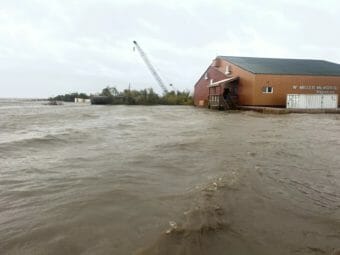
A small ship graveyard is forming on the Kuskokwim River outside Napakiak.
During the last week of July, a landing craft sank while carrying construction equipment to Napakiak for work on the high school.
Bethel-based contracting company Jobs Done Right, which was operating the landing craft, then brought in a Homer-based Kachemak Marine to help salvage it. They sent a 20-by-45-foot barge upriver to serve as a work platform for salvage divers, who planned to attach lift bags to float the sunken landing craft.
The barge sank, too.
Earl Brock, Kachemak Marine’s salvage master, says no one saw either vessel sink. He blames last week’s storm.
“I am sure that between the high waves, the high wind, and all the other things that could possibly go wrong, Murphy showed up and that was the end of it,” Brock said. “It sank that barge.”
Brock says it’s likely no one will ever know why the landing craft sank.
“I’m going to tell you that if you talk to 15 different people in the community, you’ll get 15 different answers,” Brock said. “What I’ll also tell you is that nobody has a smoking-gun, rock-solid explanation of why the landing craft sank.”
According to Brock, no one was on either vessel when it sank, and both have been secured to land and aren’t blocking river traffic. He says no fuel is leaking.
“We don’t see any environmental threat,” Brock said. “There is a very small amount of fuel that was released when the vessels went down, possibly less than a gallon, but a gallon looks like a lot of fuel.”
If there is oil in the water, the U.S. Coast Guard said that it would be Jobs Done Right and Katchemak Marine’s responsibility to clean it up.
Kevin Williams, a marine casualty investigator with the Coast Guard’s Anchorage sector, says there’s a lot they don’t know about the landing craft.
“We don’t know if the tanks were full or half empty, or if there was oil in the bilges in the engine room, ” Williams said. “The vessel name that was given to us is not even in our database.”
Brock, the salvage master, gave no timeline for recovery of the two vessels but said they’re constructing rigging to refloat the two boats. He doesn’t expect either to be damaged.
“We’re still in the middle of sourcing the equipment we need, but the short version is, we’re going to lift them up, refloat them, and take them and deal with them once they’re refloated,” Brock said.
Hale, the owner of Jobs Done Right, says the sinkings have not slowed the timeline of the school construction.
According to Sally Benedict, the site administrator for Napakiak’s schools, construction was supposed to be completed on Aug. 21. The school is still waiting to be hooked up to water and heat before they bring students back into the building.