KYUK - Bethel

KYUK is our partner station in Bethel. KTOO collaborates with partners across the state to cover important news and to share stories with our audiences.
US Department of the Interior puts $40M toward community relocation efforts for Newtok and Napakiak

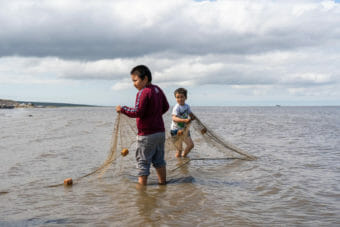
Drake Charles and Jeffrey Charles Jr. catch fish along the banks of Baird Inlet on July 20, 2020 in Mertarvik, Alaska. Residents of Newtok are slowly relocating to Mertarvik and will receive $25 million from the Interior Department toward that effort. (Katie Basile/KYUK)

The U.S Department of the Interior is putting $75 million toward community relocation efforts for three U.S. tribes struggling with the consequences of a changing climate.

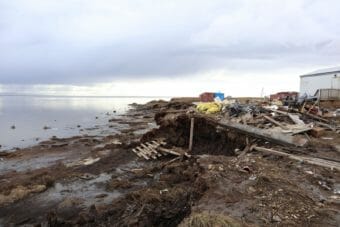
Among the recipients is Newtok, where the Ninglick River has edged closer and closer to the community’s school as the frozen ground under the community melts away. Most of Newtok’s infrastructure is sinking. The story has garnered national attention for years.

About 150 people live at a new village site, Mertarvik, roughly 9 miles upriver. But housing there is limited, as is infrastructure, so another 200 people remain in Newtok.

“We’ve never really done anything like this before in this country, particularly for tribes,” said Assistant Secretary for Indian Affairs Bryan Newland. He said that the funding is meant to help Newtok continue the relocation process. In turn, the Interior Department aims to capitalize on some of the progress to develop a blueprint for the federal government’s future response to climate change.

“We want to make sure that we are gaining experience on the federal side of things, working with tribes to do climate relocation work,” Newland said.

The Newtok community started discussing relocation more than 20 years ago, but the process has been complicated by local politics and disagreements between local, state, and federal governments as conditions have worsened.

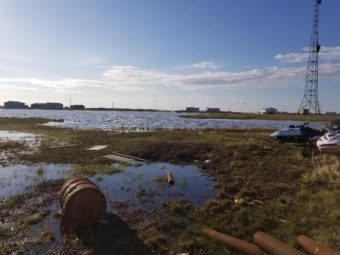
In the summer months, the slough that separates Newtok from its garbage dump is too shallow for a boat and the mud is too thick to traverse, so there’s nowhere to dispose of garbage. Ongoing permafrost degradation has rendered the sewage lagoon useless, so there’s no official place to dispose of raw sewage. There’s also no running water, other than at the school, and much of Newtok’s housing is unstable and outdated.

Stanley Thom grew up in Newtok and has been around for much of the relocation process. While he appreciates this new infusion of cash, he said that it will take more than $25 million dollars to build out what’s needed in Mertarvik.

“You know the airport is done, that’s very important, and now we need a clinic,” Thom said. “It’s very important for the tribal community. And we need to have a water source, a water point. Those are very important parts of the building structures in order to keep the community going,” he said.

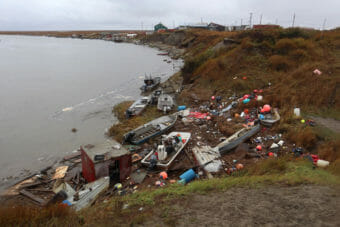
Alongside Newtok, Napakiak will also get $15 million from the Interior Department. Most of the village’s critical infrastructure there is threatened by erosion along the Kuskokwim river bank. The Quinault Nation in Washington state also qualified for the funding.

Newland said that the Interior Department weighed a lot of factors in deciding who got the money.

“We evaluated a number of communities that have gone through some of our climate funding programs before, and we weighted a number of different factors like readiness, need, existing plans, as well as our ability to glean lessons learned,” he said.

The tribes will also receive funding from the Federal Emergency Management Agency, which has otherwise been limited in what it can do with respect to climate change response in the past. Eight other tribes across the U.S. will share $40 million to assist in planning for climate change mitigation.

Village school closed after principal is banished from Kipnuk

The village of Kipnuk in summer 2018 (Photo from Department of Commerce, Community and Economic Development; Division of Community and Regional Affairs’ Community Photo Library)

Students in Kipnuk are without some of their school staff, after Alaska State Troopers responded over the weekend to the principal’s banishment from the village, located about 85 miles southwest of Bethel.

Starting this week, students at the Chief Paul Memorial School will shift to remote learning following an apparent dispute between the Lower Kuskokwim School District and the Kipnuk Traditional Council.

Two weeks ago, the council sent a letter to all Kipnuk households prohibiting children in the village of around 700 people from attending school, citing concerns for students’ safety.

On Monday, the school district released a statement announcing the school’s closure. It also cited concerns for the safety of students and staff. Kipnuk’s Traditional Council has not agreed to comment.

The reasons for the dispute are unclear, but class was canceled Monday and Tuesday. Students will shift to remote learning beginning Wednesday until further notice.

The school closure comes just days after the Kipnuk Traditional Council wrote a formal banishment letter to the school’s principal, LaDorothy Lightfoot, calling for her to leave the village on the noon flight on Friday.

According to a trooper dispatch, troopers received a call from the school district reporting that Lightfoot had locked herself in her office after village law enforcement tried to take her into custody “by serving a banishment order for unknown reasons.”

“It was reported that local community members and Kipnuk Tribal Police Officers were inside the school as well as LKSD teacher housing searching for the school principal,” the dispatch said.

Troopers said they tried to get in contact with local law enforcement and tribal leadership, but it was unsuccessful. Troopers arrived in Kipnuk Saturday to find the boardwalk between the airport and the village blocked. They were able to deescalate the situation and meet with the principal and staff at the school. The principal and other school staff chose to leave the village, according to troopers, and the district charted two flights for them.

The state district attorney’s office has been contacted. No crimes have been committed and no threats were made, according to troopers.

Kipnuk’s school will be closed to the public during remote learning. Some staff will teach remotely from Bethel.

AFN delegates push for measures to decrease salmon bycatch

A man speaks into a microphone while others wait in line behind him.
Roy Ashenfelter is an AFN delegate representing the Bering Straits region. He speaks during a debate over fish-related resolutions at the AFN conference on Saturday in Anchorage. (Photo by Elyssa Loughlin/Alaska Public Media)

Two resolutions brought before the Alaska Federation of Natives during this year’s annual convention called for efforts to reduce salmon bycatch for fish that return to the Yukon and Kuskokwim rivers. Debate over both resolutions was contentious and revealed a regional rift among tribes.

One resolution calls on Alaska’s Department of Fish and Game to support measures that decrease salmon bycatch by commercial trawlers in a region along the Aleutian Island chain known as Area M. A second resolution requests the North Pacific Fisheries Management Council address bycatch amounts in the same region.

“I really have to take a step back here and talk about how sad I am that we have to fight so hard here to be heard to try to protect our salmon,” said Brian Ridley. Ridley is the chairman of the Tanana Chiefs Conference, an Interior region tribal organization that brought both resolutions to the floor of this year’s annual Alaska Federation of Natives convention in Anchorage.

“I know this is a controversial issue,” Ridley told a crowd of hundreds, after the resolutions were introduced on the floor Saturday. “There’s a lot of people that didn’t want to have this discussion here, but if we don’t have it here and we don’t get the support of AFN, the problem is, we’re gonna be out of the fish on the Yukon and Kuskokwim and we’re gonna be talking endangered species.”

In Interior communities like Eagle, where Ridley grew up, people have not been able to fish for salmon for three years.

Resolutions are kind of like marching orders for AFN. Those that pass tell AFN leadership where to concentrate their efforts on behalf of the organization’s membership for the coming year. Member delegates from across the state debated on the two resolutions regarding salmon bycatch for over an hour.

“Historically, income we have received throughout the summer fishing season has lasted throughout the winter, and we also rely on it for subsistence fishing and we don’t have a store in our community,” said Bobbie Allen, who represents the Nelson Lagoon Corporation. “We have to have stuff flown in, barged in, or whatever other methods that we can to get food there that we can’t get through subsistence fishing or hunting,” she said.

Allen and other Aleutian and Pribilof islands representatives say they’ve seen salmon declines for two decades and that further limits on both their commercial and subsistence resources threatens the long-term sustainability of communities in that region.

“This resolution has singled out Area M without uniting and addressing the other affected areas,” Allen said. “We support the underlying initiative but we are unable to support the divisive nature of this resolution.”

Jodi Mitchell (far right) moderates the Consideration of 2022 AFN Convention Resolutions at the Dena’ina Center in Anchorage. (Photo by Elyssa Loughlin/Alaska Public Media)

Rob Sanderson is the second vice president of the Tlingit and Haida Central Council from Southeast Alaska.

“We’re fighting this fight in the wrong arena. I’ve been attending the North Pacific Fishery Management Council for over 22 years” he said. “And if you want action to get taken, start attending these meetings. Because ultimately, it’s gonna fall on the feds and the state government that makes these decisions.”

Fisheries are managed by the National Oceanic and Atmospheric Administration, which is within the Department of Commerce. During the debate, Karen Linell, who is the executive director for the Ahtna Intertribal Resource Commission, said she also sees federal managers as a more appropriate target for a fight about subsistence resources.

“The problem with this system is that the fisheries are under the Department of Commerce and not a natural resource agency who has the responsibility for sustainability,” said Linell.” It’s all about that dollar and not about the salmon.”

AFN Members who utilize Area M for subsistence fishing did try to both postpone the vote and move debate on the resolutions to executive session, but those motions failed. At one point, attendees from the Aleutian and Pribilof Islands region stood with their backs to AFN’s resolutions committee in protest of the process.

In the end, both resolutions passed. Some AFN members abstained from voting on the grounds that the issues were not unifying — and the theme of this year’s convention was unity.

This year’s AFN convention ended Saturday in Anchorage.

New federal Arctic strategy lacks focus on issues local to Alaska

""
The Coast Guard icebreaker Healy breaks ice in the Nome Harbor on Jan. 13, 2012. (U.S. Coast Guard photo)

The federal government rolled out a new Arctic strategy this month, a move welcomed by the Alaska congressional delegation. But it’s unclear what it means for residents back in Alaska.

“It’s much more a list of goals,” said Amy Lovecraft, the director of the Center for Arctic Policy at the University of Alaska Fairbanks. She said that the strategy isn’t necessarily new as much as a revival by the Biden administration of Obama-era policies discarded by the Trump administration.

“So, it’s got a lot of buzzwords: conserve and protect, you know, Arctic ecosystems, Indigenous co-production, co-management. Right. What do all those things mean? And so it seems like it’s pretty specific, and so in that sense there are initiatives mentioned,” Lovecraft said.

Lovecraft said that the document falls short of providing clarity on how the goals outlined might be met.

“So these are strategic objectives,” she said. “What I want next are the action items.”

It’s action items that Sen. Lyman Hoffman also wants to see. He’s been a state legislator representing the Bethel region as a Democrat for more than three decades.

“How do you make people that are living in the Arctic, their lives affordable to live up here?” he wondered. “The food is high. The transportation costs are high. The heating costs are high. Everything is too exorbitant.”

Hoffman said that he’d like to see a strategy that addresses on-the-ground realities for Alaskans.

“A large portion of it needs to be focused on global warming and the effects that it’s having on places like Newtok, and places that are eroding; the permafrost melting away. What effect does it have on our food supply for salmon?” Hoffman said.

He said that these are some of the realities people in Western Alaska live with every day.

U.S. Secretary of State Antony Blinken announced the new strategy for the government’s future Arctic in a video posted to Twitter. In it, Blinken outlined four pillars that will guide White House policy in the Arctic in coming years.

The last time the U.S. government released an Arctic strategy was in 2013. That version was heavy on military presence in the region. The new strategy also calls for improved military capabilities in Alaska, but includes three other objectives that focus on economic development, climate change and international relations and diplomacy.

Lovecraft said that the timing of the new strategy’s release is not coincidental. Federal midterm elections are less than a month away. The announcement also comes as Arctic leaders and policy experts gather for an annual meeting in Iceland to discuss science innovation and international policy in the Arctic.

September storm leaves behind treasured beach finds

Norma Tunutmoak of Chevak shows off a message in a bottle she discovered after flood waters from an historic storm in September. (Emily Schwing for KYUK)

The remnants of Typhoon Merbok battered Alaska’s west coast in September, bringing hurricane-force winds, high seas, and severe damage to some Western Alaska communities. Homes were flooded and personal belongings were destroyed. But in its wake, the storm also left behind a few treasures.

After the storm tossed boats in Chevak like bath toys and scattered debris across the community, Norma Tunutmoak went out to survey the damage. Flooding carried loads of driftwood 17 miles inland from the Bering Sea coast. Tuntumoak, an avid beachcomber, said that she spotted something tangled among a pile of logs.

“I was like, ‘Holy cow, look at this!’” Tunutmoak said. “It was a message in a bottle.”

Her eyes lit up as she showed off a brown glass bottle with a roll of paper at her home.

When she opened the cork stopper and pulled the message out, it said that the bottle had been floating around in the Pacific Ocean and the Bering Sea for more than 20 years. According to the message, the bottle was dropped from a boat off the coast of Vancouver in 2000 as part of a long-term study on ocean currents. Tunutmoak contacted the scientist listed on the message. He’s since retired, she said.

Tunutmoak said that she had hoped the find might be more personal.

“But it’s OK,” she said proudly. “It’s still an amazing find.”

She said that she plans to display the bottle, and its message, on a shelf in her kitchen.

Up and down Alaska’s west coast, people have reported finding treasures from glass fishing floats to shoes and other flotsam. A giant prehistoric tusk discovered outside Newtok didn’t float in on a tide; it washed out of the tundra near Newtok.

“Half of it was showing from the tip and all the way to the end of it,” said Bruno Chakuchin, who discovered the tusk while scouring the coastline for debris.

Chakuchin said that the tusk was huge.

“Probably like 8 feet and 10 inches and probably a diameter of 1 foot, 6 inches,” he said.

It also weighed 128 pounds — too heavy for him to lift alone.

Tusks like this are popular among collectors and artists. Days after he discovered it, Chakuchin said that he wrapped it up and shipped it to a buyer in Anchorage.

“Depending on condition, they’ll go for about $150 a pound if it’s in really good condition,” he said.

That kind of cash can go a long way in a small community like Newtok. Chakuchin said that he’s likely to use it for bills, to pay for food and maybe invest in a four-wheeler.

“No I’m not gonna use it for fun,” he said.

Beachcombing offers a nice break for residents who are still cleaning up after their communities were ravaged by flooding, high winds and an historic storm surge.

Swiss paddlers arrive in Bethel after 700 mile journey down the Kuskokwim

Thomas and Tomi Isenschmid with a map of their route down the Kuskokwim. (MaryCait Dolan/KYUK)

A father and son from Switzerland paddled ashore at Lomack Beach in Bethel last week. They had kayaked around 700 miles down the Kuskokwim to get there from Lake Minchumina, but Thomas and Tomi Isenschmid’s journey got off to a rocky start.

Their first challenge was to carry all of their gear, kayak, tent, food and supplies, 10 miles from their starting point at Lake Minchumina to the North Fork of the Kuskokwim. They had to carry 350 pounds of gear across the tundra, Tomi said.

It took him and his father, Thomas, a week of walking back and forth from their camp to their starting point on the river. Their hiking boots got soaking wet trudging through the soggy tundra.

At first they couldn’t even find their entrance point to the Kuskokwim, the river they’d traveled from Switzerland to paddle down.

“The first day we made a terrible mistake, you know. We went more or less in a circle. We worked for six or seven hours, completely frustrated,” Thomas said. “We were doubting whether we could do it.”

A trapper in Lake Minchumina helped them with directions. They’d been looking on the left, but the way out was on the right.

“And then the next morning we made it to the North Fork,” Thomas said. “And that was really highlight: when you see the water of the North Fork for the first time. That was really great.”

The Isenschmids said that once they started paddling down the river it got easier. It felt more like the adventure Thomas had planned to do with his son. In a year off from work, he did a trip with each of his three adult children.

Thomas estimated that only four parties have paddled that far down the Kuskokwim, at least in the past 30 years.

Getting onto the river didn’t mean their challenges were over. Their first day paddling, a black bear with two cubs stood up behind their tent and smashed it down. Thomas was able to scare her away with bear spray, and there was no damage to their tent. But when they got back to their boat they found it ransacked: parts broken, supplies pulled out.

“That was the second moment where we thought ‘this is the end.’ First day on the river. This is the end,” Thomas said.

But they were able to fix what they needed to to get back on the water. There’s still a small chunk ripped out of one of their Klepper foldable kayak’s seats. The kayak is a German design inspired by traditional Yup’ik kayaks, Thomas said proudly.

“You’re very busy, and you’re busy with really the basics,” Thomas said. “How can I stay warm? How can I get food?”

The Isenschmids did a 100 mile, week-long kayak trip to prepare in Switzerland. But it’s a different experience in Alaska in that you’re far away from help if there’s an emergency.

“When you think: ‘Is this it? Is this the end?’ You start feeling the heat rising in your body and you start thinking there is nowhere you can go,” Thomas said. “There is no immediate help, not even within a day or two. And this is really a special feeling. But it’s also a good feeling. Because you can see you can really do it.”

After two weeks of paddling, they reached McGrath. From then on they started to encounter more people as they traveled down the river.

In Akiak, people brought them food, coffee, and dried fish when they camped by the village for two nights. One night, they went into town to play bingo and they won the $228 jackpot.

They said that many locals they encountered also gave them advice, like the best fishing spots or which channels to take.

“Some people were telling us how it was like 50 or 60 years ago,” Thomas said. “How they camp and how it has changed. It’s interesting to hear and exchange, and people are really very nice.”

The Isenschmids aren’t the only ones to complete challenging paddling trips in the area this summer. Thomas Dyment and Luke Wenger paddled 850 miles from Fairbanks to Bethel.

Site notifications
Update notification options
Subscribe to notifications