KYUK is our partner station in Bethel. KTOO collaborates with partners across the state to cover important news and to share stories with our audiences.

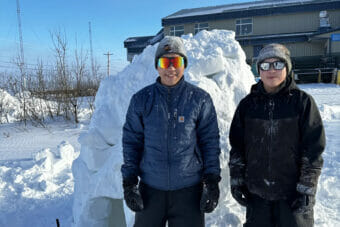
Ignatius Hunter and Tom Jimmy outside of the Yuut Elitnaurviat dorms. (Francisco Martínezcuello/KYUK)
On Feb. 10, the forecast called for heavy snow in Bethel with temperatures reaching 10 below. Two teenagers decided it was good idea to go outside after school to build igloos near the Yuut Elitnaurviat dorms. It’s a study in engineering, architecture and history.

KYUK’s Francisco Martínezcuello followed their two-day progress and joined them inside the igloo. Here’s an audio postcard about this experience.
The lunchroom of the Tuluksak school, where John Mark Hammonds first worked in the Yupiit School District. (Olivia Ebertz/KYUK)
After a week without running water, administrators in Tuluksak say that they are on the verge of closing the village’s school.
Principal Kary DelSignore said that the trouble started on Thursday, Feb. 9 when a line leading from the water plant broke, leaving the school and all of the teacher housing without running water.
That water plant is a portable one on loan from the Yukon-Kuskokwim Health Corporation, which sent a technician out to take a look.
“He was not able to find the leak,” DelSignore said. “He said that even if they did find the leak, that the equipment is not currently available in Tuluksak to get to it and fix it.”
There’s a temporary workaround, but it requires trucking a 200 gallon plastic container back and forth from the water plant to the school and would afford just a fraction of the water the school and teacher housing would normally use.
“We’re trying our best to conserve water where we can. We’re making choices that we shouldn’t be having to make in the schools,” DelSignore said. “You know, pulling out the honey buckets, doing things like that. Having to choose, you know, ‘will we feed you today? Will you be able to wash your hands?’ What can we do? Can we provide you with drinking water? Nope, we don’t have any drinking water right now that is safe for you in the school.”
The lack of water is making it difficult to cook food in a clean environment, and DelSignore and Yupiit School District Superintendent Scott Ballard say that it’s putting the health and safety of children and staff at risk.
“Our teachers are going, they’re working on their weekends to help pump water. They’re working in the evening to help pump water,” DelSignore said.
Then, those teachers head home to honey buckets and cold showers.
“Its just become very, very difficult and we are in need from some assistance from the state,” DelSignore said.
But it’s not exactly clear where that help should come from. DelSignore and Ballard said that they have reached out to Bethel’s Sen. Lyman Hoffman and the commissioner of the Alaska Department of Education.
“Whether it’s the National Guard, whether it’s another state, you know, water, health and safety, environmental agency coming in. They have the tools that we don’t have available in this rural community to help us and get this fixed quickly,” DelSignore said.
In the meantime, as each day passes Ballard said that they may not be able to keep the school open.
“Right now, we’re just trying to assess whether those teachers can even make it to next week because they basically stated that they’re exhausted and they haven’t had showers in a week,” said Ballard. “If all of our teachers are so exhausted and so frustrated without even being able to maintain basic personal hygiene, they’re gonna leave and we won’t have a school.”
The remnants of Typhoon Merbok left Newtok’s coastline littered with storm debris in September 2022. The Federal Emergency Management Agency (FEMA) contracted with a company to translate disaster relief documents into Yugtun and Iñupiaq, but those translations were indecipherable. (Emily Schwing for KYUK)
A translation service company that contracted with the Federal Emergency Management Agency to offer disaster relief information to Alaska Native people will reimburse the federal agency for work that has been deemed indecipherable.
Accent on Languages was supposed to translate information for speakers of two Alaska Native languages: Yugtun, or Central Yup’ik, and Iñupiaq. Those documents could have helped Indigenous language speakers impacted by Typhoon Merbok apply for disaster relief.
The translation company has committed to reimbursing FEMA for the work. But that’s not enough for former Assistant Secretary of Indian Affairs Tara Sweeney.
“Fraud is fraud, in my opinion,” Sweeney said. “And you can’t put a price on the impact [of] denying services to vulnerable communities because of misinformation. When you look at the cost of living in rural Alaska it’s exorbitant and it’s challenging. There’s no dollar amount that can be refunded to the federal government to make that behavior and that business practice okay.”
Lee said that her company was paid just over $5,000. Of that, more than half, or about $3,400, covered the costs for the Yup’ik and Iñupiaq translations. That’s the money Lee said that she will give back to FEMA. Lee wrote that in taking on the translation work, her goal was “not only to just merely help these languages survive, but to help these languages and cultures thrive.”
The contract between Accent on Languages and FEMA falls under a much larger one that the company shares with the U.S. Department of Homeland Security. Accent on Languages has held contracts with various federal agencies since 2004, according to a federal spending database.
“Have we had this happen at FEMA before? The answer is no,” said FEMA’s Tribal Affairs Advocate Kelbie Kennedy. “We’ve never had this happen before. And this, in particular, is not a systemic issue.”
Kennedy is a citizen of the Choctaw Nation of Oklahoma. She also speaks her Indigenous language.
“We have a very hard working team within FEMA, and we want to make sure that they keep doing the work that they’re doing to improve and get more translations out to Indian Country,” Kennedy said. “It’s so important, I would say as a tribal citizen, to have FEMA speak in a language and speak in my native language in a way that makes sense for my community. You have to have that culturally competent element.”
Kennedy said that the agency has been contacted by members of Congress. She said that FEMA is willing to take part in any sort of investigation that may result from the mistranslations.
Sweeney is pushing for an investigation.
“My recommendation would be to members of Congress to exercise their fiduciary responsibility to American Indian and Alaska Native people across this country to look into whether or not this is common practice for the federal government,” Sweeney said.
Julia Jimmie is a life-long Yup’ik speaker who works as a translator for KYUK in Bethel. She said that there’s a silver lining to what is otherwise a deep disrespect for her language.
“They probably thought Yup’ik and Iñupiaq were going extinct, and they probably thought they wouldn’t be caught,” Jimmie said. “So this puts it out there that Yup’ik and Iñupiaq are still alive and used.”
It’s unclear how or why the work provided by Accent on Languages ended up as it did. The company said that it has provided FEMA with a list of corrective actions. Neither Accent on Languages or FEMA would share that list, but FEMA said that the agency is no longer doing business with the translation company.
The storm surge from Typhoon Merbok brought high water 17 miles inland to Chevak from the Bering Sea coast, where boats parked on the Ninglikfak River were tossed around like bathtub toys. These boats aren’t just for recreation; they offer residents a way to access subsistence food resources, including fish and moose. (Emily Schwing/KYUK)
The translated documents were supposed to offer information on how to apply for financial assistance. On the Y-K Delta, at least half the population, about 10,000 people, learn Yugtun, or the Central Yup’ik dialect, before they learn English. Another 3,000 people speak Iñupiaq further north.
Julia Jimmie, a translator at KYUK, said that the Yugtun translations were incorrect. Other Indigenous language speakers also didn’t understand the translated documents. Two sources on Nelson Island agreed: they were not Central Yup’ik. Another source from Chevak said that it wasn’t Cup’ik. Siberian Yup’ik speakers also couldn’t make sense of the documents.
Tara Sweeney, the former Assistant Secretary of Indian Affairs under the Trump Administration, also said that the Iñupiaq translations were wrong; her great-grandfather helped develop the Iñupiaq alphabet.
“We don’t use characters like the letter ‘e’, or the way some of the words seem to be put together or structured,” Sweeney said.
To refer to the documents as translations would be wrong, said linguist Gary Holton.
“That is an amazing understatement,” Holton said after reviewing some of the documents. “The only thing you might gather from that is there are a couple of dates, but you wouldn’t know what those dates are for. I would say the only useful bit of information in there might be if there’s a reference to a website or something.”
Holton spent 20 years documenting Alaska Native languages at the University of Alaska Fairbanks’ Alaska Native Language Center. He said that whoever created the Yup’ik translations just lifted full phrases from a compilation of language and folklore from Far East Russia known as the Rubtsova texts. It was published in the Soviet Union in the 1940s.
According to Holton, in at least one of the documents where FEMA’s news release says “State News Desk,” the translated version reads, “when she said so, the dog ran farther off from the curtain.” In another section of the same document, what should be a translation of information about the Small Business Administration reads, “that one said that I should draw a line on the ice when he gets close.”
“I mean, imagine if someone, you know, took all of your folktales and then interviewed your great-grandmother about her experiences growing up. And had all of this information recorded, and wrote it down, and then scrambled it and stuck it in various different ways and made kind of a collage out of it,” Holton said. “It’s offensive.”
Sweeney agreed. She said that the work is not only a waste of federal funding, it’s insulting to Alaska’s Indigenous people.
“There’s a lot of that historical trauma of being beaten in schools because they were speaking their Indigenous languages, which is why there’s a generation of us in Alaska that struggle with fluency,” Sweeney said.
Accent on Languages touts work it has done in Alaska on its website. (Www.Accentonlanguages.Com)
The company contracted to do the work is Accent on Languages, whose website boasts a 100% customer satisfaction rate and touts its recent service in Alaska “after emergency flooding.” CEO Caroline Lee declined to answer questions about how or why the mistakes happened and what she plans to do to ensure that something like this doesn’t happen again.
The company’s Iñupiaq translations were meant to help language speakers in the Bering Strait Region who were impacted by Typhoon Merbok. But at least one of Accent on Languages’ Iñupiaq translations was actually done in the Inuktitut alphabet. Inuktitut is an Indigenous language spoken in Northeastern Canada. The mistake should have been an easy catch because the Inuktitut alphabet is made up of syllabic characters, unlike Iñupiaq where many of the letters are identical to the Latin alphabet.
A Federal Emergency Management brochure incorrectly presented as an Iñupiaq translation. It is written using the Inuktitut alphabet – a language spoken in the central and eastern Canadian Arctic – though speakers say it is garbled in that language as well.
At least two Inuktitut speakers in Canada said that a tri-fold glossy brochure created for FEMA by Accent on Languages is unintelligible.
FEMA spokesperson Sharon Sanders said that some of the translations were up to two weeks late. Her colleague, Tom Kempton, said that he had suspicions about the inaccuracies from the beginning. He said that the final products looked strange.
“I don’t speak, you know, Yup’ik. What we were seeing coming back, I mean, when I first saw the Iñupiat [sic] ones I was like, ‘What is this?’ It was all, like, hieroglyphic,” Kempton said.
According to FEMA, the agency paid $27,800 for the translations. The money comes out of a larger contract Accent on Languages holds with the U.S. Department of Homeland Security. There are at least half a dozen news releases and other documents that have been translated incorrectly.
“It’s a problem for underrepresented, minority communities if this is the type of information that’s being disseminated and people can’t even understand it,” Sweeney said. “Services to American citizens are being denied, especially in time of need. That is egregious.”
FEMA spokesperson Sharon Sanders said that the translations were not widely distributed, but they were sent to at least two radio stations and two newspapers in Western Alaska. And in October, a month after Typhoon Merbok hit the state, multiple staff members of Alaska’s Congressional delegation reported receiving the incorrect Iñupiaq translation at Alaska Federation of Natives (AFN), the largest annual gathering of Alaska Natives.
Staff from both Sen. Lisa Murkowski and Rep. Mary Peltola’s offices said that they informed the agency that the translations had many problems. In response, Sanders said that the mistranslated documents were removed from FEMA’s website. The agency also hired an Alaska-based company to continue the work.
High water from Typhoon Merbok caused a fuel spill and damaged Newtok’s diesel fuel tanks. The storm surge also shifted boardwalks across the community and further exacerbated coastal erosion. The Federal Emergency Management Agency contracted with a California-based company to provide documents for Yup’ik and Iñupiaq language speakers impacted by the storm, but the company’s produced “unintelligible” work, according to speakers of both languages. (Emily Schwing/KYUK)
In a December statement, FEMA said that it was “committed to enhancing [it’s] capacity to work with Tribal Nations … which includes providing culturally competent services and translating FEMA products into Native American languages… ” But whoever wrote that statement later misspelled both Yup’ik and Iñupiaq.
“All I can say is, you know, FEMA is a people-first agency,” Sanders said. “We’re people helping people who have been hurt, right? So when we don’t get it right, that really matters to us. And we work really hard then to make sure we do get it right.”
To date, the agency has paid roughly $7,600 per applicant to people whose applications for disaster relief were approved. To put that into perspective, the agency paid the original translation service, Accent on Languages, more than three times that amount, which is also more than the median annual income in the Yukon-Kuskokwim region.
Rebecca Trimble with her husband, John, and their three children. (Courtesy of John Trimble)
On Dec. 27, President Joe Biden signed a law that provides former Bethel resident Rebecca Trimble with a pathway to permanent resident status in the United States.
Trimble’s journey to legal immigration has been unfolding for more than a decade. And even with the help of an immigration attorney, her unique situation took an act of Congress to resolve.
“It has been amazing and heartwarming to see the Alaska Congressional delegation come together and do the hard work necessary to help this military spouse stay in the United States,” said Trimble’s attorney, Margaret Stock.
U.S. Sens. Lisa Murkowski and Dan Sullivan, both Republicans, celebrated the enactment of private legislation they carried with the late Rep. Don Young.
In a press release, Murkowski said, “After a decade of uncertainty and legal appeals, I’m so pleased that we have put an end to any possibility of deportation and provided Rebecca with the peace of mind she so clearly deserves. She has lived in America, built her life in America, and raised her family in America. Now she can remain with her husband and children in the only country she has ever called home.”
Sullivan noted that it is exceptionally rare for Congress to pass this type of legislation.
“It is fitting that this will be Don Young’s final bill to get signed into law, a capstone to a long and amazing career advocating for a state and a people he loved. I commend Rebecca and her family for their patience and dogged determination,” Sullivan said in a statement.
Trimble said that she is relieved to have the bill signed, finished, and enacted into private law. In a statement to KYUK, she said that it feels good to not worry about her status.
“We are so happy, and it made this holiday season all the more special,” Trimble said.
Rebecca’s husband, John Trimble, had conflicting reactions.
“It’s amazing that Rebecca’s case has gone so far. When we first started this journey of trying to obtain her a legal status in the U.S., I thought it was going to be easy: fill out a few forms, pay a fee, wait a month or two. Eight years later, it developed into something that I couldn’t have imagined,” said John.
John said that he is grateful for the new law, but years of ups and downs, fear, and disappointment have colored the experience for him. He said that he is upset about how long the process took, and the loss of time, effort, and money.
H.R. 681 is the first private bill to become private law during the 117th Congress, and just the third to be enacted in the past 10 years.
Rebecca Trimble with her husband, John, and their three children. (Courtesy of John Trimble)
If everything goes right, former Bethel resident Rebecca Trimble will be an American soon.
It’s a moment that has taken years to reach, but her husband, John Trimble, a captain in the U.S. Army Reserve, said that they’re waiting for a final decision before they celebrate.
“You know, like, we’ve gotten so hopeful so many times along the way and then been disappointed, you know,” he said. “So now it’s, I mean, I don’t know, that’s just how I feel about it. It’s like it’s definitely exciting, but it’s, but we’ve kind of trained ourselves to not get too, too excited.”
Trimble’s story made national headlines in 2020, but it has been slowly unfolding for more than a decade. She’s been in the U.S. since she was a few days old.
“I was adopted at birth in Mexico. And then I came up from, like three days on up, to Salem, Oregon, and that’s where I grew up,” Trimble said. “Later on, in middle school, I moved up to Vancouver, Washington. I lived in Vancouver until 2017, when we moved to Alaska for my husband’s job.”
Trimble said that she didn’t knowshe wasn’t legally a citizen. She even voted in the 2008 presidential election, which is illegal for a non-citizen. This caused a lot of problems when she found out she wasn’t a citizen and started looking for legal ways to stay.
“There’s been so many ups and downs and dead ends where we’re like, ‘oh, connect with this person or do that paper. Let’s try this.’ And it’s just been a whirlwind,” she said.
Trimble first told her story to the Alaska Landmine in early 2020 after she received a letter from the U.S. Citizenship and Immigration Services saying that she had a month to leave the country. That was hard on her husband and her kids.
”They saw the hurt, and they saw me crying, and they kind of, we kind of tried to explain in the, like, soft way, how, you know, ‘Mommy was adopted.’ And you know, there’s just papers and that makes you like, who you are, where you’re born, and just like, ‘Mommy might not be here,’ you know. ‘We might have to move,’ kind of thing,” she said.
Trimble’s situation is tricky, and she said that trying to find a way to get immigration officials to understand that felt dehumanizing.
“I didn’t get approved one way because of this. So we filed a paper the other way. Then they’re like, ‘no, because we feel like you don’t fit in this way either.’ And then no one had taken the time to talk to me, and it was like ‘mail this in, and three months later you’ll hear a response to that question.’ I felt like a number at times. And if I didn’t fit that number, then, you know, then it didn’t move forward,” she said.
In 2019, the Trimbles hired Margaret Stock, an immigration attorney in Anchorage.
“The facts of Rebecca’s case are very sympathetic. I think most people understand that when you came to the United States when you were a few days old and you thought you were an American citizen your whole life, that it’s not fair for the government to come forward when you’re an adult and tell you that you need to be deported,” Stock said.
But in the end, it took a literal act of Congress to get results. Alaska’s congressional delegation had to push a private bill through Congress specifically for Trimble. A private bill allows individuals to get relief directly from federal lawmakers when they’ve exhausted all of their other options. Many of them deal with immigration. But even with high-level support from Alaska’s delegation, it has taken more than a year for that bill to work its way through the House and Senate.
Trimble’s case is unique in some ways, but the circumstances are deeply familiar to hundreds of thousands of undocumented people living in the country.
“We know the story of so many, who we refer to as the Dreamers. Young people who came into this country and very, very young, knowing no other country other than the United States, brought here by their parents, and who have been denied opportunity,” said Alaska Sen. Lisa Murkowski who sponsored Trimble’s bill in the Senate.
What’s rare about this case is that her private bill actually made it through Congress.
“But Rebecca Trimble came to us as, as really, a very special case,” Murkowski said.
Stock, Trimble’s attorney, deals exclusively with immigration cases. She said that she’d like to see a legislative fix to this problem.
“I think it’s really important for people to know about cases like this — they’re not actually that uncommon. So to help the rest of the people, I think, though, we’re gonna have to get immigration law changed,” Stock said.“Because one of the problems with private bills, of course, is they only benefit one person and they don’t fix the general laws.”
Trimble’s bill passed the Senate unanimously on Dec. 15. Now she’s waiting for President Biden to sign it, but that doesn’t mean she’s done with all of the paperwork.
“So this will grant me, I believe, permanent residency, and then I’ll have to get a green card after that. And I know that’s, you know, that’s a long process as well,” she said.
And, once she’s legally able to, Trimble said, she’ll probably vote again — even though it caused so much trouble the first time around.
“I mean, once I become a U.S, citizen I — yeah, I might vote. I don’t know yet at this point. I mean, I want to do my civic duty as a U.S. citizen,” she said.
Close
Update notification options
Subscribe to notifications
Subscribe
Get notifications about news related to the topics you care about. You can unsubscribe anytime.