KYUK - Bethel

KYUK is our partner station in Bethel. KTOO collaborates with partners across the state to cover important news and to share stories with our audiences.
Hooper Bay residents weigh in on fishing closures: ‘It’s like taking away food from our table’

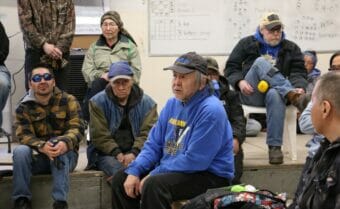
(Francisco Martínezcuello/KYUK)

Inside Hooper Bay’s brown tribal council building, nearly 50 people gathered to hear more from state officials on why they decided to close chinook salmon fishing in the coastal area from the Naskanat Peninsula up to Point Romanof. That closure includes Hooper Bay, Scammon Bay, Chevak, Emmonak, Kotlik, Nunam Iqua and Alakanuk.

State biologists said that the closure is intended to protect chinook salmon while they migrate upriver to spawn in Alaska and Canada. But most in the crowd were subsistence fishermen and fishing means survival.

“It’s like taking away food from our table,” said one person who testified.

Alaska Wildlife Trooper Sergeant Walter Blajeski arranged the meeting. He said that he wanted to give the community an opportunity to ask questions they might have on both fishing opportunities and restrictions.

“And, you know, I think the meeting was a success. Our goal was just that: to be available to answer questions and to provide maybe some explanation as to why restrictions were going to be occurring. And I think we accomplished that,” Blajeski said.

Non-salmon fishing will still be permitted during the closures, but with restrictions. Gillnets will be limited to 4-inch or smaller mesh and 60 feet or less in length. These nets must be operated as a setnet and should be set near shore.

Blajeski said that troopers can’t always enforce these regulations; they do it when weather and time permits.

“We don’t often get to the coastal villages. But when we do, we usually go there, you know, for the day. And those types of enforcement patrols are usually conducted, you know, onshore in the village, walking around the village because we just don’t have the resources to get out there,” Blajeski said.

Blajeski warned that anyone caught violating the regulations will be fined up to $500, though there is wiggle room.

“What we’ve seen over the last couple years, for people that don’t have a history of violations, is a about $300 fine. We don’t recommend to the court that we forfeit any fishing gear that would otherwise be legal,” Blajeski said.

Blajeski said that the troopers don’t normally seize the fish either.

“And if we do seize fish, we would donate those fish to qualified charities such as Elders or people in need in the region,” Blajeski said.

Deena Jallen, an Alaska Department of Fish and Game biologist and the Yukon River summer season manager, traveled to Hooper Bay for the meeting. She said that residents asked a lot of questions about commercial fishing in other areas of Alaska that may catch the same fish subsistence users are supposed to avoid.

In her role as the Yukon River summer season manager, she said that she often fields the same questions from all over the region.

“We often get questions and [statements] about Area M and the pollock fleet. We hear that a lot at every meeting that we come to,” Jallen said.

What makes Hooper Bay different from others is that it is a coastal community.

“In previous years, the coastal area has not been closed. They’ve had restrictions to 6-inch mesh, but they’ve typically been left open. They do catch some kings and summer chum as they migrate up along the coast of the Yukon River. So unfortunately, when there’s no harvestable surplus, we do feel the need to close that district as well to hopefully reduce the harvest of king salmon as they travel up along the coast,” Jallen said.

Jallen said that she was happy to see the turnout as well as the level of participation.

“It’s very understandable that people are very frustrated with the salmon and with the management actions in recent years,” Jallen said.

Jallen said that the salmon in Hooper Bay are either bound for the Yukon River, where runs have been very low in recent years, or they could be headed to other streams either along the coast or in other areas of the state.

She also has concerns for king salmon runs across Western Alaska and particularly in the Yukon River area. Jallen said that the region didn’t meet any of the escapement goals for king salmon last year.

“So any king salmon that’s coming back either to the Yukon River or to a nearby spawning stream is likely to have a pretty low abundance this year, and so we’re concerned for all of them. So even if that fish isn’t specifically Yukon-bound, we haven’t really seen anything that says, like, oh, well, this river is doing better or the stream is doing better,” Jallen said.

Fisheries managers said that they could loosen restrictions if the run is stronger than they’re projecting, but right now Jallen said that every district of the Yukon is going to be closed to king salmon fishing. Based on salmon run timing, those closures will work their way up through the entire Yukon area through all the districts and all the tributaries.

“I think just the main takeaway is that we know these management actions are very, very intensively managing subsistence. And we know it’s incredibly frustrating. But we’re only taking these actions because the runs are so low that there’s no fish available for harvestable surplus,” Jallen said.   

The frustration was palpable.

“You know, they wanted to ask questions, but a lot of the community members that were attending, after the meeting thought that, you know, they really didn’t get any answers,” said Native Village of Hooper Bay Tribal Administrator Jan Olson.

Community members said that they need access to their subsistence foods.

“We don’t do any commercial fishing, you know, we don’t even go up to the Yukon or Black River to do any type of commercial fishing. All we do is stick around here and do subsistence fishing,” Olson said.

Olson said that there’s still confusion as to why they are being regulated. They need to fish to survive.

“We’re not in it for the money. We are in it to put fish in our freezers for future use. And, you know, that’s a big part of our diet there. You know, that’s one thing that we missed,” Olson said.

Remnants of Typhoon Merbook, which happened in fall 2022, caused major flooding in Hooper Bay. Families were displaced, homes were lost, people’s stores of salmon and other subsistence foods were destroyed. The community relied on state assistance as well as donations of fish.

“You know, we’re not bad people, you know, we just want to fish and, you know, it’s just, we want the fish that we’re accustomed to,” Olson said.

Olson, along with several other members of the community, said that these restrictions will make winter more challenging as many residents don’t make enough money to buy more groceries.

Bethel residents hunt for fiddleheads, before fronds unfurl

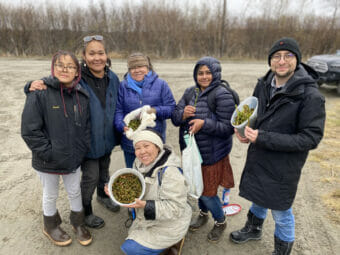
Participants in the Finding Fiddleheads Ethnobotany Walk hosted by the Kuskokwim Consortium Library show off their harvest on Thursday, June 1, 2023. (Evan Erickson/KYUK)

Among the many harvestable wild foods on the Yukon-Kuskokwim Delta, fiddlehead ferns are revered for their nutritional value and taste. Before fern fronds have unfurled, they peek out from the previous fall’s decay in tight coils to greet the coming of spring. This short period is when the harvest takes place, and 20 or so participants in the June 1 Finding Fiddleheads Ethnobotany Walk in Bethel showed up just in time to catch them.

Sharmin Shompa and Aiden Keller were both rewarded for showing up on the cold and drizzly Thursday evening. Shompa said that she was able to gather about 100 fiddleheads in an hour, while Keller had brought a larger container and estimated his take to be about 200 fiddleheads.

“[I] didn’t know anything about ‘em until they posted on Facebook. No one’s ever brought it up; I’ve never seen it posted anywhere,” Keller said. “People sell the berries online, people put the fish online, things like that. Whale, seal, furs — never seen fiddleheads online.”

Bethel Community Services Foundation Food Security Coordinator Carey Atchak led the event, which was hosted by the Kuskokwim Consortium Library. She met the group of foragers at a wooded stretch of land along BIA Road.

“I like picking the ones that are close to the ground and they look just like that,” Atchak said as she swept aside a layer of dead leaves to reveal a cluster of recently emerged fiddleheads.

While unsafe to eat raw, fiddleheads are a delicacy boiled, sautéed, roasted, braised, or even deep-fried. If you’re a fan of asparagus, artichoke, and string beans, you’re in luck because the fiddleheads have been compared to all three. They can be tossed into pasta and salads, placed atop pizzas, or on the Y-K Delta, mixed into whipped fat as traditional akutaq.

Just as soon as the attendees had identified the plant, they split off in different directions, trudging through thick stands of alders and willows in search of the fiddleheads. Participant Margaret Herron met back up with Atchak after an hour’s worth of foraging.

“There you are. Oh man you gathered lots over there,” Herron said. “I almost chickened out, but I’m glad I didn’t.”

It is recommended to only harvest fiddleheads from plants with healthy numbers and to leave at least half of the fiddleheads on each plant crown undisturbed to ensure sustainability.

First Lady Jill Biden and Interior Secretary Deb Haaland visit Bethel

First Lady Dr. Jill Biden wears a qaspeq gifted to her by Rep. Mary Peltola and Ana Hoffman, president of the Bethel Native Corporation, on Wednesday in Bethel. (MaryCait Dolan/KYUK)

Bethel was the site of a VIP visit Wednesday, when First Lady Jill Biden and Interior Secretary Deb Haaland arrived to tout a telecommunications project financed with federal infrastructure funds. Part of Bethel Regional High School was secured to receive the dignitaries.

The first lady’s visit occurred just hours after her husband, President Joe Biden, made a refueling stop in Anchorage aboard Air Force One. Both Bidens stopped in Alaska on their way to the G-7 economic summit in Japan.

First Lady Jill Biden and Interior Secretary Deb Haaland are greeted on the tarmac as they arrive in Bethel. (MaryCait Dolan/KYUK)

First Lady Jill Biden is the first spouse of a sitting president to visit the Southwest Alaska hub of Bethel.

She and Haaland touched down at 5:39 p.m. Wednesday. Biden exited their plane first, waving to reporters as she stepped outside onto a mobile stairway. The wind was strong and chilly, with temperatures in the high 30s. It had snowed earlier in the day.

Biden and Haaland were greeted by three Alaska Native women: Congresswoman Mary Peltola, Alaska first lady Rose Dunleavy and Bethel Mayor Rose “Sugar” Henderson.

Biden, Haaland, Peltola and Dunleavy got in vehicles and made their way to the high school. Along the way, the motorcade was greeted by residents along the side of the road.

Bethel residents stand along Chief Eddie Hoffman Highway to welcome First Lady Jill Biden. (MaryCait Dolan/KYUK)

When the motorcade arrived at the high school, Henderson and other Bethel leaders spoke to the crowd. Ana Hoffman, president and CEO of the Bethel Native Corporation also spoke, as well as Dunleavy, Haaland, Peltola and Biden.

In Biden’s speech, she referenced her last visit to Alaska, where she received her Yup’ik name.

“I had the opportunity to visit the Alaska Native Tribal Health Consortium in Anchorage, where I met Valerie Davidson, the president of the consortium and a daughter of Bethel. And through Valerie and her team, I got to know this incredible state a bit better,” Biden said.

First Lady Jill Biden, Interior Secretary Deb Haaland and Rep. Mary Peltola speak at Bethel Regional High School. (MaryCait Dolan/KYUK)

Biden said she understood the connection to family, tradition and the natural world, as well as the importance of subsistence.

“And yet, I also learned about the challenges you face, and how communities in rural areas like this one often feel unseen and unappreciated for their unique contributions to our country,” Biden said.

Biden touted the Biden-Harris administration’s work to invest $100 million in the region to bring an affordable, faster and more reliable internet to Alaska through a partnership of BNC and GCI extending fiber-optic cable inland from the coast of Kuskokwim Bay.

“This is one of the largest tribal broadband expansions in the country. With high-speed internet, you’ll have better access to critical health care, new educational tools and remote job opportunities,” said Biden. “It will change lives. It will save lives.”

After the speech, there was a performance from Ayaprun Elitnaurvik students and Biden was given a qaspaq, a traditional overshirt. The colors? Red, white and blue, of course.

First Lady Jill Biden poses with Ayaprun Elitnaurvik students at an Investing in America event at Bethel Regional High School on May 17, 2023 in Bethel, Alaska. (Katie Basile)

Rural Alaska could lose out on funding for water and waste infrastructure

The floor is buckling under the weight of one of two wells in Napaskiak, with cracks in the concrete and water leakage. The community is afraid the critical well is at risk of imminent collapse. (Sunni Bean/KYUK)

President Joe Biden’s Infrastructure Investment and Jobs Act dedicated billions of federal dollars to plan and build better water and waste systems. In rural Alaska, communities with some of the least-developed water and sewage pipe systems in the country, the state promised to match those funds.

But in a letter to the state, the Bethel’s city government challenged the state’s method for evaluating which communities are eligible.

Bethel leaders are asking whether the state is making a good-faith effort to financially support sustainable water and sewer services in rural Alaska. They ask whether the only thing the state is paying is lip service.

In a letter, Bethel City Attorney Libby Bakalar says those funds are buried in a “bureaucratic maze.”

“So the funding for these water projects comes from the EPA, and it goes to the state, and the state has to manage those funds,” said Bethel City Manager Pete Williams. “And so the state comes up with how they’re going to qualify somebody for the funding. And we’re kind of saying that it’s more of a stumbling block to obtain the funding than it is helpful to obtain it.”

Unlike the vast majority of the U.S., many communities in rural Alaska have few or no piped water and sewage facilities, primarily because of the cost. Bethel has some of the most expensive utility costs in the country. But the city points out, the state’s scoring system punishes communities that don’t already have piped infrastructure. Communities without pipes scored on average 22 points lower than piped communities.

“You know, I mean, I think there has to be a better way. I mean, you can’t expect somebody out in Timbuktu to do the exactly the same as somebody (in) downtown Seattle. So I mean, there has to be some give and take here,” Williams said.

This year, Bethel didn’t qualify to apply for grant money because it didn’t pass one of the two metrics for the Rural Utility Business Program by one point. That single point meant the city couldn’t apply for a $19 million grant. This score was surprising in part because, according to the letter, the city submitted nearly identical documentation last year and scored 28 points higher. The city contends this is a flaw with the scoring system.

“What’s required has been sometimes said to be a moving target.” Williams said.

While Bethel submitted the high volume of information required, it was penalized because it hadn’t included some of the information on the budget correctly. Williams said it bothers him because city staff weren’t told this was an issue until months later – and all of its budget records are available online. He said a lot of other communities fail to make it through the system too.

“There’s 110 communities that didn’t meet this score,” Williams said. “So in the end, the money that was expected to be used – you know, the federal government gives you the money, they say, ‘Hey, we’re going to build some pipes for water and sewer projects’ – and then it doesn’t trickle down to those that need it. And it’s that simple.”

The letter also points out the metrics don’t account for local factors like the financial impact of subsistence living, the subsidies communities already benefit from, and the willingness of customers to pay. In any case, the cost of construction has been high, and these grants only pay for new projects, which Bethel has a hard time affording.

“These projects go out to bid and they come back, they’re three times the estimate,” Williams said.

Managing water and sewage effectively isn’t a problem that’s going to go away. Piped infrastructure is the single most important tool to improve health outcomes in rural Alaska, and to meet the Safe Drinking Water Act.

“To stay healthy, it’s been proven that it’s very, very important,” He said. “You know, I know out here when I first came here in the early 80s, there was an epidemic of hepatitis B, and that had a direct correlation with honey buckets.”

The city’s letter requests that the state change course, and deliver on the infrastructure investment they’ve promised. They ask that Bethel be made eligible to apply for funding immediately, and that the state remove eligibility metrics gatekeeping grants, which, they contend, perpetuate long-standing health disparities in Bethel and the surrounding region.

Staff from the state Department of Environmental Conservation say they’re working on a response to the letter.

Y-K Delta women describe the realities of living with climate change for foreign dignitaries

Della Carl, Lisa Charles, and Carolyn George spoke about the unsettling realities of living with climate change at the Arctic Encounter Symposium in Anchorage. (Emily Schwing/KYUK)

Three Alaska Native women from the Y-K Delta delivered a powerful story about the impacts of climate change and village relocation to hundreds of international dignitaries and federal officials gathered last week in Alaska for the Arctic Encounter Symposium.

Carolyn George is raising five young daughters in the small community of Newtok, which lies on the edge of the Ningliq River. She’s candid about what it’s like to live in a community that has been ravaged by a changing climate.

“We have flooding everywhere, every year and, you know — we don’t have sanitation, we don’t have plumbing, we don’t have running water,” George said to a crowd of hundreds. “We have honey buckets. It’s a bucket where you poop and pee and we dump it in the river. And when it floods, it comes back washing in. It’s gross!”

Residents in Newtok are supposed to be moving 9 miles across the Ningliq River to Mertarvik, but the process has been ongoing for more than two decades, complicated by politics and disagreements between local, state, and federal governments.

The largest hurdle to relocating out of Newtok is available housing. There simply isn’t enough in Mertarvik.

“Every year it seems to get worse,” George said. “And I can’t wait to move to the new site.”

But when George will have her chance to move is unclear. Some families started relocating back in 2019. To date, only 150 people have relocated permanently to Mertarvik. There are still nearly 200 people living in Newtok.

Last year, the U.S. Department of Interior announced a $25 million infusion of cash for relocation. The cost to fulfill the housing need alone is roughly a third of that, and it’s not clear that the new money can actually be used on housing.

Last fall, a massive storm fueled by Typhoon Merbok brought waves so fierce that the water claimed roughly half of the remaining land that stands between the village’s school and the Ningliq River. What’s left is about 30 feet of spongy, waterlogged land and George says that Newtok is out of time.

“I think if everyone works together, you know, the state, the federal [government], and all the companies work together, it will make it so much faster. We need help and this is America. We still don’t have running water. We’re Americans!” George said.

The women told their story to a crowd of officials from the U.S. Department of Interior as well as Arctic ambassadors from Finland, Norway and Germany.

After Lisa Charles’ 10-year old daughter relocated to Mertarvik in 2019, she wrote a letter as part of a school assignment.

“I have a dream for the workers to finish working on Mertarvik so that people can move here…” it reads. “… we have friends and families at Newtok that are split up from us… It is important that we need to be one village again, because we just want to be in Mertarvik and see our friends and family.”

Charles, who is raising seven children in Mertarvik, said that the separation is hard on them.

“When we first moved over, every weekend they would ask if they could go spend the weekend with everyone over in Newtok because they missed everyone over there,” Charles said.

There’s no store in Mertarvik, so residents often make the trip by boat or snowmachine back across the river to buy food at the store in Newtok.

When it was Della Carl’s turn to share her perspective, she talked about what her kids notice when they travel between the two communities.

“So we took the boat over and we were getting close to Newtok. And they were saying something like ‘oh what is that smell?’ Like it was… it smelled like muddy poop.”

She said that her kids were excited when they returned to Mertarvik and they noticed the stark difference. “As soon as we got to the barge landing, my daughter hops out and she goes ‘Mom. Mom, do you smell that? It smells like watermelon here!’”

Bethel veterans weigh in on cost of living, health care and suicide rates during VA secretary visit

U.S. Secretary of Veterans Affairs Denis McDonough met with local veterans on Feb. 23, 2023 in Bethel, Alaska. (MaryCait Dolan/KYUK)

More than a dozen veterans shared their concerns with U.S. Secretary of Veterans Affairs Denis McDonough and U.S. Rep. Mary Peltola (D-Alaska) during a listening session in Bethel last week.

“They stressed the high cost of living here in Bethel or in the Y-K Delta,” said Bethel’s Veterans of Foreign Wars (VFW) Post 10041 Commander Henry Hunter Sr. “Just to fly from Hooper Bay, I think it’s about $600 one-way. So it’s pretty expensive for those veterans.”

Peltola and McDonough answered their questions for nearly two hours on Feb. 23. Veterans said that they were concerned about the lack of benefits and internet access, Alaska’s high cost of living, and their concerns about the U.S. being dragged into a war between Russia and Ukraine.

When it comes to veterans in rural Alaska, McDonough said that citizens from rural communities across the country serve at a higher rate than citizens living in urban or suburban areas. When those servicemembers separate or retire, they often return home to their small communities.

Alaska Natives, in particular, serve at a high rate.

“I thought it was really important to come out here to Bethel and to see the particular life that our veterans here live,” McDonough said. “So that we are making sure that we’re getting care available to them, getting benefits that they’ve so earned and so richly deserve available to them in a reasonable way, not making them have to fly halfway across the biggest state in the union to get that done.”

One big issue that came up was the rate of veteran suicide. The most recent data available is from 2020, and one sobering metric is clear: more U.S. vets have died by suicide in the last 10 years than service members who died from combat in Vietnam. Alaska Sen. Dan Sullivan is co-sponsoring a proposal for the VA to study the effects of medical cannabis on vets with post-traumatic stress disorder (PTSD) and chronic pain.

“We want to make sure they take a hard look at whether there isn’t a way for us to get better access to research, the potential uses of cannabis for things like PTSD,” McDonough said.

Veterans in attendance and at large said that they don’t think the government is doing enough. McDonough said the VA’s clinical priority is to reduce and end veteran suicide. Recently, the VA invested $3 million into an app for Native veterans to reduce suicide. McDonough said that it connects veterans who are at risk or in crisis to care in their home communities.

“So this is precisely the kind of activity that we wanted to invest in to see if we can grow it so that other veterans in Alaska, and then other veterans across the country, can get access in a timely way to the care they deserve,” McDonough said.

Site notifications
Update notification options
Subscribe to notifications