KYUK - Bethel

KYUK is our partner station in Bethel. KTOO collaborates with partners across the state to cover important news and to share stories with our audiences.

An Alaska district aligns its school year with traditional subsistence harvests

Students from the Yupiit School District learn how to prepare freshly caught salmon. (MaryCait Dolan/KYUK)

Seventy miles inland from the Bering Sea, on roadless lands beside the Kuskokwim River, three Yup’ik villages are perfect examples of the educational challenges faced in Alaska.

Teacher turnover in the state runs 25% to 30% a year, and poor attendance and low test scores have been constant issues in many rural schools.

In the mid-1980s, the villages of Akiachak, Akiak and Tuluksak, broke away from a bigger district to form the Yupiit School District. They wanted to provide an education that more fully embraced traditional Yup’ik Native knowledge.

Salmon caught near Akiachak, Alaska is processed with an uluaq. June 23, 2023. (MaryCait Dolan/KYUK)
The Akiachak School in Akiachak, Alaska. June 23, 2023. (MaryCait Dolan/KYUK)

This year, the district was allowed to operate on an academic calendar that’s aligned with seasonal subsistence harvests. School leaders spent much of 2022 working to get it approved by the state.

It starts a week later than other districts in the state, and classes finish 10 days earlier. They make up the difference with an extra half hour of instruction each day.

Students can now take part in the fall moose hunt and the spring migratory bird harvest. The strategy is to pass along traditional knowledge that cannot be gained in the classroom, and attendance was already poor during seasonal harvests.
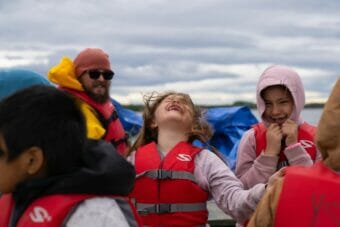
Students from the Yupiit School District go drift netting for salmon. June 23, 2023 in Akiachak, Alaska. (MaryCait Dolan/KYUK)

Summer culture camp

In the summer, Yupiit schools offer culture camp.

On an overcast day this June, teachers and elders meet students at a large cutting table near teacher housing near the river. Originally, the morning catch of salmon was supposed to be processed at a nearby community fish camp, but those plans were scrapped because a black bear was hanging around.

Literacy coach Evelyn Esmailka wields a large ulu as she explains the differences between chum, chinook, and sockeye salmon to the small group of children. After this lesson, the kids will board drift boats to go fishing for salmon on the river.

Barron Sample, principal of the Akiachak School, prepares to take students out drift netting. June 23, 2023 in Akiachak, Alaska. (MaryCait Dolan/KYUK)
Fish hangs to dry at a fish camp near Akiachak, Alaska. June 23, 2023. (MaryCait Dolan/KYUK)

“They’re getting ready to go out. This will be for the winter supply of fish, [to] supplement the lunch program,” Esmailka said.

After the fish are cleaned, they are loaded into the back of a beat-up truck to be dropped off at the school’s walk-in freezer. Salmon blood, to be returned back to the river, sloshes around in plastic totes as the truck lurches along Akiachak’s heavily potholed main drag.

Woody Woodgate, the school district’s federal programs director, said that staff favor indigenous foods in the district’s cafeterias.

“Not really taking anything away from the [United States Department of Agriculture] and the school lunch program, but most of that stuff that’s on those menus is designed for people in big cities, the lower 48, and a lot of it just goes into the trash can because kids don’t wanna eat the food,” Woodgate said. “So if we can supplement with fish and moose, and especially fish and moose that the kids catch.”

A student from the Akiachak School holds up a king salmon. June 23, 2023 in Akiachak, Alaska. (MaryCait Dolan/KYUK)

Taking part in the harvest

With the exception of sockeye, the salmon runs on the Kuskokwim River are crashing, and the day the kids were out was one of the limited opportunities to fish for them. As time ticked away on the 12-hour salmon fishing opener, the order of the day was making sure that every student gets a chance to take part in the harvest.

Barron Sample was in charge of the drift net fishing component of the summer culture camp. He is in his third year as principal at the Akiachak School.

Salmon caught near Akiachak, Alaska. June 23, 2023. (MaryCait Dolan/KYUK)
A fish camp near Akiachak, Alaska. June 23, 2023. (MaryCait Dolan/KYUK)

“For some of them, it’s the first time actually out here on the river doing this, and the first time they’re actually pulling a net,” Sample said.

The 24-foot boat is one of three owned by the school district.

“There’s three schools in our school district: Akiak, Tuluksak, and us, Akiachak. So, kind of in a little competition, like, ‘how many did you catch today?'” Sample said.

After a 150-foot gillnet was unfurled, the boat drifted slowly down the river. The children intently watched a line of buoys for signs of life.

Students from the Yupiit School District learn how to prepare freshly caught salmon. June 23, 2023 in Akiachak, Alaska. (MaryCait Dolan/KYUK)

“Fifteen more minutes and then we’re gonna reel it in,” a fourth-grader informs the crew.

While the first drift only yields two fish, the second brings in around a dozen: a mixture of reds, kings, and chums. The students scream in delight as the squirming salmon are picked from the net, landing with a thud in a plastic tote.

“I wanna fish again. This is actually a good spot to fish,” a fourth-grader chimes in.

Students from the Yupiit School District go drift netting for salmon. June 23, 2023 in Akiachak, Alaska.

After two drifts, there are plenty of fish to be processed and stored at the school for the coming winter. All the kids can talk about is going out again.

During the narrow window when fishing was allowed, the village of Akiachak felt like a ghost town. But along the river, the fish camps buzzed with activity as families processed the day’s harvest in a way that has changed little over the centuries.

Local stories mean Yukon River ‘treasure trove’ is more than just a lot of dinosaur footprints

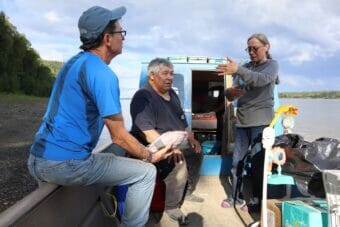
Rita Painter (right) and husband Dean Painter (center) tell paleontologist Tony Fiorillo (left) about a footprint they saw along the Yukon River more than 30 years ago. (Emily Schwing/KYUK)

It has been more than a decade since researchers first announced that they’d found dinosaur footprints along the middle section of the Yukon River. And when that team did make their discovery public, they also said that it was unlikely that people who live along the river even knew dinosaur footprints littered the riverbanks near them.
But Nulato resident Rita Painter can prove them wrong.

“It was maybe about 30 to 35 years ago, and that’s when they had a fish wheel right down here,” Painter said.

Painter stands in her family’s long, aluminum boat near the riverbank at Halfway Camp, a fish camp about 12 miles downriver from Nulato. She tells the story of a large fossilized dinosaur footprint that had been found nearby.

“We were coming up from Grayling; they invited us to have some tea,” Painter said. “And while we were visiting with them, they showed us this rock. It was huge, and there was, like, a footprint on the rock.”

Painter said that the rock was maybe a foot or so wide and about 8 inches long.

“It was clearly a foot, but the toes looked different. And it was embedded in a rock,” Painter said.

Her husband, Dean Painter, said that the footprint had three toes.

The Painters told their story to three scientists who spent 16 days on the Yukon River in August. The team was hoping to find out more about the ancient reptiles and birds that once lived in this area.

The Painters’ description pretty accurately describes the footprint made by a bipedal, plant-eating dinosaur known as an ornithopod. And it’s helping the researchers meet their goal to better understand what locals know about the footprints.

A large dinosaur footprint lies along the banks of the Yukon River downriver from Kaltag. The three toes are a signature sign that plant-eating ornithopods, which walked on two feet, once lived in abundance in this region of Alaska’s Interior. (Emily Schwing/KYUK)

Martha Turner grew up fishing along the span of riverbank where the Painters told the story of their dinosaur footprint encounter. It’s also a place where researchers found dozens of similar footprints. “Oh wow. That’s so cool. Like, our camp has all these dinosaur tracks,” said Turner when she heard Painter’s story.

Turner, who is Nulato’s tribal administrator, said that her grandmother, who was born at Halfway Camp, never mentioned any large, three-toed footprints to her before. Now she’s eager to ask about it.

In Kaltag, a village just over 30 miles downriver from Nulato, news that a research team was finding dinosaur tracks there this summer came as no surprise.

“Ever since we were this big, ever since we were 3-foot high we knew,” said Patrick “Paddy Bun” Madros Jr.

Madros Jr. said that he’s been finding ancient footprints left by giant reptiles along the riverbank his entire life. He grew up at a fish camp even further downriver.

“When we flip over rocks on the bluffs and we’re making a deadman, we put a stick down and we bury it and we see the footprints,” Madros Jr. said.

A deadman is a pile of wood buried deep in the sand and silt. It helps anchor a fish wheel in place.

Patrick “Paddy Bun” Madros Jr. grew up at a fish camp downriver from Kaltag. He said that he’s been finding prehistoric footprints left by dinosaurs along the Yukon River’s banks all of his life. (Emily Schwing/KYUK)

Madros Jr. said that he was always finding preserved footprints in the rocks, but he was too busy subsistence fishing with his family to pay much attention to them.

“You would never think twice about it. It’s just another rock. Throw it on the pile,” Madros Jr. said.

“I don’t think it’s something that people would stop and say ‘we need to dig here and look around here,’” said Kaltag Mayor Violet Burnham. She added that the science is interesting, but not her community’s focus. “Because there’s so many other things that we face as a community that are just more important.”

Burnham was born in Kaltag. She said that things have changed drastically, and it’s been hard on her community where jobs are limited and where, in recent years, the salmon populations people rely on heavily for food have crashed.

Kaltag Mayor Violet Burnham’s husband has been finding dinosaur footprints along the Yukon River’s banks for years. While she says that the Yukon River’s paleontological story is interesting, her community’s main priority is survival. (Emily Schwing/KYUK)

“In my lifetime we went from no phone to phones, to internet, to 24-hours-a-day news. From a subsistence lifestyle to a cash-based economy,” Burnham said.

Paleontologist Tony Fiorillo said that he is pleased to hear people’s memories and stories of footprints. Fiorillo is the Executive Director of New Mexico’s Museum of Natural History and Science and he has studied Alaska’s dinosaurs for 24 years.

“I think that’s fascinating to me because if you go back, what did they say? Thirty to 35 years? You’re starting to get to when dinosaurs were first recognized in this state,” Fiorillo said.

Fiorillo and his colleague, paleontologist Yoshitsugu Kobayashi, spent time traveling on the Yukon River this year. They spent much of the field season collecting data to create 3D images of every track they found. Instead of removing the footprints themselves as specimens to be housed in a museum archive, they also made numerous molds of the footprints. Kobayashi said that he believes the footprints should stay where the locals can see them.

“It’s not ours,” Kobayashi said. “The specimens belong to this place.”

Marshall’s tribal president speaks on the cultural toll of the Yukon River salmon crash

Christian Mulipola reaches for king salmon strips his grandmother, Diane Ishnook, has hung up to dry. Her king salmon were caught far downriver from Koliganek. (Photo by Avery Lill/KDLG)
Christian Mulipola reaches for king salmon strips his grandmother, Diane Ishnook, has hung up to dry. (Avery Lill/KDLG)

Salmon runs on the Yukon River have been dwindling for years. And the loss of commercial and subsistence fishing has hit communities hard. KYUK sat down with Tribal President Nick Andrew Jr. of Marshall on Aug. 9 to talk about what the salmon crash means for people who have relied on the fish since time immemorial.

Andrew has fished for salmon commercially and for subsistence since he was five. He spoke about the emotional and cultural toll that the salmon crisis has taken on his community.

Listen:

This interview has been edited for clarity and length.

Nick Andrew Jr.: My name is Nick Andrew Jr. I am a tribal citizen of Marshall. I am also the tribal president, but what I have to say is not necessarily a statement on behalf of the tribe.

I’m from Marshall, born and raised. I’ve been part of the salmon fishery, the commercial and subsistence, since I was five years old. I helped my family, my grandparents, my uncles, my aunts, my nieces, my cousins, we all worked together in the past. And yes, salmon does define who I am. It does define my ancestors, my family, my relatives, everyone on the river.

Nick Andrew Jr., Native Village of Marshall Tribal President. (Dean Swope/KYUK)

We’ve been in conservation mode for king salmon for about 40 years. And that’s a long time. I’ve seen the years of plenty. I’ve seen the years of scarcity, and it’s a political issue now.

Loss of salmon hit us really hard on the cultural side. There went our connection to the ancestors. We also lost that family connection. Because a lot of people went fishing and processing, they involve the family. And the last four years have been hard, especially the years we were in strict conservation mode. It was felt in the community and the region on the lower Yukon River. We had a sense of helplessness.

Basically, not knowing was the biggest thing. We thought that the salmon were going extinct, that was one of the thoughts. And we also had a sense of despair. We didn’t have salmon, dried salmon, smoked salmon, salmon strips, salmon dry-fish, king salmon, salted fish, and salmon for the freezer, for the winter. That took a big emotional toll on our people.

Our subsistence rights are not negotiable. We only take a small fraction of any of the runs that pass the river. And it’s not too hard to ask that more be done for the salmon. Because if nothing’s done, within 50 years we’re gonna be on the endangered list, probably extinction at the rate things are going. So we just need a voice at the table, especially on the North Pacific Fishery Management Council. Our input is important. Our traditional knowledge is important. And we, the Native peoples along the river on shore, we matter too. That needs to be kept in mind.

Francisco Martínezcuello: How has this year’s run been?

Nick Andrew Jr.: Well, when we look at the run we get information from the Alaska Department of Fish and Game on their Facebook page and the faxes we’re getting to the tribe, and they’re showing lower and lower numbers. That’s very concerning. And on a different note, we were allowed to harvest the summer chum. And that really helped a lot of people. And that put reassurance that hey, we do matter. Hey, we’ll have salmon for the winter, even though it’s not the king salmon we’ve desperately been wanting for years. So that’s where we are.

Francisco Martínezcuello: What about your memories as a kid fishing around here, to give people like me who are complete outsiders an understanding of how things used to be, especially for your people, your family?

Nick Andrew Jr.: Growing up was a different time. We had plenty of fish: king salmon, summer, fall chum, and the silvers. The village would empty. Families went to fish camp during those years. Everyone was happy. The dogs that were needed for our transportation and subsistence activities back in the day were fed, they relied on salmon too. All the bears, the birds, meaning the eagles and falcons, seagulls, they were happy too, and the world was complete then. So, on any given day, dried salmon, salted salmon were eaten three or four times a day.

Nowadays, as the salmon started to dwindle, people had to find other species. But still that left the void, the void meaning a big part of our staple was gone. And it’s still, the puzzle isn’t complete today because we got all these factors, and that affected our culture, our physiological and our mental well-being as well. You know it does weigh heavily on our minds, and our very DNA are in tune with salmon as our diet, our identity, our culture. So as the salmon continue to dwindle, that’s impacting just about everyone in our region and on the lower Yukon River because it was the common denominator that made us whole.

KYUK’s Evan Erickson helped with this story.

Scientists find a ‘dinosaur bonanza’ during Yukon River trip


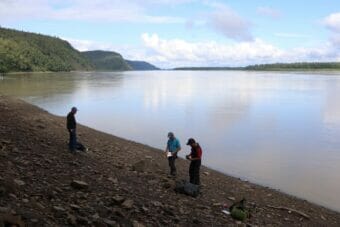
A three-man team of scientists are traveling the middle section of the Yukon River by boat with a local guide this summer. They’re looking for signs of dinosaurs that once roamed here during the early Cretaceous Period, which was around 100 million years ago. (Emily Schwing/KYUK)

A small team of researchers is on the Yukon River this month to learn more about an area where dinosaur footprints were discovered 10 years ago. And in a single week, they’ve turned up at least two dozen footprints left by at least five different ancient species

Halfway into the second day along the Yukon River, the team is more than 300 miles west of Fairbanks, near Nulato. Paleontologist Tony Fiorillo points to two small blobs protruding out of a large block of yellow sandstone. They look like flattened tennis balls, except there are three distinct toes. These are 100-million-year-old dinosaur footprints.

“So it’s either another body size of a dinosaur that lived here or it’s a baby,” Fiorillo said.

Fiorillo is the Executive Director of the New Mexico Museum of Natural History and Science. He said that this print was made by an ornithopod, a group of bipedal herbivores. This is the smallest ornithopod print he that said he’s ever found.

The leader of a three man team, Fiorillo also discovered signs of an ancient fish species. He pointed to a gray block of sandstone with marks that look like someone scraped their fingernails across it. There are a series of three evenly spaced, raised lines.

“What this surface is is an ichnogenus called undichna, a trace fossil of a fish, a bony fish,” Fiorillo said. “As the fish is swimming and it’s fins are hitting the bottom, the rays of the fin will do that.”

Between 2000 and 2013, Fiorillo, who is an expert on the dinosaurs that once roamed Alaska, visited the upper reaches of the Yukon River six times. During those years he only ever found two dinosaur footprints.

“That’s the hardest I ever worked for two footprints,” Fiorillo said.

But now, on the middle section of the river, Fiorillo said that it’s something of a “dinosaur bonanza.”

“I think it might have taken an hour to find the first footprint. I wouldn’t say the floodgates are open yet, but I think we’re gonna feel like that at the rate we’re finding stuff,” Fiorillo said.

By the end of the second day of field work, the three-man team had recorded nearly a dozen fossil footprints. In the following few days, that number has more than doubled and the team plans to continue their search through the middle of August.

Scientists embark on a Yukon River expedition to track down a trove of dinosaur footprints

Tony Fiorillo and Yoshitsugu Kobayashi measure and record a dinosaur track at Aniakchak Bay in the Aleutians in 2022. This year, the two paleontologists are focusing their attention on the Interior, where scientists reported a trove of dinosaur tracks in 2013 somewhere along the Yukon River. (Emily Schwing/KYUK)

A team of scientists was in Fairbanks this week making final preparations for a three-week expedition. The goal of the trip is to locate and document a treasure trove of dinosaur tracks discovered along the banks of the Yukon River a decade ago.

“When I started this project 24 years ago, I think the number of dinosaur sites known from Alaska you could count on one hand, maybe with a couple of extra fingers,” said New Mexico Museum of Natural History and Science Executive Director Tony Fiorillo. He’s an expert on dinosaurs in Alaska’s arctic and subarctic.

After dozens of field seasons along the Aleutian chain and on the North Slope, Fiorillo will explore new territory along the middle section of the Yukon River.

“We’ve got a geologic map. We know where the rocks of interest intersect with the river, and that’s what we’re going to do: we’re going to let the geology and paleontology determine what happens while we’re on the river,” Fiorillo said.

Back in 2013, a team from the University of Alaska Fairbanks reported finding thousands of tracks from at least two dinosaur species somewhere along the Yukon River between the villages of Ruby and Kaltag. It’s unclear if anyone has been back since, and it’s also unclear what the people who live along the river know about them, which is a question Fiorillo also wants to answer.

“These communities may actually have something just because they’re up and down that river. And those people see stuff, and they’ve had to have seen stuff, and maybe they have an explanation. What does that mean to them?” Fiorillo said. “And so if these communities have those stories, and if they’re willing to share them, I would love to hear them.”

Fiorillo is joined by Yoshitsugu Kobayashi, a paleontologist with Japan’s Hokkaido University. Paul McCarthy, a paleopedologist, or expert in ancient soils, from the University of Alaska Fairbanks is also on the team.

The rocky outcrops the team will target are from the Cretaceous Period and are up to 100 million years old. They also hold fossilized plant material, small clues that can help the team piece together the story of the dinosaurs that once roamed the Interior. The expedition will cover up to 250 miles of the middle Yukon over the next three weeks.

Editor’s note: Emily Schwing is traveling with this group of researchers for the duration of the project. Her flight from Fairbanks to Galena was covered by funding for the project. 

Bethel’s first car show is a blast from Alaska’s past

Cars line the parking lot of NAPA Auto Parts for Bethel’s first car show. (Josiah Swope/KYUK)

Gary Baldwin prefers to find parts for his teal 1953 Willys Jeep pickup truck rather than buying them. It shows when he pops the hood.

“There’s a lot of parts from different vehicles from the dump in here,” Baldwin said. “This air cleaner is out of a Toyota. The cable for the throttle is a Subaru cable. The gas pedal is a Chevy truck.”

Baldwin showed off his truck at Bethel’s first-ever car show, held over the weekend. The Southwest Alaska community is off the U.S. road system, and cars must be shipped in on barges, for a higher price, or flown in.

Baldwin’s classic was the car of a former principal in the Lower Kuskokwim School District in the 1970s, who would drive it on the local trails when the snow wasn’t too deep. Baldwin inherited it in the ’90s.

“People tell me it was driven to Quinhagak, and I know it used to be driven back and forth between Nunapitchuk because he worked in both of those villages,” Baldwin said.

Baldwin, who was the district’s superintendent, said that he drove it daily until he retired.

Henry Peter said that his wife learned to drive on that same model. Peter was born in a log cabin in Kasigluk, a village west of Bethel. He first saw more vehicles when he came to Bethel in 1966.

“When I grew up, there was hardly no drive, no cars,” Peter said. “And those old-time snowmachines.”

It takes a lot of work for a car lover to maintain a vehicle in Bethel, and that’s a big part of why Alaska State Trooper Zack Huckstep decided to organize the city’s first car show.

Zack Huckstep’s 1971 Toyota Brown, basically a Land Cruiser. (Josiah Swope/KYUK)

Huckstep showed up with his 1971 Toyota Brown, which is basically a Land Cruiser. On the morning of the show, he converted its flatbed into a temporary playpen so that he could keep his toddler under control while he did some last-minute polishing.

Visitors who peeked inside got to see its long leather seats — and a perfect LEGO replica of the vehicle.

“Did I tell you about the LEGO garage?” Huckstep asked. “So, I didn’t want to geek out too much, but I actually have, like, a LEGO garage with, like, all the tools, and a garage and a lift and everything for that LEGO truck.”

That LEGO garage is actually the only one Huckstep owns. He doesn’t have a life-size one in Bethel. And that has been a problem because Bethel’s dust storms can wreck a paint job. Replacement paint, like everything else that makes its way to town, isn’t cheap. Neither is getting these vehicles to Bethel.

A LEGO replica of Zack Huckstep’s Toyota Brown. (Josiah Swope/KYUK)

“It was shipped from Australia all the way to, I believe, San Diego. And the funny thing was, it was actually cheaper to ship from Australia to America than it was to ship from Anchorage to Bethel,” Huckstep said.

NAPA Auto Parts, the only car parts shop in town, welcomed the car show. And it was a team effort. Alaska Commercial Company donated hot dogs and hamburgers, then NAPA employees grilled them for visitors.

It wasn’t just cars that showed up. There was a brand new four-wheeler, one of the more popular vehicles in the region, and a cherry-red Vespa.

Trooper Elondre Johnson entered his vehicle to support Huckstep. He had additions, including a panel of fluorescent lights for when he drives to villages on the frozen river in winter.

“Alaska is a dark place,” said Johnson. “And so anytime we get kind of get off-road, running down the river where things are really dark, it’s nice to have the extra lighting.”

Don Roberts brought arguably the most practical vehicle: a new Bobcat. For the show, he put a 6-foot long snowblower on the front of it, which he’s used to plow 20 feet of blown snow off friends’ houses along the tundra. But Roberts said that there are probably 75 different tools he can swap into that spot.

“God there’s so much. There’s numerous attachments,” said Roberts. “You can put grass cutters on here, posthole diggers, backhoes will go on it. Anything that will go on a tractor will go on the front of this. I can’t name all of them. There’s just so many things that will go on this.”

But it was Jimmy Guinn who brought the showstopper: A giant, shiny, sun-yellow truck from 1942. He said that it was a rare find because most of them were shipped off in WWII. He had it shipped up from Seattle. It rarely leaves the garage. It was easy to admire the inside, with its yellow and black stripes and a classic dashboard, but many were struck by how well-maintained it was.

The interior of Jimmy Guinn’s rare yellow 1942 Ford 1-Ton. (Josiah Swope/KYUK)

“The reason why I like it is because it’s almost impossible to keep things clean,” said Ava, an 11-year-old spectator. “I wonder how they even got here without getting it dirty.”

“Yeah. This is beautiful,” agreed city mechanic Eddie Fenn. “Oh, this is beautiful. Like a Tonka toy.”

But as much as the Alaskans appreciated the sunny vintage vehicle’s uncanny shine, they’re suckers for trucks.

“The big yellow ’43 truck is by far, you know, the most spectacular,” said Iskandar Alexandar, who works in behavioral health at the Yukon-Kuskokwim Health Corporation.

“But I actually feel the best in choice, I voted for this one more kind of conventional-looking guy. [Because] if you just had a suitcase full of money, you could go and buy that off the shelf yourself and imagine yourself driving it. And, you know, it’s Alaska,” Alexandar said. “Chicks dig trucks.”

From the left, Jimmy Guinn won first place, Best in Show and People’s Choice. Gary Baldwin won third place, Rick Cunningham won fourth place, Curtis Robinett won Best Truck and Skyler Kingley won fifth place. On the far right, organizer Zack Huckstep won second place and Best 4×4. (Josiah Swope/KYUK)

In the end, when all of the votes were counted, Guinn’s truck won Best in Show.

“Don’t run away too far, Jimmy,” Huckstep said from the megaphone as Guinn collected a bucket of car repair goods donated by NAPA Auto Parts. “You also ended up with People’s Choice and first place.”

Still, Guinn said that the best part of the day was getting to hang out with all of the other gearheads in town.

“All these cars have just lots of love in them,” Guinn said. “Doesn’t matter if they’re beat up, or if they’re brand new or whatever, that owners really love every one of them. So that’s what makes owning a car like this fun, because everybody cares.”

Guinn didn’t even bring his favorite car. It’s metallic gold, with grills in the front and nuggets on the license plate. It seems like a strong contender for another set of awards next year, but who knows what other cars might roll up then.

Site notifications
Update notification options
Subscribe to notifications