KYUK - Bethel

KYUK is our partner station in Bethel. KTOO collaborates with partners across the state to cover important news and to share stories with our audiences.
Starlink connections among latest round of tribal broadband funding for Alaska

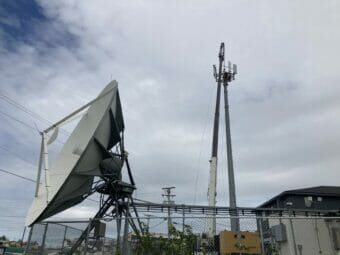
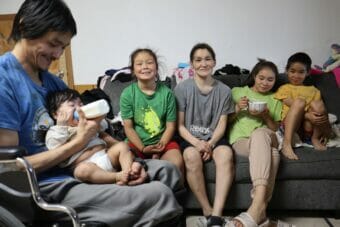
GCI’s wireless tower at Watson’s Corner in Bethel is seen on June 27, 2023. (Evan Erickson/KYUK)

Alaska Sens. Lisa Murkowski and Dan Sullivan are applauding nearly $54 million in additional grants this month under the federal Tribal Broadband Connectivity Program.

Among the grants is $4.5 million to purchase and install Starlink, a low Earth orbit satellite communications network owned by SpaceX, in 1,410 homes and nine community institutions on the Yukon-Kuskokwim Delta.
Alaska has thus far received more than $400 million under the tribal program, most of which is going to fiber-optic network projects spearheaded by GCI, the primary internet service provider for Western Alaska, and its partners. The Sept. 19 grant announcement is the first mention of federal funding for Starlink in Alaska.

Sen. Murkowski’s director of communications, Joe Plesha, said that the summer-long network disruptions experienced by GCI customers following a subsea fiber-optic cable cut in the Beaufort Sea showed a need for backup options.

“It’s great that it’s been repaired and service has been fully restored, but it really underscores the importance of broadband redundancy for our rural communities so that our networks are resilient to outages,” Plesha said.

The remainder of the nearly $54 million in tribal broadband grants is spread among seven other projects, with more than half going to Alaska Tribal Spectrum, a project to bring “2.5Ghz spectrum and/or satellite service” to unserved tribal households, businesses, and community institutions across Alaska.

The specific grants include:

Igiugig Village: $8 million for planning, engineering, feasibility, and sustainability studies. The project will serve 16 Alaska Native Villages and complete in-depth feasibility studies, last-mile design, and construction cost estimates.

Alaska Tribal Spectrum: $29.5 million to install a wireless network using a Tribally-controlled 2.5Ghz spectrum and/or satellite service to directly connect a total of 2,569 unserved Tribal households, 125 unserved Tribal businesses, and 89 Tribal community anchor institutions with qualified broadband speeds.

Alaska Village Initiatives: $7 million to construct last-mile wireless deployment infrastructure in 13 of the Alaska Native Villages in the Consortium by utilizing 2.5Ghz licensed spectrum. Additionally, the project will also deploy fiber to the premise in one Alaska Native Village.

Alutiiq Tribe of Old Harbor: $500,000 to upgrade equipment in the current system in order to deliver qualifying broadband service to 72 unserved Tribal households.

Benhti Economic Development Corporation: $999,997 for the pre-construction planning, engineering, design, and permitting of last-mile network services. The project will create a shovel-ready project to build broadband networks in the Native Village of Minto and of Manley Hot Springs.

Chugachmiut: $991,974 to provide satellite internet service subsidies for the Native Village of Nanwalek and the Native Village of Port Graham.

Huna Totem Corporation: $2,467,546 to provide minimal upgrades to network and customer equipment in addition to providing Native households with three years of subsidies service.

Yukon-Kuskokwim Delta Tribal Broadband: $4.5 million to purchase and install Starlink to 1,410 homes and nine community anchor institutions.

New ‘berry booklets’ for Alaska pickers combine traditional knowledge and science

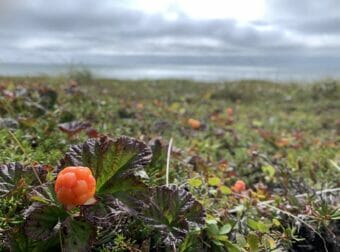
Cloudberries are the focus of a new booklet out this month that includes information on how climate change is impacting Alaska’s berries statewide. (Emily Schwing/KYUK)

A team of scientists at the University of Alaska Fairbanks just released its first “berry booklet.” It’s part of a larger project that digs into the future of Alaska’s wild berries as the climate warms.

Berries, regardless of species, are a huge part of rural Alaska’s subsistence lifestyle. They are often the only fresh, local fruit available in remote villages. Their value is not lost on the Alaska Climate Science Center’s tribal resilience liaison, Malinda Chase.

“Well, berries mean to me joy,” she said from her home in Fairbanks. Chase grew up between Anvik and Anchorage.

“To see your berry bucket get full, to know that this is part of our beautiful land. It’s food that is delicious, it’s something that we do as families, as communities, as good friends,” Chase said.

A warming climate means where and how people harvest berries is changing. And over the years, communities across Alaska have developed climate change adaptation and mitigation plans.

Two years ago Chase’s colleague, University of Alaska Fairbanks Research Association professor Katie Spellman, started reading them.

“Malinda told me, ‘You go read all the climate adaptation plans and start there, because that’s where the important research needs to be,’” Spellman said.

Among dozens of plans she read, Chase said that she only found two references to scientific research specific to berries.

“It made it really clear that the science on berries, which is a topic that Alaskans care a lot about, was not accessible,” Spellman said.

“Scientific papers are really hard to read if you’re not trained to read them,” said Christa Mulder, a plant ecologist at UAF. “They’re really dense. They’re full of difficult words, so what we decided to do is essentially a translation project.”

Mulder said that the team set out to learn everything they could about how climate change could affect the plants people care about.

Mulder, Spellman, and Chase held three listening sessions with berry pickers representing 50 communities. And this month, they’ve released the first in a series of six booklets. The aim is to blend scientific research with traditional knowledge and current observations on how climate change is altering where and how berries grow in Alaska. Chase said that it’s a good start.

“You know, we have so many beliefs and traditions around berries, and they’re so central to many of our family time together, our time on the land, and that is significant,” Chase said.

The first berry booklet, which is focused on cloudberries, was released earlier this month. Also known as akpiqs in Iñupiaq and atsalugpiaq in Yugtun, cloudberries are soft, round bright orange berries that grow on Alaska’s tundra. Many people also call them “salmonberries.”

Spellman said that they’re fascinating.

“It has male and female flowers, and so if the weather during pollination time is off, then it’s gonna really affect how many fruits, how many berries, are produced in that year,” Spellman said. “I just think it’s a really beautiful and fragile berry that really relies on those pollinators.”

Those pollinators can’t fly in colder temperatures, according to the cloudberry booklet. But a warmer climate may help pollinators.

Mulder said that the team worked hard to make sure to include the potential benefits of a changing climate. She said that the booklets include advice on how people who rely on berries can help them thrive.

“So very simple pruning, for example, of blueberries can give a gazillion blueberries on a single plant. And that’s not a solution for everything, of course, but if you have Elders who can’t go very far, having patches of forest where sort of cultivate, semi-cultivate, have a bit of a food forest could be a really good thing,” Mulder said.

Five other booklets are due out in the coming months. Those will focus on blueberries; lingonberries, also known as low-bush cranberries; crowberries, also known as blackberries; and red currants. They’ve already garnered so much interest that the team is looking at ways to combine all the booklets into one main resource.

Alaska’s congresswoman is thankful for the overwhelming support she has received

U.S. Rep. Mary Peltola is thankful for the overwhelming support and sympathy that she has received after the passing of her husband, Eugene Peltola Jr., said a statement from her congressional office.

“To everyone who has reached out, from Alaska to D.C. and everywhere in between, thank you,” the congresswoman’s chief of staff, Anton McParland, said in a written statement Thursday. “You have made a dark time just a little lighter.”

Eugene Peltola Jr., who went by Buzzy, died after the plane he was flying crashed Tuesday in remote Western Alaska.

The National Transportation Safety Board is investigating the accident and has briefed Peltola and her staff on the process, according to McParland.

He said U.S. Rep. Peltola’s office has gotten support from Alaska’s U.S. senators and governor, and many others have also reached out with sympathy and stories about Buzzy.

“Alaska is a tight-knit state that relies on planes for basic travel, and so many Alaskans have felt the impact of an accident like this,” McParland said. “That doesn’t make it any less devastating, but it does mean we know how to support one another.”

McParland said U.S. Rep. Peltola is back home with her family, and out of respect for their privacy, the office “will not be commenting any further on the investigation.”

He said condolences can be sent by mail to Peltola’s district office at 121 W. Fireweed Lane, Suite 260, Anchorage, AK 99503.

Alaska Public Media contributed to this story.

Eugene ‘Buzzy’ Peltola, husband of Rep. Mary Peltola, has died in a plane crash

Mary Peltola hugs her husband
Mary Peltola hugs her husband, Gene “Buzzy” Peltola, as results are tallied on Wednesday, Aug. 31, 2022. (Photo by Matt Faubion/Alaska Public Media)

U.S. Rep. Mary Peltola’s husband, 57-year-old Eugene “Buzzy” Peltola Jr., died awaiting rescue after the plane he was flying crashed Tuesday in remote Western Alaska, according to officials.

Anton McParland, Mary Peltola’s chief of staff, said in a statement posted on her social media accounts that she was returning to Alaska to be with her family after the crash.

According to the National Transportation Safety Board, Eugene Peltola Jr. was the pilot and sole occupant of a Piper PA-18-150 Super Cub that crashed under “unknown circumstances” around 8:45 p.m. Tuesday.

Peltola, who is from Bethel, had flown a hunter and the hunter’s equipment to a remote location 64 miles away from the Western Alaska village of St. Mary’s.

“After leaving the hunter, the plane took off to return and appears to have crashed in an area of remote, mountainous terrain,” said the statement from NTSB spokesperson Sarah Sulick.

Weather in the area at the time was reported as roughly 10 mph wind out of the northwest and overcast skies, according to the National Weather Service.

Alaska State Troopers said Peltola initially survived the crash, and was cared for by two hunters at the crash site.

The NTSB says the Alaska Rescue Coordination Center at Anchorage’s Joint Base Elmendorf-Richardson received a satellite signal from the plane’s emergency locator transmitter at 8:48 p.m. Tuesday and deployed an Alaska Air National Guard rescue team, which arrived at the scene early Wednesday.

“The pilot was confirmed to be Peltola who was flying a Piper Supercub that crashed just after departure,” troopers said in an online report. “Peltola unfortunately died before the rescue team arrived. The rescue team transported Peltola and the two uninjured hunters back to Joint Base Elmendorf-Richardson.”

Troopers said Peltola’s body was sent to the state medical examiner’s office for an autopsy.

NTSB investigators were trying to reach the crash site Wednesday morning.

NTSB Chair Jennifer Homendy said Wednesday that a specialized team was en route from Washington, D.C., to Alaska to investigate the crash. It will include representatives from aircraft manufacturer Piper and engine maker Lycoming, as well as the Federal Aviation Administration.

NTSB meteorologists will be gathering weather reports from the area, according to Homendy. Investigators will also examine the aircraft’s origin and destination, as well as whether Peltola was flying the plane on a private flight, she said.

Condolences and remembrances for Eugene “Buzzy” Peltola Jr. poured in Wednesday morning.

He “was completely devoted to his parents, kids, siblings, extended family and friends, and he simply adored Mary,” said McParland, the congresswoman’s chief of staff. “We are heartbroken for the family’s loss.”

Eugene Peltola served in a number of high-level posts. He worked for the U.S. Fish and Wildlife Service and led subsistence management, and he was the top Alaska official in the Bureau of Indian Affairs. He retired last summer, as his wife was running for office.

Peltola recently joked that he was adjusting to his new job as “arm candy” to the congresswoman.

In addition to being a prolific subsistence harvester, Peltola was an avid sports hunter and fisherman, a hobby he pursued all over the globe. His Facebook page includes photos of a 2017 hunting trip in Spain with his daughter, KK.

The ANCSA Regional Association described Peltola as a “beloved husband, father, andaughterd friend to so many, making an impact on everyone he met.”

“He lived a life of service, dedicated to Alaska Native people and his home of Bethel through his decades-long career in federal service and his years of local government and Alaska Native corporation leadership,” said a statement from the regional association.

U.S. Sen. Lisa Murkowksi said “anyone who met Buzzy felt his warmth, generosity and charm.”

“It was easy to see why so many Alaskans called him a friend, and how he was so loved by his family,” she posted on social media.

U.S. Dan Sullivan and Alaska Gov. Mike Dunleavy both said in social media posts that they were shocked and saddened to learn of Peltola’s death.

“Today, we mourn the tragic loss of Gene, and offer Mary and her family our heartfelt prayers for strength and consolation in this time of unspeakable loss and grief, and know that Alaskans across our great state are doing the same,” Sullivan said.

“We will be praying for Mary, their children, and all of the Peltola family. Gene’s dedication to Alaska ran deep, and he will be dearly missed,” Dunleavy said.

Alaska has a history of plane crashes affecting political figures, including the 1972 disappearance of a small plane in the Portage area carrying then-U.S. House Majority Leader Hale Boggs, the father of late NPR journalist Cokie Roberts, and U.S. Rep. Nick Begich, former Sen. Mark Begich’s father. Begich’s aide, Russell Brown and pilot Don Jonz were also on board.

Alaska’s longest-serving U.S. senator, Ted Stevens, was among five people killed when a floatplane crashed north of Dillingham in 2010.

Stevens’s first wife, Ann Stevens, and four others were killed in a plane crash in Anchorage in

1978. The senator was injured but survived.

Mary Peltola was elected to replace longtime U.S. Rep. Don Young, who died in March 2022 aboard an Alaska Airlines flight to Seattle.

The congresswoman’s staff will continue to operate her office and meet with constituents while the family grieves, McParland said.

Watch the full NTSB media briefing on the crash:

This is a developing story. Please check back for updates.

Correction: Peltola’s father, Eugene Peltola Sr., was CEO of the Yukon Kuskokwim Health Corporation, which runs the Bethel hospital.

100 million years ago, dinosaurs left clues about how they lived in Interior Alaska

A three-man research team spent three weeks exploring more than 100 miles of Yukon riverbanks this summer to find out more about how dinosaurs lived in the region during the Early Cretaceous. (Emily Schwing/KYUK)

Over the course of three weeks, scientists documented more than 90 sites where dinosaurs left their footprints along the middle section of the Yukon River. It’s the first time researchers have dug so deep into the region’s ancient history.

Paleontologists Tony Fiorillo and Yoshitsugu Kobayashi spent many hours considering the details of footprints left behind by at least half a dozen ancient species.

The most common footprints this team found here along the Yukon River this summer were plant-eating dinosaurs that made three-toed prints. Fiorillo and Kobayashi also found footprints left behind by a four-toed, armored ankylosaur.

Yoshitsugu Kobaysahi, a paleontology professor from Hokkaido University in Japan, points to a dinosaur footprint, left behind 100 million years ago along the bank of the Yukon River. (Emily Schwing/KYUK)

For his part in the research, Kobayashi, who is a professor at Japan’s Hokkaido University, brought a lot of tools. He uses a technique called photogrammetry to create a 3D image of the fossils. This kind of imagery can help parse out finer details human eyes could miss. He also used a drone to fly over sections of the riverbanks that hold clues about the ancient landscape.

This kind of research is kind of like reading a book and filling in the details. The various dinosaur footprints indicate who the characters in the story are, but at least one of those characters also raised some questions. Nearly 100 million years ago, a species Fiorillo couldn’t immediately identify left a large print with three long, slender toes behind.

Once he returns to his office at the New Mexico Museum of Natural History and Science, Fiorillo will dig through literature and other museum archives to figure out what kind of ancient species left its mark here.

Halfway through the trip, the team stumbled upon a stretch of riverbank about the length of a football field. It was littered with large sandstone blocks that were covered in footprints left by at least two shorebird-like species. Fiorillo was floored by the find: at least 16 blocks covered in the same footprints.

“This must have been a place that they found something to do, like lots of food,” Fiorillo said.

The next day brought another interesting find: a series of small, knobby bumps on a dark gray siltstone that gave Fiorillo and Kobayashi pause. It was a dinosaur skin imprint. They said that the imprint indicates that this environment is also ripe for the preservation of bones.

Tony Fiorillo (in orange) and Yoshitsugu Kobayashi puzzle over the imprint of dinosaur skin, preserved in a chunk of gray siltstone. The two wonder if the rock isn’t also a preserved dinosaur footprint. (Emily Schwing/KYUK)

In all, the team recorded more than 90 track sites left behind by at least half a dozen different ancient species — so many discoveries that both Fiorillo and Kobayashi nearly ran out of pages in their hard-backed yellow field notebooks.

“I was starting to wonder, what am I going to do if I run out of pages? But I never had a field notebook this full,” Fiorillo said.

Kobayashi laughed. He said that he was also running out of space. “So my figures, drawings, and letters are getting smaller and smaller.”

This summer’s work informs a larger body of research, nearly a quarter century’s worth, on how large reptiles survived this far north. Kobayashi said that the story isn’t yet fully told.

“So once we get back and we get the data together, then we will have another question to ask. More than one, probably,” Kobayashi said. “This stretch of river, just one chapter of the book. We know there are more outcrops down the river. So we try to understand this chapter, and if there’s any holes left unsaid, we’re going to come back.”

After burying Marshall mother, friends and family ask why it took so long to find her

(Courtesy Of Kimberly Fitka O’Domin’s Family)

On Wednesday, Aug. 9, About 50 people gathered around a coffin centered in the living room floor of Kimberly Fitka O’Domin’s home in Marshall to welcome her home and say their goodbyes

Friends, family, and community members were finally able to bury her almost two months after she went missing from the village on June 15. Many are now asking why it took so long to find her in the first place. Her best friend, Jackie George, led the search to find her.

“Kimberly and I started our friendship when we were teenagers. We used to always go to teen dances and singing. There was times when we danced until three or four in the morning. We had so much fun,” George said. “Eskimo dancing brought us together. Later in life we became parents of our own kids, but our friendship still remained strong.”

The search

George has been leading Marshall’s search and rescue for more than 15 years and he is intimately familiar with the Yukon River. The night Fitka O’Domin disappeared, she told her mother someone had hit her and that she was going to break up a fight. She didn’t return, and her mother reported her missing on June 16. Somehow she ended up in the Yukon River.

“There were some scratch marks on top of the bank, which kind of indicated that we assume that’s where she went in. So we concentrated from her residence all the way down. At least two miles was our target area. And at the time, the river condition here was high water, the current flow is pretty fast,” George said.

(Francisco Matínezcuello/KYUK)

He coordinated with other villages. Even now he has a detailed memory of who did what, when.

“On June 18, [we had a] search and rescue meeting at 10 a.m.,” George said. “At 1 p.m., five boats from Marshall are utilizing drag bars and lead lines with hooks. That’s when the five Marshall boats went back out again to continue the search. At 3 p.m., two boats from Russian Mission, three boats from Pilot Station. At 5 p.m., three boats from Mountain Village join,” he said.

He also reached out to search and rescue in Bethel, where Fitka O’Domin lived for a time.

George said that search and rescue volunteers used boats equipped with fish finder sonar in the hope of finding her body.

“You start doing that figure eight, just back and forth going down the river slowly. That would detect more of what would be, say, the bodies in the river. They would detect it a lot faster using a figure eight grid. So they did that from below Kimberly’s residence all the way down to about 4 miles, 4 miles below Marshall,” George said.

These communities rallied without hesitation. George said that even the mining company Donlin Gold put together a Costco order for the search volunteers. Someone downriver brought up 200 dragging hooks; another sent money from Anchorage.

Troopers’ response

Alaska State Troopers did not send anyone to Marshall until five days after Fitka O’Domin went missing. Online and in private, family and friends have criticized the troopers for what they see as a lack of urgency.

Alaska State Trooper Capt. Andrew Merrill leads the C detachment, which covers Western Alaska. He said that they got a call about Fitka O’Domin’s disappearance on June 16 and started reaching out to village police officers and community members to find out what was happening.

“We did a lot of different things,” Merrill said. “We worked with the cell company to see if there was a way that we could try to locate her cell phone. And GCI, unfortunately, didn’t have the ability to do that. Their system wasn’t working. And so we did some of those investigative steps throughout the 16th.”

Merrill said that the village police officers also pulled video footage from the local stores to search for clues.

(Francisco Marínezcuello/KYUK)

Merrill said that troopers were told that this wasn’t the first time Fitka O’Domin had gone missing.

“That impacts kind of the immediacy of our response and how we’re going to do things,” Merrill said.

Two troopers from St. Mary’s arrived in Marshall on June 19 and spent the day talking to people.

Later, a couple not involved with the volunteer search efforts found her body about 100 miles downriver. 

Friction points

No one is saying that if the troopers had responded sooner, they think that Fitka O’Domin would still be alive today. But George wants accountability.

“We believe that if they had come earlier and properly investigated, this case would have been solved. There was some visible sign that there had been a struggle where her eyeglasses were found. We had also found handprints where someone had been dragged into the beach below her home. All that evidence was gone by the time the troopers arrived. The blood from an assault had pretty much dried up and washed away,” George said. “This was a neglect of duty on part of the Alaska State Troopers. We need answers.”

The trooper response time is not the only point of friction for the Marshall community. Fitka O’Domin’s mother, Elizabeth Fitka, attended the last Governor’s Council on Missing and Murdered Indigenous Persons meeting held in Anchorage on July 24. Trooper Merrill has been involved with that council since it started three years ago.

(Francisco Martínezcuello/KYUK)

Fitka told the council that troopers botched the investigation and she believes that the State Medical Examiner is culpable.

“I was the one that had to go through her contents. They gave me ah, they gave me a sealed muddy wet bag of her contents that were in her pocket. Maybe if they took a couple of seconds to wash those contents, they would have been able to find out that her phone can actually turn on,” Fitka said.

Fitka said that the State Medical Examiner’s Office is located near the Alaska Bureau of Investigations.

“Maybe if they were to took a couple of seconds to go over and ask for her contents. They would have been able to see her credit card that had her name on it. They had her keychain with her “Kim” on it, and then a phone that was in a muddy, wet, sealed bag when I washed it out and ran it to GCI and to Apple. Put it on the charger, it turned right on,” Fitka said.

What isn’t clear about this case is how it happened, who was responsible, and exactly why it took so long to get Alaska State Trooper resources mobilized when Fitka O’Domin was reported missing.

What is clear is that the Marshall community lost their tribal administrator, a woman who was revered in the community, and that Fitka O’Domin’s seven kids will grow up without their mother; the youngest is just two years old.

The family set up a GoFundMe account to help cover the cost of living for her children.

Site notifications
Update notification options
Subscribe to notifications