KYUK - Bethel

KYUK is our partner station in Bethel. KTOO collaborates with partners across the state to cover important news and to share stories with our audiences.
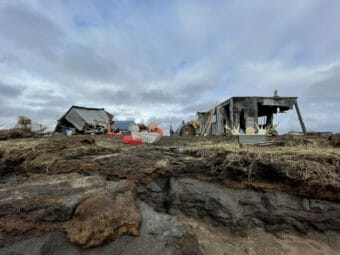
Reopened case into the death of Bethel woman leaves ‘more questions than answers’

(Katie Basile/KYUK)

In late 2021, Bethel police responding to a report of an intoxicated man at a home on 1st Avenue Access found an unconscious woman on the back porch. A black windbreaker was twisted around her neck. When they removed it, they noticed ligature marks, a common type of bruising when someone is strangled or hung.

Nikki Taylor didn’t have a pulse and she wasn’t breathing, according to their report, so they started CPR until medics arrived. Taylor was revived and medevaced to Anchorage, but the 31-year-old was declared brain dead three days later on Aug. 25, 2021.

Taylor’s parents were devastated.

“That is my daughter. I took care of her,” said Timothy Evon.

The State Medical Examiner’s Office ruled the death a suicide, but Evon and Taylor’s mother, Sophie Pinder, weren’t satisfied with that explanation. Pinder said that she called the state examiner’s office.

“When I talked with the medical examiner, I told her that it’s not suicide,” Pinder said.

But the cause of death did not change, and Taylor’s case was closed on Aug 27, 2021.

“Grief has no expiration,” Pinder said. “You die with them.”

Unanswered questions

The case could have ended there, another grim statistic in a state where the suicide rate is twice the national average, but Taylor’s family kept pushing for someone to listen to them. They found that man when Bethel swore in a new police chief, Leonard “Pete” Hicks, in late 2022.

Hicks, a transplant to Alaska from Alabama, encouraged members of the community to talk to him about their concerns. So Taylor’s parents called and asked him to look at the case.

“After talking to them, I told them I would look at the report again,” Hicks said. And when he did, Hicks said that what he found was concerning.

“There were a lot of unanswered questions that should have been addressed when you’re dealing with any death investigation. The last thing you want is a report that generates more questions than answers. And that was kind of the case here. A lot of statements didn’t make sense,” Hicks said.

Hicks told officers to reopen Taylor’s case.

“I definitely think that there’s more that occurred that day than just a simple suicide. And we need to know the truth as to what happened that day for the sake of the victim, the sake of the family,” Hicks said. 

When Bethel police reopened the case, the investigator who reviewed the case, Sgt. Brandon Boyle, eventually found more than a dozen “points of contention” — essentially red flags in the initial investigation.
For one, it would have been difficult for Taylor, who was 5 feet tall, to hang herself in the spot where she was found. According to the report, there wasn’t anything found nearby for her to use as a step. The investigator said that the windbreaker found twisted around her neck would likely have come undone with her full body weight on it.

Many of the investigator’s other questions about the case revolve around Taylor’s former fiancé, a man named Walter Williams.

According to police reports, Williams was found near Taylor’s body when Community Service Patrol officers arrived at the home. Those officers later told Bethel police that he was kneeling over her body and then yelled at them and fled the scene. He was caught moments later by Bethel police and handcuffed. Then, according to their report, he told police that Taylor had tried to hang herself.

The initial investigation details that police read the heavily intoxicated Williams his rights and then questioned him. According to that report, Williams said that he and Taylor had been arguing, and that he had stepped away to talk to someone else. He told police that when he got back, he noticed she was hanging.

“Follow-up that should have been done hadn’t been done”

The initial investigating officer concluded that Williams was too intoxicated to lift Taylor off the ground and tie her up by her jacket. The officer wrote that Taylor attempted suicide. But Williams has a history of assault convictions, and Hicks said that should have been investigated further.

“You had a suspect or boyfriend that had a history of domestic violence. So there were things that needed to be addressed. There was follow-up that should have been done that hadn’t been done,” Hicks said.

After the case was reopened, the new investigator got a search warrant for Taylor’s medical records and found no history of suicidal ideation. In fact, a note from Taylor’s doctor casts doubt on her suicide as well.

“I do not think Ms. Taylor’s injuries are consistent with hanging by a windbreaker. I am highly concerned for non-accidental trauma and possible homicide, especially since she had been assaulted within 48 hours prior to these injuries,” reads the note.

Despite the red flags, the reinvestigation of the case stalled in March 2023 when the Bethel Police Department asked the State Medical Examiner’s Office to reopen the case for review. There has been a lot of turnover at the department since then, and the case has changed hands three times.

Taylor’s father used to be in law enforcement. When he talks about this investigation, his frustration is palpable.

“The investigating officer, there’s many of them, two of them quit. And this last one right now, I told the investigating officer the only time I’ll shake your hand is when this thing is done in the court. Then I will shake your hand,” Evon said.

Now Hicks, the police chief who pushed for the case to be reopened, has stepped down too, leaving Taylor’s parents back where they were more than two years ago when she died: unsatisfied and still pushing for answers.

Williams, who is currently being held at Goose Creek for violating a protective order another woman has against him, has not been charged with anything connected to the investigation into Taylor’s death.

The District Attorney’s Office would not comment on the open case into Taylor’s death.

The State Medical Examiner’s Office would not comment either, but Taylor’s parents said that her death is still officially categorized as a suicide.

Pinder said that she doesn’t believe her daughter’s death is an isolated case. She thinks there are a lot of other families out there struggling with unresolved questions around the death of a loved one.

“We deserve justice,” Pinder said. “How would you feel if this was your child or if this was your sister? How would you feel? What would you do?”

Operation Santa Claus delivers Christmas gifts to Tuluksak

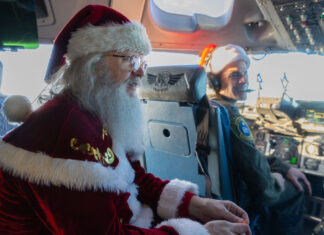
Visibility was poor, the ground was slick, and the rain was more ice than wet on Nov. 15. Conditions too challenging for even Santa’s seasoned sleigh crew. Some problems require modern solutions. Enter the Alaska National Guard’s Black Hawk, a four-blade, twin engine workhorse helicopter, reliable enough to transport wounded troops out of combat zones and get gifts to good boys and girls in remote places.

There wasn’t enough room inside the UH-60L Black Hawk helicopter for the Clauses and their helpers, the gifts and a radio reporter. So we took two trips. Santa was in the second group. That didn’t dampen seven-year-old Tuluksak second grader Stella’s excitement for St. Nick’s late arrival.

“I am excited to see Santa,” Stella said.

Over a hundred students and their families packed inside Tuluksak’s gymnasium. Mr. and Mrs. Claus were greeted and treated with Yup’ik drumming and dancing.

Tuluksak School Principal Kary DelSignore welcomed the visitors. She said that the community has faced a lot of challenges the past few years.

“We lost our water plant in a fire. Last year we had pipes burst underground, and the school had no running water, no sewer. We had to have water shipped in. That was a hardship on our community. We’ve had to rearrange our school schedules and get support from the state. But this is a really exciting event for our community and definitely a very positive event for everyone,” DelSignore said.

DelSignore also said that the high cost of living and the lack of employment opportunities make it difficult for families to afford Christmas gifts.

“This is a huge event, very meaningful to our students. I just saw the backpacks that they were unloading. And I cannot wait for our kids to be coming to school with their brand new backpacks and all of the surprises that are inside of them,” DelSignore said.

Maj. Henry Graciani is the Divisional Commander for the Salvation Army, Alaska division. He said that the Salvation Army has a long-standing partnership with the Alaska National Guard to run Operation Santa Claus.

“It’s an important thing. Every child is special, right? Every kid matters. And so it’s important for children not just in the city, but in rural areas to get support to be remembered, to be thought of. And so here we are partnering with Alaska National Guard, Mattel, and Tastee Freez to help out the children of Tuluksak, and we’re just grateful to be part of it. The Salvation Army is grateful to be a part of it,” Graciani said.

In addition to Santa, hundreds of servings of Tastee Freez ice cream were precious cargo on the flight. In fact, it was difficult to tell who had more people waiting in line: Santa or Tastee Freez.

“Do you want any toppings, chocolate, or caramel?” Tastee Freez representative Linwood Stowe asked an eager patron.

This reporter counted, and there were more people waiting for a Tastee Freez sundae than to sit on Santa’s lap.

Stowe said that he served over 200 sundaes in about an hour.

“Yeah, I love it. Coming out here, seeing the kids’ faces, even the adults, or adults are probably more excited for ice cream than the kids. So it’s pretty awesome to see,” Stowe said.

Once everyone’s hands were all sticky, it was time to see Santa and Mrs. Claus.

Santa said he likes to get out early in Alaska. The terrain and the weather are good practice runs.

“Operation Santa Claus works really early because it’s like train up for all the elves, you know. So we always have a training program. And sprinkling this around sort of helps people turn toward Christmas and be thinking about some really good things in their lives and appreciation for each other,” he said.

Santa was elusive when asked about their age or specifics regarding Operation Santa.

“Santa Claus was right there from the big very beginning at St. Mary’s mission all those years ago. It seems like a galaxy far away, but it was a lovely thing. Mrs. Claus and I have been a couple for, we’ll just leave it at decades,” Santa said.

But not everyone was excited about Santa.

Some of the kids cried when families took pictures of them with Santa and Mrs. Claus, but Mrs. Claus remained unfazed.

“We love the children. We love the Elders. We even like the little ones who scream their heads off. We love them all,” Mrs. Claus said.

She felt that Operation Santa was a success.

“The kids all got their presents. They all got pictures, and sundaes, and candy. And we don’t have to deal with a sugar high,” Mrs. Claus said.

The Clauses and all of the helper elves retreated back to the Black Hawk. They traveled to Golovin on Nov. 30, then to Fort Yukon on Dec. 1, with a final stop to Koyuk on Dec. 15.

St. Olga of Kwethluk to become first-ever Yup’ik saint

Matushka Olga and Fr. Nikolai Michael (Courtesy Fr. Michael Oleksa)

Olinka Arrsamquq Michael of Kwethluk, known as “Matushka Olga,” died more than four decades ago, but she may soon become a household name among Orthodox Christians across the world. In a recent meeting of the Orthodox Church in America, she was selected to be the first female saint in North America, and the first-ever Yup’ik saint.

The late Orthodox missionary and scholar Fr. Michael Oleksa played a key role in compiling the accounts of holiness essential to the official process of Olga’s glorification. Oleksa spoke to KYUK shortly before his death in late November 2023.

“She’s the first saint who didn’t go on a great missionary journey, didn’t publish any theological books, had not become a nun or a monastic, had not been martyred for the faith,” Oleksa said. “She’s proof that as long as you’re true to your Christian calling, living a good Christian life even in the humblest circumstances, as we could certainly say hers were, that’s good enough.”

Fr. Oleksa was born in 1947 in Allentown, Pennsylvania. He said that he first met Olga and her husband, Fr. Nikolai Michael, when he served as deacon in the Kuskokwim River village of Kwethluk in 1972.

“I was welcomed to the village at the home of Uliggaq and Arrsamquq, their Yup’ik names,” Oleksa said. “And I had my first akutaq there, what’s called Eskimo ice cream in English.”

Olga is known to have lived a humble life as a midwife and the wife of a priest, denoted by the honorific “matushka,” literally meaning “little mother.” Born in 1916 in Kwethluk, Olga gained a reputation throughout her life for compassion when it came to women who had suffered abuse. Upon her death in 1979, this reputation continued to spread.

An extraordinary account

About a decade after publishing an account of Olga in his 1993 book “Orthodox Alaska,” Oleksa said that a stranger reached out to him to share an extraordinary account.

“I got a letter from a woman who wasn’t Christian, wasn’t Orthodox for sure, married to a Hindu from upstate New York,” Oleksa said. “And she said, ‘I’ve had this vision, this dream of a woman who came out of a birch forest and signaled for me to follow her.’”

A rendition of St. Olga (Courtesy Diocese Of Sitka And Alaska)

The woman went on to describe being led into a house that looked like a hill, illuminated within by stone oil lamps. She was told to lay down on a bed of moss where, despite not being pregnant, she was treated as if giving birth. She said that the pain of sexual abuse suffered as a child left her body. She was led outside, where the northern lights danced in the sky, and was given a hot drink that fit the description of tundra tea, known more commonly as Labrador tea.

“And then she started to walk back into the forest. And this woman called after her, ‘Who are you? What’s your name?’ And she said something she didn’t understand, something indistinguishable: ‘Olga,’” Oleska said. “And that was the end of her vision, and she wrote to me about this.”

Oleksa said that he was shocked by the depiction of traditional Yup’ik ways of living by someone claiming to have no prior knowledge of Alaska. He also said that the woman from upstate New York ultimately converted to the Orthodox faith.

“Now this woman has come to Alaska, she herself has painted some of the first icons of Matushka Olga,” Oleksa said. “But the miracles then began multiplying.”

The glorification of St. Olga

Over the years, Oleksa said that he compiled dozens of testimonies of healing associated with Olga from around the country, which he eventually sent to Bishop Alexei, head of the Orthodox Church of Alaska.

“There are more stories than what I’ve heard, of course, but I compiled a dossier, you could say,” Oleksa said.

Oleksa said that Alexei then presented the accounts to the Holy Synod of Bishops of the Orthodox Church in America, and that the decision to canonize Olga was immediate and unanimous.

Fr. Michael James Oleksa is seen while giving an interview at St. Innocent Russian Orthodox Cathedral on July 5, 2021. (Simon Scionka/Sacred Alaska Film)

St. Olga is expected to be added to the official canon of Orthodox saints as early as November 2024.

“The news of her miracles and appearances has actually become global by now. And when she’s formally added to the canon, there will be people coming from all over the world wanting to participate in those services,” Oleksa said.

With no hotels and limited access to Olga’s remote home village, Oleksa emphasized that Kwethluk is not the most ideal pilgrimage site for masses of Orthodox followers. When Olga is officially glorified, services will likely be held in both Kwethluk and Anchorage.

Oleksa was laid to rest on Dec. 5 after two days of services at St. Innocent’s Cathedral in Anchorage, where Alaskans from across the state came to say their goodbyes. Among his numerous accomplishments in the Orthodox clergy and as a cross-cultural communicator, one of his last acts was playing a direct role in the canonization of St. Olga.

Federal fisheries managers hold Bering Sea pollock quota steady

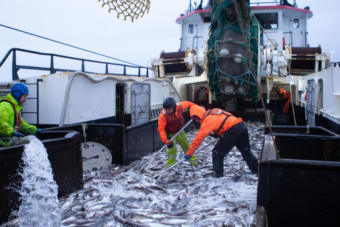
Pollock, seen here at a processing plant in Dutch Harbor, in the Aleutian Islands, are one of the species being found in increasing numbers in the northern Bering Sea. (Photo by Berett Wilber)
Pollock at a processing plant in Dutch Harbor. (Photo by Berett Wilber)

The total amount of pollock allowed to be scooped up by trawlers in the Bering Sea will stay the same in 2024. In its Dec. 9 meeting in Anchorage, the North Pacific Fishery Management Council moved to keep the total allowable catch for pollock at its current level of 1.3 million metric tons, a move that has generated criticism from conservationists, tribes, and the trawling industry alike.

Alaska’s pollock fishery is responsible for the vast majority of salmon bycatch in the region. And amid alarming declines in returns of multiple species of salmon to Western Alaska rivers, the pollock trawl fishery has faced increasing criticism for its perceived role driving the crisis. But federal fisheries managers and the trawling industry pushed back, asserting that the claims are unfounded.

Trade organizations representing the trawl industry said during testimony at the council meeting that the decision to hold the pollock quota steady is misguided.

Stephanie Madsen, executive director of the At-Sea Processors Association, told the council the move could lead to missed opportunities to harvest increased numbers of mature pollock in the Bering Sea.

“We can’t bank them like some fish species. They will age out of the system and they will be not available to the fishery,” Madsen said.

Madsen also told the council that the industry request for a modest increase to the pollock quota, which was ultimately denied, was already a compromise.

“I would just remind you that the Russian fishery in the Sea of Okhotsk and the Western Bering Sea take more pollock than our Eastern Bering Sea pollock,” Madsen said. “So a 20,000 metric ton increase in the Eastern Bering Sea is likely to have very little impact on a global situation.”

Communities hit hard

On the other side of the debate, tribes and conservation groups representing communities reeling from salmon crashes in Western Alaska have called for reining in the pollock fishery.

“We consider the salmon that do return to our rivers are survivors of climate change, which they experience in both their freshwater and marine stages,” said Kuskokwim River Inter-Tribal Fish Commission Programs Manager Terese Vicente. The commission is one of the groups pushing for increased tribal co-management of resources in Western Alaska.

“We ought to protect every one of them to be precautionary, to be protective with the factors we can control because they’re so vulnerable to climate-driven ecosystem changes,” Vicente said.

Dozens of tribes impacted by salmon crashes have made calls for a greater voice at the federal management table, including advocating for Alaska Native representation on the 11-member North Pacific council.

Council member Jon Kurland noted that requests from the Association of Village Council Presidents and Tanana Chiefs Conference to meet with the council ahead of the meeting hadn’t panned out.

“We have been making a lot of efforts to improve our process for tribal consultation and to try to ensure that when tribes and tribal consortia and so forth are interested in talking to us that we do that before the council takes final action,” Kurland said. “We made a number of attempts to reach out, and unfortunately were not able to make those connections.”

Both organizations are suing suing the federal government over the way the Alaska pollock fishery is managed.

Council member Anne Vanderhoeven, who introduced the motion to hold the 2024 pollock quota the same as this year, pushed back against the notion that the fishery is a significant driver of salmon crashes.

“We have heard calls and public comment to reduce the pollock TAC [total allowable catch], and recognition of the current salmon crisis in Western Alaska rivers, and the devastating impacts that crisis has on subsistence users and Alaska Native cultures,” Vanderhoeven said. “But the best scientific information available does not support the assertion that relatively small adjustments to the pollock TAC will measurably or significantly increase salmon escapement to Western Alaska.”

The pollock quota for 2024 is set, but for 2025 the quota has yet to be determined.

The council’s next meeting is scheduled for Feb. 5 to Feb. 12 in Seattle, where it plans to discuss potentially refining the environmental impact statement guiding management decisions.

Quinhagak’s tribe issues disaster declaration as power outages continue into 5th day

Quinhagak, Alaska on April 19, 2023. (Gabby Salgado/KYUK)

Quinhagak’s tribe has signed a disaster declaration as the community continues to deal with a power outage that left the community without power on Friday, Dec. 8 during freezing weather.

Throughout the weekend, the southern half of the community, which includes most public buildings and more than 50 homes, didn’t have power.

As of the afternoon of Dec. 12, only one of Quinhagak’s three generators was functioning. According to tribal administrator Darren Cleveland, the community was running on a system of brownouts, providing three hours of power at a time to the north and then south side of the community to get heat around, with the hope that short bursts of power would prevent freezing pipes.

“Getting frustrating right now as days continue on without power,” Cleveland said.

The Alaska Village Electric Cooperative runs the village’s electrical utility. Technicians have been working since shortly after the power outages began to fix the generator issues.

Cleveland said that the main goal is to get the power back on. He said that the tribe declared the disaster with the hope of securing state funding and resources to deal with all the costs associated with an extended power outage in freezing temperatures.

“Right now we don’t know any of the damages in the homes because the power’s out,” Cleveland said. “But we’re anticipating that once we get full, once the lights get back on, the power gets back on, we’re anticipating homes with burst pipes once their homes thaw, once everything’s restored. So we’re anticipating a lot of water damages.”

Cleveland said on Dec. 12 that one of the tribe’s biggest concerns is the power outage at the water treatment plant, where some pipes are already frozen. The Native Village of Kwinhagak’s disaster declaration stresses that the water and sewer systems are at immediate risk of freeze up and catastrophic failure.

The local school, clinic, water treatment plant, stores, and other homes and businesses were relying on their own generators for heat. However, Quinhagak City Administrator Tracy Pleasant said that those generators are also starting to have issues since they’ve been running for so long and the power has been on and off.

“Our school canceled today because they were having generator issues,” Pleasant said. “Ours at the water plant broke last night.”

Classes were canceled on Dec. 12 when the school’s backup generator stopped working and were tentatively canceled for Dec. 13 as well. The school had been the emergency shelter for the community.

“Because if the school’s generator’s out, there’s no use for the community to go to the school right now with the power alternating three hours on the north side, three hours on the south side. So at this point, there’s no place in the community to shelter,” said Cleveland.

In the meantime, Quinhagak is at a standstill. Cleveland said that the village has limited service at the clinic. Quinhagak’s airport is the main way in and out of the community, and the runway lights have been out because of the outages. Cleveland said that with limited winter daylight, that’s a major concern in case of medevacs or other emergencies.

“Everything’s closed right now,” Cleveland said. “Even post office is closed. Washeteria’s closed. All tribal offices are closed. School’s down. So this is having an effect on the whole community.”

The tribe’s letter to the state emphasizes that the village doesn’t have the funds or response capability to cover the emergency. In its declaration, the tribe wrote that it has formed a working group with the local government and the State of Alaska Emergency Operations Center. Moving forward, the tribe is requesting the assistance of the State of Alaska for disaster relief aid. The municipal government is also working on its own disaster declaration.

Eric Brown recently stepped down as the Quinhagak power plant operator. He said that parts to repair one of the two broken generators were expected to arrive on the evening of Dec 12.

Brown said that he thinks one of the generators, which they’ve had for more than 15 years, broke down from being too old. He said that the other was installed two or three years ago, but has had multiple issues since it went online.

Russian Orthodox Archpriest Michael James Oleksa has died at 76

Fr. Michael James Oleksa is seen while giving an interview at St. Innocent Russian Orthodox Cathedral on July 5, 2021. (Simon Scionka/Sacred Alaska Film)

The well-known Russian Orthodox missionary and scholar, Archpriest Michael James Oleksa, has died at the age of 76 in Anchorage following a stroke. His death was confirmed by the Russian Orthodox Diocese of Sitka and Alaska on Nov. 29.

Oleksa served as a priest in more than a dozen Alaska Native villages across the state over his five decades in Alaska. He came to Kwethluk in 1972, where he met his wife Xenia and served as a deacon before spending time as a priest in Napaskiak.

Retired priest Fr. Martin Nicolai of Kwethluk worked with Oleksa on Yup’ik translations of documents related to Orthodox history in Alaska. He said that Oleksa had deep ties to the local community.

“He married into a Kwethluk family. He was very close to the Yup’ik community,” Nicolai said. “He was instrumental in a lot of things, not only the church in Alaska, but for the Alaska Native peoples in general.”

Most recently, Oleksa played a key role in the process of nominating Olga Michael of Kwethluk to become the first female Orthodox saint in North America, as well as the first-ever Yup’ik saint. Oleksa met St. Olga when he served as deacon in Kwethluk in the 1970s and spent years compiling the testimonies necessary for her official naming as a saint.

Oleksa was born on March 16, 1947 in Allentown, Pennsylvania. He came to Alaska in 1970 from St. Vladimir’s Seminary in New York at the invitation of the Alutiiq village of Old Harbor on Kodiak Island.

Oleksa was a leader in cross-cultural communication in Alaska and a student of Alaska Native languages and cultures. He taught at multiple universities in Alaska and published books on Russian Orthodox history, including “Orthodox Alaska” and “Alaskan Missionary Spirituality.” He earned his Ph.D. in Slovakia in 1988 with an emphasis on Alaska Native history during the Alaska Russian period (1741-1867).

Oleksa is survived by his wife and children.

Site notifications
Update notification options
Subscribe to notifications