KYUK - Bethel

KYUK is our partner station in Bethel. KTOO collaborates with partners across the state to cover important news and to share stories with our audiences.

Pioneer of Western Alaska journalism Rosemary ‘Rosie’ Porter dies at 85

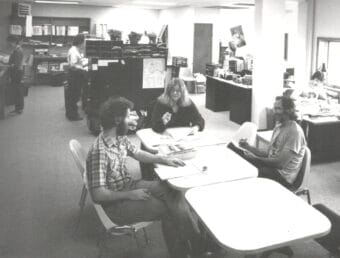
Rosie Porter is seen in the offices of The Tundra Drums weekly newspaper with reporters Peter Friend (left) and Richie Goldstein in Bethel sometime in the early 1980s. (James H. Barker/”Bethel: The First 100 Years, 1885-1985″)

Rosemary “Rosie” Porter, remembered as a fierce advocate for the people of the Yukon-Kuskokwim Delta as owner and editor of The Tundra Drums newspaper, died in Anchorage on March 1, 2024 at 85 years old.

Porter moved to Bethel in 1974, where she quickly found work at KYUK developing educational and news programming, as well as editing a weekly KYUK newspaper and program guide called The Tundra Drums.

When KYUK came under fire for violating federal public media guidelines with The Tundra Drums, Porter saw an opportunity. She bought the paper and set up shop in a small space at Leen’s Lodge, a two-story, flood-prone roadhouse on the Bethel riverfront that has since been demolished.

One of Porter’s friends from the time, Robin Barker, recalls the importance of the newspaper in its early days.

“She really started that newspaper from nothing, you know, from a little mimeographed sheet,” Barker said. “And it was a really critical time for news for people in Bethel and in the villages because things were happening fast.”

With Porter at the helm, The Tundra Drums thrived. Porter told the Alaska Dispatch in 2011 that at one point, the paper had as many as 20 employees and put out the largest weekly newspaper in the state: 48 pages or more.

The Dec. 8, 1975 edition of The Tundra Drums newspaper shows coverage of a fire that destroyed Bethel’s power plant and left the city in the dark for three days.

Friends say that Porter had an eye for cultivating talented reporters. Richie Goldstein, who wrote for The Tundra Drums from 1979 to 1984, originally came to Bethel to work as a teacher but was soon working for Porter.

“Rosie said, ‘Well just come to work for me.’ So Friday was my last day at school, and Monday I was the editor of The Tundra Drums,” Goldstein said.

Goldstein said that Porter was generous to a fault.

“In 1980, she took the entire staff and a bunch of other people, maybe 10 or 11 of us, on a two-week trip to England,” Goldstein said.

Porter also spent the money she made flying reporters to villages to cover critical issues across the region. In 1984, she even sent Goldstein to file stories and photos for the 1984 Summer Olympics in Los Angeles.

“I covered Greco-Roman, and Judo, and fencing, and weightlifting,” Goldstein said.

Another reporter who Porter sought out was Bethel resident Beverly Hoffman, who worked part-time for both KYUK and The Tundra Drums in the mid 1970s. Hoffman credits Rosie with showing her the ropes and inspiring her.

“She just covered so much and she wasn’t afraid. My gosh, she would print the salaries of every state employee person and write in those honest stories about what was going on,” Hoffman said. “I thought, ‘Wow, this is one powerful woman dealing with, you know, powerful men and issues way back then.’”

Mary Lenz, who came to Bethel to cover the first running of the Kuskokwim 300 Sled Dog Race in 1980 for the Associated Press, ended up working for Porter on and off for a decade.

“Rosie combined the best of concern for community, a dedicated journalistic experience, and a lot of fun. She made things fun,” Lenz said.

According to her friends, Porter’s editorial style was also fun, if not outright edgy at times. One memorable headline using the Yup’ik word for defecation: “Governor Anaqs on Bethel,” is said to have gotten the attention of then-Gov. Jay Hammond and reversed a decision to veto funding for the Yukon-Kuskokwim (Y-K) region.

Porter did not have a conventional childhood, according to her son, Gregory Porter. She was born Rosemary Brugman in Union City, New Jersey in 1939, the second-oldest of four children. Due to difficult family circumstances, in 1957 she and her three siblings set off across the country by train to San Francisco to find work. Porter was able to land a job at the San Francisco Chronicle, laying a foundation in print media and sparking a long and storied career in journalism.

In San Francisco, Porter and her siblings raised the funds to purchase ship passage to Alaska, arriving in Fairbanks in the summer of 1958. There, alongside opening a modeling and finishing school, Porter worked in a variety of media roles, including as a weather anchor for television stations in both Fairbanks and Anchorage. She married Don Porter in Anchorage in 1962.

In 1990, Porter sold The Tundra Drums to the Calista Corporation, calling it quits after 15 years at the helm to pursue other ventures, including indulging her lifelong love of travel.

Porter is survived by her children, Kendall Larson and Gregory Porter.

Alaska’s recent cold snap tested critical infrastructure, including in Mertarvik

The addition of six new homes in Mertarvik means an added draw on power, and a recent state-wide cold snap was too much for the new community’s generators. A three-day power outage has resulted in frozen and broken pipes at the local water plant. (Emily Schwing/KYUK)

A recent cold snap in rural Alaska tested the limits of power plants from Anchorage to the Yukon-Kuskokwim Delta. In Mertarvik, a loss of power meant that other critical infrastructure also saw catastrophic damage.

Multiple social media posts last week called for donations of both bottled water and firewood after the community of roughly 230 people lost power for three days.

“Everything is powered by a generator, but we don’t have a backup generator,” said Calvin Tom, Mertarvik’s tribal administrator.

Tom said that the main generator draws power from batteries that weren’t able to keep up with temperatures that fell to nearly 17 below zero Fahrenheit. That meant that the entire community was without electricity for more than three days.

“For some reason our batteries just drained, so on [Jan. 28] we didn’t have any power all day until the evening. It was all good the following night, and next morning I woke up to no power. So we came to a determination that the batteries were being drained,” Tom explained.

Tom said that they tried a few different methods: insulating the batteries from underneath, lifting them off a cold floor, charging them up and using a space heater to keep them warm, but they simply wouldn’t stay charged and couldn’t keep up with demand.

“The two smaller generators that we are using currently can’t take the load,” Tom said.

In the last year, the population in Mertarvik has increased from just over 180 people to nearly 230. That’s because at least half a dozen new homes were built there last year to house families relocating from Newtok, where permafrost is melting and the land is waterlogged and sinking.

With help from at least one federal agency and the Alaska Division of Homeland Security and Emergency Management, new batteries arrived from Bethel on Jan. 31 and the lights are now on in Mertarvik. But without electricity for a few days, the water plant froze. Now Tom said that Mertarvik is waiting for repair parts to fix broken pipes.

“There’s a little creek, it’s like a fresh spring water. It’s about a quarter mile outside the village and people get their water over there; you just need a four-wheeler or snowmachine to go to it,” Tom said.

According to the Alaska Division of Homeland Security and Emergency Management, both the United States Bureau of Indian Affairs (BIA) and the Yukon-Kuskokwim Health Corporation have shipped pallets of bottled water to Mertarvik. The BIA has also provided a shipment of firewood.

During cold snaps, a spokesperson said that the division often sees problems with critical infrastructure due to spikes in energy usage, just like the one that settled in over most of the state over the last two weeks.

Chevak hardware store and corporation headquarters destroyed by fire

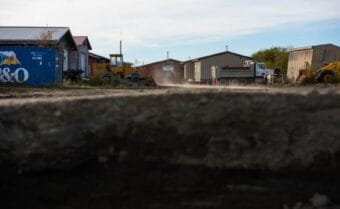
Flames engulfed one of the largest buildings in Chevak on Jan. 29, 2024. It housed the village’s hardware store and corporation headquarters. (Photo Courtesy Of Chevak Resident Stella Lake)

Chevak Company Corporation President Roy Atchak’s office is on the second floor of a building in Chevak that was entirely engulfed in flames on Jan. 29.

“I’m glad there was only a couple of workers in there at the time it was starting up. We were just going to work,” Atchak said. He was late to work because he was having trouble with his Toyo stove at home.

The local hardware store took up the bottom half of the building. It was owned and operated by the corporation. Shelves were stocked with propane, ammunition, and other highly volatile supplies. And without adequate firefighting equipment to extinguish the blaze, Chevak’s public safety team decided to let the fire burn.

“It’s very important,” said Justina Cholok, who was born and raised in Chevak and works at the corporation’s grocery store just down the street. “People get stuff like washers, dryers, fridge, beds, bed frames, ammo, propane.”

She said that the hardware store was where residents could buy home appliances, parts for snowmachines and four-wheelers, motor oil, and other supplies.

Chevak’s corporation headquarters took up the building’s second floor, one of the largest in the village of nearly 1,000 residents. A landmark for decades, it was visible from almost anywhere.

“It’s gonna be weird going that way because we’re not gonna see that building no more,” said Cholok.

It’s unclear exactly what started the fire that totaled the building.

“It might have started around the furnace or Toyo stove,” Atchak said.

A cold snap has impacted most of the state of Alaska for the past week. Atchak believes that subzero temperatures in Chevak may have contributed to the cause of the blaze.

“Nowadays in villages I know they’re having problems with Toyo stoves, you know: too cold and might have been overworking. I am just speculating without the fire marshal’s verification on what really happened,” he said.

As of the afternoon of Jan. 29, the electricity was out to one section of the community, and residents who live in about a dozen homes were evacuated to the local school. Peter Tuluk, the general manager of the community’s local public radio station, KCUK, said that the station was briefly off the air. The station also serves two other nearby villages: Scammon Bay and Hooper Bay.

Three years ago, fire destroyed an old school building Chevak residents planned to renovate into a community center. In the fall of 2022, Typhoon Merbok damaged nearly all of Chevak’s boats and had a heavy impact on food security in the village. Atchak said that no community is immune to disaster.

“Cup’ik people, they go through hardship in life,” Atchak said. “At the same time, they don’t look back and say, ‘Okay, well I had that, I had this.’ But you just recover, and rebuild, and keep going forward, you know. There’s no such thing as stopping.” He said that’s a Cup’ik value.

According to Atchak, it will be about a week before he has a plan to to set up a temporary office for the corporation. He said that it will be a few months before corporate operations can resume. There’s no plan yet for a new hardware store.

Sweeping FEMA changes aim to eliminate red tape, financial burdens for disaster survivors

Two buildings at a fish camp, one badly damaged and the other knocked over
A fish camp in the Nome area, seen on Sept. 24, shows damages wreaked by the remnants of Typhoon Merbok. The day before, President Biden declared a major disaster for a vast stretch of western Alaska that had been slammed with high winds and floods caused by the remnants of that typhoon. Federal Emergency Management Agency Administrator Deanne Criswell, Rep. Mary Peltola and Sen. Lisa Murkwoski were among the officials who surveyed the damages in and around Nome. (Photo by Jeremy Edwards/FEMA)

The Federal Emergency Management Agency will overhaul its disaster assistance program, in response to feedback from disaster survivors and an uptick in extreme weather events brought on by a changing climate. Over the last two years, thousands of Alaskans have applied for individual disaster assistance after flooding and a historic storm on the state’s west coast.

“We listened to the criticisms we received from stakeholders, as well as from the media, and we took it as a challenge,” said FEMA Administrator Deanne Criswell during a press conference on Jan. 18. “We took it as a challenge and we wanted to be big and bold, so that’s what we did.”

Secretary of Homeland Security Alejandro Mayorkas called the change “transformational.”

“For too long and in the face of too many natural disasters and extreme weather events, survivors have had to overcome many barriers to access the federal assistance they need,” Mayorkas said.

FEMA has announced six major changes to its individual disaster assistance program. The agency currently requires disaster survivors to apply for a loan through the Small Business Administration for personal property damages. Public feedback that the process was cumbersome means that the agency will eliminate the requirement.

The agency will also offer $750 payments to households to cover immediate expenses in the aftermath of a disaster.

“One of the things that I have consistently heard, that my team has consistently heard from survivors, is that they needed funds for most pressing needs and needed it faster than we were providing it,” Criswell said.

The lump-sum payments aim to help survivors access things like diapers, baby formula, and emergency supplies in the days immediately following a disaster.

The policy changes apply nationwide, so they aren’t tailored to specific challenges in the northernmost state, but Criswell said that she’s aware of Alaska’s unique needs.

“We know that everybody’s needs are different, and particularly in Alaska they have very unique situations in how they are able to start their recovery process,” Criswell said. “This will help enable them to utilize their resources better within their own communities to help them on their recovery journey.”

In September 2022, Typhoon Merbok hammered a vast swath of Alaska’s west coast. In the year after Merbok, many survivors struggled to appeal applications they made to replace subsistence hunting and fishing gear. The agency plans to simplify the appeal process when applicants are denied.

Some families displaced by Merbok also remain without permanent housing solutions. FEMA said that temporary housing assistance applications will become more streamlined. The agency will also create a new Displacement Assistance program to provide immediate funds to help pay for housing, including costs associated with staying with family or friends.

Criswell said that the changes are timely as climate-change-driven natural disasters and extreme weather continue to batter communities across the United States.

“I would say that the fact that Mother Nature is not letting up, the fact that we are breaking records year after year, as disasters become more deadly, more frequent and more severe, we need to be better prepared and better informed to recover from natural disasters faster and more effectively,” said Criswell.

The changes go into effect this spring, but are not retroactive. They apply only to natural disasters that occur on or after March 22, 2024.

Tribal groups applaud Alaska Native appointments to federal fisheries advisory panel

Crew members shovel pollock on the deck of a Bering Sea trawler last year. (Nathaniel Herz/Alaska’s Energy Desk)
Crew members shovel pollock onboard a trawler on the Bering Sea in 2019. (Nat Herz/Alaska Public Media)

Amid alarmingly low salmon returns in Western Alaska, calls have grown for tribes to have a greater say in the way fisheries are managed. Many say that the recent appointment of three Alaska Native members to the panel tasked with advising the top regional federal fisheries council could be a step in the right direction.

A recent press release from the Arctic-Yukon-Kuskokwim Tribal Consortium, representing 98 tribes directly impacted by salmon crashes in Western Alaska rivers, said that it was encouraging to see more Alaska Native faces than ever before on the North Pacific Fishery Management Council’s Advisory Panel. But it also called out the council for having a “voting majority with an economic interest in the trawl fleet,” as well as a total lack of Alaska Native representation.

“It’s something that we’ve been fighting for and asking for for many years. The fight for Alaska Native subsistence rights is getting a lot of attention right now because things are crashing,” said Eva Dawn Burk, who was recently appointed to a three-year term on the advisory panel, holding its first-ever designated Alaska Native seat.

“I sit on at least four Alaska Native advisory councils, and it’s like, yeah, I’m an advisor, but I don’t have decision-making power,” Burk said.

Burk is Dene’ Athabascan, from Nenana and Manley Hot Springs, and currently holds advisory positions with both the Alaska Department of Fish and Game and the Federal Subsistence Board. She has also spearheaded multiple educational projects in her region aimed at preserving traditional knowledge and ensuring food security.

“It kinda was naturally like this is the next thing to kind of bring all those perspectives together,” Burk said.

The first appointee to the tribal seat now occupied by Burk was Shawaan Jackson-Gamble, who is Lingít and Haida from Kake. He resigned the seat just months after being selected amid sexual assault charges stemming from a 2019 incident in Washington state.

Not all of the current Alaska Native members of the advisory panel are fresh faces. Mellisa Johnson has served on the panel since 2020 and was reappointed for a three-year term in December 2023. She is Iñupiaq and a member of the Nome Eskimo Community. In 2023, she was passed over by Gov. Mike Dunleavy for a voting seat on the 11-member council she currently advises.

The third Alaska Native appointee is newcomer Tiffany Andrew, assigned a one-year term. She is a Yup’ik tribal council member of the lower Yukon River village of Alakanuk, and handles government affairs for the Yukon Delta Fisheries Development Association, a non-profit corporation with a vested interest in the Bering Sea pollock fishery.

This is thanks to a long-standing federal community development quota program aimed at boosting the economic and social prospects of Western Alaska communities. The program allocates a percentage of the allowable commercial catch of various federally managed fisheries to non-profit corporations like Andrew’s.

According to her resume, Andrew is a lifelong subsistence harvester, growing up fishing for salmon on a river that in recent years has been nearly completely closed to salmon fishing. But she also represents a CDQ group with proven results stimulating the region’s economy, largely thanks to its stake in a pollock fishery accused of fueling the salmon crisis. She said that bringing together different points of view is critical.

“There’s too much subsistence needs not being met, and CDQ issues going on as well that we all need to see from all perspectives,” Andrew said.

As the permafrost melts, the houses in Nunapitchuk are breaking down

Erosion has left some houses in Nunapitchuk on their own little hills. The houses provide shade and support for the soil left underneath. (Sunni Bean/KYUK)

A large crack runs down the center of James Berlin Sr.’s faded brick-red home. He’s been the mayor of Nunapitchuk for 16 years, and a pillar of the community. His house needs a new porch and a new foundation.

“The best choice would be to build a new house,” Berlin Sr. said. “But right now it needs to be repaired.”

Some houses in Nunapitchuk sit on their own little hills as the soil erodes around them. Whole neighborhoods have sunk as seeping sewage mixes with the soil of the melting tundra. One long bridge on the southwest of town is blocked off now with a set of wooden planks. All of the houses in the neighborhood it once connected are abandoned.

Not far from the Johnson River, Natalia “Edna” Chase’s two room plywood home is one of the houses in especially urgent need. For the last decade, the ground beneath her house has been giving way.

A stack of lumber blocks access to the part of Nunapitchuk where all of the houses are abandoned. (Sunni Bean/KYUK)

Gaps form between the plywood floor, letting in frigid wind and blowing snow. Each time someone opens the door in the winter, Chase goes behind them and puts paper towels into the gaps with a butterknife. The floor is always moving, sometimes sloping upwards, tripping up her brother, who had a stroke and shuffles, and her partner, who struggles to balance since losing an arm.

“I’ve been trying to move around furniture because this side is sinking faster than before,” Chase said, pointing to the sagging floor under the kitchen. “We usually have rainwater coming in before winter and I have no place to put it, so we’re using buckets to bring the water in. For drinking and all that.”

Water pours in when the snow melts too. When there are sunny days in the spring, Chase stays up all night vacuuming the water gushing in from the corner of her floorboards and putting the water in a row of large buckets. Chase estimates that about 500 gallons of water flood into their home in the spring.

“I usually try to keep furniture up by using two by fours so the air can circulate under,” said Chase. “We have to keep it about 80 degrees every day to keep the floor dry. Sometimes I have five fans going on when it’s really wet outside to keep the floor from getting too moldy.”

Houses and sheds lean as they sink into the melting soil. (Sunni Bean/KYUK)

Every week, despite her chronic back pain, she moves every item and appliance and gets on her knees to clean underneath them. When she hasn’t kept up with constant cleaning, she’s seen mold patches that look like flowering orchids grow to the size of a football.

“This mold, it sticks on clothes, it sticks on the bed, the mattress, everything. That moldy smell,” Chase said. “I have to rewash every clothes. I’ll wash clothes. If I leave them out, they start stinking and I have to wash them again.”

Her partner has developed a chronic respiratory illness and recently her 14-year-old had to get an inhaler.

“It gets very depressing. Most days I can’t shake it off until I, I don’t know, maybe get mad and it will shake off. But we’re trying to deal with it,” said Chase.

Except for school for her son, they rarely leave the house. All of her time is devoted to taking care of the house and family. Chase worries about how her own health issues might mean she won’t be able to keep up with all the work.

“I wouldn’t want them to go through what I have been going through all this time with this house. It’s very debilitating, especially when you’re disabled. To see your partners cough away. And that black mold. I have to get started even though I’m hurting so much.”

A house was knocked down and moved to a nearby plot with firmer soil. (Sunni Bean/KYUK)

The lots next to Chase’s home are empty, filled with abandoned chests of drawers and washers, heavy items that made the homes sink faster. Her neighbors knocked down their houses and moved in with nearby relatives because of the flooding and increasingly unstable ground.

Chase wants to move, too, but there’s nowhere to go. There’s no land in Nunapitchuk that’s good enough to build on anymore. That means a lot of houses are overcrowded. James Berlin Jr. recently moved in with his dad.

“Practically everybody here, practically every family you know have multiple families living in houses now,” Berlin Jr. said. “Living conditions, with our water and sewer system, it’s causing health issues that we normally wouldn’t be seeing.”

Berlin Jr. said that he thinks their house is sinking because the nearby sewage lagoon is seeping out. Many residents point to the toxic chemicals in the multiple sewage lagoons dotting the center of town, soaking into the soil and speeding up the already rapidly-melting permafrost.

When we walked around, Berlin Jr. pointed at the large number of snowmachines gathered by properties for different members of households. Overcrowding was one reason Nunapitchuk was one of the first places in Alaska to see the coronavirus run rampant.

“I’m not saying everybody’s sick, but you know, it’s more common to see people going to the clinic for respiratory issues like colds, head colds, flus, sore throat,” said Berlin Jr.. “You know, all kinds of common flus and stuff that you see, but it’s more so here in Nunap[itchuk] because we have multiple family units living in small spaces.”

(Sunni Bean/KYUK)

It’s not the first time the village has seen widespread disease, but in the past, one of their protections was the spread out nature of their community and their nomadic lifestyle. Nunapitchuk resident Morris Alexie explained.

“When they brought in, they call it the Black Death. If we were all gathered in a village like we’re gathered now, I bet it would wipe out almost all of the community,” Alexie said. “But then since they were in, in tribal, in small tribes separately, that Black Death they called would leave, like, only one remaining family of that tribe.”

Site notifications
Update notification options
Subscribe to notifications