KYUK - Bethel

KYUK is our partner station in Bethel. KTOO collaborates with partners across the state to cover important news and to share stories with our audiences.
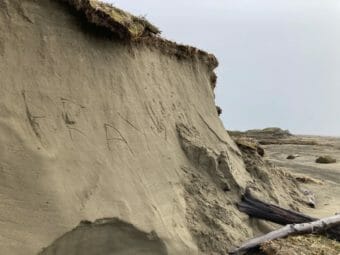
Many of Hooper Bay’s dunes were washed away by the storm. Without them, residents feel exposed.

On the beach in Hooper Bay, Daniel Cernek, a middle school science teacher, is working to wrangle a few dozen of his students. It’s been less than a week since a powerful storm brought flooding and severe winds to the town of 1,300.

As part of his science class, Cernek wants his students to observe the coast and learn about erosion.

“You need to think back before the storm,” Cernek said. “When you drove down the beach, what was different between then and now?”

The students are on the beach south of the village where the storm surge was the strongest. In parts of this area, what was once a stretch of rolling sand dunes is now a flat floodplain. There used to be five rows of dunes. Now, there’s only one row here. In other places, they remain intact. The beach itself has also shrunk. Those dunes form a natural sea wall for the town. Without them, it’s left the town exposed.

Before the storm, Cernek took measurements of how far the water was from the dunes. On this field trip, he’s trying to gauge how things have changed.

“We’re going to get the GPS. They’ll record it on their paper, and we’ll use that to build a map that has the old coastline and the new coastline overlaid on each other,” Cernek said.

According to Cernek’s calculations, the storm eroded about 300 feet of coastline, bringing the water that much closer to town. The loss of Hooper Bay’s dunes has potentially serious consequences.
Emma Smith, a longtime Hooper Bay resident, drove her four-wheeler down to the beach after the storm to get a sense of the impact.

“That was traumatizing just by seeing how much our coastline has eroded,” Smith said. “There is not going to be enough protection for the village if water should be coming in from the Bering Sea. That’s really scary.”

Hooper Bay has minimal ground above sea level. The dunes have protected the village from high water. A 2014 assessment by the Alaska Division of Geological and Geophysical Surveys estimated that the coastline near Hooper Bay erodes about 5 feet every year. Floods like this accelerate that timeline.

The airport, which is only about a quarter mile from the shoreline, is the infrastructure that is most at risk of erosion over the next few decades. But more immediately, storm surges threaten the safety of the whole village. Although no one was injured or killed in the storm, the flood caused serious property damage and destroyed the homes of multiple families. Experts say that these storms are becoming more frequent due to climate change.

Tom Ravens, a professor at the University of Alaska Anchorage and an expert in coastal erosion, said that oceans can be an extremely destructive force.

“If you think about a wave building over, you know, hundreds or thousands of miles, those waves encapsulate just a ton of energy,” Ravens said.

Ravens said that Hooper Bay’s dunes likely made the flooding less severe than it otherwise could have been.

“The dunes can be considered like sacrificial elements, so there is value in rebuilding the dunes even if the next storm is going to take them out,” Ravens said. “The value is that they’re preventing the water from flowing from the ocean into the community.”

Mary Hoeschler, another lifelong resident of Hooper Bay, said that she was already concerned about what erosion along the coastline meant for the village. With the loss of the dunes, it’s hard for her to feel safe planning for her future in Hooper Bay.

“I wanted my kids to live here. I wanted to build them a house and live in Hooper Bay,” Hoeschler said. “But it feels like we have to move.”

On the beach, students were laughing and enjoying being outside of the classroom, rushing in and out of the waves. For them, at least right now, this moment is a learning experience and a chance to process the trauma of the past week. But for adults, it’s hard not to wonder what the loss of Hooper Bay’s dunes will mean for these students’ futures, and for the future of the town.

“I have no idea,” Hoeschler said. “This is just crazy and scary.”

As recovery begins, people in Hooper Bay worry about their village’s future

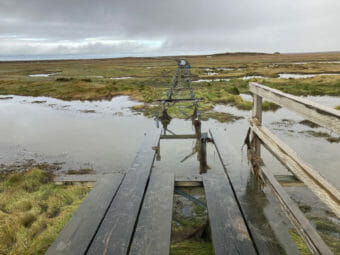
The frame of a boardwalk, with most of its planks gone, extending out into flooded tundra
The boardwalk to high ground in Hooper Bay was wiped away by floodwaters. (Photo by Will McCarthy/KYUK)

At the boat ramp by one of the sloughs running through Hooper Bay, John Rivers is checking on the damage to his boat. It’s one of the many vessels that were ripped from their anchors by a storm unlike anything Western Alaska had seen in years. But Rivers wasn’t surprised. His grandfather told him many years ago that this storm would come.

“The Elders told us long ago, this will happen, the storm, if you’re alive to see it,” Rivers said. “I lived to see it, Grandpa, I’ve seen it. After seeing that storm, it’s like, what’s next?”

In Hooper Bay, one of the villages hit hardest by the storm, school is back in session and cleanup has begun. The immediate aftermath of the flood has begun to pass. But residents of the 1,300-person village are just beginning to reckon with the emotional aftermath of the storm and what it means for their future.

“I’ve lived through storms before, but this was the worst,” said Loretta Smith, who lost her home in the storm. “The water came up so fast, and it was so high that the waves looked violent.”

Two people on an ATV driving through floodwaters
Major flooding in Hooper Bay on Sept. 17, 2022. (Photo courtesy of Lola Cernek)

Water rose faster and higher than anyone thought possible. Power outages threatened subsistence foods stored for the winter. There were panicked evacuations in waist-high water. Many of the most immediate crises, such as access to electricity and shelter, have been addressed. But residents of the village are still coming to terms with the raw feelings of what they experienced.

“I was afraid for my son and my grandma too,” Smith said. “How will we rescue them if the water comes up and it’s really cold? How will we save them?”

Although debris can be cleared and homes rebuilt, for many, a sense of security has been shattered.

The village was split in two by the rising waters, which turned parts of the town into literal islands in the storm. Families fled buildings while carrying their loved ones on their backs. If they couldn’t help each other, who would come in time to help the people of Hooper Bay?

Emma Smith, who works for the tribal council, has spent most of her life in the village. Because of the storm, she’s now considering leaving.

“I don’t know how to swim. I don’t have a boat. I’m a single grandma taking care of kids,” Smith said. “People were not there when my roof flew away — we had to run away ourselves. Will they be there now if it happens again?”

Mary Hoelscher, another lifelong resident of the village, thinks that it’s time that the town starts to consider relocating. One of her main concerns is that the boardwalk, which could bring people to higher ground in the event of an even stronger flood, was washed out by the storm. Even if it’s rebuilt, Hoelscher said that there’s no guarantee it won’t wash out next time. With the boardwalk gone, there would be no way to reach higher ground.

“On both sides of Hooper Bay there’s two sloughs, so we’re literally surrounded by water,” Hoelscher said. “Eighty, 90, or 100 mile per hour winds and no planes can come to evacuate people.”

Hoelscher also fears future floods will only become worse, in part because many of the rows of dunes that protected the village from storm surges were completely washed away by the storm. The next time a storm comes, there’s one less barrier to stop the water. Meanwhile, climate experts say that these types of storms are becoming increasingly common.

Taken together, lifelong residents like Hoelscher and Smith feel that the storm calls Hooper Bay’s entire existence into question.

“I know worry wouldn’t solve any problems, but it’s hard not to worry after seeing and experiencing what we went through with that storm,” Smith said.

Rivers, by his boat at the slough, said that he is also fearful for the future. He lived to see his grandfather’s prediction come true, but he doesn’t know what will come next.

“He tried to make us understand the world is about to end,” Rivers said. “But the worst is yet to come.”

As the storm raged, a mad rush to keep the power on in Hooper Bay

White fuel tanks, some tilted and one tipped over completely
An empty bulk fuel tank toppled in Hooper Bay during the storm. (Photo by Will McCarthy/KYUK)

Signs of the flood are everywhere. Seaweed and debris hang shoulder high off fences in the middle of town. A steel culvert rests on top of a building got pushed off its frame. Fishing boats lie stranded on the tundra.

Parts of Hooper Bay were without power for about 36 hours over the weekend as a storm surge flooded the coastal community of about 1,300 people. But the situation could have been far worse — and threatened the town’s winter subsistence stock — if not for the work of two local power plant operators.

On Sept. 20, at the airstrip, cousins Leemon Andrew and Leemon Bunyan were working to restore power to the airstrip’s lights.

Andrew, the older of the two cousins, said things are still in a much better shape than just a few days ago.

“Everybody’s happy that they have power,” Andrew said.

Andrew, born and raised in Hooper Bay, said he had never seen anything like the flooding that rocked the village over the weekend. He only just started his job as an Alaska Village Electric Co-op power plant operator in April. His cousin, Bunyan, has only been working as a plant operator for three weeks. Both are in their early 30’s.

The past few days have been about as intense of an initiation into the job as anyone could imagine.

When the water started to rise up to the bulk fuel tanks and the power plant on Friday night, Leemon Andrew and Leemon Bunyan were there with an AVEC contractor.

Soon, some of the empty bulk fuel tanks started to lift and tilt. One toppled over completely. The falling tank caused the gaskets of the fuel lines to rupture. Those lines bring fuel from the bulk tanks to a smaller tank that powers the generator, which in turn powers the whole town. Now that power was close to shutting off completely.

They needed to figure out a solution.

“We had a bucket brigade going to fill up the day tank so the generator wouldn’t run out of fuel,” Andrew said. “After the flood in the morning, the day tank was getting low.”

Without a functioning fuel line, Andrew, Bunyan and the AVEC contractor became a human fuel line instead. As the water rose up toward their waists, debris floating around them, they started carrying bucket after bucket of fuel to the day tank.

If the generator shut down, the whole town would lose power. Everyone’s freezers are filled with moose meat and fish for the winter. Without power, Leemon Andrew said the freezers risked thawing and spoiling all the food inside. It was more than electricity — it was a matter of food security.

As the team worked, Robert Lohman, the AVEC contractor, kept an eye on the rising waters pummeling the bulk fuel tanks. With the water around his waist, he started unlocking the gates further up the hill, creating an escape route for the crew in case they needed to abandon the plant.

I asked Lohman if he was worried for his life.

“No,” Lohman said. “I’m old.”

Eventually the group came up with a workaround for the bucket brigade. They ran a garden hose from the valve at the bottom of the tank to a pump, then ran another garden hose from that pump to the tank feeding the town’s generator. That MacGyvered solution is still powering the village.

AVEC leadership visited the power plant on Wednesday to look for a more permanent solution.

Lower Kuskokwim students return to classrooms that served as weekend storm shelters

A river flooded over its banks, right up to the front of a school building
The William Miller Memorial School in Napakiak, Alaska on Sept. 18, 2022. (Courtesy Bethany Hale)

Western Alaska’s massive storm last weekend sent residents of six communities in the Lower Kuskokwim School District to their school buildings for refuge. Classrooms turned into bedrooms, gyms into informal dining halls.

Superintendent Kimberly Hankins says those same classrooms are filled with students again, with schools already returning to instruction Monday even as staff begin to clean up and take stock of damages.

“Everyone is sort of back in session and trying to attend to student learning while we also attend to storm cleanup and assessment of damage in and around, not just the main school building, but all of our facilities,” Hankins said.

According to Hankins, schools served as evacuation centers in Newtok, Kipnuk, Nightmute, Kwigillingok, Kwethluk and Tununak. At one point, as many as 70 people were sheltering in Newtok’s school building. In all six communities, residents have since been able to return home.

So far, damage to the school buildings seems to be limited. For Hankins, it’s a point of pride that people can turn to the school in times of crisis.

“I’m just happy that we have the space to offer in order to shelter folks when situations like this happen,” Hankins said. “We work closely with the community so that folks receive the message that they are welcome to come up to the school and they can seek safety there.”

Although no school interiors flooded, there was significant erosion in some communities that brought the buildings much closer to the shoreline.

In Newtok, Hankins estimated that the school building is now only 90 feet from the water, down from about 125 before the storm.

In Napakiak, the school is only 75 feet from the water. That’s after the back half of the school was demolished this summer, which would have put the building even closer to the riverbank. Some boards beneath the school and piping running to the building were also damaged in Napakiak. Teachers evacuated their housing, which sits closest to the river, as water rose to their doorstep.

Both Napakiak and Newtok already had plans in place to retreat from the water because of erosion concerns even before the storm. Newtok is relocating the entire town to higher ground, while Napakiak is moving its community further back from the river.

Hankins said that the district is continuing to assess the safety of the buildings. With continued erosion, there could come a point that these schools might be deemed unsafe for use.

“Certainly student and staff safety is always our number one priority, so our team is constantly assessing and reassessing,” Hankins said. “I’m really hopeful that we won’t see additional fall storms that are as impactful as what we just experienced. But, you know, we never know what’s to come.”

For now, local maintenance staff will be working on cleaning up debris left from the storm. As a clearer picture of damages emerges, the school district may send extra staff out to communities that need more resources.

Alaska National Guard begins to mobilize in wake of Western Alaska storm

Debris strewn along a flooded shoreline
Major flooding in Hooper Bay on Saturday, Sept. 17, 2022. (Photo courtesy of Lola Cernek)

The Alaska National Guard is activating all guard members in the western region of the state and is deploying more to the area.

Maj. Gen. Torrence Saxe said at a Sept. 18 press conference that troops would help with debris removal and damage assessment, with additional guard members going to Hooper Bay, Nome and Bethel.

“It is critical to have boots on the ground,” Saxe said.

Saxe said that having troops in hub communities will allow them to deploy to smaller villages more quickly.

The American Red Cross is also sending out volunteers. The state has identified five communities that have been impacted the most by the storm: Hooper Bay, Scammon Bay, Golovin, Newtok and Nome.

As of Sept. 18, three communities had a boil water advisory in effect: Elim, Unalakleet and Hooper Bay. Multiple communities, including Hooper Bay, had lost power at their airports.

Gov. Mike Dunleavy said at the press conference that he hopes the recovery response moves quickly and efforts wrap up before freeze-up begins in about three weeks.

“Wherever there is help that is needed, we’ll be getting that out there as soon as possible,” Dunleavy said.

Dunleavy issued a disaster declaration on Sept. 17 to free up state resources.

The damage from the storm ranges across a thousand miles of Western Alaska, from Kuskokwim Bay all the way up through the Bering Strait. University of Alaska Fairbanks climate expert Rick Thoman said that the widespread, severe damage due to this storm is part of what made it unusual. So is the timing. It’s the strongest September storm since records began over 70 years ago.

“We had the absolute perfect set up for a big Bering Sea storm,” Thoman said.

Thoman said that Typhoon Merbok, the source of Alaska’s storm, formed in a part of the North Pacific where typhoons don’t usually form because the water usually isn’t warm enough. But the water there was the warmest it had been in the last century.

“And after it developed and started moving north, then it moved over water that was as much as 7 degrees warmer than the long term normal,” he said. “That is a dramatic difference from normal. For the open ocean, that is really amazing.”

Thoman said that as climate change continues to cause sea water temperatures to warm, storms like this one could become more common in Alaska.

In Hooper Bay, a resident named Ben called in to KYUK on Sept. 17 to describe the scene in the village. Hundreds of people were sheltering at the school due to severe damage and power outages.

“Now, this is a wake up call. We don’t know what our future, but we can’t be ignorant or ignore it also. So we need to face the facts and reality. These storms are getting worse and worse,” he said.

Also taking stock of the damage as the storm blows over is Rep. Mary Peltola, who is from the Yukon-Kuskokwim Delta, home to some of the hardest-hit communities.

Peltola, who was briefed by Federal Emergency Management Agency officials on Saturday, has been in touch with Dunleavy and a number of mayors in affected communities.  She’s worried about damage to subsistence harvests amid the flooding and power outages, as well as damage to infrastructure and equipment.

“Those are the kind of assessments that I’m going to be waiting patiently to — or not so patiently, actually — to start hearing back on,” Peltola said.

Peltola said that she and Alaska Sens. Lisa Murkowski and Dan Sullivan will be working on securing federal disaster funding.

To center Yup’ik culture, a Southwest Alaska school district has adopted a subsistence calendar

Tents set up in a clearing
A jumbled drift net, like one the district may have used at their summer fish camp. (Photo by Woody Woodgate/
Yupiit School District)

For years, students in the Yupiit School District were already following an unofficial subsistence calendar. That meant that they just wouldn’t show up to classes during bird hunting season in the spring and moose hunting season in the fall. Now, thanks to a shift to a subsistence calendar, students at the small district — made up of Tuluksak, Akiak, and Akiachak — will no longer have to miss school to go hunting.

To Scott Ballard, the superintendent, it always made sense to change the school year so that it wouldn’t interfere with those activities. When Ballard first began the process of changing the schedule, he thought it would be pretty straightforward.

“It’ll be a slam dunk. We’ll petition the commissioner of education, he’ll give us the waiver, and we’ll be done with it,” Ballard said. “It was not simple at all.”

Instead, Ballard said that it took months of phone calls. Ballard morphed from superintendent to activist as he worked to earn support from state senators and representatives. He negotiated with the Alaska Department of Education and its commissioner.

Finally, in April, the department approved the waiver for a subsistence calendar. To Ballard, all the effort was worth it.

“We think it’s going to really benefit our students and get our communities connected to the school,” Ballard said. “Instead of seeing the school as this alien institution that occupies their village that promotes Western values and Western instruction.”

The change is simple. Instead of August through May, school will only be in session from September to the end of April. To make up the time lost, 30 minutes of instruction are added to each day. There is also an optional, two-week summer school in August, which incorporates subsistence activities.

According to Moses Peter, a Yupiit School Board member, the change is all part of a decades-long initiative to center Yup’ik culture in the district’s educational goals and curriculum.

“We don’t want our future generations to forget who we are,” Peter said. “We want to educate them about our ancestors and how they survived in this harsh environment.”

That effort goes beyond changing the rhythm of the school year. It means incorporating Yup’ik culture into everything the district does.

Woody Woodgate, the federal programs director for the Yupiit School District, said the district tries to match traditional cultural activities with state educational standards. The summer school this year was a fish camp organized by the district. Woodgate said the kids loved it.

“They were just coming out, having a blast. They had a chance to do all kinds of activities,” Woodgate said. “They sat around and drank ayuk tea, tundra tea, and they heard stories from elders and community members.”

The district is already incorporating activities like fishing, hunting and gathering into their curriculum for the rest of the year. They’re also studying other issues important to the community, like science labs on river erosion.

Peter believes that this is the best way for kids to learn. It’s how he learned. When he was growing up, his parents would pull him out of the Bureau of Indian Affairs school he attended to bring him to spring camp.

“The actual environment was our education,” Peter said. “How to survive, how to get along as a village, as a whole village.”

Ballard and the board believe that centering Yup’ik culture should permeate every aspect of the school, from the topics students study to the meals that they eat. If students are excited about what they’re learning and eating salmon they caught instead of chicken nuggets for lunch, Ballard believes that they’ll be happier and more engaged in education. If students are happier, then teachers are happier, which makes it easier to keep teachers around.

“We’re striving for every child, when they get up in the morning, as much as possible is going to look forward to coming to school,” Ballard said.

This is the district’s first year operating under a subsistence calendar. Ballard said that they’ll be able to assess if the change increased attendance and student engagement by the end of the school year.

Site notifications
Update notification options
Subscribe to notifications