KYUK - Bethel

KYUK is our partner station in Bethel. KTOO collaborates with partners across the state to cover important news and to share stories with our audiences.

Can Alaska Native villagers in the YK Delta get a fair trial?

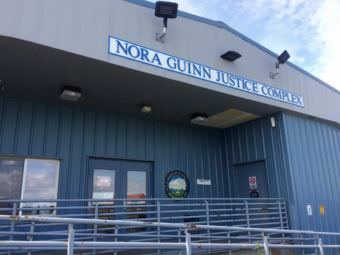
The Alaska courthouse in Bethel. (Photo by Anna Rose MacArthur/KYUK)

A new court case argues that the way in which state juries are selected in Alaska discriminates against rural, Native communities.

The case could significantly impact the Delta’s court system if it’s successful.
This story started about five years ago outside of Kiana, when Teddy Smith swore he saw an enukin – one of the legendary little people.

Smith is Inupiat and a small-time TV actor.

At the time, his mother had just died, which had affected him deeply. Smith spent the days following her death camped out in a remote cabin, hiking the tundra and surviving on berries and water.

He said that he could hear the enukins’ voices, and they “followed him continually, day and night.”

At one point, an enukin tried to enter the remote cabin where he was staying. When Smith saw the enukin, he screamed for it to get out of the cabin and then started shooting at it.

In reality, Smith didn’t shoot an enukin.

He shot two hunters, one in the chest and one in the arm, and then fled on a raft down the river.

Smith said that he was trying to get back to Kiana to “find out what was real and what isn’t.”

The two hunters survived and the State Troopers arrested Smith, charging him with first-degree attempted murder.

At trial, Smith’s attorneys argued that if Smith was going to be judged by a jury of his peers, then some of the jurors in his case had to come from the region’s remote villages.

People from hub communities like Kotzebue, they argued, might not understand the cultural significance of enukins.

But prosecutors claimed that bringing jurors in from the rural villages would be too expensive.

The judge ruled in their favor, and none of the members of Smith’s jury were people who had been raised in the villages.

Smith was found guilty of attempted murder and sentenced to 99 years in prison.

Citing a study from the 1990s, Alaska ACLU legal and policy director of the Tara Rich said that rural Alaskans see the court system as remote, intimidating and as an unfathomable institution.

Jury selection has been a problem in Alaska for a long time.

Smith’s attorney is appealing his case, and the ACLU and the Native American Rights Fund have jointly filed a “friend of the court” brief supporting that appeal.

They argue that Alaska’s current jury selection system violates Smith and other defendants’ civil rights.

Rich said that Alaska’s state court systems do not select jurors from dozens of the state’s remote villages.

The state claims that it would be too expensive to transport village residents to hub cities and house them there.

These excluded villages are largely Alaska Native, and as a result, Rich said that 30 percent of Alaska Natives will never be called to serve on a jury, even though Alaska Natives are disproportionately represented in cases in the state’s criminal justice system.

According to Rich, the policy of excluding villagers from juries alienates village residents from a criminal justice system that’s supposed to serve them. And when residents are accused of a crime, the jury that judges them might not have any Native members at all.

“That is such a critical part about the fairness of this process,” Rich said. “That decisions are not made, particularly the decision of someone’s freedom, based on someone’s cultural compatibility and ability to relate.”

She added that the Bethel Court System is, in some ways, worse than most. It includes more villages than some other courts do.

Bethel’s court selects jurors who live within a 50-mile radius of the courthouse, and Aniak and Emmonak’s courthouses also only pull jurors from nearby villages.

As a result, Rich said in the YK Delta, “40 percent of Alaska Native residents are never called to a jury. That’s slightly more than the state average.”

Smith’s appeal, including the brief from the ACLU and Native American Rights Fund, is currently pending before the Alaska Court of Appeals.

Science and culture merge as one at summer camp on the Kwethluk

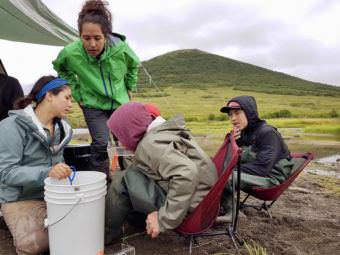
Orutsaramiut Native Council partner fisheries biologist Janessa Esquible helps campers identify juvenile salmon. (Photo by Christine Trudeau/KYUK)

Orutsararmiut Native Council held its first Science and Culture camp in July for high school students.

Campers collected juvenile fish, like baby king and red salmon, and participated in activities in avian biology, ethnobotany and workshops on federal and state subsistence management.

Campers are on a mission on a cool July morning at the base of Three Step Mountain, along the Kwethluk River.

“It’s good, let’s go,” said Nicolai Chase, 16, as he led the way through the tall grass to cross over to a waist-deep waterway sliver separating an eddy from the mountainside.

On the opposite side is a 10-foot-high, 8-foot-wide beaver dam, upon which the campers have placed a fish trap to catch juvenile fish.

They’re keeping an eye out for coho, chinook and chum, as the juveniles tend to like the coarse, woody debris as a feeding habitat.

But the trap comes up empty.

Orutsararmiut Native Council Summer Science and Culture camper Nicolai Chase, 16, gets ready to set up a beach seine net. (Photo by Christine Trudeau/KYUK)

“There’s eggs in the bottle and there is holes so the smell can come out, and each five species of fish can come in here so they can get trapped and we can sample them,” said Chase, referring to a cylindrical cage with a roll of pennies-sized plastic bottle in it.

Nicolai’s mother is from Atmautluak and his father is from Nunapitchuk.

The group begins checking their other traps and laying out a beach seine.

“I have fun going around with the kids,” said James Charles, who came along on the trip as a camp elder.

Charles also has served as an in-season manager with the Kuskokwim River Intertribal Fish Commission, and received a Conservation Elder Award from the U.S. Fish and Wildlife Service.

Charles was born before Alaska became a state.

As a young child he learned the importance of the river, and the life it sustains.

James Charles is camp elder and in-season manager with the Kuskokwim River Intertribal Fish Commission. (Photo by Christine Trudeau/KYUK)

“My mom said, ‘think of other people who use the fish.’ I learned that there are people all the way from the mouth of the river to the headwaters above McGrath. All people want to use the fish, and all the villages are by the river, not away from it,” said Charles, speaking in Yup’ik.

“I’m glad that the youth is learning these programs, and I like them to learn what the fish behavior is — like they go upriver to spawn and die,” Charles said. “We are all growing. All the villages and people need the resource to fish, especially for their food, and I want them to be careful, not over-harvesting and not wasting food, but share their catch with other people who needs them.”

Council partner fisheries biologist Janessa Esquible organizes the camp. She says that this camp is special compared to others because of the cultural component.

“Those are phenomenal programs, but they’re more science-, leadership-, math-based programs,” Esquible said. “The cultural component isn’t there, although they do engage mostly Yup’ik students – students from the Yukon-Kuskokwim Delta.”

With the support of her old boss at ONC, Greg Roczicka, who passed away last spring, Esquible said that she was guided in the right direction.

The sense of history and culture is everywhere. The Kwethluk fish weir that the kids are working with is something that James Charles worked hard to keep open years ago.

Campers caught juvenile salmon to weigh, measure and identify them by type. (Photo by Christine Trudeau/KYUK)

Campers begin identifying, weighing and measuring the smolts (juvenile salmon) that they have caught in the beach seines.

Listening to Charles and working in this place, Nicolai wants to reconnect with his heritage; he feels a part of this work.

He hopes that there will be healthy Kuskokwim fish populations for future generations.

“Make sure we have enough fish for everyone’s future,” Chase said.

It’s a future he’s eager to embark upon, which goes hand in hand with cultural knowledge.

“Our elders, they have knowledge,” Chase said. “Even though if they never went to school they still have knowledge.”

Village of Newtok finds rebirth at Mertarvik

Over the last month and a half, a decade-long project to move the Yukon-Kuskokwim Delta village of Newtok is finally beginning to take shape.

The new village site held a ribbon in Mertarvik, which means “a place for water.”

The new community is safely above the rising water, which threatens the village of Newtok.

A small group of Newtok residents gathered high up on the bluffs at the new site of the village in Mertarvik.

“It’s a safe land; it’s high … it’s beautiful,” said Albertina Charles, a lifelong Newtok resident who mentioned that she was thrilled to be there.

Located a 10 to 15 minute walk uphill from the newly extended boat harbor, five to six homes – three of which are currently occupied – a steam house, and foundational pilings for four new homes line the main avenue.

Construction here has focused on water infrastructure.

Recent additions to life in Mertarvik include on-site hot and cold running water from water tanks fed by two drilled wells, a bathroom with four showers and four toilets, three washers and three dryers, a boiler, and a 125 kilowatt generator — equivalent to the power that is currently in Newtok.

Still under construction is the Mertarvik Evacuation Center, which the community hopes to start using next year.

The two-room building is being built large enough to house 250 people, if need be. A little ways further up the hillside is the dining hall that Troy Welch from HC Contractors helped build.

“It’s gonna be a viable community, very viable. It’s gonna be the community center, the kitchen area,” Welch said. “I think it’s gonna be the heart of the community.”

Planners still are working to secure the rest of the funding for the building and much of the planned housing.

Though there is much more to be done, there has been progress.

It’s been six years since state Department of Environmental Conservation Commissioner Larry Hartig was here.

He has been working on relocating Newtok for a decade.

“It was really great to see the rock pit open and see the progress on the road, because I can remember when we just wished we had a rock pit,” Hartig said. “There has been good progress.”

Hartig said that the commission’s ability to connect state and federal agencies has been crucial.

He also pointed out that the two wells that have been drilled will be able to use gravity to deliver the water, which will save on operating costs.

The biggest uncertainty threatening continued progress at Mertarvik is what kind of federal funding will be available.

In a boat headed back to the old village site, Bureau of Indian Affairs Acting Director Lynn Polacca said that Newtok is only one of many villages at risk from climate change.

The BIA is able to help fund roads, but does not have as much money available for housing, he said.

“Anything tied to transportation, that’s what we fund at the BIA,” Polacca said. “We’ve got limited funding for housing, but you know, we try to help out where we can.”

Charles is ready to be among the first to move to Mertarvik.

“I want to pioneer here in fall time. My daughter is scared for my grandchild,” Charles said. “She wanted me to take her with me so she can be safe here, but I want to be safe staying here ‘cause last year the water raised more than usual.”

With grey skies coming in, Charles remembers those fall storms, the high water levels that come with the rains, and the devastation that has come to a sinking land.

Toksook Bay fire destroyes family’s belongings, kills 5-year-old

A child is dead and a family’s belongings destroyed Saturday after a house fire in Toksook Bay.

Six people lived in the home. All but one, Kendrick Julius, 5, were able to make it out of the building after the fire started sometime before midnight.

City Administrator Paul Chimiugak provided the child’s identity; Kendrick was his nephew.

The cause of the fire is still undetermined.

Chimiugak said that there was a rush to respond to the blaze, with people stretching hoses to get water to it.

The flames were doused before any other structures were affected, but the house and everything inside were lost.

The community is collecting clothing for the family and asking people to ship donations. Grant Aviation, Ryan Air, and Ravn Alaska are all shipping the donations to Toksook Bay for free.

This is the village’s second house fire this month. No one was injured in the earlier blaze.

Donations can be shipped to:

Bob Julius and Family, Toksook Bay, Alaska 99637

  • Bob Julius: Pants size 30/30 or men’s size small sweatpants, shirt medium, coat medium, shoe size 8.5.
  • Cecelia Julius: Sweat pants preferred size medium, shirt large or extra large, coat large, shoe size 7.
  • Jennianne Theresa Julius: Pants size 3 or 4, shirt size medium, coat size medium, shoe size 7.5.
  • Natasha and Kayden: Clothing for 2-year-olds.

After 20 years of work, bison team win award for conservation efforts

Wood Bison No. 124, seen here from the air, was illegally shot and killed January 27, 2017 near Quinhagak. The Alaska Department of Fish and Game is calling the animal's death a setback for the Alaska Wood Bison Restoration Project. (Photo by Alaska Department of Fish and Game)
Wood Bison No. 124, seen here from the air, was illegally shot and killed January 27, 2017, near Quinhagak. The Alaska Department of Fish and Game is calling the animal’s death a setback for the Alaska Wood Bison Restoration Project.
(Photo by Alaska Department of Fish and Game)

After over 20 years of hard work, a dogged crew of wildlife managers has successfully reintroduced wood bison to the tundra of Southwest Alaska.

Now, they’ve received an award for it.

This week, the state Fish and Game department announced that the Wood Bison Reintroduction Team received a special achievement award for its work from the Western Association of Fish and Wildlife Agencies.

Wood bison disappeared from Alaska over 100 years ago, and the cause of their extinction is still unknown.

Division of Wildlife Conservation Director Bruce Dale said that the human population’s impact on the environment may have had something to do with it.

In their efforts to re-introduce the species to the tundra’s ecosystem, the Bison Team imported Canadian wood bison to Alaska and a herd of the animals was raised at the non-profit Wildlife Conservation Center near Anchorage.

In 2015, the team was ready. The team weathered avalanches, wildfires and plenty of bureaucratic red tape before transporting 100 of the wood bison to Shageluk by plane.

“I’m not gonna say that they enjoyed it,” Dale said with a laugh, when asked whether the bison were particularly good flyers. “But they survived, and I can tell you that as a biologist that was a big concern.”

The Bison Team confronted another challenge earlier this year as the animals continued to explore their range, and a hunter poached one of the more adventurous bison all the way out at the coast, near Quinhagak.

But Dale says that the incident didn’t damage the project.

“The way it was handled sort of solidified acceptance on the part of folks that live out there,” he said. “That this is a species we can manage, and the trials and tribulations are gonna be worth it.”

Dale said that local Native corporations played a pivotal role in the bison reintroduction effort.

As the bison herd matures and becomes healthy enough to hunt, non-local hunters will have to pay a fee to kill them.

That money will go directly to scholarships for students from participating Native communities, Dale said.

YK Delta tribes sign treaty, forming Nunavut provisional government

A provisional government was formed last Thursday at the Bethel Cultural Center. Over the last three days, and many long discussions, a treaty was signed to form the Provisional Nunavut Alaska Government to unite the 56 village tribes in the region. (Photo by Christine Trudeau/KYUK)
A provisional government was formed last Thursday at the Bethel Cultural Center. Over the last three days, and many long discussions, a treaty was signed to form the Provisional Nunavut Alaska Government to unite the 56 village tribes in the region.
(Photo by Christine Trudeau/KYUK)

A provisional government was formed last Thursday at the Bethel Cultural Center. Over the last three days, and many long discussions, a treaty was signed to form the Provisional Nunavut Alaska Government to unite the 56 village tribes in the region.

The third day of the Constitutional Conference saw a historic, unanimous vote pass to sign the treaty with 10 designated tribal village representatives present.

“It was a hundred percent supported, and the idea is to promote self-determination; to have tribal autonomy and sovereignty,” said Nikki Hoffman, Nunavut secretary and former Bethel City Council member. “This is the beginning of a journey. This is the beginning of a marathon that started forty years ago.”

Hoffman said that this couldn’t come at a more important time for the tribes of the Yukon-Kuskokwim Delta.

“I see people losing hope. I see people in disparity. I see people struggling to even live in dignity, and we can’t have that,” Hoffman said. “We need to do more. We need to do better.”

Chariton Epchook is the chairman of the newly formed Provisional Nunavut Government.

Beyond lengthy discussions ranging from executive qualifications to education, Epchook said that he stressed to many tribal village representatives that uniting would in no way take away current sovereign authority from their own communities, but rather unite all 56 villages as a regional tribal authority with the ability to mandate law.

“The tribal members that were here, and the people that came to witness the event, gave Nunavut the direction and the powers that it needed to get these things going that are needed,” said Epchook.

With many more discussions to come, a vote is planned for November 7 among all of the enrolled tribal members of all 56 villages in the YK Delta.

Site notifications
Update notification options
Subscribe to notifications