Alaska's Energy Desk

Same but different: How Alaska and Norway are handling low oil prices

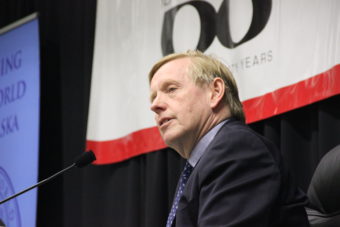
Norwegian Ambassador Kare Aas
Norwegian Ambassador Kare Aas spoke to the Anchorage Chamber of Commerce on May 16, 2016. (Photo by Rachel Waldholz/APRN)

An oil-dependent economy straddling the Arctic Circle, battered by low prices but sitting on a massive savings account. That could describe Alaska, but it also describes Norway.

Norway’s ambassador to the United States is in Alaska this week, to celebrate that country’s May 17 Constitution Day with Norwegian Americans in Anchorage and Petersburg.

But he couldn’t avoid questions about how his country is handling low oil prices — and what Alaska might learn from Norway’s example.

At the Anchorage Chamber of Commerce, Lise Falskow, of the Alaska World Affairs Council, asked Norwegian Ambassador Kare Aas whether he had any advice for lawmakers in Juneau struggling to close a $4 billion budget hole.

“I don’t,” Aas said, to laughter.

But, he said he could talk about what’s happening in Norway — where, for the record, he said, nobody is freaking out.

Because while Alaska and Norway have plenty in common — including a northern location, economies built around oil and gas, and massive savings accounts — there are also some major differences.

For starters, Norway’s economy is far more diversified, Aas said, pointing to the maritime industry, fisheries, IT, tourism — and one sector anathema to many Alaskans: farmed Atlantic salmon.

In all, he estimated Norway only gets about 20 percent of government revenue from oil and gas. That’s compared with nearly 90 percent of unrestricted state funds in Alaska just a few years ago.

And while Norway founded its sovereign wealth fund some two decades after Alaska, it’s grown to more than $850 billion. Alaska’s Permanent Fund currently has about $53 billion.

Aas said there is broad consensus that Norway’s fund must be saved for a post-oil future.

“The basic idea, that this is for the next generation and generations after that, is so solid, so part of, I would say, the Norwegian society,” he said.

The Norwegian government can use a percentage of the fund’s value to cover budget needs, though this year marked the first time ever that it exercised that right. That design is similar to a proposal before the Alaska Legislature to draw on Permanent Fund earnings to fund state government.

Another key difference? Norway never got rid of its taxes — a point raised by a member of the Anchorage audience, who asked if Norway still has an income tax. “Oh yes,” Aas said.

“We have income tax. We have a sales tax of 25 percent,” he said. “We have probably the highest gasoline prices in the world.”

One result of all these policy differences, Aas said, is that unlike Alaska, where lawmakers are struggling to cut state spending,  Norway’s government has expanded spending in the face of low oil prices, in an attempt to stimulate the economy and soften the impacts of job losses in oil-dependent regions.

Offshore drilling plan draws climate change protesters

160406 Climate Protest kids
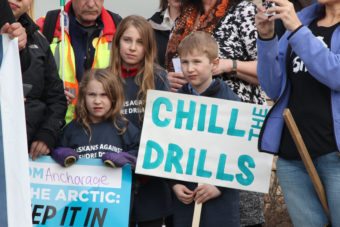
Molly, Penelope and Simon Whitlock, ages 5, 10 and 7, joined protesters opposed to offshore drilling outside the Bureau of Ocean Energy Management’s public meeting in Anchorage. (Photo by Rachel Waldholz/APRN)

About 70 people — and Frostpaw the Polar Bear — gathered in the parking lot of the Embassy Suites hotel in Midtown Anchorage on Tuesday evening, holding signs that read “Keep it in the ground” and “Chill the drills.”

160406 Climate Protest costumes
Frostpaw the Polar Bear joined protesters outside BOEM’s meeting in Anchorage. The protesters argue that BOEM has not taken climate change into account when considering offshore leases. (Photo by Rachel Waldholz/APRN)

Inside, the Bureau of Ocean Energy Management, or BOEM, was holding one of 10 public meetings around the state to get input on potential offshore lease sales. The agency wants the public to weigh in on plans for offshore drilling over the next five years. The tentative proposal would allow lease sales in the Arctic Ocean and Cook Inlet.

That plan has drawn opposition from environmentalists, who see their fight as part of a worldwide effort to halt climate change. The bureau’s plan covers the years 2017-2022, and tentatively includes three lease sales in Alaska: in Cook Inlet, and in the Beaufort and Chukchi Seas.

BOEM’s draft environmental impact statement looks at effects on local communities, infrastructure, subsistence, marine mammals and the potential for oil spills.

The one issue it doesn’t address is the one critics are most concerned about.

“We don’t say, if this much oil, for example, is taken out of the ground, it will have this much effect on climate change,” said Jennifer Bosyk a marine biologist with the Bureau. Bosyk said that kind of discussion is left to policymakers.

But Eric Grafe, a staff attorney at the environmental group Earthjustice, called that a major omission.

To reach the climate goals agreed to in Paris last year, he said, the world can’t burn much of the oil that’s already been discovered – let alone any new oil.

“If we burn all the oil we know about, the glass is already overflowing — and we’re pouring more water into the glass,” Grafe said. “That doesn’t make sense.”

There has been no offshore lease sale in Alaska since 2008. The Department of the Interior canceled sales planned for the current cycle after Shell pulled out of the Arctic last September, citing the company’s disappointing results and a lack of other industry interest.

BOEM’s new commenting process led to a somewhat surreal scene at the Embassy Suites. Instead of accepting verbal comments in a town hall-style event, the agency set up stations in a conference room, where members of the public could speak with experts and then record written comments in laptops.

160406 BOEM
The Bureau of Ocean Energy Management held 10 meetings across the state to take public input on the draft environmental impact statement for the 2017-2022 outer continental shelf drilling plan. (Photo by Rachel Waldholz/APRN)

Sergio Acuna came to support more offshore drilling. Acuna works in pipeline maintenance. Like many people in the room, he wore a bright orange sweatshirt with the logo for the Laborers’ International Union of North America, Local 341.

“We, the laborers, we’re the ones who care for our beloved trans-Alaska pipeline,” he said.

Acuna said he thought the protest was great. But at the end of the day, he said, a lot of jobs depend on how much oil is flowing through that pipeline.

“I understand their point of view,” Acuna said. But, he added with a laugh, “My only question for them will be, like, what do they do for work? Because, if there’s no more oil in Alaska, I may have to come up to them and ask them for work.”

BOEM is accepting public comment on its draft environmental impact statement through May 2.

Site notifications
Update notification options
Subscribe to notifications