Alaska's Energy Desk

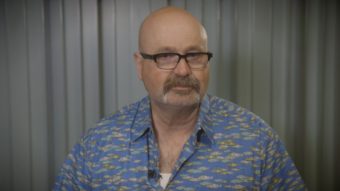
Video: Tony DeHaven can’t afford to lose his job

Alaska has lost more than 2,000 jobs in the oil and gas industry since last year, as the state faces its first real recession in nearly three decades.

This week, Alaska’s Energy Desk is spotlighting those who have been affected by the downturn, as part of the series An Uncertain Future.

Tony DeHaven can’t afford to be out of work. He has two teenage kids at home with their college years just around the corner.

So far, DeHaven has been lucky to hold onto his job as a automation engineer on the Trans Alaska Pipeline working for the engineering firm Dowland-Bach. But he worries about the future.

Video: After 15 years at BP, Brad Campbell is out of a job

Alaska has lost more than 2,000 jobs in the oil and gas industry since last year, as the state faces its first real recession in nearly three decades.

This week, Alaska’s Energy Desk is spotlighting those who have been affected by the downturn, as part of the series An Uncertain Future.

Brad Campbell worked as a financial analyst for BP for more than 15 years. Campbell says when he had the opportunity to take a job in the oil industry midway through his career, he grabbed it.

From the oil patch to oil & vinegar

Rachel Mills is the manager at Urban Greens in downtown Anchorage. She was laid off from the contractor ASRC Energy Services in January after the company was hit hard by falling oil prices and Shell's decision to end Arctic drilling. Photo: Rachel Waldholz/Alaska's Energy Desk
Rachel Mills is the manager at Urban Greens in downtown Anchorage. She was laid off from the contractor ASRC Energy Services in January after the company was hit hard by falling oil prices and Shell’s decision to end Arctic drilling. Photo: Rachel Waldholz/Alaska’s Energy Desk

For the first time in nearly 30 years, Alaska is in a recession.

With oil prices at half their recent peak, the state has shed more than 2,000 jobs from the energy industry since this time last year.

That means many Alaskans are adjusting to a new reality: lost paychecks, career changes — and the possibility they might have to leave the state entirely.

On a sunny afternoon in downtown Anchorage, there’s a late lunchtime rush at Urban Greens, a sandwich shop on the corner of Third & G.

Behind the counter is a young woman in red flannel and big glasses who seems to know the name of every other person walking through the door and their usual lunch order.

When I visited, Rachel Mills was the manager at Urban Greens. But go back several months, and she had a very different role — as a botanist for ASRC Energy Services, an oil and gas contractor.

When Shell announced it was pulling out of the Arctic last fall, it hit her company hard. A few months later, right around the time oil plunged to a 12-year low, Mills was told she no longer had a job.

“It was a January sunny day, and I’m just sitting in the kitchen, and I’m thinking, wow, so this is what it’s like to fail,” Mills said.

That same month, the state — one of the few other employers for a botanist — announced a hiring freeze, as low oil revenue prompted budget cuts.

“I have all this education,” Mills said. “I did everything by the book. I worked really hard. I got the job. Everyone likes me … and it doesn’t matter.”

Mills isn’t alone. She’s part of a wave of Alaskans who have lost work in the last year, as the state has seen its first real dip in jobs in nearly three decades.
According to Department of Labor economist Neal Fried (who is also a board member at Alaska Public Media), with the exception of a brief slowdown in 2009 when the Great Recession hit tourism, Alaska has seen economic growth every year since 1988. Until now.

“This is an interruption of that,” Fried said. “I think we will define this, possibly, as a new period.”

In some ways, the downturn came late to Alaska. The price of oil started dropping in the summer of 2014 and the bust hit states like North Dakota soon after.

But in Alaska, employment held steady. The state actually gained oil and gas jobs through the beginning of 2015.

Source: Alaska Department of Labor and Workforce Development

Fried said those gains built on a remarkable period for the state, as oil prices drove industry job numbers to record highs.

“2014, which was not very long ago, was the largest oil industry workforce we have ever had in our history,” he said.

In fact, Alaska still has historically high numbers of people working in oil and gas, more than 12,000. And Fried worries those record highs might mean record losses.

Since last May, the state is down about 2,100 jobs in the industry. Those numbers don’t include people in related fields like engineering and construction; they likely don’t even include people like Mills, who worked for a contractor.

Alaska has gained jobs in other areas, like health care and retail, but Fried said it’s not the same.

“Those are hard jobs to replace,” he said. “It’s not like closing down Sports Authority.”

That’s in part because of the pay difference. Fried estimates oil and gas jobs pay over two and a half times the average in other industries.

Brad Campbell is facing that reality. He worked as a financial analyst at BP for more than 15 years, until he was laid off in June.

Source: Alaska Department of Labor and Workforce Development

“Two years in a row I went through uncertainty. Am I going to have a job or not?” he said. “I’m kind of relieved I don’t, now. At least I know.”

Campbell would like to remain in oil and gas. “I like being able to put energy on the market — my little bit of role putting energy on the market,” he said.

And he’s doing everything possible to hang onto his home.

“I’m a little worried about getting a job that pays well,” he said. “But I’m just going to have faith that it’s going to work out.”

Above all, he said, he wants to stay in Alaska, where he’s lived since 1983.

As for Rachel Mills, she left her job at Urban Greens. She’s now working in the back office at another local restaurant — and sending out job applications in her field.

The current gig, like her last one, came with a major pay cut and no benefits.


“It’s horticulture, not botany!” When her husband mentioned that Urban Greens was looking for a new manager, Mills jumped at it – even though it meant a major pay cut. At least, she says, she gets to work with plants. Photo: Rachel Waldholz/Alaska’s Energy Desk
When her husband mentioned that Urban Greens was looking for a new manager, Mills jumped at it – even though it meant a major pay cut. (Photo by Rachel Waldholz/Alaska’s Energy Desk)

But, she says, she feels lucky to have a salary —  and it’s better than when she was waiting to be laid off from her job in oil and gas.

“It was agony,” she said. “You’re just standing around, knowing there’s nothing to work on.”

That’s the uncertainty facing many people around the state, as they wonder how long this new period will last, and whether the end is in sight — or if this is just the beginning.


As economics of gas pipeline shift, stakeholders mull state takeover

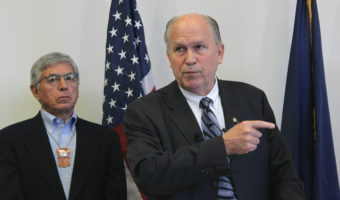
Lt. Gov. Byron Mallott & Gov. Bill Walker - budget vetoes 2
Gov. Bill Walker announces line-item budget vetoes at the Atwood Building in Anchorage on Wednesday. Lt. Gov. Byron Mallott is also pictured. (Photo by Rachel Waldholz/Alaska’s Energy Desk)

Gov. Bill Walker says the state’s three oil company partners told his administration this winter they weren’t sure they could move ahead with efforts to build a natural gas line — and suggested the state take over.

Walker’s comments came a day after lawmakers grilled his point person on the Alaska LNG project.

Meanwhile, the companies expressed skepticism about the state-led approach, telling a slightly different story.

In its current form, the state holds a 25 percent share of the project, partnering with ExxonMobil, BP and ConocoPhillips.

But Walker said today that in a meeting on Feb. 9, the three companies said they weren’t sure they’d be able to continue the project next year as planned — and offered two options: slow down work, or let the state take control.

“The words they used (are) transition the project over to the state,” Walker said. “Those were the exact words that they used. That took us completely by surprise.”

Companies told a slightly different story to lawmakers on Wednesday. Representatives of ExxonMobil and ConocoPhillips said they had just received the concept for a state-controlled gas line last week – the same week it was made public to reporters.

Walker said he found that testimony puzzling.

“Not only did they understand it, it was their idea, it was their concept that they brought to us. So I’m a little surprised,” he said. “Now, what they could mean is that this is the first time they’ve seen this specific on-paper proposal, as a follow-up to what they had proposed. Perhaps that was what they were saying. But the concept – goodness, it was one that they brought to us.”

The companies also told lawmakers the state had suspended negotiations over the gas line this spring. Walker confirmed that; he said after the Feb. 9 meeting, the companies wanted to continue negotiations on “fiscal certainty,” or locking in tax rates on the project. But, he said, with the project structure up in the air, the state didn’t see the point in continuing the expensive negotiations and broke them off.

Either way, in testimony on Wednesday, the companies did not seem enthusiastic about a state-run project.

All three stressed that the key issue is whether an Alaska natural gas project can compete in the current market — in other words, whether it can be built cheaply enough to match the price of gas coming from other regions, including the Lower 48.

The partners have been trying to bring down costs, but the companies made clear they don’t believe the project is there yet.

Alaska BP regional manager David VanTuyl said he understands the state’s desire for a gas line that might bring in new revenue next decade, especially given Alaska’s budget situation.

“But we don’t want to move quickly at all costs,” he said. “We don’t want to rush into the largest energy project in North America that only ends up losing lots of money for all of us.”
Lawmakers were also skeptical. They grilled the new head of the state-owned Alaska Gasline Development Corp., Keith Meyer, for more than four hours.

Meyer was blunt. The existing partnership may have made sense a year ago, he said. But the market has changed.

“I think we need to recognize that under the current path, this project is not going forward,” he said.

Meyer has proposed a state-controlled project that could bring in outside investors to cover the estimated $45 billion to $65 billion price tag, insisting that increased state ownership does not have to mean increased costs.

But many lawmakers remained unconvinced.

Rep. Mike Hawker, R-Anchorage, asked if Alaska is prepared to take on the added risk that comes with a bigger stake.

Sen. Peter Micciche, R-Soldotna, said he doesn’t see why the project needs to move forward immediately. “I don’t subscribe to the ‘build it now or die’ mentality,” he said.

Sen. Mike Dunleavy, R-Wasilla, was perhaps the most succinct. “My confidence is waning,” he said.

But it was Rep. Andy Josephson, D-Anchorage, who touched on the heart of the issue. If this project doesn’t work for the big three oil companies, he said, why would it work for the state?

“I’ve sort of felt like, if the three majors saw merit in moving forward, the plan had merit, and if they didn’t, it likely didn’t,” he told Meyer. “Is there something you can tell me that would dispel that general concern?”

Meyer said the three companies have to weigh the Alaska project against many others in their portfolios. Just because it comes up short for them, he said, doesn’t mean it’s not worth it for the state.

But, Meyer said, that’s what Alaska has to find out.

Industry, lawmakers criticize Walker’s oil tax credits veto

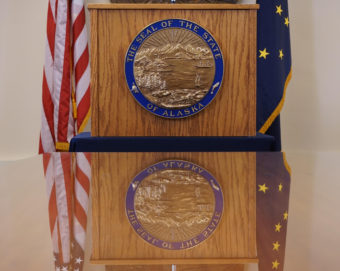
The governor's podium and seal of the state of Alaska in the governor's temporary offices in Juneau, June 19, 2016. (Photo by Jeremy Hsieh/KTOO)
The governor’s podium and seal of the state of Alaska in the governor’s temporary offices in Juneau, June 19, 2016. Gov. Bill Walker announced a $430 million veto of money in the budget earmarked for oil tax credit payments the state owes to companies.  (Photo by Jeremy Hsieh/KTOO)

One of the budget vetoes announced Wednesday would eliminate $430 million in funding for oil tax credits. It’s the second year Gov. Bill Walker has used his veto power to cut funding for the program.

Walker is now under fire from industry representatives and lawmakers who say the state is backtracking on payments it already owes and still must pay.
The credits were designed to encourage companies to explore and develop new oil fields in the state. But Walker said Alaska simply can’t afford it right now.

“In some cases we’re paying as much as 85 percent of the cost of some of the projects. That’s a pretty heavy lift when you’re basically borrowing money to pay those costs on that,” Walker said.

The veto doesn’t let the state off the hook for the credits it already owes, it just delays the payments.

Benji Johnson is president of the small Texas-based company BlueCrest Energy that’s developing an oil field in Cook Inlet.

“It’s basically just like tearing up your credit card bill. ‘Oh, I don’t want to pay it this month, just tear it up,’” Johnson said. “… the state can bully their way through, but it’s not saving one penny by doing this.”

Johnson said his company has received about $25 million in tax credit payments from the state in the last few years. But, according to Johnson, the state currently owes another $35 million and he anticipates filing for $15 million more by the end of the year. Now he doesn’t know when he’ll see those payments.

“While we were aware … this veto could happen, everything we heard from the administration during this last session was that ‘Oh, that’s not going to happen again. We’re going to make sure that it’s fully funded.’ We were told that by pretty much everyone that we talked to.”

Johnson said BlueCrest has been relying on the credits to help fund its drilling operations. He said the company has the money to get started, but may not be able to continue if oil prices stay low or drop further.

Some companies have used the promise of tax credit payments to bring in outside investors. Johnson said the veto makes that option less likely for his company.

“In the past, banks have been willing to loan that money at fairly low interest rates because they could be absolutely certain that the state is going to pay that. Now that certainty has absolutely gone away. The state has no credibility at this point.”

Lawmakers were also swift to criticize the veto.

House Speaker Mike Chenault, R-Nikiski, said the state looks unreliable when it doesn’t make payments it guaranteed to companies.

“I think it probably hurts independents. I think it hurts development of Alaska, whether it’s in Cook Inlet or Prudhoe Bay and I think it’s, it’ll probably have detrimental effects into the future.”

Lawmakers are scheduled to reconvene for a special session on the budget in mid-July when they could, in theory, override the vetoes.

Hunting baby seals for science near Yakutat’s glacial fjords

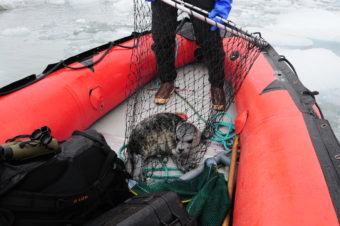
Capture_mode: Researchers move slowly through the ice in Disenchantment Bay hoping to get close enough to net a seal so as to measure and weigh it, collect samples, and attach a satellite tag to monitor behavior. Photo collected under the authority of MMPA permit No. 19309. Photo credit: Jamie Womble (NPS)
Researchers move slowly through the ice in Disenchantment Bay hoping to get close
enough to net a seal. (Photo by Jamie Womble/National Park Service)

Summer is an important time for seal pup development. So the federal government is asking vessels — like cruise ships — to stay farther away from harbor seals in glacial fjords. Biologists are tracking the population in Disenchantment Bay near Yakutat to see how the new guidelines are working. 

Tagging 45 precocious baby seals is no easy task. That’s the number John Jansen, a federal biologist, has in mind. His crew is preparing to float through the water near the face of Hubbard Glacier.

The plan: Catch the pups as they drift by on hunks of glacial ice.

“Our first attempt is going to be using a small dip net and trying to approach them in a stealthy way,” Jansen said.

Of course, mama seals can make this difficult. It’s easier if they scoop up a pup before she notices they’re around. Once Jansen and his crew catch a seal, they’ll glue a satellite transmitter to its fur, either on its back or head.

“Because that’s the only part that typically comes out of the water when they’re at sea. Those have been equated with party hats,” he said with a laugh.

Back in his Seattle office, Jansen will be able to see the pup — just a small dot — on his computer screen. It sounds like a seal version of Big Brother, but the National Oceanic and Atmospheric Administration wants to know how much time pups spend hauling out on the ice. It’s an important time for seals to rest. And for baby seals, it’s a chance to fatten up.

A netted pup: a harbor seal pup just captured in Disenchantment Bay, Alaska. The pup will provide hair, skin, and whisker samples just before having a satellite tag glued to the hair on its back. Pups were reunited with their moms in 20-30 minutes. Photo collected under the authority of MMPA permit No. 19309. Photo credit: John Jansen (NOAA)
A netted pup: a harbor seal pup just captured in Disenchantment Bay near Yakutat. (Photo by John Jansen/NOAA)

“There is a really critical function of hauling out, and if that period of hauling out is disturbed by humans, it has a consequence,” Jansen said.

As many as four cruise ships can be in Disenchantment Bay a day. It’s popular spot to see massive hunks of the Hubbard Glacier fall into the water. Seals are rest on icebergs nearby.

But the ships sometimes scare seals into the water.

“In Yakutat, we harvest seals so the seal population has to stay healthy,” said Victoria Demmert, the president of the Yakutat tribe.

She said local hunters became concerned in the late ’90s when they noticed fewer seals in Disenchantment Bay. And they wondered if an increase in tourism was affecting the population. So NOAA started monitoring the seals. Over the years, the federal agency has observed large vessels are causing the seals to spend less time on the ice.

Demmert said that’s a growing concern for the tribe.

“We understand they want to show off the area for their passengers but we need them to be considerate,” Demmert said.

The old marine viewing guidelines advised vessels to stay 100 yards away from seals. They were created before the boom of tourism. Aleria Jensen, a NOAA stranding coordinator, said that’s no longer adequate in glacial fjords. So the agency came up with new guidelines and public comment was taken.

NOAA had two options: Make it voluntary or require it through regulation.

“The agency decided to go with a voluntary approach. So there are some measures that are meant to apply to glacial fjords across Alaska,” Jensen said.

Vessels are now being asked to stay 500 yards away from seals. Jensen said NOAA realizes the tour industry offers the state a significant economic boost.

“And the goal here is to protect seals without compromising opportunities for high quality glacial viewing and wildlife viewing experiences but finding the balance,” Jensen said.

Satellite technology: A closeup view of a satellite tag attached to a harbor seal pup. The tag will transmit information about haulout and diving behavior of pups during the period they are dependent on mom for nutrition, and during their first year of independence. Photo collected under the authority of MMPA permit No. 19309. Photo credit: Jamie Womble (NPS)
A closeup view of a satellite tag attached to a harbor seal pup. (Photo by Jamie Womble/National Park Service)

Soon, NOAA and the National Park Service will be closer to figuring out what that balance is. They’ll use this summer’s research to determine exactly how the vessels impact the growing seals. For example, how much time are they really spending on the ice?

Back in Disenchantment Bay, John Jansen and his team are giving a seal pup a haircut. Actually, they’re taking hair and whisker samples to bring back to the lab. Then they glue on the tracking device.

“We just want to make sure that the rise and presence of humans is not putting those populations at risk,” Jansen said. “We want to make sure they’re there for everyone to enjoy in the long term.”

After awhile, the seal mom swims around to check on her baby.

“That’s frickin’ awesome!” Jansen said.

When the biologists are finished, they’ll dip the pup back into the water — with new haircut and new hardware.

Study participant: A study animal resting on ice in a group near Hubbard Glacier in Disenchantment Bay some days after having a satellite tag attached (see tag on pup’s back). Photo collected under the authority of MMPA permit No. 19309. Photo credit: John Jansen (NOAA)
A study animal resting on ice in a group near Hubbard Glacier in Disenchantment Bay. (Photo by John Jansen/NOAA)

Correction: An earlier version of this story overstated how many cruise ships are in Disenchantment Bay at once. This summer, as many as four cruise ships are scheduled to pass through the bay in a single day, but not at the same time. 

Site notifications
Update notification options
Subscribe to notifications