Alaska's Energy Desk

Rating agencies warn Alaska: We’re watching you

16 05 24 Capitol Construction
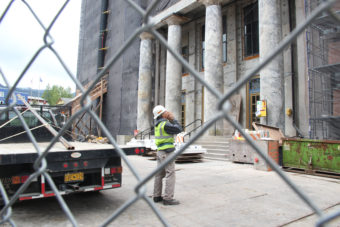
Construction on the Capitol building in Juneau on May 24, 2016. (Photo by Rachel Waldholz/Alaska’s Energy Desk)

In his quest to remake Alaska’s finances, Gov. Bill Walker has found a set of perhaps unexpected allies.

They don’t live in Alaska – some of them have never been to Alaska – but they have the power to give Alaska lawmakers an ulcer every time they speak.

They are the credit rating agencies.

Like an individual’s credit score, Alaska’s credit rating is our calling card in the world of finance. Want to refinance our pension obligations or borrow to build a giant natural gas pipeline? Alaska’s credit rating determines whether the state can access that money and how much it will cost.

This month, the last of the big three agencies revoked Alaska’s top-notch credit rating, citing the state’s massive budget gap.

The downgrades mean it will be more expensive for the state and many Alaska communities to borrow.

But Gov. Walker said the downgrade is about more than just money.

“It sends a message across the country that there’s something wrong with Alaska, there’s something going on in Alaska,” he told reporters after Fitch Ratings announced its downgrade on June 14.  “I’m concerned it would have a chilling effect on investment in our state.”

The three major rating agencies have names out of a Harry Potter novel: Moody’s, Fitch, Standard & Poor’s. But who are the men and women behind the curtain? We called up to find out.

Gabe Petek is the lead Alaska analyst at Standard & Poor’s. He’s 44 and based in San Francisco. He’s been working on Alaska’s credit rating, on and off, for about a decade.

You can think of Petek as Alaska’s defense attorney — or prosecutor — within S&P. He tracks developments in the state through news reports and financial filings, then makes the case to an S&P credit committee for how much of a risk we are or aren’t. The committee then assigns a rating.

“We don’t claim that we’re the Good Housekeeping seal of approval here,” he said. “We’re just providing an opinion on the creditworthiness of the borrower.”

And lately, that opinion has been bearish. S&P was the first agency to downgrade Alaska back in January, knocking the state down a notch, from AAA to AA+.

Which, to be clear, is still pretty good. Alaska is better rated than, say, Colorado’s AA, similar to New York or Minnesota’s AA+, but apparently not as rock-solid as Texas’ AAA.

S&P has made clear in its public statements that unless lawmakers can find a long-term budget solution, that rating is likely to drop.

As for what that solution should look like, Petek claims it’s not for him to say.

“I think sometimes people maybe read into it that way, but that’s really not what we’re about,” he said.  “We’re not trying to put our thumb on the scale for any specific policy.”

That said, S&P has been pretty explicit about what would change their minds.

This spring, they issued no fewer than five reports tracking the state and lawmakers’ progress.

Their main conclusion: The state can’t cut or tax its way out of the current budget hole. The only way to close the gap and retain Alaska’s current credit rating is something like the governor’s plan to restructure the Permanent Fund and use the earnings to fund state government.

“We can do the math as well as anyone,” Petek said. “If there’s a $4 billion gap, and a $5 billion budget, it’s pretty tough to make all of those adjustments just through spending cuts or through tax increases.”

“I do think that Gabe’s had his finger on the pulse more than some of the other analysts,” said Deven Mitchell. Mitchell is the state debt manager, essentially the steward of Alaska’s financial reputation for the last 18 years.

He is not enjoying the current moment. It took 50 years for the state to work its way up to a AAA rating. According to Mitchell, the state’s first credit rating was Baa1, from Moody’s Investors Service in 1961. Moody’s uses a slightly different rating scale than S&P – Alaska’s current Moody’s rating is Aa1.

“It’s a very long and hard progression to obtain credit rating increases,” Mitchell said. “To have a diminishment of that credit rating at this point is disheartening, because I recognize that it’s going to be a difficult course to reverse.”

With interest rates at historic lows, the issue isn’t so much what it will cost the state in the short term, Mitchell said. The difference between borrowing costs for a AAA rating or a AA+ rating is perhaps a quarter of a percentage point interest, and the state doesn’t have immediate plans to issue significant debt.

The fear is what comes next. In early June, S&P warned it could lower the state’s rating again within 90 days if lawmakers don’t act. That warning came about a week before a version of the governor’s Permanent Fund plan died in the Alaska House.

A second downgrade would be unusual, Petek said.

“For a state government to go down more than one notch in a year signals that there’s pretty serious fiscal stress,” he said, adding that S&P is focused on the “sheer magnitude” of the gap between revenue and expenditures in Alaska.

“It’s a bigger gap than we see, in relative terms, in other states,” he said. “It’s something that investors are concerned about as they look ahead … They are asking the question, what will the state’s ability be to repay its debt 10 years from now, if no correction is made?”

The governor has called another special legislative session to focus primarily on a Permanent Fund plan. Lawmakers are due back in Juneau on July 11.

State considers increasing ownership stake in Alaska LNG pipeline project

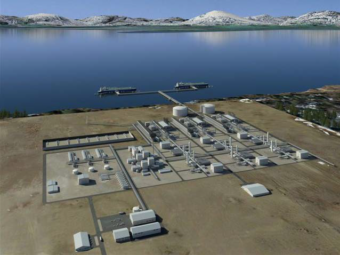
This illustration shows what a liquefaction plant could look like. (Image courtesy of Alaska LNG)
This illustration shows what a liquefaction plant could look like. (Image courtesy Alaska LNG)

Gov. Bill Walker’s administration is considering major changes to the Alaska LNG project, the effort to build a massive natural gas pipeline from the North Slope.

State officials said Tuesday the administration is considering increasing Alaska’s stake in the project — or even taking over ownership completely.

That would be a radical shift from the structure as it’s currently envisioned — and blessed by the legislature. Right now, Alaska holds a 25 percent stake, sharing ownership with the big three North Slope producers: ExxonMobil, BP and ConocoPhillips.

Keith Meyer started work as president of the state-owned Alaska Gasline Development Corp. last week. In an interview Tuesday, he said if the state increases its ownership, it would look for outside investors to fund the project.

“So this is significantly different from the way it was done (to date),” Meyer said. “However, it’s very similar to the way that most of the pipelines in the U.S. have been built, and also the way most of the LNG facilities now have been built.”

Both Meyer and Marty Rutherford, the acting commissioner of the Department of Natural Resources, said Tuesday that the state is discussing the change because the three oil companies have indicated they may not be ready to move the project forward next year as planned, as low oil prices have cut into their bottom lines. The final project is expected to cost $45 to $65 billion.

But both stressed that nothing has been decided, and the state is still in discussions with its three partners.

The administration is set to deliver its quarterly update on the project to the legislature on June 29.

As comment deadline approaches, military leaders weigh-in on Arctic lease sales

Drift ice camp in the middle of the Arctic Ocean as seen from the deck of icebreaker XueLong, July 2010. (Photo by Timo Palo via Wikimedia Commons)

More than a dozen former military leaders jumped into a fight over offshore drilling in the Arctic yesterday, asking the Department of the Interior to allow lease sales in Alaska’s Arctic.

The deadline is Thursday for groups to weigh-in on the interior department’s plan.

The military leaders say the U.S. is lagging behind other nations and could lose its economic and political foothold in the resource-rich region without new investments.

Gen. Joseph Ralston, formerly of the U.S. Alaskan Command, joined 15 other military veterans, and a former Secretary of Defense, asking for the Arctic leases to be kept in the plan. It covers the next five years.

“The idea that we would somehow take leasing from the Chukchi and the Beaufort Sea off the table while Russia is investing heavily, while Norway is drilling, while Canada will be drilling, just does not make sense from a national security perspective,” Ralston said.

The Interior Department has been deluged with comments. Nearly 200,000 have been logged since the agency first requested them in mid-March.

Some industry and pro-exploration groups fear the administration might drop the Arctic from its leasing plan. The agency is already proposing to drop similar lease sales in the Atlantic.

Michael LeVine is the Pacific Senior Council for Oceana, an ocean conservation organization based in Juneau.

He said private companies shouldn’t be responsible for the nation’s geopolitical ambitions.

“Certainly, all of us in Alaska and in the environmental community are sensitive to the needs of national security and a sustainable energy future. If, however, we are depending on Shell and other companies for national security, we’re all in trouble,” LeVine said.

In the past six months, several companies, including Shell, have abandoned the leases they already hold in the region.


388 scientists ask Obama to stop offshore lease sale

Shell Polar Pioneer
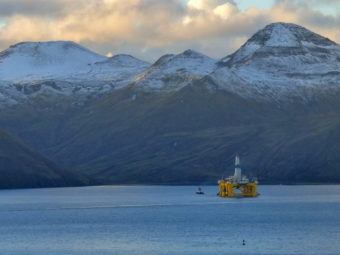
Shell’s Polar Pioneer leaving Dutch Harbor on Oct. 12, heading for Washington state. (Photo by John Ryan/KUCB)

Nearly 400 scientists sent a letter to President Barack Obama Wednesday asking for an end to offshore lease sales in the Arctic. The U.S. Department of the Interior is considering leasing areas in the Beaufort and Chukchi Sea for offshore drilling.

More than 30 scientists from Alaska signed the letter. Eugénie Euskirchen, an associate research professor at the University of Fairbanks, says most of her colleagues are opposed to the lease sale.

Euskirchen studies the effects of climate change in the Arctic and worries that if drilling occurs a crisis could follow.

“First of all, it upsets an ecosystem that’s already very fragile,” Euskirchen said. “And second of all, if there’s a disaster or spill or any sort of problem, the oil companies do not seem like they’re very well ready to handle any such problem.”

There hasn’t been a lease sale in Alaska since 2008. Last year, the Department of the Interior canceled the current lease cycle after Shell decided to halt exploratory drilling, citing disappointing results and lack of industry interest.

Josh Kindred, of the Alaska Oil and Gas Association, says even though oil prices are low now, that may change. He thinks getting rid of the lease sale altogether could bar the U.S. from drilling in the Arctic forever.

“You know, at the end of the day, we don’t know where we’re going to be as a nation from an energy standpoint five years from now,” Kindred said. “And so foreclosing this opportunity prematurely — particularly when we’re still afforded that opportunity four or five years from now to simply have BOEM pull those lease sales — seems like poor policy.”

BOEM is the Bureau of Ocean Energy Management. The bureau’s public comment period for the 2017 to 2020 plans ends Thursday.

Juneau charges ahead with electric vehicles

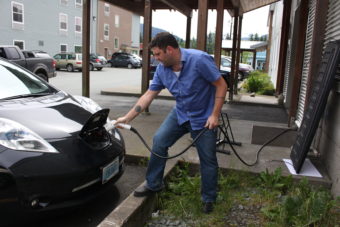
Travis McCain plugs in his 2013 Nissan Leaf. (Photo by Elizabeth Jenkins/KTOO)

With its limited road system, Southeast doesn’t seem like a paradise for car lovers. But it might be the perfect spot for Travis McCain.

He’s the enthusiastic owner of a 2013 black sedan. With the push of a button, he starts the quiet car and describes some of his favorite features:

“Heated seats, heated steering wheel, heated rear seats.”

McCain hasn’t been to the gas pump in months — ever since he bought the all electric Nissan Leaf. When he bought the car back in February, he tried to shop locally.

“I went to all the dealerships in town and said, What can you do that’s similar to the Nissan Leaf?’ And nobody quite had the answer,” McCain said.

So he bought one from Washington and had it barged up. He says he wanted the car to help cut fuel costs — the electricity for the vehicle is only about 2 cents a mile. The positive environmental impact was the icing on cake. In Southeast, there’s one thing he doesn’t have to worry about, and it’s something that does worry drivers in the Lower 48.

“Range anxiety. That’s associated with the car, which I never really had,” McCain said. “It’s Juneau, if I get stuck somewhere, oh, well. I’ll call a friend.”

But even that scenario is unlikely because along Juneau’s nearly 60 miles a road, there are a lot of plugs.

Alec Mesdag, a director at the Alaska Electric Light & Power Company, runs down a list of ten public charging stations.

In 2014, he worked with the city’s economic development council to help identify the locations for the charging stations, which were grant funded.

Mesdag says at first some criticized the charging stations as a handout. The electricity is free, and the city doesn’t give away gasoline.  

“While that analogy is out there, the biggest difference is the expense is so different,” Mesdag said. “It would literally cost the city more to administer the collection of funds than to give the electricity away.”

Mesdag says Alaska’s capital currently ranks with places like Austin, Texas and Portland, Oregon when it comes to plugs per capita, but he thinks Juneau has the advantage.

“In all honesty, we’re better suited for the vehicles than a lot of those other communities,” Mesdag said.

What some see as an oddity — the city’s remoteness — is actually a superpower for electric vehicles. There’s just not that far to drive. Still, it can be a pain to ship cars here or have them repaired. Groups in Juneau and Sitka are trying to organize regular visits from technicians. Soon, there might be enough electric cars to warrant the trip.

Mesdag says there’s a new Nissan Leaf arriving just about every week. There are about 50 fully electric vehicles, or EVs, now.

“We’ll be close to 100 EVs in Juneau by the end of the year,” Mesdag said.

This couldn’t work everywhere in the state. Fully electric vehicles can have issues in colder climates. Furthermore, it requires cheap — or relatively cheap — electricity, which means it doesn’t make sense in regions that rely on expensive diesel. But in Southeast communities with lower-cost hydropower like Juneau, Sitka and Petersburg, electric vehicles pencil out.

Mesdag thinks they could start to become the new norm.  

“A year ago, I would have been less sure this was going to happen, but now people seem to be developing a pretty strong comfort-level with the vehicles,” Mesdag said. “Word of mouth is a big sales tool. And we have a lot of people who own these vehicles now, and they’re pretty happy with their experience.”

Travis McCain says he doesn't feel like he's given anything up driving a fully electric car. (Photo by Elizabeth Jenkins/KTOO)
Travis McCain says he doesn’t feel like he’s given anything up driving a fully electric car. (Photo by Elizabeth Jenkins/KTOO)

Back on the road in his Nissan Leaf, Travis McCain is going down the list of five people he’s converted to the church of EV, including his sister and fiancé.

He still keeps a truck around to haul his boat, but the Leaf has become his primary vehicle. It’s changed the way he looks at other cars.

“On a nice day even like today, I’ve noticed that I might typically drive with the windows down,” McCain said. “And then as I pull up to an intersection, I put my windows up so I don’t have to smell other’s car exhaust. Getting finicky!”

McCain is in the process of buying another Leaf. It’ll be a delivery car for his business.

Thousands of dollars granted for Southeast energy audits

Village of Angoon
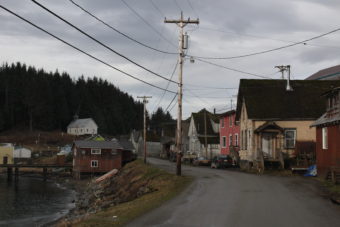
Some remote Southeast communities, such as Angoon, run off of a diesel generator. Power cost equalization helps lower the bill for residents but for local businesses, the energy costs can be extremely high. (Photo by Elizabeth Jenkins/KTOO)

In remote Southeast communities, electricity costs for local businesses can be very high. Businesses don’t qualify for power cost equalization — a state program that subsidizes energy costs for private residents. But a small federal grant could help businesses identify some simple ways to save.

When you hear the word “audit,” good things may not come to mind. You might think about the IRS peeking into your personal accounts, finding you owe more on your taxes.

“Sometimes I call it an assessment so we don’t get that negative connotation with it,” says Shaine Kilcoyne, a director of the Renewable Energy Alaska Project.

She said this audit is something businesses might want to sign up for.

“The level of energy audit we’re doing is really trying to get an understanding of how the building is using energy,” Kilcoyne said.

Up to 26 Southeast businesses can request the energy audit, and the grant covers most of the costs. Kilcoyne says to think of it as more of a workshop. After businesses turn over two years of electricity and heating info, an energy auditor stops by and makes suggestions.

“Some of the easier ones are efficient lighting. LEDs have become a lot more affordable. Weatherization — we see a lot of cracks in doors and windows,” Kilcoyne said.

And those suggestions can save big bucks, especially in communities that run primarily on diesel. In Hoonah last year, the energy auditor recommended LED lights in the harbor and gym.

“They had these old lights that would buzz and take a while to turn on, and they were having we’re having a problem keeping the gym open,” Kilcoyne said.

After the switch, the city saved $17,000.

Kilcoyne says this year they’re considering offering the energy audits to commercial fishing vessels, too. Later on, the final reports could help businesses qualify for loans to finance more expensive improvements.

Even though that’s money spent, Kilcoyne thinks it’s also money saved.

“That could go back to staying open longer or hiring more people or expanding their business,” she said.

The Renewable Energy Alaska Project is administering the $95,000. It was awarded to Southeast Conference — an economic development organization based in Juneau.

Site notifications
Update notification options
Subscribe to notifications