Alaska's Energy Desk

State to measure extent of toxic chemical spread in Gustavus

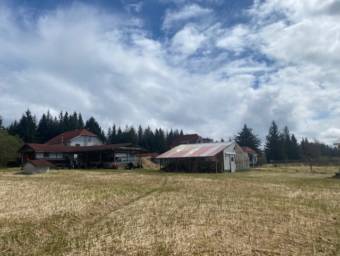
A property where PFAS have contaminated the well water in Gustavus. (Claire Stremple/ KTOO)

The state announced its latest plans to gauge the extent of contamination at and around the Gustavus Airport this week. It’s the transportation hub for the small Southeast community and an active contamination site due to the presence of PFAS — toxic “forever chemicals” that are used in firefighting foams and can linger in the ecosystem indefinitely.

Local advocates say the state should have started this work a year ago, before breaking ground on a $20 million runway upgrade project this April. They say construction risks spreading the chemicals even more. So far, the PFAS have contaminated more than a dozen wells in the town, which does not have a city water source. The state’s Department of Transportation has provided water to those homes since 2018.

Sammy Cummings manages PFAS for the agency. She says they’ve studied the extent of the PFAS in Gustavus before, in 2019. And this second round will be good for monitoring if the PFAS have spread.

“It’s really important for people to understand we are out there, we are sampling. We are following the data,” she said. “And we’re working with our technical experts … and taking their recommendations into consideration and moving forward and doing the best that we can with the little information that we have about PFAS.”

This project’s goal is to monitor what’s called a “plume” — the area where the chemicals have moved over time through soil and groundwater. The state plans to install 23 permanent monitoring wells. More than a dozen temporary wells will test for PFAS that may have spread due to flooding in the last year.

Because previous testing shows that the chemicals have moved beyond the airport, the contractor will take surface water, sediment and soil samples from drainage ditches on and near the airport as well as underground samples to see how deep the contamination goes.

The state will accept public comment on its plan through July 21st. Work is scheduled to begin in August and last 2-3 weeks.

Environmental regulators to give Alaska LNG pipeline another look

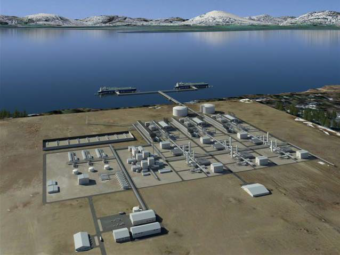
This illustration shows a rendition of what the liquefaction plant in Nikiski could look like if the Alaska LNG project is completed as planned. (Image courtesyAlaska LNG project.)
A 2015 rendering of what the plant in Nikiski might look like. (Image from Alaska LNG Project)

The Alaska LNG project would take natural gas from the North Slope of Alaska down to a proposed plant on the Kenai Peninsula, in Nikiski, where it would be liquified, sold and shipped out.

The gas is already pumped out of the ground on the North Slope. But it isn’t currently sent to market.

To get it there, the state wants to construct an 800-mile pipeline. And last year, it got the go-ahead from environmental regulators, under then-President Donald Trump, to build the massive project.

But now the Biden administration wants to take another look.

The federal Department of Energy announced last week that it’s ordering a supplemental environmental review of the Alaska LNG project. It’s part of the Biden administration’s focus on fighting climate change and it’s also in response to a legal challenge from the Sierra Club, a national environmental organization.
Under the review, regulators will take a new look at the environmental impacts of natural gas production on Alaska’s North Slope. Plus, they’ll analyze the project’s greenhouse gas emission potential — from the extraction of natural gas to its export, to its use overseas.

The federal government could then decide whether to keep, change or overturn it’s approvals for the project.

The Alaska Gasline Development Corporation, a public corporation under the state, doesn’t see the order as an obstacle, said to Tim Fitzpatrick, AGDC spokesman.

“The project has been thoroughly scrutinized over a period of about six years or so, taking a look at over 150,000 pages of data,” Fitzpatrick said. “So we’re confident that the project is going to continue to stand up to any environmental scrutiny.”

AGDC still needs funders for the project. It’s requested money from the federal government and is looking for private investors.

The project is estimated to cost $38.7 billion dollars.

“The new environmental review is not really going to slow down or impact the project’s time table,” Fitzpatrick said. “At this point, we do have the authorization that we need to construct the project, and we’re continuing to talk to investors to secure the funding so that work can begin.”

Fitzpatrick declined to name those investors, saying negotiations are ongoing.

Supplemental environmental review or not, Larry Persily just doesn’t see the gas line project happening. He was a coordinator for gas transportation projects under President Barack Obama.

“I looked at it and thought, ‘Well, OK, that’s good. You can do a supplemental EIS on a project that’s probably never ever going to go ahead. But hey, if you got the time, go for it,’” he said.

Three large oil and gas companies were once signed onto the project and filed a permit to ship the resulting natural gas overseas. But they later pulled their support due to high project costs and Alaska’s declining market for liquified natural gas.

A completed environmental impact statement does not necessarily mean a project will happen. But it’s a necessary step before something can be built.

Regulators said they plan to take a full-scope approach to their new environmental analysis.

Persily said that’s easier said than done.

“One flaw in this is the assumption that you know who will burn the gas over the next 20 or 30 years,” Persily said. “How efficient their equipment will be. What kind of emissions they’ll give off. So it’s a bit of a flying leap to try to really project that in 2021.”

A spokesperson from the Department of Energy said the department will foot the bill for the supplemental environmental assessment.

The department also said it will issue a notice when the draft supplemental statement is released. It will take comments and hold hearings on the draft.

Once the assessment is finalized, the agency could decide to reaffirm, modify or retract the federal authorization for the project, according to an April re-hearing on the project.

Coast Guard responds to tar-like substance spill on Utqiagvik beach

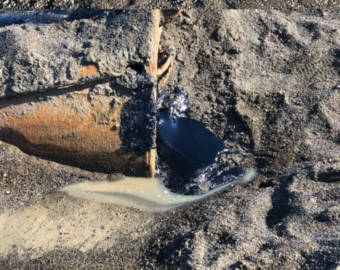
An Utqiagvik resident reported a tar-like substance spill on Tuesday morning near Simmons Field Beach. (Photo courtesy of North Slope Borough)

Coast Guard officials are en route to a beach in Utqiagvik in response to a tar-like substance spill.

The spill was reported just past midnight Tuesday morning when a local resident posted photos to Facebook, said Kimberly Maher, a spokeswoman for the Alaska Department of Environmental Conservation.

“A private citizen in Utqiagvik was on the beach and noticed this tank that was on a line of tanks that is on the beach for coastal erosion,” Maher said. “And they noticed some black tar-looking substance oozing out of one of the tanks.”

Maher said officials are still examining the substance in a lab to determine what it is, but DEC suspects it’s black tar or asphalt. In the 1960s, local officials placed 38 2,500-gallon tanks on the Simmons Field Beach in response to coastal erosion from a storm.
“These tanks, all chained together in a long line, were repurposed and brought down to the beach and placed for erosion control, to help reduce additional erosion in the future,” Maher said.

Maher said DEC believes that this is a one-time occurrence, where large metal drums were used to protect against erosion. However, she said, similar makeshift coastal protection methods were common.

“In the past people have tried to recycle different types of things in order to do either streambank revetment or coastal erosion type things,” Maher said. “If you’re in the Fairbanks area and you’re floating down the Chena River you’ll definitely see some old vehicles that have been used for bank stabilization. So it was not an uncommon practice in the past.”

So far, one of the tanks has been confirmed to be leaking, but there’s evidence that another four tanks could have leaks as well. Responders observed evidence of corrosion and weathering damage on the tanks.

The day the spill was reported, North Slope Borough officials began shoveling the spilled substance into a 55-gallon drum and placed sorbent boom around the tanks to try to absorb some of the contaminant.

Maher said the tanks haven’t been removed from the site, but the area is blocked off as responders continue their investigation. The spill does not appear to be impacting local wildlife.

At home in an avalanche path: Why Juneauites buy and keep homes in a hazard zone

The Behrends avalanche path seen from the 100 block of Behrends Ave., south of where the neighborhood crosses the path. (Rashah McChesney/KTOO)

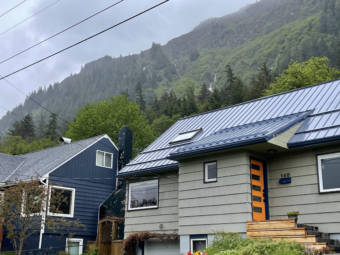
Dozens of sought-after Juneau homes are built in an avalanche path. And decades of studies have pointed to the very real possibility of a big, destructive slide in the neighborhood’s future. But researchers and residents gauge risks differently, and a mix of personal choices and policy decisions keeps people in at-risk areas.
Janice and “Butch” Holst have owned the yellow house in the middle of their block since the late 1970s. Janice sits in an armchair in her cozy, slightly nautical-themed living room.

“We’re a landmark,” she said. “The Holsts on Behrends Avenue.”

At the time of purchase, they didn’t know the house where they planned to raise their children was in a zone that National Geographic Magazine once called the nation’s worst risk for a major avalanche disaster. 

Janice’s husband found out about the risk at work, from a colleague.

“He was bragging about having found a nice house right here. With the schools and having four kids, it was perfect. And this friend said, ‘Really? I don’t know why. It’s a big avalanche area. You’re not going to be safe there,'” Holst said.

“And and we’ve lived here happily ever since. But we have had some scary times.”

Behind their house, the 3,000-foot avalanche chute is bright green with new spring foliage that stands out from the darker, older forest on either side.

When avalanche danger climbed into the extreme range in their neighborhood last winter, the Holsts went and stayed with their grown son for a night. But Janice doesn’t have any plans to leave her home for much longer than that. The city has toyed with the idea of a home buyout program, but she says there’s almost no way they’d take it.

“Unless it was like, a million, trillion, zillion, billion dollars and a free maid and cooked meals every day. And a mink coat to keep me warm,” she said, whacking the arm of her chair for emphasis.

She says they have great neighbors, and the avalanches everyone’s talking about haven’t hurt them.

Lisa Ibias in front of her home on Behrends Avenue. (Claire Stremple/KTOO)

Lisa Ibias lives down the street from the Holsts. She and her husband didn’t know they were buying into an avalanche zone either. The seller, the realtor and even their lender did not mention the home was in a known avalanche path. She found out from a neighbor, after the papers were signed.

She raised six kids in the house, and says when there was avalanche risk, they slept against the uphill side wall in the basement. She says she’d take a home buyout if it was offered.

“If the city’s wants to buy the house, come on, bring it,” Ibias said. “I don’t know where I’d move. But not where there’s another avalanche.”

In harm’s way

In 2011, the city of Juneau contracted Swiss researchers to assess the risk to the Behrends neighborhood. The report said a major avalanche could run all the way to Gastineau Channel with enough force to destroy wood frame houses in its path.

“When you look at town, and you see these huge snowfields looming over neighborhoods — I mean, the gentlemen I brought in from Switzerland and France and other places in Europe look at me and say, ‘we can’t believe you built here,'” Tom Mattice said.

He runs the city’s avalanche program, and he co-authored a study that describes the risk to 60 homes, a hotel and a boat harbor in the Behrends avalanche path.

City code reveals how seriously the municipality takes avalanche risk. In severe avalanche zones, like the Behrends path, the city of Juneau doesn’t allow new construction. No additions, no in-law units, no new bedrooms. Nothing that would increase the human density of the area.

But Mattice says right after he took on his job in 2008, he floated the idea of home buyouts. He says the assembly at the time balked at the cost share the city would have to take on and decided not to spend the money. Mattice says it’s a hard sell because people who have moved in more recently knew about the risk when they bought — sellers have to disclose it.

Mattice says he wanted to build a wall to protect the houses and do controlled detonation of landslides, but that idea didn’t gain traction either. Swiss experts said a wall wouldn’t work. And the city can’t force people to evacuate their homes while Mattice’s crew sets off avalanches.

Juneau’s Emergency Programs Manager Tom Mattice in his office in April 2021. (Andres Camacho/KTOO)

Mattice says one way to get the city and residents to consider a buyout might be after an avalanche causes damage in the neighborhood.

“Because as soon as you get the insurance company involved because you damaged your house, that actually could be used as the cost share,” he said.

“So we could get some FEMA money to come in and buy that property, use that insurance money instead of government money to be that local cost share, make that homeowner whole, move them out of that residence and turn that into open park space for perpetuity.”

It might sound reckless to wait for a predictable disaster to happen rather than take action to get people out of the way. But Matisse tried that. For a buyout to happen now, he says the homeowner would have to take their case to the assembly for approval. He remembers less than half of residents were even interested in a buyout. Some people on Behrends think the studies overestimate the risk. One accused Mattice of fear mongering.

Home buyouts aren’t simple

Sherri Brokopp Binder is a community psychologist and an independent researcher based on the East Coast.

“I’m a disaster researcher; I think about disasters all the time. But for residents, disasters are just one point among many that make up you know, the complex reality of their lives,” she said.

She studied home buyouts in the wake of major storms like Hurricane Sandy. And she found that while municipalities see buyouts as a tool for prevention, people see them as a tool for recovery. That is, most homeowners don’t want to leave a perfectly good home in a dangerous place. But they are more likely to consider leaving a damaged home.

“I can look at pictures of a community that’s in the path of an avalanche and think, ‘Yep, those houses shouldn’t be there,’ right? That’s not a great place to build a community. But it’s not my house, right? It’s not my community that we’re talking about dissolving. And it’s not my life that we’re talking about upending.”

A discarded warning sign leans against a railing in the woods behind Behrends Avenue. (Photo by Claire Stremple/KTOO)

She says there are social consequences to a move — think of the Holsts who love their neighbors — and financial consequences. There’s no guarantee about getting the market value for a home. Juneau’s housing market is tight. If more than 30 households wanted to move at once, it would be tough.

Current city policy offers residents an avalanche warning system — someone to literally knock on their doors and ask them to get out of harm’s way. But while the city won’t add people to the area, it hasn’t invested in a plan to reduce the number of people who live in the hazard zone yet. For those residents, the only path out of harm’s way is to sell their homes, passing the risk to someone else.

Alaska’s Avalanche Capital

This story is part of a KTOO series about Juneau’s urban avalanche risk.

Alaska agency moves to spend $1.5 million on Arctic Refuge development, setting up clash with Biden administration

Congress opened the Arctic National Wildlife Refuge’s coastal plain to oil and gas leasing in 2017, but the fate of the area is uncertain as the Biden administration has announced a new legal analysis of the Trump administration’s environmental reviews. (Nat Herz/Alaska’s Energy Desk)

The Biden administration has suspended oil leases in the Arctic National Wildlife Refuge and aims to thwart drilling there, but an Alaska agency is still pushing ahead with its plans for development.

The state-owned Alaska Industrial Development and Export Authority, which won seven leases at a sale in the final days of the Trump administration, is proposing to spend $1.5 million on its development efforts.

The money would go toward studies, data collection and permitting needed in advance of what’s known as seismic exploration: using heavy equipment to map areas under the earth’s surface to see how much oil could be there.

AIDEA’s board will consider the staff proposal at its meeting next week.

If it’s approved, the agency aims to begin its seismic work in the refuge next year.

But the Biden administration opposes drilling in the refuge and has moved to block development there — and AIDEA’s move could put the two sides on track for a battle in court.

Earlier this month, the Interior Department suspended the oil and gas leases issued for the refuge by the Trump administration, and it placed a temporary ban on all federal activity related to a Trump-era development program. That includes acting on applications for activity like the seismic work that AIDEA wants to carry out.

The Biden administration says it’s now studying what it describes as legal errors in the Trump administration’s environmental reviews used to pave the way for leasing — and it says the leases could be reaffirmed, voided or subject to tighter environmental controls.

In a memo to board members, AIDEA’s executive director, Alan Weitzner, argued that the suspensions lacks a legal basis, adding that his agency still holds “valid and enforceable leases.”

He said AIDEA has already informed the Biden administration that it “will continue to assert our legal rights as authorized for the responsible development of the leases.”

Leaseholders generally enjoy stronger legal rights to conduct seismic work in the area under their control — so if the Biden administration were to reject an AIDEA application for such work based on the lease suspension, it could strengthen AIDEA’s case if it decides to sue the federal government.

Officials at both AIDEA and the Interior Department, which oversees the management of the refuge and the leasing program there, declined to comment.

One of the groups opposed to drilling in the refuge, the Northern Alaska Environmental Center, criticized AIDEA’s proposal to advance towards development.

“This resolution is a continuation of AIDEA’s commitment to throwing the state’s money at bad ideas — projects that will cause harm to people, our climate, and our state’s economy,” Emily Sullivan, the group’s Arctic program manager, said in a prepared statement. “By asking for approval, from themselves, to spend more money on work that is not permitted and is unlikely to ever occur is just another round of political posturing to prove an increasingly irrelevant point.”

Ravn Alaska to purchase fleet of electric aircraft

Airflow’s rendering of a Ravn electric aircraft. (Courtesy of Airflow)

Ravn Alaska said it will buy 50 electric planes from the California-based company Airflow when they come onto the market. Airflow’s planes will use batteries instead of gas to power their engines.

But the company first has to finalize its aircraft design. Airflow CEO Marc Ausman said he hopes to have Airflow’s planes ready for service by 2025.

“My feeling is, if we can build an aircraft that’s successful in Alaska, it can be successful anywhere in the world,” he said.

Airflow’s planes are electric versions of short takeoff and landing aircraft — the kind of small planes you might see private pilots flying around Alaska.

Ausman said they will be able to fit nine passengers each. They’re not meant to replace Ravn’s existing airplanes, which are larger, Dash-8 planes. Ravn has service to Kenai and 12 other airports around Alaska.

Instead, Ausman said these planes are designed for smaller airports and towns.

That’s partly because electric aircraft technology is more scalable. The internal combustion engines that planes currently use don’t scale down to smaller aircraft well, Ausman said.

“Whereas electric motors scale down very nicely,” he said. “So we can put small electric motors, small propellers, all around the aircraft to accomplish certain things.”

Ausman also said the planes will need half the length of a typical runway for taking off, which could make them optimal for more rugged runways.

The batteries in Airflow’s planes are not unlike electric vehicle batteries. But Ausman said their battery packs are designed differently, to fortify them even more against fires.

Early electric planes will have ranges of 100 miles. Some of Airflow’s planes will be hybrids. Those will be able to fly for 500 miles.

“Sort of think of it as a Prius, as a first step to an all-electric car,” Ausman said.

Ravn CEO Rob McKinney said Airflow approached Ravn a few months ago to talk about their plan. He said he was excited to sign on, in part because the smaller planes could allow Ravn to serve new destinations in Alaska.

“I’ve been a big supporter of electric aviation for over a decade now,” he said. “I just truly believe that that is the future of smaller aircraft, especially in the beginning.”

He also said the electric planes could save Ravn money. It takes a lot of gas to turn combustion engines on and off. That can add up for short flights.

The technology still has a ways to go. And Airflow isn’t the only company developing electric plane technology or signing agreements with airlines. American Airlines just said it plans to buy electric aircraft from UK-based Vertical Aerospace.

Ausman said Airflow has signed agreements with other flight companies that operate in Alaska, too, though he wouldn’t say which ones.

Airflow is currently working on simulations and smaller model aircraft. The next step is to build a proof of concept from an existing aircraft, Ausman said.

When the aircraft are ready, Ravn will get them piecemeal, not all at once. McKinney envisions using the planes as a launching pad for pilots’ careers.

“It’s part of our larger scheme, whereas there’s going to be a nationwide pilot shortage,” McKinney said. “So it’s part of our plan to trade our own flow of pilots into our Dash-8 fleet by having a fleet of smaller aircraft as a launching point for pilot careers.”

At the same time, Ausman said the battery technology will be getting better and cheaper. That, he said, could make plane tickets more affordable in the long run.

A previous version of this story included the word “aircrafts” as the plural form of “aircraft.” It has been corrected.

Site notifications
Update notification options
Subscribe to notifications