Alaska's Energy Desk

Federal appeals court rules Trump administration was wrong to reverse protections for Pacific walrus

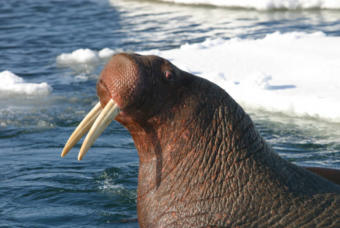
A Pacific walrus bull. Due to declining sea ice, walrus started hauling out in 2007.
A Pacific walrus bull (Public domain photo by Joel Garlich-Miller/U.S. Fish and Wildlife Service)

The U.S. Ninth Circuit Court of Appeals ruled Thursday that the Trump administration was wrong to reverse protections for the Pacific walrus. The ruling will force federal agencies to reconsider what protections are warranted for the species as their ocean habitat warms.

The ruling comes more than a decade after the Center for Biological Diversity, a conservation group, first petitioned the U.S. Fish and Wildlife Service to list the walrus as endangered or threatened. In 2008, attorneys for the Center said that oil and gas development threatened the species, as did the melting of sea ice that walruses use for habitat.

Emily Jeffers, an attorney for the Center, says that in 2011, during the Obama administration, the federal agency initially agreed with the petition, but was too busy to take action on it.

“And then six years later in 2017, the Trump administration found that the species did not warrant listing under the Endangered Species Act,” Jeffers said.

One of the factors in measuring threats to the walrus is what constitutes a problem in the immediate future.

In the Obama administration’s original 2011 ruling, scientific models predicted substantial sea ice loss by the year 2100, causing walrus population declines.

In its reversal, the Trump administration said 2060 was a better timeline to measure the immediate future of walrus sea ice habitat. And while Fish and Wildlife acknowledged that the species was in danger of losing that habitat, the agency said it didn’t believe the risk was at a level warranting federal protections.

In their lawsuit, Jeffers and the Center for Biological Diversity said the Trump administration didn’t fully explain its justification for changing the timeline from 2100 to 2060. And in a 20-page ruling Thursday, the court agreed.

“The court said, ‘Fish and Wildlife Service, you did one thing in 2011, you did another thing in 2017,’” Jeffers said. “‘That’s the hallmark of agency decision-making, that you have to explain the reasons why you’re doing something. And here you just didn’t explain what you were doing.’”

The Pacific walrus remains a subsistence staple in Arctic Alaska Native communities, which harvest an estimated 5,300 walruses annually. Endangered Species Act protections for the species, if adopted, would not affect subsistence hunting for Alaska Natives. Jeffers says that while subsistence hunts have the potential to threaten the Pacific walrus, that risk is small.

“Climate change and sea ice loss is overwhelmingly the main threat to the species, not subsistence harvests,” Jeffers said.

With the new ruling, Jeffers says the Biden administration will have to reassess whether the Pacific walrus should be listed as threatened or endangered. She says the Center for Biological Diversity is confident that the agency will boost protections.

“I think that when they do have to go back and reexamine their decision, we’re very confident that they’ll find that the walrus warrants protection under the Endangered Species Act because the science overwhelmingly supports that,” Jeffers said.

If listed, the federal government would also have to designate critical habitat deemed essential to the species.

State upholds controversial permit for Donlin gold mine

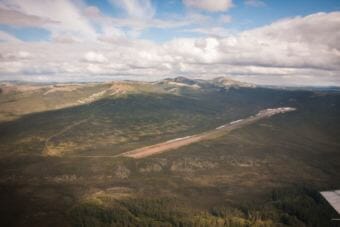
Donlin runway and camp site in summer 2014.
The site of the proposed Donlin Mine, 145 miles northeast of Bethel. (Dean Swope/KYUK)

On May 27, the commissioner for the Alaska Department of Environmental Conservation chose to uphold a key state water quality certificate for the proposed Donlin Gold mine. The decision comes after an administrative law judge recommended that the DEC should not uphold the certificate in April.
In August 2018, the DEC issued a “certificate of reasonable assurance” to Donlin Gold that said that the state can count on the company’s operations to comply with water quality standards. The Army Corps of Engineers required the certificate before it issued its federal one. The Orutsararmiut Native Council challenged the certificate and passed a resolution opposing the mine. The tribe is based in Bethel, the largest community downriver from the proposed mine.

ONC tribal citizen Gloria Simeon said that DEC’s latest decision risks the health of people in the region and did not take into account the opposition from many of the tribes in the Yukon-Kuskokwim Delta.

“We have our work cut out for us,” said Simeon.

In April, Administrative Law Judge Kent Sullivan ruled that Donlin Gold’s mining operations would not guarantee a “reasonable assurance” that the mine would meet and maintain state environmental and water quality standards — specifically for mercury levels, water temperature and salmon habitat.

Sullivan said that the agency and Donlin Gold did not properly calculate the risk of mercury levels in the water. Donlin Gold is planning to build the mine in a mercury belt, where levels already exceed the state standards. Sullivan said that Donlin Gold and the agency were “tak[ing] the misguided approach resorting to sleight of hand” when they used a different calculation to justify the certificate.

Disturbing salmon habitat in Crooked Creek, a Kuskokwim River tributary near the mining operation, is another issue that the tribe is concerned with. Sullivan said that “salmon and salmon habitat in a large segment of Crooked Creek will be significantly and detrimentally impacted by the project.”

Sullivan’s recommendation to not uphold the state certificate potentially jeopardized the Corps’ federal permit, one of the major ones that Donlin Gold needs to operate. DEC Commissioner Jason Brune had the final say over whether to accept the recommendation. He chose to reject it.

In his decision, Brune said the analyses performed by federal and state agencies throughout the permitting process showed that the mining operations would meet state and federal environmental and water quality standards.

Donlin Gold applauded the decision. Donlin Gold spokesperson Kristina Woolston said, “Simply put, we will not operate the project without demonstrated compliance with the state’s water quality standards.”

Calista Corporation, which owns the mineral rights to the mine, also agreed with Brune’s decision.

Thirteen tribes in the Yukon-Kuskokwim Delta have passed resolutions opposing the mining project. During the 2019 convention of the Association of Village Council Presidents, 35 tribes voted to pass a resolution opposing Donlin Gold, citing possible environmental impacts to the Kuskokwim River.

Biden administration puts Arctic refuge leases on ice as it asks for new environmental reviews

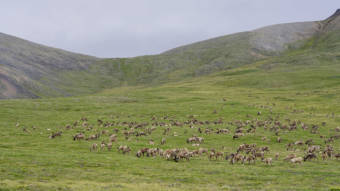
The Porcupine Caribou Herd in the Arctic National Wildlife Refuge on July 3, 2019. (Danielle Brigida via Creative Commons)

The Biden administration Tuesday took its first steps toward reversing the opening of the Arctic National Wildlife Refuge’s coastal plain to oil drilling, by suspending leases issued in the final days of the Trump administration.

The suspension comes as no surprise: Biden, on the campaign trail, vowed to adopt permanent protections for the refuge. And on his first day in office, on Jan. 20, he directed the Interior Department to put a “temporary mortarium” on all oil and gas leasing activities in the refuge and to review the environmental impacts of the Trump administration’s oil and gas program for the area.

Now his Interior Department says it’s doing just that. It announced in a written statement Tuesday that it’s conducting a new environmental review of the Trump administration’s oil and gas leasing program for the refuge’s coastal plain while addressing what it called “legal deficiencies.”

All activities related to the program — including the current leases — are suspended until the review is complete. The department will then decide whether the leases should be “reaffirmed, voided, or subject to additional mitigation measures,” the statement said.

The refuge’s coastal plain — the area Congress opened to drilling in 2017 — is the northernmost slice of the Arctic refuge.

It’s home to migrating caribou, polar bears, birds and other wildlife. It also potentially sits atop billions of barrels of oil, according to federal estimates. Some Indigenous Iñupiat leaders in the village of Kaktovik, which sits within the coastal plain, support oil exploration, while the Gwich’in, who live to the south and subsist on caribou, are opposed.

The Arctic National Wildlife Refuge’s coastal plain is shown in orange. The area covers about 1.6 million area, roughly the size of Delaware, and makes up about 8% of the refuge. (USGS map)

After a decades-long fight over whether to drill for oil in the coastal plain, the Trump administration held the refuge’s first-ever lease sale Jan. 6.

It was a controversial sale, snarled in lawsuits and opposition.

Critics said it was rushed, sloppy and a threat to animals and the environment. But supporters said drilling in the refuge is good for jobs and the country’s energy independence.

The sale ended up drawing little interest; no major oil companies bid on the leases. Instead, two smaller ones each picked up a single lease, and the state-owned Alaska Industrial Development and Export Authority picked up seven. The leases last for 10 years.

An Alaska-based spokesperson with the Bureau of Land Management said she had not been given any information on a suspension by late Tuesday morning.

An AIDEA spokesperson did not immediately respond to a request for comment.

Meanwhile, environmental groups and a Gwich’in organization cheered the news of suspended leases.

“The Gwich’in Nation is grateful and heartened by the news that the Biden administration has acted again on its commitment to protecting sacred lands and the Gwich’in way of life,” said a statement from Bernadette Demientieff, executive director of the Gwich’in Steering Committee.

Demientieff said she hopes the Biden administration goes a step farther soon and cancels the existing oil and gas leases and bans drilling in the refuge’s coastal plain.

This is a developing story. Check back for updates.

Utilities propose changes to make vehicle charging stations more affordable

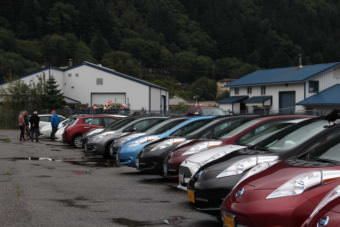
An electric vehicle fair in Juneau in September 2017. (Photo by Elizabeth Jenkins/Alaska’s Energy Desk)

There could be a chain of electric vehicle chargers along Alaska’s railbelt by 2022. The Alaska Energy Authority is building out its plan to make the 600-mile stretch of highway friendlier to electric vehicles.

But advocates say the state needs to change regulations before that plan is feasible. Earlier this month, a coalition of railbelt utilities proposed some of those changes to the Regulatory Commission of Alaska, the body that manages public utilities in the state.

The Alaska Energy Authority wants to line the railbelt with fast chargers, which can charge some cars in under an hour.

The problem is, those faster chargers consume large amounts of electricity for short bursts of time. That means a business hosting a charging station may have to pay a high demand charge.
And the businesses might not bring in many sales to balance those costs, at least in the beginning. Michelle Wilber with the Alaska Center For Energy and Power is part of the Alaska Electric Vehicle Working Group.

“Any public charging station isn’t going to be used very often right now, and it’s sort of a chicken or the egg problem,” she said. “Without the publicly available charging, then less people buy vehicles because they’re worried about running out of range to do a long drive or get to work or do a road trip.’

That’s going to be expensive for the businesses operating those stations. The Alaska Energy Authority is paying some station installation and maintenance costs with money from a 2017 Volkswagen settlement. But businesses have to pay for their own electricity.

“That’s not really tenable as far as someone owning the station and paying for those electricity costs,” Wilber said.

The Alaska Energy Authority has already received a lot of interest from potential site hosts along the railbelt. Wilber thinks that’s because they anticipate these regulations will change.

The utilities proposed a new rate design that would remove that high demand charge, at least for the first few years of operation. Each utility will have a little bit of wiggle room to determine its own rate and will approve that rate with the regulatory commission separately.

Wilber said she doesn’t think utility members will see much change in their rates. She said the idea is that ratepayers would eventually pay less as utilities sell more electricity to charger site hosts.

The other change the utilities are proposing is to explicitly allow site hosts to charge drivers for electricity.

Currently, public utilities are the only entities allowed to sell electricity to several different customers.  The workaround from charging site hosts has been to charge by the amount of time.

“For instance, there’s a level two charging station here at the Rustic Goat in Anchorage, and I believe they charge $1.75 and hour, or any portion of an hour,” Wilber said.

But, she said, different vehicles charge at different rates. And charging is slower when more of the vehicle is charged up.

The utilities want to clarify that charging site hosts don’t have to be public utilities themselves to sell electricity. That way, they can charge electric vehicle drivers for the electricity directly.

The Regulatory Commission of Alaska has received the docket of proposed changes and is now accepting public comment.

Frustration mounts as CDC keeps face mask rules for commercial fishing crews

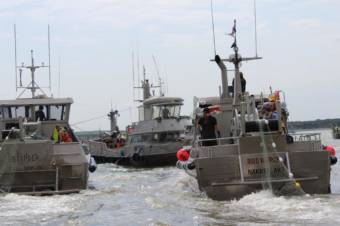
Naknek’s in-river opener on July 18, 2019. (Sage Smiley/KDLG – Dillingham)

Joe Trotter has fished in Bristol Bay for 13 years, in Egegik on the East Side of the bay. He strongly disagrees with the federal rule that would require people on commercial vessels to wear face masks to mitigate the spread of COVID-19.

“I think it’s ridiculous that they’re asking us to wear masks,” he said.

Trotter’s crewmembers on the F/V Seahag will all be vaccinated, and he said that since they don’t come into contact with anyone else during the season, spreading the virus to others isn’t really a possibility.

“If you go into shore, or you go into Dillingham, you go into Naknek, if you go on land somewhere, yeah, OK. But requiring us to have a mask on our fishing boat while we’re fishing? No. That’s ridiculous,” he said. “I’m not going to have my crew do that. It’s a safety issue, if nothing else.”

But he’s up against the federal Centers for Disease Control and Prevention and the Coast Guard.

Both agencies say crew on commercial fishing vessels need to wear a face mask.

The Coast Guard says crew members can take off their face masks for specific tasks if it’s unsafe to be wearing them, but when they’re done they have to put the masks right back on.

U.S. Sen. Lisa Murkowski is frustrated by the rules.

At a recent Senate hearing, she said she worries fishing crews will be more concerned about the liability of noncompliance with the mask requirement rather than their immediate safety.

“This is more a safety hazard than anything out — you’re out on a boat, the winds are howling, your mask is soggy wet. Tell me. Tell me how anyone thinks this is a sane and a sound policy to do,” she said.

This week, Murkowski and New Hampshire Democratic Sen. Maggie Hassan wrote a letter to the CDC and Coast Guard asking them to work together to exempt commercial fishers from the mask requirement.
They pointed out that the CDC has loosened its recommendations for fully vaccinated people in general, but not commercial fishing crews.

The CDC has lumped commercial fishing vessels in with all other forms of public transportation where face masks are required.

Murkowski and Hassan said they support masking on public transportation like planes, trains and buses, but commercial fishing vessels are different.

Trotter, the Egegik fisher, agrees.

“Most of the time we can’t hear each other on the boat, and we read lips or facial expressions,” he said. “It’s kind of important to have that on the boat for communication, for safety. And when you can’t hear what they’re saying, facial expressions are important.”

According to the letter, the Coast Guard told the senators it couldn’t change its mask requirements until the CDC changed its order. The CDC did not immediately respond to a request for comment Thursday about if it had plans to change the rules.

The mask rules do come with penalties. According to the Coast Guard, repeated failure to comply could result in “civil and/or criminal enforcement action.”

In an email, Coast Guard Chief Warrant Officer Kurt Fredrickson said, “We will be checking for compliance during the course of regular business.”

But they won’t deploy separate teams to check for face masks.

Hilcorp gets more time to replace leaky pipeline in Cook Inlet

Cook Inlet oil platforms are visible from shore on Dec. 13, 2016 near Kenai, Alaska.
Cook Inlet oil platforms are visible from shore on Dec. 13, 2016 near Kenai, Alaska. (Photo by Rashah McChesney/Alaska’s Energy Desk)

The federal agency that regulates pipeline safety is giving oil and gas company Hilcorp three more months to fix a line running under Cook Inlet.

The spill site, near Nikiski in Cook Inlet. (Graphic courtesy of the Alaska Department of Environmental Conservation)

Hilcorp’s line, which delivers fuel gas to a system of oil platforms in the inlet, sprung a leak last month. The 55-year-old pipe has leaked several times prior, most recently in 2019.

In response, the federal Pipeline and Hazardous Materials Safety Administration, or PHMSA, ordered the company to repair the line and come up with a plan for its replacement.

PHMSA originally gave Hilcorp until May 1 to permanently repair the line. Now, Hilcorp has until Aug. 1.

A spokesperson from PHMSA said the agency granted Hilcorp an extension in response to a formal request from the company.

The deadline to file a replacement work plan has also been pushed back by several months, to Sept. 1. Originally, that was to be done no more than 45 days after the order.

Meanwhile, the line remains shut off and no gas is running through it.

The shutdown pipeline appears to be impacting production, though Hilcorp declined to comment on that, as well as the status of the repairs to the pipe.

Data from the Alaska Oil and Gas Conservation Commission, however, shows that the system of platforms the pipeline fuels — called the Middle Ground Shoal — didn’t produce any gas in April, and it produced fewer than 2,000 barrels of oil. That’s down from over 38,000 barrels of oil and nearly 7 million cubic feet of gas in March before the pipeline leaked and was shut in.

The PHMSA spokesperson said Hilcorp removed a section of the pipeline and sent it to a lab for analysis. They say the agency’s investigation is still ongoing.

The leaky line is 7 miles long and 8 inches wide. It was built in 1965 and had two reported leaks in 2014, a year before Hilcorp bought the pipeline. Leaks occurred again in 2017 and 2019.

Last month’s leak occurred about 6 miles offshore from Nikiski.

Site notifications
Update notification options
Subscribe to notifications