Alaska's Energy Desk

A state corporation is still pushing a massive gas line plan in Alaska. Is it a pipe dream?

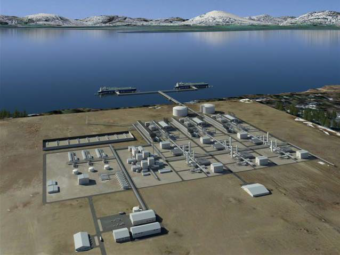
This illustration shows a rendition of what the liquefaction plant in Nikiski could look like if the Alaska LNG project is completed as planned. (Image courtesyAlaska LNG project.)
This illustration shows a rendition of what the liquefaction plant in Nikiski could look like if the Alaska LNG project is completed as planned. (Courtesy Alaska LNG project.)

A state corporation is in the middle of making another big push to try to get an 800-mile-long natural gas pipeline built from the North Slope to the Kenai Peninsula.

It’s a massive and complicated project that’s been talked about for decades.

Supporters say it will be good for the state’s economy and for energy costs. But critics argue that it’s way too expensive, and it’s time to give up on the pipe dream.

“There’s just no money in it. It’s never worked out. It’s never gotten built,” said Larry Persily, who was tasked under former President Obama with trying to get an Alaska gas line constructed.

Frank Richards, president of the Alaska Gasline Development Corporation, sees it differently. Richards’ job is to develop the long-talked-about liquefied natural gas project on the state’s behalf.

“I’ve been sitting in numerous and daily Zoom and Teams meetings, presenting the project and talking to potential investors, keeping people informed,” he said.

The project, Alaska LNG, involves building three big parts: A gas treatment plant on the North Slope, a pipeline down to Cook Inlet and a giant plant in Nikiski, where the gas would be liquified so it could be shipped out and sold.

Richards said the pipe would move the gas that’s already being pumped out of the ground on the North Slope, but is — as he puts it — stranded there.

“That natural gas comes up with the oil every day and must then be recycled back down into the reservoir,” he said.

If the gas can be piped out, some could stay in the state to generate electricity and heat homes, while some could go to the liquefaction plant on the Kenai Peninsula, he said.

“We would have energy delivered to Alaska, but also be able to have the financial reward of selling those natural resources to markets where they’re needed,” Richards said.

It’s not a new idea.

People started talking about building a gas pipeline soon after natural gas was discovered at Prudhoe Bay in the late 1960s.

But it never worked out. It’s expensive to build, and that’s still a major issue today. The Alaska LNG project is estimated to cost $38.7 billion.

Richards’ next steps include finding companies to take over pieces of the project. He also hopes to secure more funding. The corporation is asking the federal government for almost $6 billion to pay for the project’s first phase: A roughly 500-mile pipe that would run from the North Slope to Fairbanks, where the gas could be used locally.

Persily said there’s no way.

“The notion of the federal government spending billions of dollars to underwrite, to subsidize a fossil fuel pipeline to the Arctic is preposterous,” he said.

Persily worked as the federal coordinator of the Alaska Natural Gas Transportation Projects from 2010 to 2015, trying to get a gas pipe built from Alaska’s North Slope to the Lower 48.

He said the economics just don’t make sense. Companies will always invest in projects with the least amount of risk and best potential for profit, he said, and Alaska’s LNG project doesn’t stack up.

“I do feel bad for the people who are working on it and want it,” Persily said. “It’s just, you know, I wanted to be a pitcher in baseball. At some point I realized I’m 70 years old and I’m probably not going to be a major league pitcher. I need to move on.”

Persily argues that it’s time for the state to let go of the natural gas line,and stop funneling money into it. Since 2010, the corporation has received roughly $630 million in state funding.

“Every governor, every candidate for half a century has told people it’s coming,” Persily said about the gas line project. “And of course, we want it to come: It’s revenue, it’s jobs, it’s more royalties and tax dollars, and our life can go on happily ever after. So there’s no reason not to want it. But it’s time just to wake up.”

Richards, with the state corporation, strongly disagrees. He believes now is the time to build the gas pipeline.

The project, he said, will mean lower energy costs for Alaskans and thousands of jobs, plus more revenue for the state government. Also, he said the corporation has the environmental permits it needs to get building.

“We had received in 2020 literally all of our federal authorizations and permits necessary to construct the Alaska LNG project,” he said.

While there’s no sign of money for the gas pipe in President Biden’s infrastructure plan, Richards described himself as “ever the optimist” and said a lot could change between now and when the plan is finalized by Congress.

Even if Congress doesn’t add the funding, he said, the project is not dead.

“The project is not contingent on receiving those funds,” he said. “That was just an option that we represented, that would benefit the state and would ultimately help the project in terms of its economics, should there be that infrastructure funding.”

Without the federal help, private companies would have to foot more of the bill. The idea is that the corporation would hand over the gas line project to the private sector.

Richards said he’s talking to companies that want to take over different pieces of the project.

“They would not continue if they thought this was not a viable project,” he said.

Who those companies are is still a secret. The corporation said it won’t reveal their names yet because negotiations are ongoing and confidential.

The goal is to announce the companies later this year, said Richards. He said the state will also have to decide what stake it wants to keep in the project, if any.

Dozens of Alaska’s seismic stations are going offline, but earthquake monitoring is still on solid ground

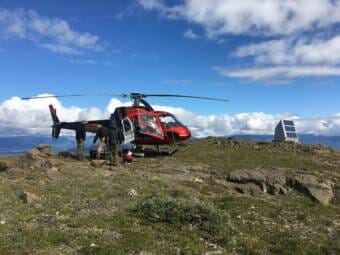
A seismometer station in 2018 (Photo by Kasey Aderhold/Incorporate Research Institutions for Seismology)

More than 80 seismic monitoring stations went dark in Alaska on Friday as a national project comes to an end. But the work leaves behind a more robust earthquake monitoring system than ever before.

If you ask Alaska Earthquake Center Director Michael West, he’ll tell you that what matters isn’t how many seismic stations the state is losing, but how many it gained.

“More than 100 of those are staying behind and they have already become part of our long-term earthquake and volcano and tsunami monitoring infrastructure,” he said.

The seismic stations are part of the U.S. Array, a multi-million dollar national research project. It spanned nearly two decades and the entire continent. The goal was to monitor seismic activity and better understand the ground under our feet. Transportable seismic stations started on the west coast and moved east, then doubled back to their last stop: Alaska.
“Think of it like a kids science fair project or something, you go out, you do an experiment, you collect some data, and then you pack up, go home and move on to something else,” West said.

“Somebody came along and did a really cool $50 million, you know, site short-term seismic experiment. But that plan always had in it, that at the end of the project, the lights would be turned off … and the project would be over.”

Except more than half of the equipment that should go home is staying in Alaska. That’s due to a big push from the scientific community and the state’s federal delegation. West says to think of it as the stations just getting thinned out a little bit.

He says the system brought earthquake monitoring and recording capabilities to huge swaths of the state where very little had existed before — filling in the details of what was once a sketchy understanding of certain regions.

“I can remember discussions a decade ago, where, you know, well-intentioned engineers thought, ‘oh, they’ll never be able to pull this off. This is too big and scale. This is too grandiose.'” West said.

But, they did. And now, it’s over.

Kasey Aderhold is a project associate for the Incorporated Research Institute for Seismology,  one of the national research groups responsible for the project. She says taking dozens of far-flung research stations in some of the most remote parts of the continent offline is actually pretty simple.

“It’s basically like calling up your cell phone provider and saying, I would like to cancel my line,” she said with a laugh.

They’ll just stop transmitting. Later this summer, scientists will visit the sites and pack up the equipment. That part is more complicated. Aderhold says because of the pandemic, they even got an extra year of data.

“It’s been an amazingly productive time, geophysically, in Alaska to have this network there. Alaska always has had a lot of earthquakes, a lot of volcanoes and other things, but the past years where this network has been in place have been extraordinarily busy,” she said.

The array captured data from Kaktovik earthquakes in 2018, a magnitude 6.4 rumbler on the North Slope, 2018’s Anchorage quake, and some magnitude 7 quakes in the Aleutians.

West says the end of the project is bittersweet for Alaska Earthquake Center.

“Kind of sad, it is. But there are just an unbelievable number of people who should be, you know, thanked and back slapped and all that stuff for their incredible vision and efforts to change — fundamentally and forever — change Alaska’s seismic monitoring environment,” he said.

The legacy of the U.S. Array in Alaska is a more robust earthquake monitoring system and years of data whose impacts have only begun to rumble through the scientific community.

State-owned corporation considers shuttering Skagway ore terminal, building a new one in Haines

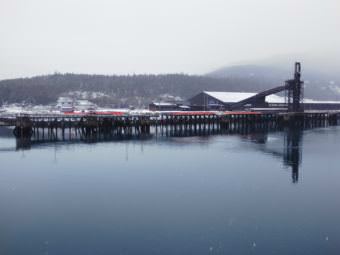
The Skagway ore dock. (Photo by Emily Files/KHNS)
The Skagway ore dock. (Emily Files/KHNS)

The state’s development corporation is thinking about decommissioning its ore terminal in Skagway and opening a similar facility in Haines instead. Local officials in Haines see it as an opportunity to upgrade old shipping infrastructure. It’s an expensive proposition, and one that not all Haines residents are excited about.
Skagway’s deep water port has been used to ship ore from the Yukon for over a century. The Alaska Industrial Development and Export Authority bought Skagway’s ore terminal facility from White Pass and Yukon Route Railroad in 1991.

It has a contract with a British mining company to ship gold, copper and silver ore out of Canada. Last year, the amount of material they shipped was historically low.

AIDEA is now considering walking away from the ore terminal in Skagway. At a recent board meeting, the corporation decided to commission a cost-benefit analysis to see if it makes sense to invest and upgrade the facility or decommission it.

At the same time, the public corporation has been meeting with Haines Borough officials to discuss the possibility of developing an ore terminal at the town’s only freight dock along Lutak Inlet.

AIDEA’s Jesse Peterson explained the basic idea to the borough’s Ports and Harbors Advisory Committee on Thursday, April 22.

“There’s an opportunity to expand and modernize the existing Lutak Dock in combination with a potential bulk export ore loading facility that would improve the dock’s overall commercial function. This opportunity would create a facility that could accommodate the transportation of other resources, and really support the mining industry,” Peterson said.

Constantine Metal Resources has been exploring a mineral deposit north of Haines with hopes of one day developing a mine. At the meeting, Constantine CEO Garfield McVeigh said that while they had initially envisioned shipping ore from Skagway, an ore terminal in Haines would make more sense for the company.

“Haines would be a very obvious, even a more obvious place to ultimately ship concentrate from,” McVeigh said.

Developing the terminal in Haines would require a significant investment. In 2014, engineers determined that the dock had reached the end of its life and was at risk of failing.

The borough needs millions of dollars to repair the dock and has so far been unsuccessful in securing any federal funding for it. Some see investment from AIDEA as a way to save a critical piece of infrastructure for the town. But not everyone is so excited.

“I’m not going to stand for an ore terminal in our community,” said Shannon Donahue, a Haines resident and staff member of Southeast Alaska Conservation Council.

At the meeting, she referenced how decades of ore shipping out of Skagway has contaminated the basin of the port. The city has been working with stakeholders, including AIDEA, to develop a remediation plan for years, but the cleanup has yet to begin.

“I appreciate that our community needs repairs to our freight dock. I would encourage the committee to continue with the existing footprint. There are other ways AIDEA could help our community through small business assistance, through helping out with our rebuilding. But an ore dock is really a terrible idea here,” Donahue said.

Some residents have accused the Haines Borough of lacking transparency in its discussions with AIDEA. The borough had initially scheduled an evening town hall meeting to learn more about AIDEA’s proposal, but it was canceled abruptly. The Haines Chamber of Commerce then organized a series of speakers to discuss the proposal during the ports and harbor committee meeting.

It’s unclear what the next steps are for the proposal. AIDEA officials said community support would be important before proceeding with any project development.

Gustavus calls for halt to state construction project after officials find more toxins at city’s airport

Gustavus Airport terminal (Photo by Mike Castleman/Creative Commons)

Concerned residents in the Southeast Alaska town of Gustavus pushed state agencies to do more testing for contaminants before major construction at the city’s airport. And the state found more toxic “forever chemicals” at the site. Now, the City of Gustavus and a local advocacy group want the state to stop work until their safety demands have been met.
The state had already broken ground on a big federally funded airport upgrade project when test results revealed previously undocumented PFAS contamination on asphalt at the site.

PFAS are a group of toxic chemicals found in firefighting foam that used to be required at defense sites — and airports like the Gustavus airport. They’re known as “forever chemicals” because they don’t break down. There’s evidence they’re linked to cancer, thyroid problems and other health effects.

The asphalt thing was a big surprise — environmental regulators don’t typically ask for tests on asphalt. It’s not really absorbent like soil is. But citizens were concerned because the agency plans to scrape up the asphalt and grind it up to make new material. The state Department of Transportation, who is leading the project, responded to their request and found that there was PFAS present in the sample it tested.

Kelly McLaughlin is among the concerned citizens that asked for a full stop to the construction earlier this month.

“What we are asking for basically is just for the preventative measures to keep these PFAS from spreading further into the community,” McLaughlin said.

She found out her well water was too contaminated to drink in 2018. Her chickens and their eggs tested positive for PFAS. It’s in the soil where she kept a garden.

She founded the Gustavus PFAS Action Coalition to organize on behalf of her community.

“I don’t wish that lack of sleep and amount of worrying and lack of access to everything that you have worked for … I don’t wish that on anybody. And that that could come to many, many more people if the PFAS spread,” McLaughlin said.

The request was followed by a similar letter from the City of Gustavus. It asked the state to pump the brakes on a $20 million dollar upgrade at the airport. It cited “grave concerns” with the agency’s “lack of response” at the ongoing project. The city asked for a series of safeguards against public health before the agency continues work.

State regulators at the Department of Environmental Conservation threw out the project’s soil mitigation plan in response to the findings. The Department of Transportation & Public Facilities took more asphalt samples. The two agencies were scheduled to meet Monday morning to review the most recent test results and revise the soil mitigation plan. As of Monday afternoon, they had yet to comment on what was decided at that meeting and whether or not construction has been stopped.

McLaughlin said she realizes DOT is in a tough spot but said she thinks a solution is possible.

“If we can all work together and share information and help each other, I think we can get to a point where PFAS could be remediated at the airport in tandem with this project, and then it’s a win across the board for everybody. And that’s the ultimate goal,” she said.

The State of Alaska joined a lawsuit against certain PFAS manufacturers earlier this month. Sen. Jessie Kiehl represents Gustavus and is among lawmakers sponsoring a bill to regulate the use of PFAS in firefighting foams in the state.


Arctic research conference to highlight how rural Alaska communities approach energy, climate issues

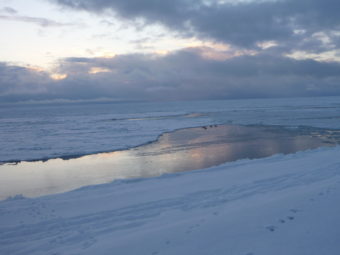
The view from Point Hope, early winter 2015. (Photo by Ellen Chenoweth/University of Alaska Fairbanks)
The view from Point Hope early winter 2015. (Photo by Ellen Chenoweth/University of Alaska Fairbanks)

Several Alaska energy researchers will be featured in a national conference this week of the U.S. Arctic Research Commission.
One of the big topics of discussion will be how rural Arctic communities deal with energy and climate issues. Bruno Grunau is the director of the Cold Climate Housing Research Center in Fairbanks. He’s slated to introduce the climate, energy and equity keynote speeches on the first day of the conference.

“You know, we’re operating and looking in a place of the earth where people have been for 10,000 years and living sustainably for that long,” Grunau said. “So what we’re looking at here is what does the future look like, what does sustainable future look like in this part of the earth.”

Tim Leach is a contractor with the Arctic Research Commission. Leach said a lot of these issues related to renewable energy overlap with other chronic problems in rural Alaska communities like water and sewer problems, as well as issues dealing with infrastructure.

“Really with regard to both the provision of electricity and for heat,” Leach said. “Those are two focus areas within this energy sphere that we’re looking at in the conference.”

Deputy Director Cheryl Rosa with the U.S. Arctic Research Commission said that they are eager to hear from Arctic residents on the individual energy challenges their communities are facing.

“We’ve got remote communities, they’re all very different from one another,” Rosa said. “So there’s very rarely a one-size-fits-all solution for approaches to almost any technology or things that you’re trying to install in remote areas. And it’s very important to work with folks, learn what their needs are and figure out how to best address them, with them as part of the equation.”

The conference is free and will be held virtually from 8:30 a.m. to noon Tuesday through Thursday. Those interested in attending can register online. It will also be broadcasted live on Facebook.

Alaska development authority signs land access agreement with Native corporation for Ambler Road project

Map showing the BLM-approved route for the Ambler Road
A map of the proposed Ambler Road project (Bureau of Land Management)

In the latest move forward for the controversial Ambler Road project, the Alaska Industrial Development and Export Authority reached an agreement with regional Native corporation Doyon to conduct survey and feasibility studies on the corporation’s lands.

The proposed 211-mile road would stretch west from the Dalton Highway to the Ambler Mining District in Northwest Alaska. The area is rife with mineral deposits, including zinc, gold, silver and cobalt. The road has drawn controversy from environmentalists and subsistence advocates over it crossing Gates of the Arctic National Park and potential impacts to caribou migration.

The land along the road’s route near the highway and the village of Evansville is owned by Doyon, the state’s largest private landowner. The agreement is not a right of way and does not guarantee long-term access to the area by AIDEA or the road project.

In a statement, Doyon President and CEO Aaron Schutt said that the corporation has not changed its position on the project, neither opposing or supporting it.

AIDEA plans to continue its summer field activities along the proposed route. The current budget for those activities totals about $13 million, a cost the state corporation will split 50-50 with Ambler Metals, the primary mining company interested in developing the Ambler Mining District.

Site notifications
Update notification options
Subscribe to notifications