Alaska's Energy Desk

Glacier Bay’s Alsek River predicted to shift course within a few decades due to climate change

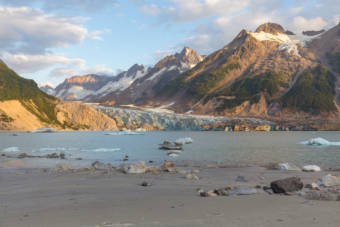
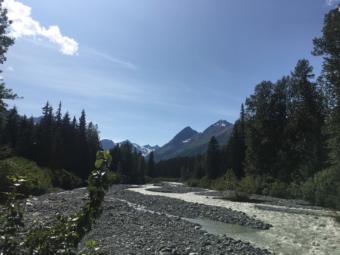
Walker Glacier at Alsek River (Photo by Matt Zimmerman/Creative Commons)

New research indicates that the Alsek River will change course dramatically over the next few decades. Geologists with the National Park Service predict that glacial retreat related to climate change may move the mouth of the river 20 miles away from its current location. This could pose challenges for raft trips and fishing in Glacier Bay National Park.

The Alsek River originates in the Yukon Territory and flows hundreds of miles south before emptying into the Pacific Ocean at Glacier Bay National Park. Near the end of its journey, the river widens into Alsek Lake. It’s currently separated from the Grand Plateau Lake by a glacier.

But when that glacier melts enough, the lakes will combine and eventually drain into the ocean down a steep embankment.

Michael Loso is a Park Service geologist who researches the Alsek changing course.

“Presently, the Alsek River can’t get there because this glacier, you know, this big pile of ice is in the way,” Loso said. “But really, the thrust of our paper is to make the case that once that glacier ice completely goes away, by a combination of melting and calving into the two lakes, you would be able to paddle your raft right on over to Grand Plateau Lake because the two lakes would be combined.”

For centuries, the Alsek has been used for fishing and hunting. It was an access corridor to the interior for Indigenous people living at the mouth of the river.

Now, the Alsek is a world-renowned rafting destination. Haines Rafting Company owner Andy Hedden has guided trips down it for years. He said the latest research confirms what many who are familiar with the area had expected.

“Anybody who’s done the trip with any regularity has watched this glacier trough, growing shorter and shorter, and these two lakes growing closer and closer together,” Hedden said. “So it’s pretty apparent the direction that it’s going. To me, it was really exciting to see the level of in-depth science and it was just rewarding to know that somebody out there is noticing it and paying attention.”

There are still some uncertainties about how the glacial melt will affect the current of the river, but Hedden said if Loso’s predictions are correct, it could pose some challenges for future rafting trips.

“If it adds 17 miles of flat water rafting across a long stretch of lake and still water, that adds some big challenges that might not be possible. It could take days and if there’s any wind it could be impossible to move. So there’s definitely some unknowns,” Hedden said.

The change in course could also pose problems for fishermen who set nets for salmon at the mouth of the Alsek, known as Dry Bay.

Glacier Bay National Park Superintendent Philip Hooge said if the river moves, commercial fishermen will not be able to get permits to fish at the location of the new mouth. That’s if the salmon still return to the area.

“Now, it would be very unclear whether there would even be the opportunity for salmon harvest,” Hooge said. “The river would be substantially changed in its nature, quite a ways up.  It might develop into a to a robust fishery or it might not.”

Glaciers have changed northern landscapes for much of the earth’s history. That’s not new, and Loso said the dynamic geology of Alaska is what fascinates him about the state.

But the climate change implications of this latest study are worrying for Loso. He said it’s striking to see such significant changes happening so rapidly.

“The glacial change that I’m studying is a painful reminder of some pretty big problems that we need to address. So that is concerning to me,” Loso said.

In Glacier Bay, they will just have to let this river run its course.

Future of Donlin Gold mine permit uncertain after judge recommends state regulators to rescind key certificate

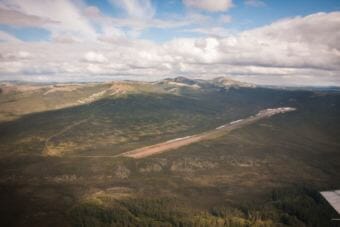
Donlin runway and camp site in summer 2014.
The proposed Donlin Gold mine would be one of the biggest gold mines in the world if completed. (Photo by Dean Swope/KYUK)

On Monday, an administrative law judge issued a recommendation that the Alaska Department of Environmental Conservation rescinds a state water quality certificate that was issued to the Donlin Gold mine in 2018. The certificate is required under the Clean Water Act. Here’s what rescinding the certificate could mean for the proposed mine, and how the parties involved in the decision have responded to the judge’s recommendation.

The judge’s proposed decision throws doubt over the future of the Army Corps of Engineers’ permit that Donlin obtained back in August 2018.

The state water quality certificate is a big one. It’s required under Section 401 of the Clean Water Act. Under Section 401, states have the legal authority to review an application for a project that requires a federal permit. James Rypkema, a program manager at DEC’s Division of Water, told KYUK in 2018 that the U.S. Army Corps of Engineers has to permit the project since it impacts 3,500 acres of wetlands. Without the state water quality certificate, Donlin could not receive its federal permit from the Corps.

The Orutsararmiut Native Council in Bethel is the organization that challenged the certificate. The tribe contended that the state cannot guarantee that the mining operations will maintain Alaska’s water quality standards for mercury levels, water temperature, and fish habitat. Administrative law judge Kent Sullivan’s proposed decision agrees with the tribe.

In a press release, ONC Executive Director Mark Springer celebrated the judge’s recommendation.

Springer wrote: “This decision by Judge Sullivan demonstrates that the concerns of the People of the Kuskokwim River surrounding development of the Donlin Prospect were, and are legitimate.”

Springer claimed that the state “erred in their hasty issuance” of the water certificate, and he urged ADEC Commissioner Jason Brune “to take to heart the conclusions” in the judge’s recommendation and “ensure protection of salmon streams.”

DEC spokesperson Laura Achee would not respond to KYUK’s questions on the judge’s proposed decision or what it means for Donlin Gold. In 2018, Rypkema told KYUK that it is rare for any permit to get denied.

In a statement, Donlin Gold spokesperson Kristina Woolston wrote that the company “strongly disagrees” with the judge’s proposed decision and that the decision “does not affect Donlin Gold’s commitment to the Project’s Alaska Native landowners, The Kuskokwim Corporation and Calista Corporation, to build an environmentally responsible mine that enriches the lives of those in the Yukon-Kuskokwim region.”

Achee said that under state law, the department’s commissioner has 45 days from the release of the judge’s recommendation to issue a decision, which would be a deadline of May 27.

Cook Inlet slated to have one of the first tidal power generators in the country

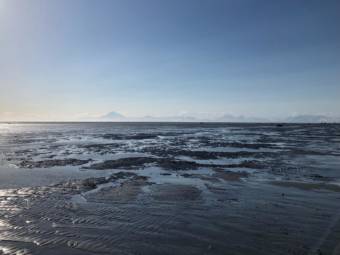
Low tide at Kenai Beach. (Sabine Poux/KDLL)

Cook Inlet has long been a hotbed of oil and gas development in Alaska. But for years, renewable energy advocates have been eyeing another Cook Inlet resource — tides. The inlet has some of the largest tides in the world but their energy potential has remained untapped.

One company is trying to change that, and says it could have a generator in the water in the next three years.

Ocean Renewable Power Company, of Maine, is filing a permit later this spring for a pilot project in Nikiski. Merrick Jackinsky is one of two employees in Anchorage.

“Where we’re looking at, the East Foreland site, is mainly just because the extreme velocity that it has there to kind of get that bigger bang for our buck right off the bat,” he said.

Anyone who’s fished in the area knows the tides can really rip. That’s important because the company’s tidal tech relies on the movement of the tides to spin turbines connected to an underwater generator.

The turbines work when the tide is going in and out.

“So we’re always able to generate power, except during slack tide,” Jackinsky said.

ORPC currently has another hydrokinetic generator in Igiugig, on the Alaska Peninsula. That device sits in freshwater, in the Kvichak River, and is helping Igiugig ween off its dependence from diesel.

The potential power in Cook Inlet’s tides is much more vast. Studies estimate the inlet holds over a third of all tidal energy potential in the U.S.

But that power has proven elusive. Multiple companies, including ORPC, have filed permits with the federal government that haven’t come to fruition.

One challenge has been finding a market.

“Tidal power’s biggest concern right now, I’d say, is solar and wind power,” said Chris Rose. He’s executive director of Renewable Energy Alaska Project, a non-profit that advocates for renewable energy statewide. ORPC is a member.

“Solar and wind power have come down so quickly in price over the last decade,” Rose said. “It used to be that tidal power 20 years ago was competing against fossil fuels. But now, really, the biggest competitor is solar and wind. And so more investment has gone into those renewable technologies and less has gone into tidal.”

The Cook Inlet project would be one of the first tidal power generators in the country. Jackinsky estimates tidal is 10 years behind its wind and solar counterparts.

Tidal energy, however, could be more dependable than solar and wind. It’s predictable hundreds of years in advance.

“If you were to put tidal power stations up and down Cook Inlet, they would produce power at different times of the day,” Rose said. “Which could make the resource what the utilities call a ‘base load resource’ — something that they can manipulate and count on.”

Initially, the company hopes to produce a megawatt of power from the device, eventually increasing that load into the hundreds of megawatts. The Railbelt as a whole has an average annual load of 600 megawatts, according to REAP.

But that’s all far down the road. First, ORPC has to file a preliminary permit with the federal government, including an environmental assessment. Any project in Cook Inlet has to avoid damage to the fish and whales that call the region home.

Jackinsky said salmon have been able to avoid the turbine in Igiugig because the device is free floating and doesn’t dam up the water.

In three years, he said, ORPC could have a pilot device in the water. That first device wouldn’t send power to the grid , but would be in place as a sort of test — to gauge the impact of the salty water on the machine, for example. A permanent device could take a decade.

“It’s more like a marathon, it’s not like a sprint,” he said.

As for the all-important market, ORPC thinks it has one. The company signed a joint development agreement with Homer Electric Association, the local utility, and HEA said it will purchase power generated by ORPC for its grid.

Currently, HEA gets most of its power from natural gas also produced in Cook Inlet. The oil and gas industry in Cook Inlet has slowed in recent years, with lackluster industry interest in offshore exploration and a declining supply of natural gas that shuttered the once-bustling Kenai liquefied natural gas plant.

Renewable advocates like Rose see tidal as a more enduring resource.

“When you invest in the technology like that, you’re investing in perpetuity,” he said.

He said with tides like the ones in Cook Inlet, Alaska could be at the center of tidal energy production.

Hilcorp ordered to replace gas pipeline with history of leaks

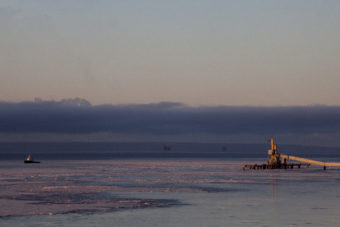
Cook Inlet oil platforms are visible from shore near Kenai, Alaska. (Photo by Rashah McChesney/Alaska’s Energy Desk)

Energy company Hilcorp has been ordered to replace an undersea pipeline in Cook Inlet after it leaked gas last week, for the fifth time in the last several years.

In a corrective order dated April 6, the Pipeline and Hazardous Materials Safety Administration told Hilcorp it must temporarily repair the 55-year-old pipeline by April 17, permanently repair it by May 1 and submit a plan for the pipeline’s replacement within 45 days.

The last time the pipe leaked, in 2017, Hilcorp didn’t complete repairs for three months, citing danger from ice in the inlet.
Sea ice is again a problem.

Crystal Smith, an environmental program manager with the Alaska Department of Environmental Conservation, said Hilcorp is waiting for the weather to improve before sending divers down to inspect the pipeline.

She said Hilcorp has both temporary and permanent clamps and will determine which will work best. The line is seven miles long, eight inches wide and carries fuel gas, mostly containing methane, to two Hilcorp platforms in Cook Inlet.

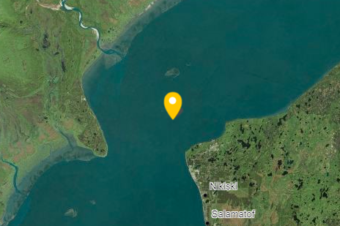
The spill site, near Nikiski in Cook Inlet. (Graphic courtesy of the Alaska Department of Environmental Conservation)
The leak site, near Nikiski in Cook Inlet. (Graphic courtesy of the Alaska Department of Environmental Conservation)

A pipeline administrator said in the order he thinks it’s dangerous to continue to operate the pipeline due to its history of leaks and the its age, plus the fact that the pipeline is under a critical habitat for endangered species, including the Cook Inlet beluga.

Smith said DEC has deployed state and federal agencies to provide input on resources that might be at risk.

“Hilcorp has actually had folks out there doing wildlife observations,” she said. “They have not seen any impacts to the wildlife at this time.”

The leak occurred a mile from one of Hilcorp’s platforms and six miles offshore from Nikiski. It was first reported last Thursday by a helicopter pilot who spotted bubbles on the water’s surface.

Hilcorp reported the leak to state and federal authorities an hour later and immediately reduced pressure on the pipeline. When it could not sustain that amount of pressure, it changed course and shut in the line, the order said.

Hilcorp estimates the leak initially let out between 75,000 and 150,000 cubic feet of natural gas per day.

Authorities still don’t know what caused the leak. But the order gives Hilcorp four months to find out. Before restarting operations there, Hilcorp has to submit a plan to federal regulators.

The pipe was built in 1965 and had two reported leaks in 2014, a year before Hilcorp bought it. Leaks occurred again in 2017 and 2019, and all were repaired with clamps, the order said.

Hilcorp is known for buying and reinvigorating old infrastructure and is currently Cook Inlet’s biggest oil and gas producer.

Exploratory drilling to resume at controversial mine project near Haines, Klukwan

A drill site at the Palmer Project north of Haines. (Photo courtesy of Constantine Metal Resources)

Exploratory drilling will resume this season at a controversial mine project in Southeast Alaska. Constantine Metal Resources announced one of its biggest work seasons yet after a slow year in 2020.

Drillers will be back on the mountain around the clock after a year-long hiatus at a mining project near Haines and Klukwan.
Canadian company Constantine Metal Resources announced its Japanese partner, DOWA Holdings Company, will finance the $8.8 million work season. The Canadian metals company will give up its majority stake in the project in exchange for that cash.

Constantine’s CEO Garfield MacVeigh says that shift won’t have much impact on surrounding communities.

“DOWA was happy with Constantine as operator — we’ll continue to be office operator for the foreseeable future. You know, go up, DOWA is keen to keep the project moving ahead towards feasibility, which is why they were prepared to fund the program this year,” he said.

The Palmer Project is in the advanced stages of exploration for a large-scale copper, zinc, sliver, gold and barite mine. Critics in the region say mining risks harm to the nearby Chilkat River’s salmon run and have spent years fighting the project. But many residents hope a metals mine could bring high-wage jobs to the region.

A federal appeals court upheld the mine’s permits last summer after a legal challenge brought forth by the Chilkat Indian Village of Klukwan and environmental groups.

Fieldwork this year will include 6,000 meters of drilling and a seismic survey — work the company says is required to make a decision on whether or not to mine.

The company has had permits to build a large underground tunnel at the site since 2019, but it will not begin that construction this year. The permits were contested by environmental groups, but are valid while under review by the state Department of Environmental Conservation.

The company plans to employ up to 50 workers for the 2021 season and is advertising jobs with plans to hire locally when possible. MacVeigh says the company will strongly recommend all workers be vaccinated for COVID-19.

Hilcorp gas pipeline springs another leak in Cook Inlet

Hilcorp’s Anna Platform in Upper Cook Inlet. The company is looking to further expand its operations in the Inlet after buying up additional acreage at federal and state lease sales. (Photo courtesy Cook Inletkeeper)

Oil company Hilcorp is reporting another undersea natural gas leak near one of its platforms in Cook Inlet, about six miles offshore from Nikiski.

Authorities said they don’t yet know how much gas has leaked into the ocean or what caused the leak from the eight-inch-wide pipeline, located 80 feet underwater. Hilcorp said the leak was first reported Thursday evening by a company helicopter pilot who spotted bubbles on the water’s surface.

Hilcorp reported the leak to state and federal authorities an hour later and immediately reduced pressure on the line, according to a report issued late this afternoon by the Alaska Department of Environmental Conservation.

A map of the spill site, near Nikiski in Cook Inlet. (Alaska Department of Environmental Conservation)

It said Hilcorp activated valves to control the leak on Saturday afternoon, and officials said there’s no longer gas running through it.

This is not the first time the same pipeline has sprung a leak, according to local watchdogs. Four years ago, a rock on the ocean floor punctured the line and caused the loss of as much as 310,000 cubic feet of natural gas per day.

The pipe also leaked twice in 2014, according to Bob Shavelson, the advocacy director of Homer-based watchdog group Cook Inletkeeper.

Ice in the inlet blocked Hilcorp from repairing the 2017 leak for three months. Cook Inletkeeper threatened to sue the privately owned company over damage to the environment and local marine life.

The leaking pipeline is more than 55 years old, according to Cook Inletkeeper. Hilcorp is known for buying and reinvigorating old infrastructure and is currently Cook Inlet’s biggest oil and gas producer.

The gas that leaked isn’t produced from the platform. Instead, it’s dry natural gas that fuels nearby Hilcorp platforms. It’s almost entirely composed of methane.

Hilcorp will assess damage when ice conditions allow, the company said. A representative from the company also said divers will install a temporary clamp on the pipeline later this week.

The spill area is within the designated habitat for endangered Cook Inlet belugas. It’s also an essential fish habitat for several Pacific salmon species.

Site notifications
Update notification options
Subscribe to notifications