Alaska's Energy Desk

New construction at Gustavus airport digs up old concerns about toxic chemicals

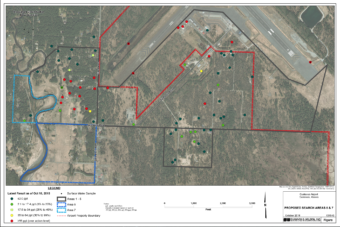
PFAS levels in Gustavus. (Image courtesy of the Alaska Department of Transportation)

Contractors plan to break ground on a multimillion dollar airport project in Gustavus  this month. But newly discovered toxic chemicals at the site make the state-run project more complicated, and some residents don’t think the environmental oversight goes far enough to keep them safe.

The upgrade at Gustavus’ state-run airport is a decade in the making, but in 2018 contaminants were discovered at the airport — and in water, soil and wells around the Southeast community.

The contaminants are called PFAS, a group of toxic chemicals found in firefighting foam that used to be required at airports and defense sites. They’re known as “forever chemicals” because they don’t break down. There’s evidence they’re linked to cancer, thyroid problems and other ill health effects.

In Gustavus, some residents are speaking out because equipment is already showing up for the $20 million federally funded project that is scheduled to break ground this month — but state agencies are still gauging the PFAS risks.

“I would like to trust the state government to do the right thing at the airport, knowing that there is a contamination present and that it has been impactful to the community, but I don’t have that confidence,” said Nicole Grewe.

The House Health and Social Services Committee listens to testimony from invited witnesses about toxic chemicals sometimes referred to as PFAS or “forever chemicals" in state waters on March 9, 2020, in Juneau. Facing away from the camera, from left to right: Kelly McLaughlin from the Gustavus PFAS Action Coalition, attorney and author Robert Bilott, and Pamela Miller of Alaska Community Action of Toxics.
The House Health and Social Services Committee listens to testimony from invited witnesses about toxic chemicals sometimes referred to as PFAS or “forever chemicals” in state waters on March 9, 2020, in Juneau. Facing away from the camera, from left to right: Kelly McLaughlin from the Gustavus PFAS Action Coalition, attorney and author Robert Bilott, and Pamela Miller of Alaska Community Action of Toxics. Bilott is portrayed in the movie “Dark Waters,” a story based on his 20 year battle against Dupont. (Photo by Skip Gray/KTOO)

She is among a number of residents leery of a project that will move contaminated soil. And to be clear, the state has done what it’s legally required to do. There just aren’t many legal requirements.

More than a dozen Gustavus households have been drinking bottled water for years after learning their wells are poisoned with PFAS from runoff. Grewe lives across the street from the airport. She’s worried the contamination could spread.

She and members of Gustavus PFAS Action Coalition are pushing for more accountability from the state.

“There is no permanent disposal plan for the contaminated ground. There, there is no permanent solution to this. They found the contamination, there are plumes across the community,” said Grewe.

The state Department of Transportation runs the airport and is responsible for the contaminants, but there’s no current requirement to clean them up. It does have a plan to keep contaminated soil from spreading toxins in Gustavus, which state regulators approved in early March.

Grewe says the plan doesn’t go far enough because it doesn’t test the airport runways for PFAS or sample enough of the surrounding soil.

“I never thought I would be at a place where I have to advocate on behalf of myself and the community to ensure the state does not do further harm,” she said.

DOT spokesperson Sam Dapcevich says the agency takes community concerns seriously.

“We’re not going to do any construction work until we resolve those issues,” he said.

The agency even tested some of the asphalt at the contaminated site after Grewe voiced her concern. That’s a step beyond what they’re required to do. State regulators say it may be a first.

“It is a rather new issue that we have to deal with. And we’re figuring it out as we go,” said Dapcevich.

DOT officials point to regulation by another state agency — the Department of Environmental Conservation — that signs off on their safety measures.

State environmental regulators don’t typically inspect construction at contaminated sites that they’ve already checked out. It’s up to DOT to comply with state regulations. And there’s motivation to do that because the agency is responsible for any further contamination.

PFAS are known to be toxic, but they aren’t considered a hazardous waste substance. There are federal guidelines for how to manage PFAS, but no regulations. And the state is actually out in front of the federal government on this one.

But State Senator Jesse Kiehl says Alaska’s regulations aren’t enough to keep residents of Gustavus safe.

“The state of Alaska has some very, very weak regulations. They really only cover two of these forever chemicals. And at surprisingly high levels,” he said.

Kiehl says Alaska’s agencies typically go farther than they have to, but it still isn’t far enough. He’s introducing a bill this legislative session that would significantly tighten state restrictions. It would limit the use of firefighting foams with PFAS in them and create stricter protective standards for people. He says it’s a start.

“Unfortunately, nothing in my bill can create the kind of instant understanding and and solidly defensible cleanup standards that we need to to get these contaminated water plumes cleaned up under the ground,” said Kiehl.

There’s federal legislation in the works this year that could set nationwide regulations for PFAS. But until any of these bills become law, folks from Gustavus are pretty much left to advocate for themselves. Nicole Grewe says state regulators have responded to some of her requests for additional testing at the airport, but not all of them.

“So does it allay all my fears? No. Am I hoping for a good outcome? Yes. And I hope that we’ve created enough noise of the DOT is going to double down on making sure there’s no additional risk at Gustavus,” she said.

Until more regulations are set, making noise is about all she — or anyone — can do.

Editor’s note: This story has been updated to clarify that the state Department of Transportation doesn’t have to clean up the contaminants at this time. While there is no plan for full PFAS clean up in Gustavus now, Department of Environmental Conservation officials have not ruled out cleanup in the future.

Hilcorp gas wells near Anchor Point get green light

Hilcorp’s Seaview drill site in Anchor Point. (Photo courtesy of Willy Dunne)

The state has approved Hilcorp’s plans to drill two gas exploration wells near Anchor Point.

As early as Thursday, the company could start construction on a gravel exploration pad for the company’s Whiskey Gulch prospect. Hilcorp plans to drill two exploration wells there — an oil-gas combination well and gas-only well. An ENSTAR Natural Gas line runs by the site.
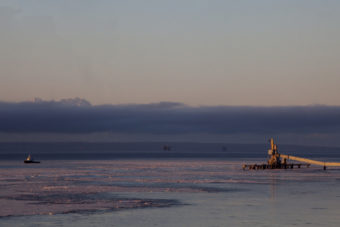
Hilcorp’s proposal for an access road and pad in Whiskey Gulch. (Department of Natural Resources, Division of Oil and Gas)

Hilcorp proposes drilling the first well in May, testing it in June and suspending and securing it in July. It would drill the second well in July and secure it in September.

Hilcorp also wants to improve the access road to the pad, which begins at the intersection of Cape Ninilchik Avenue and Opportunity Lane.

Plans for Whiskey Gulch are still in the exploration stage. But Hilcorp is slated to begin production soon on another well on the southern Kenai Peninsula — Seaview 8, south of Anchor Point. Hilcorp plans to start production there later this year after construction delays in 2020.

At federal forum, Alaskans weigh in on future of oil and gas

Cook Inlet oil platforms are visible from shore near Kenai, Alaska. (Photo by Rashah McChesney/Alaska’s Energy Desk)

Oil and gas leasing on federal lands and waters is on pause. That includes a sale in Alaska’s Cook Inlet that was originally slated for later this year and is now suspended indefinitely.

At the same time, the federal government is reviewing its energy program and gathering input from industry experts, environmental advocates and tribal leaders across the country. Several representatives from those groups, including two from Alaska, weighed in on the program at an Interior Department forum Thursday.

Nicole Borromeo, executive vice president and general counsel of the Alaska Federation of Natives, said that while Alaska Native communities are on the front lines of climate change, the federation also acknowledges the oil and gas industry is a boon for the Alaska Native workers it employs.

“Alaska natives do not operate in an either/or space when it comes to the nation’s energy policy,” Borromeo said. “We favor both traditional and emerging forms because a combination of both best serves our state and our people.”

In Alaska, the National Petroleum Reserve and a large swath of Cook Inlet are both part of the federal oil and gas program.

Earlier this year, the federal government halted an upcoming lease sale in the inlet in response to an executive order from the Biden administration, geared toward addressing climate change. Alaska and 12 other states are suing the Biden administration for that decision, while some environmental advocates are petitioning the government to block offshore leasing for five years.

Interior Secretary Deb Haaland said the government needs to take a long view at its management of public lands and waters.

“The pause on new oil and gas lease sales give us space to look at the federal fossil fuel programs that haven’t been meaningfully examined or modernized in decades,” she said.

Michael LeVine is a Juneau-based Arctic fellow with Ocean Conservancy, an environmental advocacy nonprofit. He said the pause was a good first step but further reforms and legislation are needed.

“If we could make one change in the legislation about offshore oil and gas, it would be to prioritize the health and viability of ocean ecosystems, rather than the way it’s stated now, a priority for extraction,” LeVine said.

He said offshore leasing in Alaska jeopardizes ocean ecosystems and the people who rely on them, including coastal communities and members of the fishing industry.

Representatives from trade unions and oil and gas industry associations said cutting federal oil and gas production would be bad for jobs.

Borromeo said AFN is also concerned about maintaining energy jobs for Alaska Native people. She said the department should actively consult Native communities in its decision-making on energy policy.

“Let us show you our lands,” she said. “Don’t necessarily just rely on what private industry or environmental groups are saying. We want to be the ones to take you and to show you.”

She encouraged Interior Department officials to visit Alaska to see it for themselves.

“That means you’re going to have to stay probably a week or so,” she said. “Because it’s going to take you a day to get here, a day to adjust up in Anchorage, and then we’ve gotta get out to the bush. We need to travel.”

The Interior Department said it will complete an interim report on its federal conventional energy programs this summer. It’s soliciting additional feedback until April 15.

Soldotna construction company reaches $130K settlement with EPA over unauthorized well, contaminated groundwater

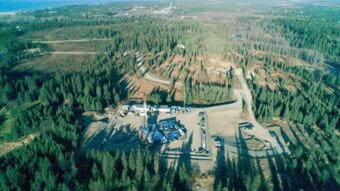
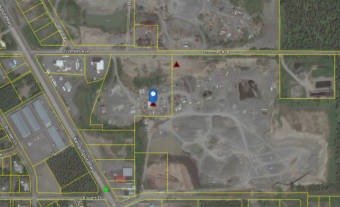
An aerial view of the contaminated site at North Star Paving and Construction in Soldotna. (Alaska Department of Environmental Conservation)

A Soldotna construction company has settled with the U.S. Environmental Protection Agency for $130,000 after an unauthorized injection well was discovered on the property.

North Star Paving and Construction had a well at its maintenance shop near Knight Drive that drained vehicle waste from the shop into an oil-water separator, then leach field in the ground.

It was likely on the property for several decades. But those types of wells were banned in 2000 since the chemicals can impact groundwater. Alaska required all wells of that type to be removed by 2005.

A consulting firm found the well over a year ago when it was hired by a potential property buyer to do an environmental assessment there.

“Actually, a pretty common way that things are found,” said Suzanne Skadowski, the public affairs manager for the region of the EPA that includes Alaska. She said the consultant then sent its findings to the state.

Peter Cambpell, project manager for the state’s contaminated sites program, said they discovered contaminated groundwater near the well. The floor drain was connected to a tank that was supposed to separate water from oils and greases.

“But it was, from what I understand, never used properly in that there wasn’t any water in it on a regular basis,” he said.

As a result, more chemicals seeped into the ground.

The well is above a community water supply for Soldotna. But Campbell said that supply is 163 feet deep and is in a confined aquifer.

“I don’t think there’s any chance that that’s been impacted, and it is sampled regularly,” he said.

There are also several business wells nearby. Campbell doesn’t think those would have been impacted, either. He also said it would be virtually impossible for the Kenai River — located less than a mile away — to be impacted by the contamination.

North Star didn’t respond to requests for comment. But Campbell said the owner did have knowledge of the well since they had floor drains in the shop. It’s not clear why they didn’t remove it, or whether they knew it was illegal.

EPA inspector Donna Ortiz said the prospective property buyers have gone through with the sale but are avoiding the area around the contaminated site until it’s fully cleaned up. North Star has already removed the well and a few hundred yards of soil.

“They’re very interested in getting this done as soon as possible because they wanted to sell the property and then go into a retirement,” she said.

Campbell said the state is continually testing the groundwater in the area.

State of Alaska, cities, business groups file to defend exemption of Tongass from Roadless Rule

Tongass National Forest
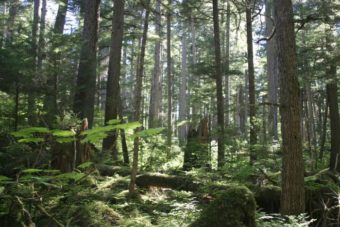
Part of the Tongass National Forest on Douglas Island pictured in 2004. (Creative Commons photo by Henry Hartley)

The state of Alaska and a former governor along with a host of municipalities, trade groups and businesses have filed to defend the Tongass National Forest’s exemption from a Clinton-era rule that limits development on federal land.

The Trump administration decided to get rid of the Roadless Rule for the Tongass last year. Shortly afterwards, a group of tribes, conservation groups, fishermen and tourism companies sued the federal government, seeking to overturn the decision. They say the decision to lift the rule on more than 9 million acres of the Tongass is based on a flawed environmental analysis and ignores the input of Alaska Native tribes and the public.

But the state and the rest of the coalition looking to defend the exemption for the Tongass say the rulemaking process was proper and that an exemption is critical to the state’s economy.

“The Tongass holds great economic opportunity for not only Southeast Alaska, but the State as a whole,” Gov. Mike Dunleavy said in a news release. “From resuming our timber industry to attracting tourism, this region has the potential to create good-paying jobs and it is my administration’s intent to defend our state’s rights and improve access to public lands.”

Robert Venables is executive director of Southeast Conference, an economic development group. He said projects in the Tongass are already held to high standards under state and federal laws and regulations.

“What really is the issue, in my mind, is having a conversation of, how does Alaska really access and control and have more of a conversation about how the forest is managed? Because this is very unique, where you have almost 96% of the region in direct federal control,” Venables told Alaska’s Energy Desk in a phone interview.

He said the Roadless Rule places unnecessary hurdles in front of development, pointing specifically to renewable energy projects. While developers can apply for exemptions to the Roadless Rule — and most are granted — he said the rule adds to the cost and time required to complete projects.

“This is not about extraction of resources. This is about every single economic sector meeting having unique needs for the forest, and we need a management plan that can reflect that,” Venables said.

Roadless Rule supporters disagree. They see increased resource extraction and development as an inevitable consequence of the rule going away in Alaska.

President Joel Jackson from the Organized Village of Kake said he’s concerned development could hurt the region’s other economic drivers.

“Our region, before COVID, was heavily reliant on tourism, and sport fishing, and commercial fishing and subsistence fishing. And it still is. And those areas provide way more jobs and more economic value to Southeast Alaska,” Jackson said in a phone interview.

Jackson said it’s also a threat to Alaska Native tribes’ way of life, since they harvest food and medicine from the forest and nearby waters.

Ketchikan’s city and borough have joined the state in defending the exemption. City Mayor Bob Sivertsen said development doesn’t have to harm the environment.

“Well, there are mitigations for everything we do,” Sivertsen said via phone. “We have the technology these days to do construction and other things that would lessen the impact on environmental issues, whether we’ve got to put in fish culverts, silt fences, the design and placement of the roads, all those types of things.”

Roadless Rule advocates say that logging and other development could accelerate climate change because the Tongass stores vast amounts of carbon.

Other parties defending the exemption include the city of Craig, statewide and Southeast chambers of commerce, electric utilities, shipping companies and resource development advocacy groups.
Alaska cruise cancellations pile up even as lines plan return to North America this summer

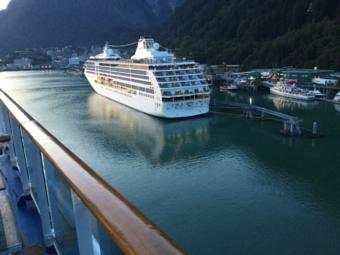
Royal Caribbean International’s Ovation of the Seas, another quantum-class cruise ship, in Skagway’s port. (Claire Stremple/KHNS)
Royal Caribbean International’s Ovation of the Seas, in Skagway’s port. (Claire Stremple/KHNS)

Cruises are returning to North America in June, but the news is not as good for Alaska as it might sound.

Celebrity Cruises and parent company Royal Caribbean announced Friday that cruises in North America would resume this June. It’s good news for an industry that’s been sidelined in the Western Hemisphere for more than a year.

Cruises are still effectively banned in the U.S. — the federal Centers for Disease Control have yet to issue rules necessary for cruise lines to resume calling on U.S. ports.

And cancellations are starting to take a bite out of the heart of the Alaska cruise season. PrincessHolland America and Disney have each canceled cruises from Seattle through about the end of June. Norwegian has nixed sailings worldwide through the end of June.

None of them are taking online bookings for almost any of the 2021 Alaska season — the sole exception is a trans-Pacific voyage scheduled for October.

That’s due in part to Canadian authorities’ decision to bar cruise ships from the country’s waters until early next year. Federal law requires foreign-flagged ships — including all large cruise ships that sail to Alaska — to make an international stop on domestic routes.

Sen. Lisa Murkowski says the state’s congressional delegation is working to overcome that significant hurdle.

Legislation that would waive the federal law requiring a foreign stop so far hasn’t picked up steam. But Murkowski says that’s only one part of the effort — she says the delegation is also lobbying both the Biden administration and the Canadian government to allow the season to go forward.

“So you have a legislative track, you have an administrative track, you have a personal persuasion track — where effectively, as a delegation, we are raising this issue with anyone who will listen and work with us,” Murkowski said.

State lawmakers are also advancing a resolution that calls for a waiver of the Passenger Vessel Services Act, the law that requires a foreign stop.

But the clock is ticking. Norwegian’s CEO recently told investors it’d take roughly 90 days to go from layup to sailing again.

Local officials and business owners in Ketchikan aren’t betting on a 2021 season happening. Ketchikan’s city council voted to lay off two city employees Thursday after local officials said another near-zero cruise season would cost almost $9 million in lost tax and fee revenue.

And consulting firm Bermello, Ajamil and Partners issued a bulletin this week predicting that cruise ships won’t return to Alaska ports until April 2022, at the earliest.

As U.S. and Canadian authorities appear hesitant to allow cruises to resume, Celebrity, Royal Caribbean and another cruise line, Crystal, are starting the summer on Caribbean islands outside of U.S. jurisdiction.

Celebrity will sail from the island of St. Maarten on the Millenium — which normally sails to Alaska over the summer. Crystal and Royal Caribbean will sail from the Bahamas.

All three lines will require adult guests to be fully vaccinated against COVID-19.

Site notifications
Update notification options
Subscribe to notifications