Alaska's Energy Desk

After COVID-19 hiatus, Denali climbing season returns in 2021

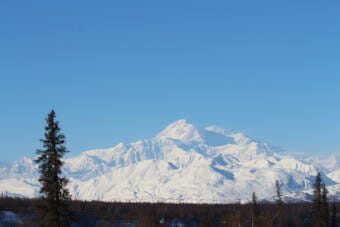
Denali in Feb. 2021 (Lex Treinen/Alaska Public Media)

For the first time in seventy years, nobody climbed Denali last year. The season was canceled due to COVID-19. Now the climbing season is returning, along with its boost to businesses in the Northern Susitna Valley.

Maureen Gualtieri, a public information officer for Denali National Park and Preserve, said the National Park Service is going into this climbing season with more information about COVID-19 than last year.

“We have better information on transmission, on prevention … We have better treatments, we’ve got more testing, more access to PPE for ourselves and our climbers, and of course, the potential game-changer of vaccines becoming more prevalent,” she said.

On average, the National Park Service expects around 1,200 climbers per year to attempt to summit Denali. The number is expected to be smaller this year, and Gualtieri said the distribution of where climbers are coming from is also expected to change.

“We would expect — and have seen — a decline in foreign registrations. That said, we expect a bit of an uptick in domestic climbers.”

Part of that anticipated increase in domestic climbers comes from Americans who might otherwise consider traveling abroad for mountaineering trips. With the fluid nature of travel restrictions, it’s likely to be easier to come to Alaska than to travel to another country.

Many of the climbers who come to Denali each year do so with a guide service. Alaska Mountaineering School in Talkeetna took a big hit last year when expeditions to the highest peak in North America were taken off the menu.

This year, the company is looking forward to resuming their Denali trips, but taking extra precautions. Caitlin Palmer, a managing partner at AMS, said COVID-19 prevention measures begin before climbers even come to Alaska.

“We had — already had — at AMS an internal rule/guideline for everybody that’s coming in: Have a negative COVID test seventy-two hours before their flight to Alaska,” she said.

In high-elevation environments, a respiratory disease has the potential to be particularly dangerous. Even under normal circumstances, conditions like high-altitude pulmonary edemas are a real concern for climbers and guides. Palmer said a few days in Talkeetna before a guided trip and a rapid test before departure gives extra time to make sure a climber has not contracted COVID-19.

“Those climbers come a few days ahead of time … to Talkeetna just for jet lag, do to some prep … with us at headquarters.  So there will be a few days that they’re off their flight and in Talkeetna,” she said.

In addition to climber safety, keeping guides and mountaineering rangers safe is also a priority for Talkeetna’s mountaineering community. One way to do that is through vaccination. Mountaineering rangers are medical first-responders, which puts them high on the priority list to receive a vaccine. The National Park Service intends to limit the number of volunteers accompanying ranger patrols and largely limit them to medical professionals who also get early vaccine access.

Palmer hopes mountain guides may also be able to get higher-priority vaccinations for COVID-19.

“All the guides from all the different guide services get called upon by the rangers to help with rescues,” she said.

For climbers, rangers and guides, the commercial airliner to Alaska isn’t the only flight they’ll take. Air taxis in Talkeetna provide the main means of transportation to and from Denali’s base camp.

Courtney Schaeffer, the office manager for Talkeetna Air Taxi, said the business is following strict guidelines to protect staff and passengers including regular disinfecting, social distancing where possible, and requiring masks.

“Their whole experience with us is masked, from their check-in process in the office to their safety briefing to their actual flight,” she said.

Despite all the precautions, some climbers may develop COVID-19 symptoms on Denali. Caitlin Palmer said if that happens with one of Alaska Mountaineering School’s groups, the procedure is much like for any other serious respiratory issue.

“If you have some signs and symptoms that indicate [COVID-19], then descent is the option,” she said.

Despite the concern, most guides and park officials are optimistic for climbing season this year, which could mark the beginning of a return to normal for businesses and residents in the Talkeetna area.

Power restored in Selawik weeks after outage, but ‘detrimental’ impacts to water system remains

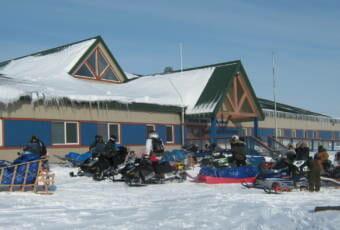
Davis-Ramoth School in Selawik. (Photo courtesy of Northwest Arctic Borough School District)

Several weeks after an outage knocked out power in the Northwest Arctic village of Selawik, officials say it has been restored. However, the outage has exacerbated chronic problems at the local water treatment plant.

On Febr. 14, the diesel generators went out in Selawik, knocking out power at the school, dozens of homes and — perhaps most critically — the village’s water treatment plant. As local, regional and state officials worked to solve the issue, the community of roughly 800 people was without running water and had to conserve power, relying on back-up generators while power was slowly restored.
Tribal administrator Tanya Ballot said officials don’t know for sure what the cause was, but she suspects wear and tear on the engines.

“Just like any regular engine, if it’s not maintained properly it doesn’t work. So that may have been the problem,” Ballot said.

Having power issues during any time of year would be rough on the village, which is about 90 miles east of Kotzebue, but Ballot said the winter weather is making things tougher.

“Mother Nature is not helping us right now,” Ballot said. “It’s 17, 18 below with a 50 below wind chill factor today. We have been cold for the last two weeks.”

Ballot said power was restored to two of three engines this week, and the community no longer has to conserve power or boil water. However, she said the power was out for so long, that serious damage was done.

“Having the power restored a little late was detrimental to the water treatment plant,” Ballot said. “Those lines had a chain effect and froze so far, that we’re still not thawed out today.”

Ballot said community members now have to haul their water from the water treatment plant to their homes, instead of being able to rely on their pipes or water taps. She said it’s led to a lot of frustration among residents.

“They’re right in their frustrations because we’ve become accustomed to having running water out of a tap, and being able to flush our dishwater down a drain, and our bath water and our toilet water and whatever else is in a toilet down the drain,” Ballot said. “And it makes more work for us to haul it out and pack it in and empty it out in a bucket. And it’s not sanitary.”

Ballot said she’s concerned that the lack of clean water could have other, less obvious consequences.

“We’ve seen increased illnesses and skin problems because people aren’t able to stay as clean as we’re used to,” Ballot said. “Attendance at school may or may not be affected because students don’t want to go to school with dirty clothes or smelling stinky. So it really has a bigger effect on us than we think.”

Having frozen pipes isn’t a new problem in Selawik. Ballot said long-term issues at the 30-year-old water system have persisted for years.

“We keep putting band aid fixes on it that don’t seem to stick,” Ballot said. “And we need a complete overhaul of this system. And parts are not cheap.”

Ballot said they need new motors, which cost about $26,000. Additionally, they need a new water pump which costs about $5,000.

“We don’t have that kind of funding in our pocket,” Ballot said. “So we’re going to be putting through some applications. We’re going to request for state funding, emergency funding to try to help get these necessary parts. Above-ground water and sewer is very, very… it’s a challenge to maintain.”

Ballot said the village has seen a lot of support from surrounding communities, including parts from the Alaska Native Tribal Health Consortium, water donations from the Kiana AC store, and emergency assistance from NANA Regional Native Corporation and the Northwest Arctic Borough.

“I feel very fortunate that all these folks are contributing and helping us, and I wish the same for Ambler,” Ballot said. “I understand Ambler is going through the same problem with water and sewer. And Unalakleet, and Tuluksak.”

Ballot said she’s hopeful that the impending spring weather will help thaw some of the pipes, making running water more accessible in town, though she said it’s “taking its sweet time.”

Kaktovik tribe says Biden didn’t reach out before agreement with Canada over caribou in Arctic refuge

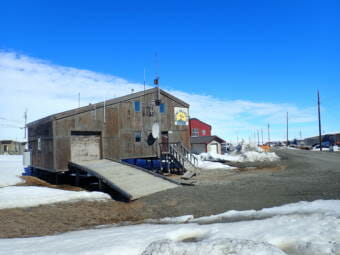
The building that houses the Native Village of Kaktovik
The Native Village of Kaktovik building in June 2018. (Photo by Jennifer Pemberton / Alaska’s Energy Desk)

The Native Village of Kaktovik is speaking out against the Biden administration, claiming their tribe wasn’t consulted about an agreement President Biden made with Canadian Prime Minister Justin Trudeau regarding protections of the Porcupine caribou herd in the Arctic National Wildlife Refuge.
Last week, in a joint statement with Prime Minister Justin Trudeau, President Joe Biden pledged to “help safeguard the Porcupine caribou herd calving grounds that are invaluable to the Gwich’in and Inuvialuit peoples’ culture and subsistence.”

The herd’s migration takes them through both Canada and the United States.

It’s the latest in a series of moves from the Biden administration to stop oil drilling in the Arctic National Wildlife Refuge. Shortly after taking office, Biden placed a halt on lease sales in the refuge.

Eddie Rexford Sr. is the president for the Native Village of Kaktovik, an Iñupiat tribe and the only one located within the refuge. He says they weren’t consulted by the Biden administration before the announcement. Despite their opposition, Rexford says the tribe is committed to protecting subsistence resources.

“We certainly like to protect our homelands also, but we want to utilize the natural resources that our creator provided to us,” Rexford said. “Oil and gas, so we can get use the natural gas to get away from using diesel.”

Rexford went on to say that Biden’s actions run counter to his recent memorandum to respect tribal sovereignty and self-governance.

“He promises to work with the tribes and the Native groups in Alaska, and it’s not coming to fruition to our community and tribe,” Rexford said.

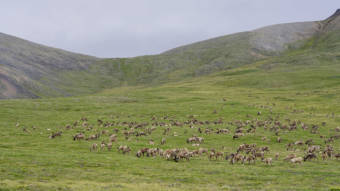
The Porcupine Caribou Herd in the Arctic National Wildlife Refuge on July 3, 2019. The Gwich’in live outside of the refuge but harvest caribou from the Porcupine Herd, which breeds in the refuge. (Danielle Brigida via Creative Commons)

Rexford says the tribe had successes with the Trump administration and former Interior Secretary David Bernhardt. He’s hopeful that, if confirmed, Biden’s Interior nominee Deb Haaland, of the Laguna Pueblo people, will make more efforts to work with the tribe.

“Have her come to our community to meet with our folks,” Rexford said, “to let her know that we live here and there’s no Gwich’in homelands here in the refuge, like it’s being purported in the news nationally, internationally and statewide.”

The Gwich’in are an Alaska Native people who reside primarily in the Yukon-Koyukuk region in Interior Alaska. The Inuvialuit are a First Nations people from Northwest Canada. Both oppose opening the refuge to drilling.

Beyond the agreement with Canada last week, the Biden administration has not made any concrete plans to address how they will safeguard the caribou herd.

This is the second scuffle Kaktovik has had with the Biden administration in recent weeks. Last month, the local Alaska Native corporation Kaktovik Iñupiat Corporation was informed by the Interior department that they missed a deadline to do oil exploration in ANWR. The corporation says the federal Fish and Wildlife Service held up the process, resulting in the deadline passing.

Cruise ships don’t appear to be behind Ketchikan’s beach bacteria problem — so what is?

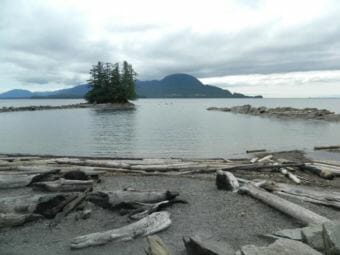
Rotary Beach south of Saxman is also called Bugge’s Beach. (File photo by KRBD)
Rotary Beach south of Saxman is also called Bugge’s Beach. It’s one of only two tested beaches in the Ketchikan area that regulators say shouldn’t be included on the EPA’s impaired waters list. (KRBD file photo)

For the fourth year in a row, weekly summer water quality tests show that most Ketchikan beaches have elevated levels of bacteria that could make people sick. That happened this year even without dozens of cruise ships sailing through the Inside Passage and discharging wastewater.
And it’s less of a surprise than you might think.

Ketchikan’s federally recognized tribe has been working with Alaska’s Department of Environmental Conservation to monitor fecal coliform and enterococci bacteria levels at Ketchikan’s beaches since 2017. But Meredith Pochardt of the Southeast Alaska Watershed Coalition told attendees at a recent public meeting that this year was different.

“2020 gave us a really unique opportunity to monitor for bacteria around Ketchikan without cruise ships,” she told a half-dozen or so attendees. “And we’re still seeing pretty elevated levels.”

At some sites, bacteria levels were higher than they’ve ever been. Others, like the city’s Thomas Basin harbor, saw improvements that regulators credit to sewer line repairs.

“And so that just opens up more questions and hopefully some more dialogue,” Pochardt said.

All of Ketchikan’s beaches exceeded state standards for fecal coliform bacteria at least once in the summer of 2020. (Southeast Alaska Watershed Coalition graphic)

That cruise ships don’t appear to be contributing to Ketchikan’s beach bacteria problem isn’t as surprising a conclusion as it might seem.

For some quick background: fecal coliform bacteria levels are measured in colony-forming units per 100 milliliters — in simple terms, you take a water sample, filter out the bacteria, drop it onto a petri dish and count how many bacteria colonies form. Do some math, and you get the standard unit for fecal coliform bacteria: CFU per 100 ml.

Cruise ships’ wastewater has to average less than 14 CFU per 100 ml. DEC’s Gretchen Augat put that in perspective.

“That’s extremely low, extremely safe. It is what we use as our most stringent fecal coliform criteria in the state,” Augat said at the meeting.

So, in theory, you could safely swim right next to cruise ships’ wastewater pipes. You could harvest mussels and clams and eat them raw, assuming they’re not tainted by other toxins. That 14 CFU number? That’s less bacteria than is allowed in Ketchikan’s drinking water reservoirs. (That “raw water” is chemically treated before it’s pumped to taps around town.)

Cruise ships are able to achieve those low bacteria levels because they have advanced treatment systems onboard. But on shore, Ketchikan’s wastewater treatment plants are far less effective.

The Mountain Point wastewater treatment plant run by Ketchikan’s borough is allowed to put out 200 CFU per 100 ml — more than 10 times as much as cruise ship systems. DEC’s Augat told Alaska’s Energy Desk that septic systems are held to a similar standard.

And then there’s the city-run Charcoal Point wastewater plant.

“On a daily level, the Charcoal Point [plant] is allowed to, or permitted to discharge 1.5 million CFU,” the watershed coalition’s Pochardt said.

That’s the maximum limit for a day. Over a month, it’s required to average no more than 1 million CFU per 100 ml — more than 70,000 times the limit for cruise ships.

The plant is allowed to put out that much bacteria because it’s exempt from some requirements of the federal Clean Water Act. It’s only required to do what’s called “primary” wastewater treatment — essentially, letting solids settle out of the water before shooting it into the sea. Ketchikan’s city-run plant is not required to do “secondary” treatment, which uses bacteria to break down waste products and generally results in cleaner water.

And it’s not the only plant like that in the area: wastewater facilities in WrangellPetersburgSitkaHaines and Skagway have similar permits and are allowed to put out similarly high concentrations of fecal coliform bacteria.

But Pochardt said DEC and the watershed coalition aren’t pointing fingers.

“One of the important things to point out is we don’t know, and we can’t currently tell the magnitude of each source’s contribution to the bacteria levels that we’re seeing at the sampling locations,” Pochardt said.

A two-mile swath of the Tongass Narrows serves to dilute the flows from Ketchikan’s wastewater treatment plant. Samples taken by the city of Ketchikan and a DEC contractor from within and around the mixing zone met state bacteria standards in 2020. (Alaska DEC graphic)

She said leaky septic tanks, pet waste, small boat harbors and private sewer systems are other potential sources for bacteria.

And there’s reason to believe Charcoal Point isn’t the problem. The city of Ketchikan tracks the bacteria levels in and around the two-mile “mixing zone” near the plant, and for at least the past year, bacteria have stayed below state standards. And a separate water quality study sponsored by DEC also found low levels of bacteria near the sewer plant. The only location that tested above standards in that study was a small boat harbor: Thomas Basin.

While it’s not clear where the bacteria are coming from, environmental regulators are sounding the alarm. DEC recommends that all of the Ketchikan beaches tested, except for popular Rotary Beach and Mountain Point Surprise Beach, be included on the EPA’s “impaired waters” list. That would require the state to come up with a plan to address the bacteria problem. DEC’s Chandra McGee explained at another recent public meeting.

“We’ll be working with the community on a watershed plan and implementing actions from that plan to hopefully bring all of these beaches into compliance with water quality standards in the future,” she said. Environmental regulators are seeking comments on the decision to list Ketchikan’s beaches as impaired.

And while DEC has monitored Ketchikan’s beaches since 2017, it’s not stopping there. Monitors sampled waters all over the state this summer, taking advantage of low cruise ship traffic to establish a baseline, said DEC Environmental Program Specialist Brock Tabor.

“We’re specifically looking for pollutants. A couple different things: We’re looking at bacteria concentrations, which is of great interest to the public. We’re also looking at selected metals that we identified to be associated with cruise ship discharges in the past,” Tabor told Alaska’s Energy Desk.

The study’s data is preliminary, but it found high levels of bacteria near small boat harbors around the state — Juneau, Wrangell, Petersburg, Homer, Valdez and, of course, Ketchikan. And in Seward and Nome, monitors found elevated levels near the cities’ commercial and cruise ship docks.

That study also found high levels of dissolved copper and nickel at several sites in Knik Arm near Anchorage. Those can be toxic to marine life.

Tabor said DEC plans to continue water sampling in 2021.

Kaktovik Iñupiat Corp. blames feds for missed ANWR deadline, demands apology

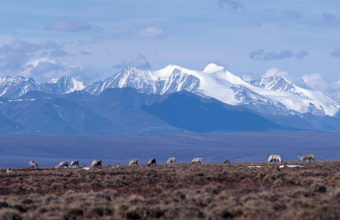
Caribou graze on the coastal plain of the Arctic National Wildlife Refuge, with the Brooks Range as a backdrop. (Creative Commons photo by USFWS)

Last weekend, officials from the U.S. Interior Department said there would be no searching for oil in the Arctic National Wildlife Refuge this winter.

The reason: The Alaska Native corporation proposing to do it failed to meet a key deadline to identify polar bear dens in the area, which could be threatened by the trucks used to detect underground oil formations.

Now, Kaktovik Iñupiat Corp. is firing back.

In a strongly-worded statement Thursday, KIC said the Interior provided a “blatant mischaracterization” of what happened.
“It was the agency that ran the time out, not KIC,” said Nathan Gordon Sr., the corporation’s chairman.

KIC said it was blocked from making the flights to search for polar bear dens by a Feb. 13 deadline because it never got approval from the U.S. Fish and Wildlife Service, an Interior Department agency.

It blamed Fish and Wildlife’s “negligence, irresponsibility and failure to do its job” for thwarting its plans to search for oil this winter, which were largely targeting corporate-owned lands within the Arctic refuge’s boundaries.

“They held all the cards,” said Matthew Rexford, president of KIC, “and then we saw a lot of delays and excuses from them.”

Rexford, in a news release and six-page letter to Fish and Wildlife, is demanding an apology and correction from federal officials, saying they harmed KIC’s reputation and caused significant economic loss to the corporation and the village of Kaktovik — the only community within the Arctic refuge’s boundaries.

An Interior Department official said the agency had no comment on KIC’s statement.

What KIC wanted to do this winter was bring the big trucks and dozens of workers onto a piece of the Arctic refuge’s coastal plain to search for pockets of oil using seismic technology.

Much of the surface area it wanted to assess is owned by the corporation, with an affiliated regional Native corporation, Arctic Slope Regional Corp., holding rights to any oil under the ground.

But for the seismic testing to move forward, KIC needed approvals from the federal government, including an authorization for “incidental harassment” of polar bears in case the work disturbed any dens.

KIC originally applied to do the work under the Trump administration, which pushed for oil development in the Arctic refuge. But the administration didn’t take action on the request before Trump left office — leaving decisions to the anti-drilling administration of Joe Biden.

Federal officials’ correspondence with KIC suggests that one reason the review took as long as it did was a campaign opposing the seismic exploration that popped up on the popular video-sharing app TikTok.

Video creators called on people to submit comments opposing KIC’s proposal to explore for oil this winter — their messages often playing over montages of polar bears and caribou. One activist even created an “influencer kit” to help other social media users promote the campaign.

@alex.harausLink in bio for some footage you can use! Hit those buttons to spread the word! #anwr #activism #outdoorsy #climatecrisis #cuteanimalsoftiktok #arctic

♬ Intro – The xx

In a letter Sunday to KIC, a Fish and Wildlife official pointed out that the agency received more than six million public comments. He said the agency could not review and consider all of the comments tied to the corporation’s request by the Feb. 13 flight deadline, despite taking “extraordinary measures.”

“These efforts included hiring a contractor to process and sort the comments, assembling a team of approximately 40 service staff members to review unique comments and working nights, weekends and holidays to ensure that all substantive comments were appropriately addressed,” the letter said.

KIC says that’s no excuse.

In a response letter, Rexford, with KIC, said the corporation expected approval by late January, which would have left more than enough time for the aerial surveys.

When that deadline seemed no longer possible, Rexford said, the corporation asked if it could do the flights without the harassment authorization and was told no.

“In other words, the service put KIC in an untenable situation where it could not perform a task without the service’s authorization, and then turned around and blamed KIC for the service’s failure to provide said authorization,” Rexford wrote.

KIC’s thwarted efforts to search for oil this winter are a major blow for proponents of drilling in the Arctic refuge. Any future proposals will likely face steeper hurdles under Biden’s administration.

Kaktovik Iñupiat Corporation misses deadline for seismic work in Arctic refuge this winter

The Porcupine Caribou Herd in the Arctic National Wildlife Refuge on July 3, 2019. (Danielle Brigida via Creative Commons)

An Alaska Native corporation has missed a key deadline to search for oil in the Arctic National Wildlife Refuge, according to the Department of the Interior.

Before it could get approval for what’s known as a seismic survey, the Kaktovik Iñupiat Corporation had to make three flights to search for polar bear dens in part of the refuge.

But the corporation did not do the work before the Feb. 13 deadline, said a brief statement Saturday from Interior spokeswoman Melissa Schwartz.

It’s unclear what exactly happened. An official with KIC did not return requests for comment Monday.

The missed deadline effectively kills the corporation’s proposal to use seismic exploration to search for oil in part of the Arctic refuge’s coastal plain this winter.

It’s the latest setback for drilling proponents who have long wanted to see oil pumped out of the refuge in northeast Alaska.

Another came last month when the first-ever oil and gas lease sale in the refuge, held under then-President Donald Trump, attracted very little interest.

KIC was proposing to bring big trucks and dozens of workers onto the coastal plain to search for pockets of oil on part of the land.

But, to move forward, the corporation needed what the federal government calls an “Incidental Harassment Authorization” of polar bears.

In October, KIC submitted a request to the U.S. Fish and Wildlife Service for the authorization. The agency got inundated with more than 6 million public comments tied to the controversial request.

It had until Sunday to decide whether to give KIC the authorization.

Because the aerial work was not done, the agency told the corporation that its request “is no longer actionable,” according to Schwartz, with the Interior.

Environmental groups celebrated the news that KIC’s plan hit a major roadblock. They had raised concerns about it damaging the tundra and harming wildlife.

“The previous administration attempted to fast-track exploration on an unreasonably short timeline, so the fact that KIC was unable to do the work necessary to ensure the safety of threatened polar bears was completely foreseeable, and Interior responding by voiding the harassment request is the right move at this time,” said a written statement from Adam Kolton, executive director of the Alaska Wilderness League.

Any future proposals for seismic work will likely face steeper hurdles under President Joe Biden, who opposes oil development in the refuge.

On his first day in office, Biden directed the Interior Secretary to put a “temporary moratorium” on all oil and gas leasing activities in the refuge.

Site notifications
Update notification options
Subscribe to notifications