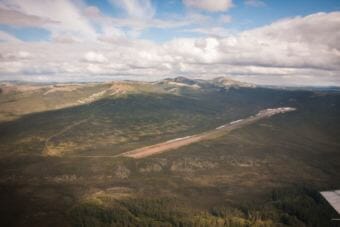
The proposed Donlin Gold mine would be one of the biggest gold mines in the world if completed. (Photo by Dean Swope/KYUK)
The Alaska Department of Natural Resources gave the public 15 days to comment on 12 water right permits for the proposed Donlin Gold mine in December 2020. The Orutsararmiut Native Council claims that wasn’t enough time, especially as villages locked down to slow the spread of the coronavirus, and taking into account limited access to the internet in rural Alaska.
Bethel resident and Orutsararmiut Native Council member Bev Hoffman has protested the proposed Donlin Gold mine for years and is frustrated that the Alaska Department of Natural Resources only gave tribes 15 days to comment on a dozen water right permits that it has granted to Donlin Gold. The comment deadline was December 15, 2020.
According to Hoffman, there are a lot of barriers to getting public comment in the Yukon-Kuskokwim Delta.
“Communities are in lockdown; they’re not meeting,” Hoffman said. “They don’t have internet data to hold big Zoom meetings.”
Hoffman is also worried that Donlin Gold’s plans for those streams will disrupt people’s way of life in the YK Delta. The Donlin Gold mine would be one of the biggest in the world, if completed, and will require a lot of water to treat the mercury and other toxins released during its operations. These 12 water right permits give Donlin Gold permission to draw down the water of 12 streams for its operations.
“First, the Department must not proceed with approving these water rights applications without providing the public the opportunity to review and comment on those applications. Notwithstanding the inadequate information provided, we ask that the Department deny these applications pursuant to Alaska Statute 46.15.080 to 46.15.090 because they are not in the public interest and the existing uses of the waters that would be appropriated by these applications are far more important.”
Both Hoffman and the letter written by ONC said that the water permits further endanger the region’s food security.
“For them to be able to get this water permit that jeopardizes that food security in the manner that it’s happening, it’s so wrong and dangerous. Dangerous to the people that choose to live a way of life out here,” Hoffman said.
The Yukon-Kuskokwim Delta is one of the most food insecure regions in the country; many of its residents cannot access three meals a day.
Roughly 22% to 24% of YK Delta households are food insecure, according to Feeding America, a national nonprofit focusing on hunger relief. The organization reports that 21% of households in the Bethel Census Area are food insecure. In the Kusilvak Census Area, which includes villages along the lower Yukon River and Bering Sea coast, those rates are even higher, ranging from 25 to 29%. This makes it the second most food insecure region in the nation, just after Jefferson County, Mississippi. Feeding America reports that one in four Alaska Native households cannot access three meals per day, a rate double that of white households.
Most YK Delta residents depend on subsistence foods for the majority of their diet. The Kuskokwim River is the primary food source, and the Donlin Gold mine site would sit near one of its tributaries. The company has emphasized its commitment to building the mine as safely as possible.
A spokesperson for the state, Dan Saddler, said that the process was legal; state statute allows a 15-day comment period. The state can extend that deadline period, but Saddler said that they haven’t gotten a request to do that from any of the tribes or organizations who commented.
Correction: An earlier version of the article incorrectly said Donlin Gold was granted the 12 water right permits in December. That is incorrect. The public comment for the permits was in December. The article and headline have been updated to include a letter and comment from the Orutsararmiut Native Council that said that DNR did not give adequate time or information for public comment.
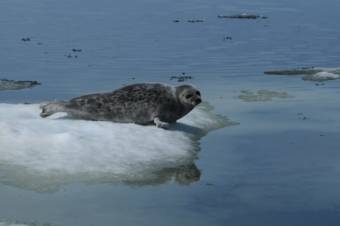
Ringed seal in Kotzebue Sound, Alaska. (Photo courtesy of NOAA)
The federal government is moving ahead with a proposal to protect the habitat of two Arctic seals. Public hearings start next week and will be hosted by the National Oceanic and Atmospheric Administration.
After being delayed for almost a decade, the federal agency proposed what’s called critical habitat designation last month in the Bering, Chukchi and Beaufort Seas. Bearded and ringed seals were listed as threatened under the Endangered Species Act in 2012 by the Obama administration. Though the species is still in relative abundance compared to other threatened species, long-term climate projections for the region forecast diminished sea ice, which the seals live off.
The hearings are scheduled for Tuesday through Thursday, Feb. 24-26 at 4 p.m. Anyone can submit their comments on the topic either by calling in during the hearings or submitting a written comment through the website.
Those who wish to make public comments can call 800-201-3962, and enter the conference code 651174.
The public comment period on the critical habitat ends on March 9.
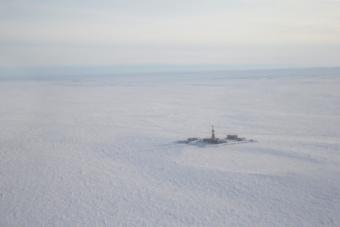
An aerial view of one of the exploration pads and wells that ConocoPhillips drilled during the 2018 exploration season at its Willow prospect. (Judy Patrick Photography / ConocoPhillips Alaska)
A federal appeals panel has halted work at one of Alaska’s biggest proposed North Slope oil fields, putting dozens of contractors out of work and costing ConocoPhillips, the project’s developer, millions of dollars.
The two-judge panel, from the Ninth Circuit Court of Appeals, issued its emergency order late Saturday.
It comes a week after a pair of Alaska Native-owned corporations hired by Conoco started building ice roads over frozen tundra to access the site of a proposed gravel mine to support construction of the oil company’s massive Willow project, according to court documents. And given the short length of the North Slope’s winter construction season, project opponents say the ruling appears to thwart Conoco’s development plans until next January.
The Willow development is one of the largest proposed projects in years on the North Slope, where total oil production has leveled off around 500,000 barrels a day after decades of decline.
At its peak, Willow, located in the National Petroleum Reserve in Alaska, could add another 150,000 barrels a day to that figure — if Conoco ultimately decides to invest the $2 billion or more needed to build it. But the court’s ruling Saturday is an indication of the new legal and political obstacles standing in the project’s way.
Just two years ago, industry boosters — including Conoco’s top Alaska executive — were hailing Willow as one of multiple promising projects in what they called a “North Slope renaissance,” buoyed by the Trump administration’s “energy dominance” agenda.
Today, Alaska’s oil industry is contending with a new presidential administration that’s pledging decisive action on carbon emissions and has already issued a temporary moratorium on all activity around leasing in the Arctic National Wildlife Refuge. And a pressure campaign by opponents of oil development in the refuge has convinced an array of banks and other financial institutions to rule out financing of drilling projects anywhere in the Arctic.
ConocoPhillips’ CD5 drill site in January 2017 (Photo by Elizabeth Harball/Alaska’s Energy Desk)
Now, Conoco’s Willow project faces new headwinds. In issuing its Saturday injunction temporarily halting work on the gravel mine and a related three-mile road extension, the Ninth Circuit judges noted that the project’s opponents, who requested the order, also have a good chance of winning their underlying lawsuit challenging the Trump administration’s environmental review of the full Willow project.
Project opponents hope that the judges’ decision Saturday will prompt the Biden administration to re-evaluate the costs and benefits of development in the petroleum reserve, according to Bridget Psarianos, an attorney with the environmental law firm Trustees for Alaska.
“It does come at a moment where it seems like we might have an administration that might question that business as usual approach,” said Psarianos, who’s working on the case. “I’m hoping that this gives us a lot of time to think clearly about the future of this case and the future of this project.”
A Conoco spokeswoman, Natalie Lowman, said the company is reviewing its options and will have more to add in the next few days.
Reserve’s future in question
The legal dispute over Willow marks an escalation in the fight over the future of the Indiana-sized petroleum reserve, which is still mostly undeveloped except its easternmost corner.
Environmental organizations, tourism interests and certain Indigenous groups are opposed to expanded development, citing impacts on the neighboring village of Nuiqsut, risks to fish and wildlife and the global push to reduce fossil fuel consumption.
They also note that while the reserve is named for its oil potential, it contains critically important habitat for caribou and birds, and the legislation that governs its management directs the Interior Department to keep environmental and scenic values in mind.
Oil companies, meanwhile, have pushed to advance development further west. And those efforts got a boost from the Trump administration, which approved major projects and also rewrote the overarching land use plan for the entire reserve to open more areas to drilling.
While Iñupiat-led corporations and political leaders have supported continued oil development balanced with mitigation measures, Conoco’s original plans for Willow provoked opposition among Nuiqsut residents and North Slope elected officials. And the company ultimately made major changes to its proposal in response to the initial backlash.
After the Trump administration approved the project in October, opponents sued in federal court. They claimed the decision violated several bedrock environmental laws, from the National Environmental Policy Act to the Clean Water Act.
A month later, the opponents asked U.S. District Court Judge Sharon Gleason to block Conoco’s work at Willow while the lawsuit played out.
The Ninth Circuit’s emergency ruling could ultimately be lifted. But opponents say the court’s briefing schedule will push a decision too late into April to allow construction to resume this year.
Conoco’s project manager, James Brodie, said in a sworn statement that any construction left unfinished by mid-April will have to wait at least until January 2022.
The company already had roughly 60 workers involved in Willow-related ice road construction and support, and it planned to employ double that number at the project’s peak this winter, Brodie said.
Conoco also had already started moving culverts from Fairbanks to the North Slope, and will have “wasted” nearly $4 million on contracts if its winter work is canceled, Brodie said.
Brodie downplayed the impacts of this winter’s plans at Willow, saying that the work was a “small portion” of construction in the petroleum reserve and noting that more than 500 people are working at a separate Conoco project nearby called GMT2.
“This GMT2 work will continue and maintain an industrial presence in the area regardless of whether the Willow gravel construction is allowed to proceed this winter,” Brodie said.
Conoco still has not made a final decision to build the Willow project, and this winter’s plans amounted to preliminary work, the company said.
But the project’s opponents argued that Conoco’s planned gravel mining and road extension would still cause “irreparable harm” to the reserve’s fish and wildlife, and to their members’ interests in subsistence hunting and fishing, tourism and research.
In a sworn statement, Nuiqsut resident and environmental advocate Rosemary Ahtuangaruak said she was concerned about the new infrastructure blocking subsistence wildlife, like caribou, from getting to the village’s hunting grounds.
“We won’t have the migration come to us,” Ahtuangaruak said. “There may be [a] smattering of animals that get through the infrastructure, but they will be unhealthy and highly stressed.”
Nuiqsut in June 2018. The village is near a growing number of oil developments in the western Arctic. (Photo by Elizabeth Harball/Alaska’s Energy Desk)
Irreparable harm is one of several legal standards that must be met in order for courts to issue an injunction. In its ruling, the Ninth Circuit judges said they agreed with Willow’s opponents on that point — and also with their argument that they were likely to win their underlying case challenging the whole project, which is another requirement for an injunction.
The two judges cited a point made by Gleason, the lower court judge who initially rejected opponents’ request to block Conoco’s work at Willow based on the two-month time limit.
The project’s opponents argue that Gleason was wrong about the time limit. And if that’s the case, Gleason wrote in one of her orders, the opponents “could well be likely to succeed” in one of their underlying claims challenging the Trump administration’s environmental review of Willow.
Specifically, Gleason cited opponents’ argument that the Trump administration review violated the National Environmental Policy Act by inaccurately estimating Willow’s potential greenhouse gas emissions.
The Ninth Circuit’s ruling, handed down late Saturday, made a big splash on both sides; Psarianos, the attorney for Willow’s opponents, called it a “really big deal.”
But she also noted the broader context of many other legal disputes still playing out on the North Slope.
In addition to the lawsuit challenging Willow, drilling opponents have sued over the Trump administration’s new, less-restrictive management plan for the petroleum reserve, and over the Congressionally-created oil leasing program in the Arctic National Wildlife Refuge.
“We’re looking forward to continuing to work on this case, and just keep fighting it,” Psarianos said. “This is one battle in a long war.”
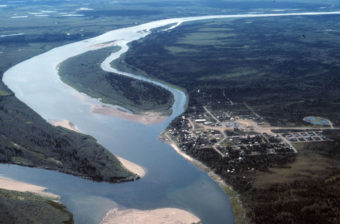
Aerial view of Ambler and the Kobuk River in the summer. (Photo courtesy of the National Park Service via UAF Gates of the Arctic Research Portal)
The state of Alaska’s investment authority board has agreed to put $35 million towards the controversial Ambler Road project. The funding is matched by Ambler Metals, the mining company looking to use the road to access mineral deposits in the region.
With the $35 million match from Ambler Metals, the $70 million infusion signals a major advancement in the development of the Ambler Road. The proposed project would run roughly 211 miles from the Dalton Highway to the Ambler Mining District in the Northwest Arctic Borough.
Ambler Metals CEO Ramzi Fawaz said the funding is for pre-development work on the project. He said the permitting process will start sometime in the second half of the year, and anticipates the process will take two to three years.
“Permitting is one of those activities that gets done in addition to the feasibility study and surveys and so on,” Fawaz said. “And that’s part of that we need to do and the team needs to do before we get to an investment decision on the road.”
The development agreement approved unanimously between the Alaska Industrial Development and Export Authority and Ambler Metals goes through December 2024.
Subsistence advocates have filed lawsuits over the road, concerned that construction would impact the migration of caribou, a staple of the local Inupiaq diet in Northwest Alaska. In its environmental assessment released last March, BLM officials noted potential impacts to wildlife migration and erosion as well as local water and air quality.
The process of getting a mine in the Ambler Mining District has garnered support from the Dunleavy administration and mining advocates, who say the project means high-paying jobs for Alaskans. Fawaz said they anticipate hiring more than 80 people for the field season work. Additionally, should construction be approved, another roughly 600 people would be hired for the construction of the road, and then about 400 for operations at the mine. Fawaz said Ambler Metals has been working with the local NANA Regional Native Corporation and the Northwest Arctic Borough in order to get locals employed.
“Our hope and our aim is to train and recruit as many as we can from the borough, from the region, from our neighbors, to participate in this work — both before we get to an investment decision and after,” Fawaz said.
Drilling at the Trilogy Metals Inc. copper-rich Arctic polymetallic deposit in Alaska’s Ambler Mining District. (Photo courtesy of Trilogy Metals Inc.)
With large deposits of gold, silver, lead and other minerals, Fawaz said the current projection is that the mine would last for 12 years. He said Ambler Metals hopes to find additional mineral deposits in the region to extend its lifetime to over 20 years.
Lois Epstein is an engineer and Arctic program director for the Wilderness Society, a conservation group that is one of the plaintiffs in a lawsuit over the road. She said that AIDEA’s board of directors was not transparent in their process for approving the funding. During their meeting Wednesday, the board was in executive session for several hours to discuss the project ahead of the vote, but those sessions aren’t open to the public. Epstein said the board spent very little time discussing the move publicly before returning to an executive session.
“So if you’re interested at all what kind of questions were asked, what kind of details they focused on, did they even pay attention to the public comment period … you have no idea,” Epstein said.
Epstein said environmentalists and some Alaska Native organizations have also critiqued the timing of AIDEA’s focus on the Ambler Road project, considering the COVID-19 pandemic which has financially impacted thousands of Alaskans.
“We think the biggest issue right now for the state is the pandemic and all the economic impacts that have happened,” Epstein said, “and to the extent that AIDEA could help mitigate those impacts, that’s what they should be focusing on. Not a long term project like the Ambler Road.”
Fawaz of Ambler Metals wouldn’t comment on the pending lawsuits beyond saying the company is pleased with the federal permitting work thus far, and believe they can operate responsibly in the region.
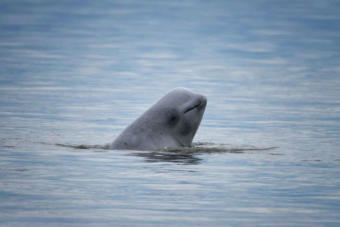
Cook Inlet belugas are the smallest of five beluga stocks in Alaska. The population has been declining for over two decades. (NOAA photo)
The beluga population in Cook Inlet is not bouncing back, and scientists are trying to figure out why. First, they need to know more about the population. A key part of that is knowing how old the whales are.
“Up until this point, the only way we’ve been able to age animals is through their teeth,” said Verena Gill, a branch chief with NOAA Fisheries.
“You count the rings in your teeth, kind of like you count tree rings,” she said. “We can’t exactly go run around the inlet, jump on top of a beluga, yank one of its teeth out and count the rings on the living animal and go, ‘OK, well, Betty Beluga out there is 10.’ So the only way we’ve been able to get teeth are from animals that have died.”
But now, researchers have found a way to determine the ages of living Cook Inlet belugas using skin samples. That technique is outlined in a paper published last month by researchers from NOAA Fisheries, Oregon State University and University of California Los Angeles.
It’s a big deal for researchers who study these whales. NOAA lists Cook Inlet belugas as one of its nine “Species in the Spotlight,” meaning they’re at high risk for extinction.
The technique relies on epigenetics. While genetics concerns DNA, epigenetics is about how that DNA is modified.
“So the term itself is a little bit of a catchall, because it actually includes a lot of different processes,” said Ellie Bors, a postdoctoral researcher on the study. “But I like to think of epigenetics as all these other ways that DNA is modified or packaged within a cell that affects the way DNA turns into genes and proteins.”
In particular, researchers looked at a specific epigenetic process called DNA methylation. That means organic compounds, called methyl groups, are being added to DNA.
“And it turns out that as a lot of mammals age, the way that DNA is methylated changes, or the amount of methylation changes with age,” Bors said.
Scientists can tell how old a beluga is based on how its DNA is methylated. And they can get that DNA through tiny skin samples of living whales.
Other species, like humpbacks, have patterns on their bodies that indicate age. Not belugas.
Paul Wade works for NOAA Fisheries’ Alaska Fisheries Science Center and was a co-author of the paper.
“Being able to estimate the age of a living animal just can be so important for us,” he said. “I’ve always been jealous of colleagues that study different species where they can know the age of their animals just ’cause they know so much about their population.”
He said this technique will help with a lot of research in the works about Cook Inlet belugas.
A lab in San Diego is studying pregnancy rates in belugas using hormones found in their blubber. Researchers knew what percentage of these whales were getting pregnant, but they couldn’t tell the age of the pregnant whales.
“But as soon as we got the ages and plotted pregnancy or not versus age, we noticed that it was only the older whales in our study that showed a fairly high pregnancy rate,” he said.
It was a small sample size, Wade said. But when scientists compare those findings with that of healthy beluga populations, they show reproduction among Cook Inlet belugas could be delayed. That might be a sign the population is struggling due to external factors, like a lack of food.
Findings are preliminary. But Wade said scientists feel they’re getting closer to knowing why Cook Inlet belugas aren’t rebounding.
Kenai Peninsula residents who are excited about beluga research can participate in local efforts, like the Cook Inlet Belugas Count, a one-day event that uses volunteers in Homer and Kenai to count whales.
There’s also the Alaska Beluga Monitoring Partnership, a program that takes place in the spring and involves training. Visit akbmp.org for more information.
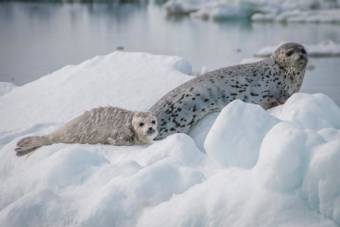
Spotted seal mother and pup in the Bering Sea. (NOAA Fisheries photo)
As global temperatures rise and warm the coldest parts of the world, scientists are watching for changes to species that live there. A new study has found evidence connecting the rapid warming of the region with a physical decline in three species of Alaska seals.
For 12 years, researcher Peter Boveng with the National Oceanic and Atmospheric Administration led a team that monitored ribbon and spotted seals in the Bering Sea. They were specifically monitoring body condition, or how fat the seals were. Boveng says what they found was the youngest seals were getting smaller.
“The fatness of the pups, the young of the year, declined on average over that time period,” Boveng said.
Boveng says this is one of the first major studies that shows evidence of a noticeable change in the seals’ body condition related to global warming.
“There hadn’t been, up until now, really much of any documentation of impacts that we think are climate related,” Boveng said.
Both of these species of seal tend to gather on the edge of the sea ice to hunt for food and raise their young. However, sea ice extent has drastically diminished over the past decade, with an average loss of just over 18,000 square miles a year. Boveng says that could impact how much seal mothers are able to forage.
“The mothers, maybe, were not finding as much food in the period prior to the birth of their pups, when they were pregnant,” Boveng said. “And also maybe not having as much fat or finding as much food during the nursing period.”
NOAA Fisheries scientists approach a ribbon seal. (NOAA Fisheries photo)
Between 2007 and 2018, the time period of the study, Boveng says that the two species of seals experienced two unusual mortality events, or an unexpected rapid decline in population. During the first event, the seals acted more lazy, with many showing sores on their bodies and loss of hair. Boveng says there was no evidence linking those things to a loss of food or a warming climate. He says the second however, saw more evidence that the decline was food-related.
“So this second UME which occurred right in the years of record low ice extent in the Bering Sea, really seemed to line up with the things we were seeing,” Boveng said.
A related study of harbor seals in the Aleutians found a similar decline over a three-year period, with an average decrease of 13 pounds per year — that’s about 10% of their weight. Boveng says that decrease is tied to a heat wave in Southwest Alaska between 2014 and 2016. He says it’s clear the dramatic decline in weight hadn’t been going on for long.
“The decline in harbor seal body condition over that period was pretty rapid,” Boveng said. “Something like that wouldn’t be something that had been going on for a long time, because they would’ve just wasted away.”
Looking to the future, Boveng says that scientists forecast warmer Arctic conditions will become more normal, and he anticipates that changes to seal bodies will be much clearer as time goes on.
Close
Update notification options
Subscribe to notifications
Subscribe
Get notifications about news related to the topics you care about. You can unsubscribe anytime.