A federal judge said Saturday that ConocoPhillips can’t start opening a gravel mine or building gravel roads at its Willow oil project for up to two weeks.
Willow is the name of Conoco’s massive oil project in the National Petroleum Reserve-Alaska, on the western North Slope.
Supporters say the project will lead to hundreds of jobs and help keep oil flowing down the trans-Alaska pipeline for decades. But conservation groups say it will cause too much harm — adversely impacting wildlife, the land and those who live in the nearby village of Nuiqsut.
Conoco has said it could start producing oil at Willow in about five years.
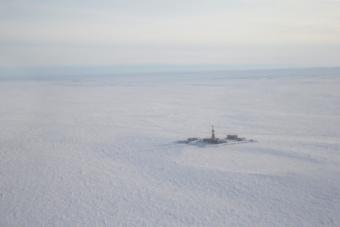
Conoco’s Willow oil and gas prospect is located in the northeastern corner of the National Petroleum Reserve-Alaska. (Image credit Bureau of Land Management)
This winter, it wants to build ice and gravel roads in the area, plus a mine site, about seven miles from Nuiqsut.
But conservation groups are suing, and want the project stopped.
Sovereign Iñupiat for a Living Arctic, the Center for Biological Diversity and about a half-dozen other conservation groups sued the Trump administration in late 2020, arguing the government violated environmental laws when it OK’d the Willow project.
The groups want work halted on the project until the lawsuits are resolved.
They’ve recently taken their requests to the U.S. Ninth Circuit Court of Appeals.
Gleason ruled Saturday that Conoco can continue construction on its seasonal ice roads, but it must not blast the gravel mine or build gravel roads until Feb. 20 or until the Ninth Circuit rules on the groups’ requests — whichever happens first.
She described the mandatory pause as a “brief and limited injunction.”
She said while she remains confident in last week’s decision to allow the work at Willow, the Ninth Circuit may disagree with her. There’s a “strong likelihood of irreparable environmental consequences” once the blasting operations at the mine site start, she said.
The conservation groups behind the lawsuits celebrated Gleason’s decision.
“We must protect the Arctic, not exploit it,” said a statement Sunday from Kristen Monsell, senior attorney with the Center for Biological Diversity.
Asked how Gleason’s order impacted Conoco’s plans for Willow, a company spokesperson Rebecca Boys said in an emailed response that it does not prevent the ongoing construction of ice roads. She said she could not comment further on the active litigation.
Editor’s note: This story has been updated with a response from ConocoPhillips spokesperson Rebecca Boys.
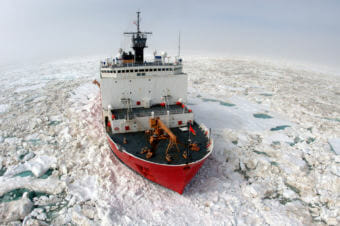
The U.S. Coast Guard Cutter Healy, a 420-foot icebreaker homeported in Seattle, Washington, breaks ice in support of scientific research in the Arctic Ocean. (Public domain photo by Petty Officer Prentice Danner/U.S. Coast Guard)
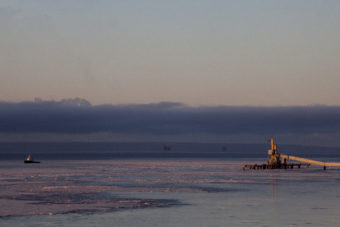
The United States and Russia have updated their plan for addressing pollutants across national boundaries in the Bering and Chukchi seas.
The agreement between the United States and Russia, known as the Joint Contingency Plan, has been in effect since 1989. The U.S. Coast Guard is the federal agency that does most of this work, working with counterparts at Russia’s Marine Rescue Service.
Coast Guard incident management official Mark Everett said the plan lays out protocols for pollution that spreads from one nation’s waters to the other’s.
“This agreement says, essentially, we will agree to notify you. We will agree to request assistance in the response if needed,” Everett said.
Everett said to date, there have been no joint responses to pollution like oil or marine debris along that boundary with Russia. However, he said the two entities regularly conduct exercises and share information on pollution within their boundaries.
“There was one recently in Kamchatka, on the Russian side, that the Russian Federation government shared information with the United States,” Everett said. “We offered assistance. They didn’t accept the offer of assistance, but that is part of the bilateral agreement — to share information about other incidents, even though they may not affect the other party.”
Everett said one of the major new features of the latest Joint Contingency Plan is the addition of what’s called an international coordination officer.
“Someone potentially from the U.S. Coast Guard, in the event of a joint response, could go over to the Russian side,” Everett said. “A Russian representative could come over to the U.S. side, and then we have embedded liaison officers.”
Everett said he’s hopeful that having the new positions will make it easier and more efficient for either nation to share information. He said U.S. and Russia officials plan to meet in the fall to discuss their next exercises related to marine pollution response across national boundaries.
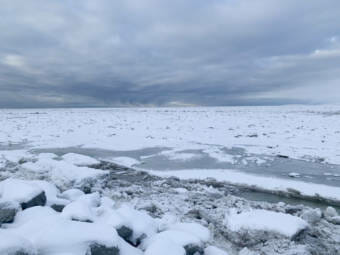
Snow piles on sea ice in the Kotzebue Sound. (Wesley Early/KOTZ)
One of the National Science Foundation’s flagship initiatives for the past few years is called Navigating the New Arctic. It looks at the effects of a warming climate on Arctic communities. However, some in the field believe NSF isn’t doing enough to involve Indigenous people who live there.
More than 200 researchers from around the country signed an open letter to the foundation last month, requesting more Indigenous input within the initiative.
Margaret Anamaq Rudolf is a doctoral candidate at the University of Alaska Fairbanks. An Inupiaq woman originally from Fairbanks, her area of study is cross-cultural science education — which she says involves trying to answer the question, “How do we improve working relationships between researchers and Indigenous communities?”
Rudolf is one of the people who authored the letter to the National Science Foundation. While she welcomes the foundation’s initiative, she says it falls short of its potential to include the people who live in the Arctic.
“NSF is still centering researchers in Navigating the New Arctic, instead of centering Indigenous people in what they want and they need,” Rudolf said.
The letter from researchers was formed in solidarity with another letter sent last year from four Native organizations — Kawerak Inc., the Association of Village Council Presidents, the Bering Sea Elders Group and the Aleut Community of St. Paul Island.
The letter from Native groups outlines several issues that would have been studied more comprehensively if traditional knowledge was included from the start. Those include food security and community infrastructure. The letter also highlighted problems with requests for proposals.
Henry Huntington is an Eagle River-based independent researcher who’s worked with the initiative. He’s also one of the main authors of the open letter. He says that requests for research proposals from the National Science Foundation are geared to traditional academic knowledge.
“The forms that you fill out work pretty well if you have a bunch of university degrees and you have some scientific publications and all the standard things that you’d expect of someone with academic training,” Huntington said.
Comparatively, Huntington says it’s harder to list the traditional knowledge of Alaska Natives, who often are much more informed about their communities and will contribute as much if not more to the research.
“They confirm what we already know, instead of investigating what we want to know,” said Cana Uluak Itchuaqiyaq, one of the more than 200 scientists who signed the letter.
Itchuaqiyaq is a PhD candidate in technical communication and rhetoric at the University of Utah. An Inupiaq woman from Kotzebue and Noorvik, she says growing up, researchers coming into her community often would form questions that Alaska Native people already knew the answers to.
“And so, it’s taken tons of time for academia and the sciences to catch up to us,” Itchuaqiyaq said. “They’re just catching up.”
Kawerak social science program director Dr. Julie Raymond-Yakoubian helped write last year’s letter. She says oftentimes when Arctic researchers are making research proposals, one of their last steps is to ask for collaboration with tribal organizations, instead of including them from the start.
“When tribes and tribal organizations and Alaska Native organizations are brought into the process so late in the game, there’s really no way to effectively collaborate on a truly equitable level,” Raymond-Yakoubian said.
NSF Arctic sciences program director Colleen Strawhacker says a major initial issue with Navigating the New Arctic was that many researchers were eager to compete for grants and proposals, making tribal outreach a lower priority.
“Given the feedback from communities, that’s clearly … quite frankly a disrespectful approach to including Indigenous communities in NNA-type science,” Strawhacker said.
While NSF officials are still working on a formal response to the letter from the Arctic researchers, Strawhacker says she values the feedback. She says building and strengthening tribal relationships is key moving forward with Navigating the New Arctic.
“I think it’s critical if we want to fund the best science in the Arctic, we need those perspectives,” Strawhacker said. “We need perspectives from multiple scientific disciplines, but we need perspectives from Indigenous elders and the knowledge that they’ve acquired. I think if we don’t do that, we are doing a disservice to the science and understanding the changes in the Arctic.”
At the beginning of February, NSF announced that the Navigating the New Arctic community offices would be hosted at three universities, including the University of Alaska Fairbanks and Alaska Pacific University, a tribal college in Anchorage.
APU president Valerie Nurr’araaluk Davidson, a Yu’pik woman, described the office as a “hub for Indigenous engagement.”
Raymond-Yakoubian from Kawerak says she’s hopeful that outreach like this, the solidarity between Native groups and researchers shown by both letters, and a push for more Indigenous researchers will produce better outcomes in Arctic research.
Editor’s note: This story has been updated to more accurately reflect remarks made by Dr. Julie Raymond-Yakoubian.
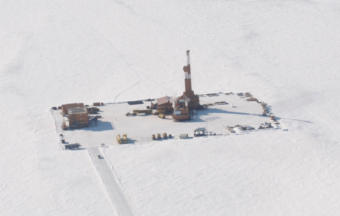
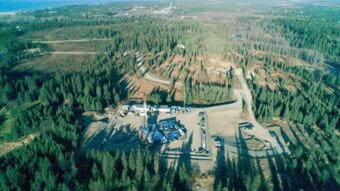
An aerial view of one of the exploration pads and wells that ConocoPhillips drilled during the 2018 exploration season at its Willow prospect. (Judy Patrick Photography / ConocoPhillips Alaska)
A federal judge has denied requests by conservation groups that she block ConocoPhillips from starting construction work this winter on its massive oil discovery, called Willow.
Sovereign Iñupiat for a Living Arctic, the Center for Biological Diversity and about a half-dozen other groups sued the Trump administration in late 2020, arguing it violated environmental laws when it approved the Willow project in the National Petroleum Reserve-Alaska on the western North Slope.
The groups also asked U.S. District Court Judge Sharon Gleason to block Conoco from starting construction on Willow this winter until the lawsuits are resolved.
Gleason denied those requests on Monday.
In a 28-page order, her reasons for the denial included that the groups, she said, didn’t demonstrate that polar bears would likely suffer “irreparable injury” if the construction work was allowed while she considered the lawsuits.
“We are hopeful that the court will put us back on the right path and stop the Trump administration’s last-minute effort to allow work on this environmentally reckless project to begin,” said a statement Friday from Earthjustice attorney Jeremy Lieb.
Meanwhile, Conoco said this week that it will begin laying gravel for the Willow project soon.
According to court documents, the company’s work this winter includes the construction of gravel and ice roads, as well as the opening of a gravel mine.
The company will have about 120 employees working on the projects, said Rebecca Boys, a company spokeswoman.
Conoco has said it expects oil production to start around 2026.
Cook Inlet oil platforms are visible from shore near Kenai, Alaska. (Photo by Rashah McChesney/Alaska’s Energy Desk)
The federal government has hit pause on preparations for an oil lease sale in Cook Inlet after President Joe Biden signed an executive order indefinitely halting new leases.
The Bureau of Ocean Energy Management was gearing up to solicit bids on 1 million acres in Cook Inlet’s federal waters later this year. But Biden said on Jan. 27 his administration wants to review the federal leasing program — one part of a broader order geared at combating climate change.
Before the lease sale stalled, the bureau had already released a draft environmental impact statement. The comment period for that impact statement and all February meetings are now canceled.
Kara Moriarty is the president and CEO of Alaska Oil and Gas Association. She said it wasn’t surprising that the Cook Inlet lease sale was paused after Biden’s order.
“What we don’t know is, is this indicative of all lease sales into the future? I mean, we certainly would hope not,” she said.
Even without presidential intervention, it’s not clear that the federal bureau would have held the lease sale. The agency canceled lease sales in 2006, 2008 and 2010 due to lack of industry interest. Hilcorp was the only bidder in state and federal lease sales in Cook Inlet for several years.
Environmental groups say the moratorium is a good thing. Cook Inletkeeper Advocacy Director Bob Shavelson said it’s refreshing to see the new administration take action.
“And there has been strong opposition over the decades to industrializing lower Cook Inlet, and we’ve got strong commercial fishing and sport fishing and tourism and subsistence economies here that would directly conflict with heavy industry and oil and gas development,” he said. “So it doesn’t make sense to throw all that away so Hilcorp can make a few more dollars.”
Tim Dillon is the executive director of the Kenai Peninsula Economic Development District. He said even without widespread industry interest, it’s important for Alaska that the opportunity is there.
“Our governor has said over and over again that here in Alaska, we do it the safest way possible,” he said. “And people know that. And to just put a stop on everything, really hurts an industry in a big, big way.”
If the Biden administration does let leasing proceed, the federal government will open a new comment period.
Hilcorp’s Seaview drill site located in Anchor Point. (Photo courtesy of Willy Dunne)
Hilcorp, Alaska is looking to build two gas exploration wells near Anchor Point later this year.
The Texas-based company has requested approval from the Alaska Department of Natural Resources to build an oil-gas combination well and gas-only well in Whiskey Gulch, three miles northeast of Anchor Point. It also wants to build a gravel pad and access road on the privately owned property above the lease.
The proposal is for a gas prospect. An ENSTAR Natural Gas line runs by the site down to the southern part of the Kenai Peninsula.
Hilcorp’s proposal for an access road and pad in Whiskey Gulch. (Department of Natural Resources, Division of Oil and Gas)
Hilcorp is the biggest oil and gas producer in Cook Inlet. The Texas-based company owns several onshore gas wells, including the Seaview Unit south of Anchor Point, and operates most of the inlet’s offshore platforms.
Hilcorp drilled five stratigraphic wells in Whiskey Gulch last summer, including two on the lease involved in its current proposal. All were plugged and abandoned in July, according to data from the Alaska Oil and Gas Conservation Commission.
In its application, the company proposed constructing the gravel access road and pad in April. DNR says the company could start drilling June 1. Any future production would need to be approved in a separate permitting process.