Alaska's Energy Desk

Impending Crowley sale stokes fears of fuel monopoly in Ketchikan

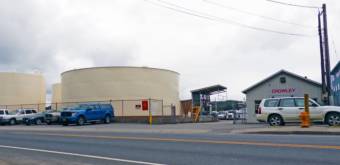
Petro Marine is set to take over Crowley Fuels’ Southeast Alaska business next month, including this facility on Ketchikan’s Stedman Street. The Environmental Protection Agency recently fined Crowley $1.3 million over gasoline tank farm violations. (Photo courtesy of EPA Region 10)

A major player is exiting the energy business in Southeast Alaska. Crowley Fuels is set to sell its Southeast Alaska business to Anchorage-based Petro Marine Services. The deal is expected to close in mid-February. But some fear the move could make life in the panhandle even less affordable.

Petro Marine and Florida-based Crowley say customers won’t notice much difference, aside from the company’s name — Petro Marine says it will honor all of Crowley’s existing contracts in Southeast Alaska.

But some local officials and residents say they’ve been burned before.

“You know, we experienced sizable price increases in shipping from Alaska Marine Lines,” said Ketchikan public works director Mark Hilson in a phone interview Tuesday.

He was talking about a merger that happened a few years back, when Alaska Marine Lines merged with shipping competitor Northland Services.

Hilson said that since the merger, prices are going up faster than they should.

“So, we saw as competition went away, prices increased much more than cost-of-living price indicators would normally escalate,” Hilson said.

Hilson said he’s afraid that once Petro Marine takes over Crowley’s business, it would leave Ketchikan with only one supplier for gas, heating oil and marine fuel. And if the past is any indication, he said, prices will go up.

AML declined to comment for this story, aside from disputing the accuracy of an op-ed that made a similar comparison.

Petro Marine’s chief administrative officer, Jasper Hall, declined an interview. But in a statement, he said there will still be competition in the region: from Delta Western, an oil company whose parent firm is headquartered in Seattle. Delta Western has a large terminal in Juneau, and its website advertises services in Sitka, Haines and Yakutat.

But Hilson said Delta Western doesn’t have nearly the footprint in Ketchikan that Crowley does. It has a single gas station seven miles north of town, nowhere near commercial harbors and fish processors.

“So there will be a monopoly on the water side of fuel,” Hilson said.

And he said if prices do start to go up, it’ll hurt — not just the city’s bottom line, but also the fishing fleet, not to mention everyday residents. He suggested the state attorney general’s office should investigate the acquisition as a possible violation of state antitrust law.

But Hall, the Petro Marine executive, said that investigation already happened. Hall said the company told the Department of Law it was interested when Crowley indicated it would leave the Southeast Alaska market. And he says state antitrust lawyers already reviewed and cleared the sale.

“Petro Marine responded to a Civil Investigative Demand and provided information regarding the potential acquisition to the State of Alaska,” Hall wrote Wednesday. “Upon conclusion of the investigation, no further action was recommended, and an agreement between Petro Marine and Crowley Fuels was finalized.”

Department of Law spokesperson Maria Bahr declined to share details. She said investigations by the department’s Consumer Protection Unit are confidential.

Hall says the acquisition isn’t expected to mean any job losses — any Southeast Alaska Crowley employees who want to work for Petro Marine will have a job. In fact, he says Petro Marine anticipates adding jobs in some locations to bolster customer service.

As for gas, diesel and marine fuel prices? Hall says Petro Marine has “no plans to change our approach to pricing.”

The deal is expected to close Feb. 17.

Ketchikan’s city council is scheduled to discuss how it should respond to the acquisition on Thursday. It’s part of a packed agenda that also includes a presentation from Royal Caribbean on its plans for the upcoming season and debate on whether the city should help the state of Alaska defend the rollback of the federal Roadless Rule in court — a conservation group is suing to reinstate the federal protections.

The meeting gets underway at 7 p.m. Thursday in the Ted Ferry Civic Center.

Biden immediately slams brakes on oil drilling in Arctic refuge

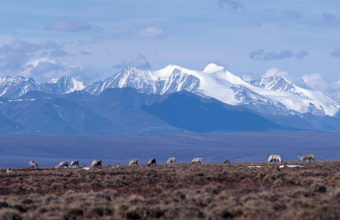
Caribou graze on the coastal plain of the Arctic National Wildlife Refuge, with the Brooks Range as a backdrop in October 2010. (Public domain photo by U.S. Fish and Wildlife Service)

President Joe Biden imposed a “temporary moratorium” on all oil and gas leasing activities in the Arctic National Wildlife Refuge shortly after taking office on Wednesday, citing the “alleged legal deficiencies underlying the program” and the inadequacy of a required environmental review.
Biden’s move to slam the brakes on drilling in the northeast Alaska refuge is among a list of executive orders the newly-inaugurated president swiftly signed to undo actions by his predecessor.

The new moratorium comes a day after the Trump administration announced, in its final moments, that it had finalized nine 10-year leases for oil drilling in the northernmost slice of the refuge, known as the coastal plain.

The leases are held by two small companies and the Alaska Industrial Development and Export Authority, a state-owned corporation.

The Trump administration had faced criticism that it rushed the controversial deals.

Biden’s executive order directs the Interior Department to review the oil-leasing program for the refuge, and “as appropriate and consistent with applicable law” to do a new analysis of its potential environmental impacts.

Biden campaigned on “permanently protecting” the Arctic refuge, and “reversing Trump’s attacks” on the area, but had not released any specifics about his intentions before Wednesday.

Larry Persily, a longtime observer of the oil and gas industry in Alaska, said he didn’t expect a moratorium to have immediate, sweeping impacts because there’s no near-term work to stop.

“The leaseholders don’t have the financial wherewithal to pay for activity,” Persily said in an interview Wednesday. “They’ve got to find partners, they’ve got to come up with plans, they’ve got to go for permits, there’s got to be environmental reviews.”

‘A very good day’

Still, environmental groups and Indigenous Gwich’in leaders said the news gave them an overwhelming sense of relief.

“I thanked the creator,”  said Bernadette Demientieff, executive director of the Gwich’in Steering Committee and a longtime drilling opponent. “And I just sat on my couch and looked at my grandson and just cried. Everything I do is for our future generations.”

The Gwich’in live just outside the refuge, and depend on the caribou that commonly give birth in the coastal plain.

The Porcupine Caribou Herd in the Arctic National Wildlife Refuge on July 3, 2019. The Gwich’in live outside of the refuge but harvest caribou from the Porcupine Herd, which breeds in the refuge. (Danielle Brigida via Creative Commons)

They have long worked with environmental groups on an aggressive opposition campaign to oil drilling on the coastal plain, arguing that development would harm wildlife and the land — and exacerbate climate change in a place that’s already warming fast.

Demientieff described Wednesday as “a very good day,” but said “the fight goes on.” The Gwich’in Steering Committee is behind one of four lawsuits that call on a federal judge to cancel the oil leases issued by the Trump administration.

“Permanent protection is what we are looking for,” Demientieff said.

Adam Kolton, executive director of the Alaska Wilderness League, summed up opponents’ feelings another way, saying in a statement: “Our long national nightmare of environmental carnage ends today.”

‘I’m prepared to use every resource available to fight for Alaskans right to have a job’

Drilling booster Gov. Mike Dunleavy, however, was not pleased with Wednesday’s news. He blasted Biden for “making good on his promise to turn Alaska into a large national park.”

“I’m prepared to use every resource available to fight for Alaskans’ right to have a job, and have a future by taking advantage of every opportunity available to us,” Dunleavy said in a statement.

Gov. Mike Dunleavy speaks in a promotional video about resource development. Dunleavy quickly slammed the Biden drilling moratorium, saying it is treating Alaska like a national park. (Screenshot from Office of Gov. Dunleavy)

Alaska’s congressional delegation also slammed the move by Biden to block oil development in the refuge, saying they were “disappointed” and “astounded” by his day-one announcement.

“Well that was fast,” U.S. Sen. Dan Sullivan said in a statement. “Today, in his inaugural address, President Biden called for national unity and healing. However, just hours earlier, his administration took their cues from radical environmentalists in issuing punitive and divisive actions against Alaska, many other resource development states, and whole sectors of our economy,”

Even before Biden’s action, though, the refuge’s future as a source of oil and jobs was far from secure.

The Trump administration held the refuge’s first oil sale Jan. 6, following a 2017 decision by Congress to open the area to leasing.

But the sale drew little interest. No major oil companies bid on the leases. Instead, two smaller companies each picked up a single lease, and the state-owned Alaska Industrial Development and Export Authority picked up seven.

‘We will be at the table for whatever they do’

Former Alaska Gov. Bill Walker had pushed the state to bid on the leases, concerned that the oil industry wouldn’t show up to the sale.

Biden’s moratorium, Walker said Wednesday, came as “no surprise at all.”

He said he’s pleased the state now holds the leases, and believes that will give it more power in talks with the Biden administration about the refuge’s future.

“We will be at the table for whatever they do, which we would not be, had we done nothing,” Walker said.

Andy Mack, a former natural resources commissioner under Walker, described the leases as “legally binding.”

If the Biden administration decides to ban oil drilling in the coastal plain, Mack said, it needs to figure out a way to compensate those that would have financially benefited from development, including the state of Alaska, and two Alaska Native corporations, Kaktovik Iñupiat Corp. and Arctic Slope Regional Corp.

“This needs to be a value exchange,” Mack said. “There has to be something really, really significant placed on the table that we, as a state, can rely on.”

This story has been updated.

Trump administration issues Arctic refuge oil leases at the last minute

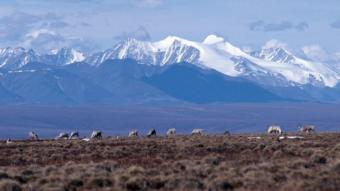
Caribou graze on the coastal plain of the Arctic National Wildlife Refuge, with the Brooks Range as a backdrop. (USFWS)

In the final moments of Donald Trump’s presidency, the federal Bureau of Land Management announced Tuesday that it has signed and issued leases for oil drilling in parts of the Arctic National Wildlife Refuge.

BLM Alaska spokeswoman Lesli Ellis-Wouters said the leases were signed on Thursday, just over a week after the first-ever oil lease sale in the Arctic refuge was held.

Issuing the leases was a priority for the administration, said Ellis-Wouters.

But critics have blasted the administration for rushing to lock-in oil leasing in the refuge at unprecedented speeds before President-elect Joe Biden takes office on Wednesday.

The process to formally issue the leases — which includes an antitrust review — usually takes about two months, said Jenny Rowland-Shea, a senior policy analyst at the Center for American Progress, a liberal think tank

“We’re compressing a 60-day process, really, into two weeks, and that raises serious questions,” she said.

Biden takes office Wednesday and has said he opposes drilling in the Arctic refuge. Locking in the oil and gas leases could make it more difficult for his administration to reverse course.

The Arctic refuge lease sale was held on Jan. 6 and attracted just three bidders, the state of Alaska being the most aggressive.

The federal government said Tuesday that it has issued nine of the 11 oil leases that got bids. Two went to smaller companies and seven went to the state-owned Alaska Industrial Development and Export Authority.

The state authority was also the highest bidder on the remaining two leases that have not yet been issued.

“I can say that we’re only issuing the leases on those we have received the required paperwork for,” Ellis-Wouters said.

This is a developing story. Check back for updates.

Red Dog Mine employee dies in production drill incident, mine operators say

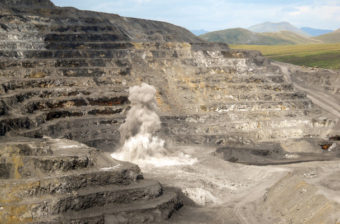
The Red Dog Mine in 2010. (Photo by Alaska Public Media)

An employee at the Red Dog Mine died during an incident at a production drill, mine operators say.

In a release Sunday, officials with Teck Alaska, the operators of the mine, say a 47-year-old employee died on Saturday. Teck says no other employees or contractors were injured and “there is no ongoing safety or environmental risk.”

A spokesman for Teck said the federal Mining Safety and Health Administration is investigating the incident, and the only information they could provide was that the employee was male.

A major employer in the Northwest Arctic Borough, Red Dog Mine is the largest zinc mine in the world, located about 90 miles north of Kotzebue.

There is an update to this story here.

Yukon birders excited about rare ‘lifer’ species that made its way from Japan this winter

An extremely rare hawfinch in Haines Junction. (courtesy Cameron Eckert)

In December, a rare bird was spotted in Haines Junction in Canada’s Yukon Territory, just north over the border from Haines and Klukwan in Alaska.  This is both exciting for the Canadian birders who saw it, and also one small clue in a wider pattern of change.

The hawfinch is usually found in Europe and Asia. It winters in Japan. From time to time it will wander into far western Alaska — in the Aleutian or Pribilof Islands. There’s a record of a couple sightings in Anchorage.

But the hawfinch sightings in Haines Junction, population 600, are a first for the Yukon Territory and a first for Canada.
“Birders call that a ‘life bird’ or a ‘lifer,'” said Cameron Eckert, the director of the Yukon Bird Club. In early December he got a call from a backyard birder with the suspected sighting.

“Myself and a number of other birders you know, mounted a search to try and track down this record,” he said. “The trail went cold till about two weeks later, when another local birdwatcher in Haines Junction saw a bird that she didn’t recognize in her yard.”

It took a handful of drives from Whitehorse to Haines Junction, but he and a group of other birders finally saw the hawfinch and identified it with some photographs. He says it seems to be wintering in Haines Junction and will likely depart in the spring.

Hawfinches have a quiet call, but Eckert and the birders didn’t hear it. He said their excitement drowned out any song.

“What it sounds like is the sound of about 50 birders getting really excited because there’s a new bird in town and they’re going to see it! That’s mainly what we heard, was the ‘hoorays’ when we finally spotted it,” he laughed.

Why this hawfinch ended up in the Yukon Territory is uncertain, but Eckert says paying attention to these sightings is still important.

“Any individual sighting might just seem kind of fun, and, you know, somewhat inconsequential. But over time paying attention to patterns, we can see changes and shifts in bird populations, as they occur over the course of weeks, months, years, and even decades. So what may seem like just a random occurrence, over time, you can start to see patterns,” Erckert said.

Eckert isn’t sure yet how this hawfinch may fit into any larger trends. But he says it’s worthwhile to keep track of the biodiversity that’s in your own backyard. You never know when you might spot a lifer.

Federal government moves toward Cook Inlet oil lease sale

Cook Inlet oil platforms are visible from shore near Kenai, Alaska. (Photo by Rashah McChesney/Alaska’s Energy Desk)

The federal government has released a draft environmental impact statement on an oil and gas lease sale in Cook Inlet, tentatively scheduled for late 2021.

The Bureau of Ocean Energy Management is planning to solicit bids on over 1 million acres in the inlet’s federal waters, which includes anything more than three miles offshore. The agency first published its notice of intent in September and released the EIS draft Wednesday.

Some fishermen and conservationists say that wasn’t enough time.

“We’ve never before seen an environmental impact statement rammed through in such a short time,” said Bob Shavelson, advocacy director of Cook Inletkeeper. “When you look at something like a three month time period, it’s not going to be adequate to understand really what the impacts are.”

The area of the proposed Cook Inlet sale, covering just over 1 million acres, is outlined in yellow. Blocks outlined in green were purchased by Hilcorp Alaska LLC in the last sale. (via Bureau of Ocean Energy Management)

The bureau spent almost two years drafting a statement prior to the last federal lease sale, in 2017.

But since that sale, the Trump administration has set both time and page limits on federal environmental impact statements. An August 2017 order from the Secretary of the Interior requires bureaus to complete final statements within a year of issuing a notice of intent.

Still, Alaska Region spokesperson John Callahan said the bureau completed the draft EIS with due diligence.

“Of course we’re always hoping for input, that’s the whole purpose for producing a draft,” he said. “And we’d like to have the Cook Inlet communities look at it, or view it, and let us know what they think.”

Callahan said the process could also move faster because the bureau was able to work off of the 2017 draft. While each environmental impact statement is different, he said it helped to have that framework.

The bureau hasn’t decided for certain whether it will hold the sale. It canceled lease sales in 2006, 2008 and 2010 due to lack of interest. Hilcorp Alaska LLC has been the sole bidder in both state and federal lease sales in the inlet for several years, including in 2017, when the company picked up 14 tracts for over $3 million. The company currently owns all the federal leases in the inlet.

The bureau will hold public hearings in February before drawing up the final environmental impact statement. To submit public comments, visit boem.gov/CookInlet2021.

Editor’s note: This story has been corrected to fix a transcription error in a quote from John Callahan.

Site notifications
Update notification options
Subscribe to notifications