Alaska's Energy Desk

New climate action task force to tackle Sitka’s carbon footprint

Sitka High School junior Darby Osborne stands on a beach between Totem Park and the Sitka Sound Science Center. Osborne thinks youth voices are an important part of climate change work, and she applied to sit on the newly formed Climate Action Task Force in Sitka (Erin McKinstry/KCAW)

Alaskans are experiencing human-induced climate change at a more rapid rate than any other state in the country. Tackling the global crisis can be daunting, but in Sitka, the city assembly and a group of concerned citizens are taking action with the revival of a decade-old task force.

Seventeen-year-old Darby Osborne is standing on a beach near the Sitka Sound Science Center.

“It’s pretty low tide right now. There’s a bunch of seagulls and eagles diving around in the ocean,” she says. “It’s pretty rainy out, typical Sitka.”

In the summers, she comes here to swim almost every day. It’s a place that inspires her climate change work, which she’s been doing since her freshman year of high school.

“Being able to see all the wildlife, being able to be near and sometimes in the ocean — I think it brings it close to home that this is what climate activists and environmental activists are trying to protect. It’s places like these.”

Osborne has applied to be part of a new Climate Action Task Force approved by the city assembly in November. The group hasn’t started meeting yet, but it has a big job ahead: to create a new plan to address Sitka’s impact on the climate with solutions the city can afford and that inspire people to get involved.

Osborne and a group she co-created called Youth for Sustainable Futures advocated for the task force’s creation.

“It really does mean a lot to people my age just because we’re seeing the decades stretch in front of us and we really don’t know what things are going to look like in the coming years, what the world is going to be like, even when we’re 60 or 70 years old,” Osborne said.

The committee is a revival of a short-lived task force that created a climate action plan for the city about a decade ago. That plan identified some of the ways Sitka is threatened by climate change and proposed actions the municipal government could take to reduce its carbon footprint.

“A lot of it got done, a lot of it didn’t,” said Michelle Putz, who led the past effort.

For example, the city converted several buildings to electric, so they could run completely off of renewable hydro power. A subsidy program also incentivized Sitkans to convert to electric heat and more efficient appliances. But some other proposed ideas about converting to electric vehicles or addressing waste didn’t come to fruition.

They also set a goal to reduce city emissions by 934 tons a year by 2020. City Public Works director and former interim City Administrator Michael Harmon wrote in an email that he thinks they reached it, but no concrete assessment has been done.

“I think it would be a great — one of the first steps — it would be great to see, did we actually get to a reduction or not?” Putz said.

The ways Sitka could and is being affected by climate change are numerous: the impact of warming oceans on the fishing industry, landslides, increased pest activity in the Tongass, more intense storms impacting utilities — the list could go on.

“To not see the impact in this community, you’d have to close your eyes and keep them shut,” Sitka Assembly Member Kevin Knox said. He sponsored a resolution last year that attempted to declare a climate emergency in Sitka among other sustainability goals. But that got voted down by assembly members who thought it too drastic. Knox thinks the task force is a step in the right direction, but worries it doesn’t go far enough.

“Right now, I’m hopeful that they work as quickly as they can because I think we are way behind the ball at this point,” Knox said.

This latest action was co-sponsored by assembly members Valorie Nelson and Kevin Mosher. Mosher said he believes climate change is real, but he isn’t convinced it’s caused by humans. He also admitted that he’s not an expert and sees no harm in making Sitka more environmentally friendly, as long as it doesn’t increase the tax burden on local residents and involves them in the process.

“I want it to be practical, you know, real measurable goals that we can accomplish. Not pie in the sky things, but what can we really do?” Mosher said.

What can one small community actually do to address such a global issue? A lot, says local climate activist Leah Mason. She thinks if Sitka can become a leader in the region or even the country in tackling local impact and using renewable technology, the city could inspire others to follow suit.

“Not just a positive move to save our own skins, but a positive move to put Sitka on the map,” she said.

While time is running out, Mason said, she has hope that there’s still enough to address the climate crisis. She thinks one thing that would help is transforming this temporary task force into a permanent commission.

Fifteen people have applied for the city’s Climate Action Task Force. The Sitka Assembly will choose no more than 12 at their meeting on Tuesday.

Arctic seals were listed as threatened in 2012. Now their sea ice habitat will be protected, too.

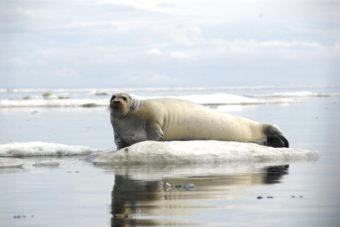
A bearded seal rests on ice in 2011 off the coast of Alaska. (Photo by John Jansen/NOAA’s Alaska Fisheries Science Center)

After being delayed for almost a decade, the federal government is moving forward with the process for designating critical habitat for two species of seal listed as threatened. What was supposed to be accomplished during the Obama administration has been dragged out by legal challenges.

The Bering, Chukchi and Beaufort seas are home to a variety of marine mammals, including bearded seals and ringed seals. Though both species are in relative abundance, long-term projections forecast a threat to the once abundant sea ice that the seals live on. As a result, the species were listed as threatened in 2012 under the Endangered Species Act.
But because their numbers aren’t low yet, and the threat comes from the loss of their habitat, Jon Kurland with the National Oceanic and Atmospheric Administration says the seals should have also gotten what’s called critical habitat designation.

“Critical habitat is areas within the geographical area occupied by a species that have physical or biological features essential to the conservation of that species, and may need special management over time,” Kurland said.

For ringed seals and bearded seals specifically, those areas need to have enough sea ice for the mammals to breed and nurse their pups, as well as provide enough food for the seals. As a result, Kurland says the proposed critical habitat area comprises a huge chunk of Arctic waters.

“It’s necessarily large because both of these species have really broad geographic distributions and they range widely,” Kurland said. “It’s the seasonality of that ice coverage that largely influences their habitat use.”

Ringed seal in Kotzebue Sound, Alaska
Ringed seal in Kotzebue Sound, Alaska. (Photo courtesy of NOAA)

By law, critical habitat is supposed to be designated as soon as a species is listed as threatened, or within a year if the habitat can’t be determined at the time. Emily Jeffers is an attorney for the Center for Biological Diversity, a prominent conservationist nonprofit. She says for the bearded and arctic ringed seals, it should have happened back in 2012.

“And here, the government had been dragging its heels, so we filed a lawsuit to hurry up the process,” Jeffers said.

That lawsuit happened in 2019. Jeffers says she believes the main holdup has been a lack of focus from the Trump administration on conservation.

“I think the short answer in terms of why it’s taken so long is that the Trump administration has been more interested in selling off the Arctic to the oil industry than they were with protecting ice seals and our climate,” Jeffers said.

Kurland with NOAA thinks that assertion isn’t totally fair. First of all, the two species were listed under the Obama administration, four years before he left office. During that time, the State of Alaska, the oil industry and others filed lawsuits challenging the listing, claiming it was premature due to the current abundance of the two species.

“Both of the listings were vacated by the U.S. District Court,” Kurland said. “In other words, they were put on hold, basically. They were not in effect for a period of time while the litigation went on.”

Eventually, a circuit court upheld the listings for the bearded seal and the arctic ringed seal in 2016 and 2018 respectively. After that, NOAA jump-started the process during the Trump administration. Kurland admits it hadn’t been done as promptly as it should’ve been.

“We didn’t get any kind of policy direction that we should stand down and not designate critical habitat,” Kurland said. “But obviously we didn’t do it as quickly as is envisioned, and that prompted the litigation that got us to where we are today.”

As part of the settlement with the Center for Biological Diversity, NOAA has until March to finalize their proposal for the critical habitat. Last week, they opened their proposed habitat to public comment for 60 days. Once that is finalized, Kurland says the critical habitat will be in place, though that doesn’t mean it’s totally off-limits to human activity. For instance, Alaska Native subsistence hunters are exempt from the Endangered Species Act.

“There tends to be this perception that once it’s designated as critical habitat that means, ‘Hands off, we can’t go there. We can’t do any development or can’t touch those areas,” Kurland said. “That’s actually not the case.”

Jeffers with the Center for Biological Diversity says the group supports the area that was proposed as critical habitat. While it isn’t as strong as federally protecting the land as a national preserve or refuge, she says when the government makes decisions about the area, they will have to take the two species into account.

“The main impact that you see from critical habitat designations is making sure that when the government is permitting something, giving someone a license to do something, it makes sure they talk to the biologists so that the species isn’t impacted,” Jeffers said.

Even though the biologists that would review those impacts are part of the federal entity that put off the designation for years, Jeffers says she still has faith in the science side of NOAA despite the bureaucratic issues.

Drilling boosters, opponents consider next steps after first Arctic refuge lease sale

Arctic National Wildlife Refuge (U.S. Fish & Wildlife Service-Alaska)

Just two companies and a state corporation showed up to the first-ever oil and gas lease sale in the Arctic National Wildlife Refuge last week, after 40 years of debate.

But still, about half a million acres of land did get picked up — nearly all of it by the state of Alaska itself.

So, what happens next?

Here’s what we know.

State agency focused on getting leases finalized

The Alaska Industrial Development and Export Authority entered the lease sale at the last minute as a backstop, in case no one else showed up to secure the rights to the land.

It wound up as the most aggressive of just three bidders.

That means the state won 10-year oil leases for nine pieces of land by submitting the minimum offer that the federal government would accept: $25 an acre.

“We are very happy that we were able to win some of the tracts in this case,” Alan Weitzner, AIDEA’s executive director, said in an interview Thursday.

“We would have preferred to see a more competitive bid put in place,” he said. “But I do think that there was a lot of uncertainty related to it.”

Drilling for oil in the refuge faces an aggressive opposition campaign. It’s also expensive, and uncertainty surrounds the future of oil demand — as well as just how much crude is actually trapped under the land.
Weitzner said he hopes the state’s decision to step in removes at least some of the uncertainty the oil industry might have about drilling in the coastal plain.

AIDEA has never held a federal oil lease before, and it doesn’t own drilling equipment, so it will likely have to depend on partnering with the industry to explore for oil and develop the land.

Weitzner didn’t have specifics on Thursday about who AIDEA might partner with, what the partnerships might look like or when it might start that work.

“It’s too early to say and give that information of what our definitive plan is going forward,” he said.

“We do have a very strong interest in ensuring that the state has tangible benefits that come from this development. And we have have distinct interest to ensure that it is done in a responsible manner.”

For now, Weitzner said he’s working with the federal Bureau of Land Management to get the paperwork done to finalize the leases.

Usually, the process takes about two months, but it’s expected that the Trump administration will rush to get it done before leaving office Jan. 20.

A map from the Bureau of Land Management shows the results of the first-ever oil lease sale in Alaska’s Arctic National Wildlife Refuge. Half of the tracts received no bids at all. (BLM Screenshot)

At last week’s sale, AIDEA spent about $12 million on oil leases that cover about 480,000 acres of federal land.

Half of that cash will go back to the state, because it splits the revenues with the federal government.

Two smaller companies see opportunity to enter Arctic refuge early

Knik Arm Services is one of two tiny companies that each picked up a single oil lease.

Mark Graber manages Knik Arm Services, and in an interview from Texas, he said the payoff is potentially huge if the U.S. Geological Survey’s estimates of the amount of oil beneath the refuge are correct.

“I’m an investor,” said Graber, who described himself as a “snowbird” who splits his time between Texas and Alaska.

“I go where I think a fair investment might offer a decent return for the risk,” he said.

Graber said he’s putting up a “good deal” of his own money to purchase the lease, along with other “funders” who he declined to name. He said he thinks he understands why major oil companies didn’t show up to the lease sale.

“Because it’s controversial,” he said. “They knew Alaska was going to bid on it. So, they knew that they’d have a chance to pick it up later.”

He argues that it won’t be a problem to develop the land without harming wildlife. Knik Arm Services wouldn’t drill itself, but would work with other companies to explore for oil “when the time is ripe,” he said.

Graber said this isn’t the first time he has made investments during a down market.

“We always bought real estate during the real estate crash of ‘89,” he said. “We’ve always tried to facilitate a weak market by taking the gamble and taking a risk. Sometimes it works. Sometimes it doesn’t.”

The other small company that won a lease is Regenerate Alaska, a subsidiary of Australia-based 88 Energy.

The slice of land it picked, on the refuge’s western edge, is near a state-owned parcel that the company already leases, and next to ExxonMobil’s Point Thompson field.

David Wall, chief executive of 88 Energy, told the Anchorage Daily News that he saw it as a “soft entry” into the refuge. He said he doesn’t want to upset anyone, but wants to “make money for ourselves, and the state and its people.”

Drilling opponents say they’re not done fighting

Meanwhile, Indigenous and environmental groups that have long fought drilling in the refuge say they’re not giving up.

“We are going to do everything in our power to prevent the leases from being issued before Inauguration Day,” said Karlin Itchoak, Alaska state director for The Wilderness Society. “And we’re going to do everything we can to prevent oil and gas development from ever happening on the coastal plain of the Arctic Refuge.”

Itchoak said he couldn’t talk specifics about how the groups could block leases from getting issued, “because we don’t want to show our hand.”

Defend the Sacred AK, a group opposed to oil development in the Arctic National Wildlife Refuge, stands in front of the Anchorage BLM office on Jan. 6, 2021, the day of the first-ever oil lease sale for the Refuge. (Jeff Chen/Alaska Public Media)

Some have raised questions about the legality of the state of Alaska jumping into the lease sale. The Bureau of Land Management said Wednesday that it doesn’t see any legal issues.

Leaders of the Gwich’in Steering Committee say they met Friday with Weitzner, the AIDEA director, and urged him to reconsider leasing the refuge. The Gwich’in subsist on caribou that give birth in the Arctic refuge’s coastal plain, which was the area that the Trump administration put up for sale.

“We let them know that our way of life is not negotiable, and that we wanted to know how they intend to include Indigenous voices, and protect Indigenous ways of life and values,” Bernadette Demientieff, the Gwich’in Steering Committee’s executive director, said in a prepared statement.

Itchoak said drilling opponents just need to halt any progress until Inauguration Day, because they expect support from the next administration.

President-elect Joe Biden and his appointee to lead the Interior Department, U.S. Rep. Deb Haaland, D-New Mexico, have both said they oppose drilling in the refuge.

“We’re hopeful that if we can hold off the issuance of the leases by or before the inauguration, that will be a positive outcome for protecting the refuge for the long term,” said Itchoak.

Biden has not said what his exact plans are for the coastal plain, but it’s possible he could try to buy back the oil leases or hold up the permits that companies need to search for oil and develop the land.

The Wilderness Society and other groups are also in court fighting against the oil leasing program for the refuge.

There are four lawsuits working their way through the federal court system that, effectively, ask a judge to cancel the oil leases, arguing that they’re based on a rushed and legally-flawed plan.

The federal government disagrees, and says it followed the law.

Alaska Public Media’s Nat Herz contributed to this story. 

Dunleavy appeals permit denial for the proposed Pebble Mine

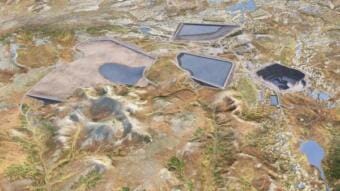
A digital simulation of what the proposed Pebble Mine’s foundation will look like. The State of Alaska is appealing the U.S. Army Corps of Engineer’s denial of a permit for the mine. (U.S. Army Corps of Engineers)

Alaska Gov. Mike Dunleavy is appealing the U.S. Army Corps of Engineer’s decision to deny a permit for the proposed Pebble Mine, back in November. 

The state’s Department of Law will file an administrative appeal with the federal government, according to a media release. 

In that release, Dunleavy calls the denial a “dangerous precedent” that would harm Alaska’s future.  His Department of Natural Resources Commissioner Corri Feige echoed that sentiment in the release, saying that it has “ominous implications for our rights as a state to develop our resources for the benefit of all Alaskans.”

Alaska Gov. Mike Dunleavy announced on Friday, Jan. 8, 2021 that the state is appealing the U.S. Army Corps of Engineer’s decision to deny a permit for the proposed Pebble Mine. (Nat Herz/Alaska Public Media)

The Army Corps denied the permit after determining that the plan for the mine would not comply with the Clean Water Act, and that the project is not in the public interest. 

Fishermen and tribes in Bristol Bay have been fighting the project for more than a decade.

If built, the open-pit gold and copper mine would be one of the largest in North America. 

Dan Cheyette, Vice President for Lands and Resources at the Bristol Bay Native Corporation, said they “completely disagree” with the governor’s decision. He said the corporation has “always held” that Pebble is unlike any other resource development project. 

 “Because of its location, because of its size, because of the type of deposit that it is, and the fact that it is in the midst of one of the world’s greatest wild sockeye salmon fisheries, it can’t be judged against any other project,” he said.” 

Cheyette said he believes the Army Corps will uphold its decision to deny the permit.

The United Tribes of Bristol Bay are strongly opposed to the project.

Protestors of the Pebble Mine in Anchorage
Opponents of the Pebble Mine protested in Anchorage in 2019, arguing that the Corps of Engineers’ environmental review of the mine was inadequate. (Liz Ruskin/Alaska Public Media)

“Bristol Bay residents and Alaskans have been clear that we will not trade one of the world’s last robust salmon fisheries for a gold mine,” wrote Deputy Director Lindsay Layland in an emailed statement. “It’s outrageous that Gov. Dunleavy and his administration would go against the will of Alaskans to benefit a foreign mining company that has no value to our state, and shows once again how out of touch he is.”

Robin Samuelsen is the chairman of the board of the Bristol Bay Economic Development Corporation. He has opposed Pebble for more than a decade and he’s not surprised by Dunleavy’s announcement.

“We’ve got two of our federal senators opposing the Pebble Mine, hundreds of thousands of people opposed to the Pebble Mine. And we’ve got a rogue governor that doesn’t care what Alaskans think,” he said. “We’ve always asked our congressional delegation, the state of Alaska to treat us fairly out here. And they always said they’re going to treat us fairly. But now, it just goes to show that the governor is stepping outside the bounds.”

Despite this most recent development, Samuelson said, he thinks Pebble is “on its way out.”

“I’m not against mining, but that mine is in the wrong place,” he said. “It’s in the spawning grounds — the most productive spawning grounds in the world. We have our gold, it’s called sockeye salmon.”

Sue Anelon, who works with the Iliamna Development Corporation, said she supports the governor’s decision. She said that the lack of jobs in Iliamna is forcing people to look for work.

“If we don’t do anything, we’re going to be stagnant,” she said. “We’re going to still depend on the government. I don’t want to move out of my hometown just to get a job, but people are moving, and I love this place and I’d rather be home.”

Anelon says people in her community commercial fish, and they also depend on a subsistence way of life, but that they need money even when fishing and hunting for food.

“If you’re going to go catch a moose, you have to buy your shells, you have to buy your gun, you have to buy your gas. You have to buy everything to keep your meat — your vacuum sealers and your bags,” she said. “So it takes money to put your food away.”

The Canadian-based parent company of the Pebble Limited Partnership is currently caught up in a class-action lawsuit alleging that the company mislead its shareholders about the viability of the project.  

Correction: A previous version of this story misspelled Robin Samuelsen’s name, it has been updated.

Federal and state officials sign right-of-way permit for controversial Ambler Road

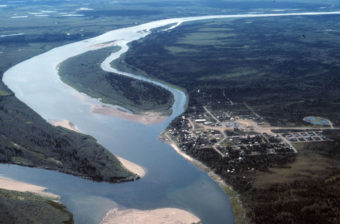
Aerial view of Ambler and the Kobuk River in the summer. (Photo courtesy of the National Park Service via UAF Gates of the Arctic Research Portal)
Aerial view of Ambler and the Kobuk River in the summer. (Courtesy of the National Park Service via UAF Gates of the Arctic Research Portal)

In the latest step in a longstanding dispute between mining advocates and environmentalists, federal and state entities signed a 50-year right of way permit for the controversial Ambler Road project on Wednesday, Jan. 6.

The permit was signed by the Bureau of Land Management, the National Park Service and Alaska’s state-owned development corporation — the Alaska Industrial Development and Export Authority. It allows the privately-owned road to pass through lands controlled by the federal government.

A company called Ambler Metals LLC, a subsidiary of British Columbia-based Trilogy Metals hopes to use the road to access copper, gold, zinc and other mineral deposits in the area, in cooperation with the NANA regional Native corporation.

The road would stretch 211 miles from the Dalton Highway to the Ambler Mining District east of Kotzebue along the Kobuk River. Environmentalists are most opposed to the part of the project that would cross Gates of the Arctic National Park and Preserve.
Bridget Psarianos is an attorney for Trustees for Alaska. The group has filed numerous lawsuits on behalf of conservation groups opposed to the project.

“Putting a gravel road through that area is going to really significantly and negatively impact the environment in that region,” Psarianos said. “The water quality, air quality, wildlife and the communities that are in that region.”

Subsistence advocates have also filed lawsuits over the road, fearful that construction of the project would impact the migration of caribou, a staple of the local Inupiaq diet in Northwest Alaska.

In its environmental assessment released last March, BLM officials flagged potential impacts to local water and air quality, as well as to wildlife migration and erosion.

The project has received millions of dollars in state support. In a statement, Gov. Mike Dunleavy described future efforts in the mining district as responsible resource development that is “key to providing high wage jobs to Alaskans and their families.”

The right-of-way permit came the same day that AIDEA also made the majority of oil lease bids on land tracts in the Arctic National Wildlife Refuge. Considering the pro-resource development attitudes of the waning Trump administration, Psarianos with Trustees for Alaska described these recent decisions as rushed.

“What we’re seeing right now is just a last-ditch, desperate effort by the Trump administration to rubber-stamp as many permits as it can before it leaves office,” Psarianos said.

Psarianos described the decision this week as one of many procedural steps in a lengthy process to get the road built. Construction would still be several years away at the minimum.

Nation’s sole heavy icebreaker arrives in Unalaska, prepares to patrol Arctic waters

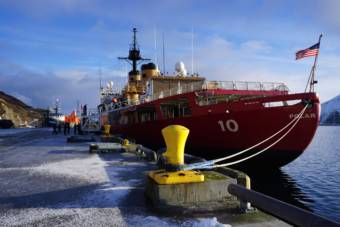
The Polar Star sits in the Port of Dutch Harbor. The ship arrived with 136 crew members on Tuesday for a pit stop 30 days into a months-long deployment to the Arctic to assert maritime sovereignty and security in the far north. (Photo by Hope McKenney/KUCB)

The nation’s sole heavy icebreaker arrived in the Aleutian Islands this week for the first time since 2013.

The U.S. Coast Guard’s Polar Star is preparing to patrol Alaska’s Arctic waters, including the maritime boundary line separating the U.S. and Russia.

The Polar Star sits in the Port of Dutch Harbor. The ship is nearly 400 feet long and can break ice up to 21 feet thick.

The ship arrived with 136 crew members on Tuesday for a pit stop 30 days into a months-long deployment to the Arctic to assert maritime sovereignty and security in the far north.

“The Arctic is incredibly important to us strategically, because of the amount of gas and oil and resources, as well as the fish stocks, which are landed here in Unalaska,” said Capt. Bill Woityra, the cutter’s commanding officer. “These are absolutely U.S. sovereign resources, and we desperately need to protect them against foreign actors, whether it’s foreign fishing fleets or it’s foreign adversaries that are seeking to push the limits of international law and claim those things for themselves.”

Capt. Bill Woityra, the commanding officer of the Coast Guard Cutter Polar Star, looks out from the cutter’s bridge on Dec. 17, 2020 while underway in the Bering Strait. (Photo courtesy of Petty Officer First Class/U.S. Coast Guard)

Typically, this time of year, this special icebreaking cutter is on its way to Antarctica’s McMurdo Station to drop fuel and other supplies to American scientists doing research near the South Pole.

“But this year, with the global pandemic, they had to cancel the mission,” Woityra said. “That created the opportunity for the Polar Star to come back north again.”

This is the ship’s first winter Arctic deployment since 1982.

In addition to the cutter crew, there are partner-agency researchers and scientists, British sailors from The Royal Navy, midshipmen from the Merchant Marine Academy and deck watch officers and ice pilots from the Healy, the Coast Guard’s medium icebreaker that’s capable of Arctic patrols during summer months.

According to Woityra, the mission isn’t only about national security and securing U.S. economic interests as human activity and international interest in the region expands. It’s also about doing environmental research.

They’re partnering with the Woods Hole Oceanographic Institute to take water samples and measurements while the boat transits over the Arctic Circle to better understand the harsh environment there. Getting data in the remote region during the winter, Woityra says, is otherwise extremely difficult.

“Basically, a heavy icebreaker is built so we can go anywhere on the earth in any thickness of ice during any time of year,” he said.

The Polar Star navigates heavy seas in the Gulf of Alaska on Dec. 10, 2020. (Photo courtesy of Petty Officer First Class/U.S. Coast Guard)

Even though the Polar Star was built to break through thick ice, just a month into their Arctic deployment, Woityra said the season has been tough on the 44-year-old vessel.

“Breaking ice in the Arctic winter is especially challenging because it’s so hard,” he said. “It sounds like a car crash, just twisting metal and screeching noises and shattering glass. It’s really kind of disconcerting. There’s no danger, but it leaves an unsettling feeling in your stomach.”

He said the crew has been working around the clock just to keep the ship running. On New Year’s Eve, they got stopped in the ice, and their engineers were up all night working to replace blown diodes and resistors that are usually considered obsolete.

“These are parts that just don’t exist anymore,” Woityra said. “We have a warehouse of spares, but when they’re gone, we won’t be able to run this ship anymore.”

That’s why Woityra and other Arctic planners say it’s so important for the government to invest the billions of dollars needed to build new icebreakers in the next decade to replace the Polar Star, which is the nation’s only functional icebreaker after a fire damaged the Healy this past summer.

The federal government is in the process of commissioning one, and Congress has agreed to build five more, but it hasn’t allocated funding.

The construction on the first new ice breaker is expected to be completed in 2024. Woityra said it will be 460 feet long, 90 feet wide, and weigh 23,000 tons — almost twice as much as the Polar Star.

“It’s going to be the largest, most complex, most powerful ship that the Coast Guard has ever built,” he said.

In the meantime, Woityra said the Polar Star’s Arctic mission will help train the future generation of Arctic sailors and mission leaders.

“This is our chance to really build up that experience and expertise and hold our proficiency operating in this environment,” he said. “Once those polar security cutters are delivered in a few years, we’re going to need operators and leaders to actually take them to sea, and we desperately need them to have experience in this environment.”

The Polar Star is expected to leave Unalaska’s Port of Dutch Harbor on Thursday afternoon. Woityra said he expects they will complete their mission and return to Seattle by the end of February.

Site notifications
Update notification options
Subscribe to notifications