Hemlock sawfly larvae (Photo courtesy of Elizabeth Graham/National Forest Service)
Elizabeth Graham pulls off the road about 25 miles north of downtown Juneau to stand in the rain looking at partially dead trees.
“There’s probably you know, in this little stand right here, about 30 dead tops that I can see just on this little hillside,” she said.
Graham is an entomologist with the National Forest Service. She points out some peaked looking hemlocks.
“And that’s a good example of what we’re seeing in other places. Not every tree affected. But, you know, a small portion,” Graham said.
Dead crowns in the canopy and rusty-colored branches are woven in with the otherwise healthy, green temperate rainforest. About a third of the trees around here were hit by the voracious sawfly. The larvae get mistaken for caterpillars. Adults are a kind of non-stinging wasp, a little smaller than a pinky finger.
In 2018 and 2019, drought conditions allowed the hemlock sawfly to thrive in Southeast Alaska. Now they are mostly done eating the needles off of hemlock trees, but the damage from their 2-year feast is still apparent.
“When I was doing these stories two years ago, I told everyone, ‘Oh, none of the trees are gonna die. You know, it’s just a defoliator, it’s not gonna kill the trees,” Graham said.
Isaac Dell and Elizabeth Graham work for the National Forest Service’s Forest Health Program. (Claire Stremple/Alaska’s Energy Desk)
Some trees are gonna die. They lost a lot more needles than she thought they would. But Graham says sawflies are nothing like spruce beetle, a really lethal pest if you’re a tree.
“It’s not going to be that bad, but it made me a liar. And we have a few that aren’t going to make it so I apologize for that,” Graham said.
Bare, sad looking hemlocks are going to stick out a bit in Juneau, Western Admiralty, Northern Prince of Wales and Mitkoff and Kupreanof islands. But the Forest Service isn’t taking any action beyond monitoring because the ecosystem is sorting things out on its own.
Sawfly isn’t an invasive species. Its larvae slowed down naturally because rain came back to the region after two years of drought conditions. The rain brought a fungus that infects the sawfly and controls the population.
But Graham says, it’s still a big deal. This is the biggest sawfly outbreak on record since the 1950s.
“When we saw this outbreak, and I saw it from the plane in 2019, the only way I can describe it is impressive,” she said.
When the Forest Service began to track the sawfly feeding frenzy they observed about 50,000 acres of the Tongass National Forest were affected. A year later, aerial surveys showed that the number had ballooned to half a million acres.
“The thing that I keep repeating to remember is, you know, that it is a natural part of our ecosystem. And, you know, we’re hoping that the impacts will be minimal,” Graham said.
Aerial view of the trees in the Tongass National Forest (Photo courtesy of Elizabeth Graham/National Forest Service)
Scientists are tracking the damage. They want to know the extent of the forest affected and how many trees don’t pull through. Scientists spent last year monitoring the outbreak via satellite since COVID-19 meant they couldn’t get in small planes together for aerial surveys.
There are drawbacks to monitoring a tiny insect from space, but the images did give scientists a sense of where to look when they’re back in the air this summer. They’re hoping there won’t be much new activity to see.
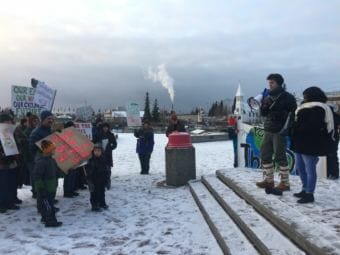
Tristan Glowa addresses the crowd at an October 2018 rally held to support Juliana vs. United States in Fairbanks. (Ravenna Koenig/ Alaska’s Energy Desk).
Alaska Republican Gov. Mike Dunleavy’s administration has joined a group of 17 states that’s trying to defeat a lawsuit by youth climate activists.
The motion to intervene, by Attorney General Treg Taylor, comes in a case called Juliana vs. United States.
The 21 plaintiffs in the case, who filed their lawsuit in Oregon, allege that federal government promotion of fossil fuels and the lack of policies to reduce them violates their constitutional rights. And they’ve asked the courts to require the federal government to draft plans to phase out carbon emissions.
Alaska Gov. Mike Dunleavy follows Deputy Attorney General Treg Taylor into a news conference at the governor’s Anchorage office on Friday, Sept. 27, 2019. (Photo by Nat Herz/Alaska Public Media)
A divided federal appeals panel ruled last year that the activists made a compelling case, but that it had to be made to elected officials rather than to the courts.
The plaintiffs and the federal government are now fighting over whether the case should be dismissed, or allowed to continue on a narrower basis. Instead of asking the courts to force the federal government to draft an emissions reduction plan, the activists are now asking for a simple declaration of their constitutional rights, said Andrew Welle, one of their attorneys.
A spokeswoman for Taylor, Grace Lee, wouldn’t directly describe the attorney general’s position on carbon emissions. But she said in an email that Alaska’s involvement in the case is about how Congress and state Legislatures are the right avenue for addressing that policy question — not the courts.
“That is why we have a democracy where we elect our representatives, who then struggle with these difficult questions where you have to balance economic prosperity, responsible resource development and impacts from a changing climate,” Lee said.
Welle was skeptical of Alaska’s separation of powers argument, noting that the states, in their filing, made multiple references to the likelihood that the litigation could change the federal government’s energy policy.
“It’s pretty clear from the state’s papers that this is not about saying, ‘Let the states handle this,’” Welle said in a phone interview Thursday. “It’s about them protecting their continuing promotion of fossil fuels and opposing any movement on those issues.”
Of the 16 states joining Alaska in the filing, all but one are led by Republican governors, and many — like North Dakota, Texas and Louisiana — depend on the oil and gas industry. They contend that upcoming, court-ordered negotiations between the activists and the Biden administration could lead to a settlement that transforms the country’s energy system and violates principles like the separation of powers.
Dunleavy, the attorney general’s boss, has promoted Alaska’s oil industry and also disbanded a state panel charged with setting the state’s climate policy not long after he took office.
Welle said the states’ participation in the lawsuit is aimed at protecting their interests in fossil fuels and blocking movement on greenhouse gas regulation.
“If you look at the states that are involved in this litigation, none of them are making progress on climate,” he said. “They’re moving in the opposite direction, and continuing to throw fuel on the fire.”
Welle is also involved in a similar case that’s quietly been playing out in Alaska over the past few years.
In 2017, a group of young Alaskans sued the state and asked the courts to order the government to draft a plan to reduce Alaska’s emissions. A lower court judge dismissed the case a year later, but it was appealed to the Alaska Supreme Court.
Welle says his side has been waiting for more than a year and a half for a decision from the Alaska Supreme Court about whether the case can continue in the lower court — an amount of time he described as “extremely frustrating” given the plaintiffs’ argument that “we’re in a climate emergency now.”
A spokeswoman for the state court system, Mara Rabinowitz, noted that the Alaska Supreme Court justices asked for extra written filings after the oral arguments, which took an extra six months to complete.
“The court is carefully considering the important issues raised in the appeal,” she said.
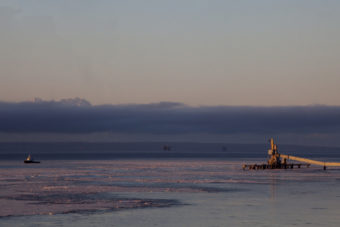
Cook Inlet oil platforms are visible from shore near Kenai, Alaska. (Rashah McChesney/Alaska’s Energy Desk)
Two companies successfully bid on nearly 21,000 acres of oil and gas tracts in Cook Inlet this week.
HEX Group and Strong Energy Resources both purchased leases in the state’s spring sale, for a combined total of $450,000. This is the first time a company other than Hilcorp Alaska has won leases in a state sale since 2015.
Anchorage-based HEX Group bought leases under two entities — HEX LLC and Furie Operating Alaska. HEX acquired Furie after it went bankrupt in 2019.
HEX Group bought almost 20,000 acres in leases, most of which are across the inlet from Tyonek, according to a state report. It also bought one lease in the North Fork field, down by Anchor Point.
HEX owns almost 10,000 acres in leases in Cook Inlet and operates the Kitchen Lights Unit there.
Strong Energy Resources, a company based in Texas, bought just under 1,500 acres in the sale, near Anchor Point. The company also owns acreage on the North Slope.
The sale was for state-owned leases only. This year’s federal oil and gas sale in Cook Inlet was put on pause this February, after the Biden administration hit the brakes on federal leasing programs nationwide.
About 3.3 million acres were up for bid in this sale.
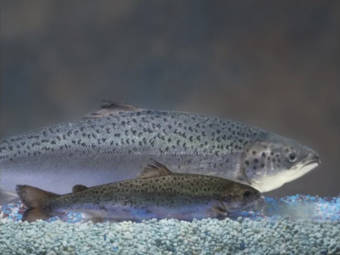
A genetically modified salmon dwarfs a non-modified salmon of the same age in an undated handout photo distributed in 2010. (Photo via AquaBounty Technologies)
A Massachusetts company is sending genetically modified salmon to dinner tables in the U.S. for the first time. AquaBounty Technologies said it’s shipping five tons of bioengineered salmon to distributors this month.
It’s marketed as a sustainable alternative to other kinds of salmon. But AquaBounty’s fish hasn’t received the warmest reception in Alaska, where it’s often called “Frankenfish.”
Tim Bristol of Homer is the director of Salmon State, an Alaska organization defending wild salmon populations.
“It’s going to be a real challenge for us moving forward to make sure we do everything we possibly can to educate the American and the international consumer that if you want the salmon that’s best for you and supports communities and small family businesses, you need to choose wild Alaska salmon,” he said.
AquaBounty’s salmon is a genetic mixture of three different fish — Atlantic salmon, chinook salmon and the eel-like ocean pout. It grows twice as fast as its non-engineered counterparts, reaching full market size in 18 months.

This is the first time a company has sold genetically engineered salmon in the U.S.
Federal regulators ruled the salmon safe to eat and sell in 2015. But for a while, AquaBounty still didn’t have permission to grow its salmon in the U.S. Instead, it was working out of facilities in Canada and Panama.
That was until 2019. The latest batch of salmon headed to market in the U.S. comes from a facility in Albany, Indiana.
The Food and Drug Administration said AquaBounty’s fish are similar nutritionally to non-engineered, farm-raised Atlantic salmon. AquaBounty says their fish could help mitigate overfishing and create less pollution than farmed fish.
Not everyone’s convinced.
“It’s just a faster way of doing business and making money,” said Sara Erickson, who owns AlaSkins in Soldotna. She’s a vocal opponent of fish farming and a former commercial fisherman.
“They have a picture of a regular farmed salmon and their farmed salmon. And it looks just like a giant. I mean, what’s the point of that?” she said.
A big concern for environmental groups has been whether fish can escape from the facility and mate with wild salmon. Late last year, a federal judge ordered the FDA to look into what would happen if that occurred.
AquaBounty said there’s no risk of that happening, since it grows sterile salmon in inland-based tanks, with multiple barriers to prevent fish and eggs from escaping.
Erickson said that’s one good thing that sets AquaBounty’s salmon apart from other farmed salmon.
“And I appreciate that. In fact, all fish farming should really go to that place. But it’s a lot more expensive to do,” she said.
Erickson said salmon should be clearly labeled in stores so people know what they’re buying.
Federal law currently requires GMOs to be labeled as such. But that doesn’t just have to be through wording — a QR code, scanned with a smartphone, also suffices.
There are some exceptions to the Department of Agriculture’s current labeling law. Food served in restaurants, for example, doesn’t have to be labeled.
Sen. Lisa Murkowski has been a vocal opponent of genetically engineered salmon. Legislation she introduced this month would require the words “genetically engineered” to appear on bioengineered salmon in stores.
It’s called the Genetically Engineered Salmon Labeling Act. Sen. Dan Sullivan is a co-sponsor.
“It would be a level of consumer awareness,” Murkowski told KDLG Friday. “Because it is only when we are aware of what is being sold, what is being put in front of us, that we can say firmly and clearly, ‘Nope. Don’t want this on my table.’”
A spokesperson from AquaBounty said the company will use the phrase “genetically engineered” on grocery store packaging.
Several grocery chains have pledged not to sell genetically modified salmon, including Safeway and Kroger, which owns Fred Meyer.
Bristol said he hasn’t heard of any Alaska businesses interested in buying the product.
“We have seen Alaskan stores carry farm-raised Atlantic salmon in the past, and usually the blowback is pretty significant and comes pretty quickly,” he said.
An AquaBounty spokesperson said the company isn’t shipping any salmon to Alaska yet.
Izzy Ross in Dillingham contributed reporting to this story.
Greg and Cindy Clark of Idaho, center and right, watch a bear during a tour last month with guide Solan Jensen, left. The group was at Pack Creek, on Admiralty Island south of Juneau. (Nat Herz/Alaska Public Media)
Chris McGraw, whose family owns Sitka’s cruise dock, is only expecting to see 20% of his company’s normal business this summer. But when he tried to go out to dinner a week ago, he said, every restaurant in town was full amid a surge in tourists traveling to Alaska on their own.
In Juneau, Laura Martinson saw just 7% of her normal May revenue this year at Caribou Crossings, her art shop just across from the town’s cruise docks. But her fiancé, who wants to go charter fishing for his bachelor party, can’t find a boat that’s not already booked.
And in Haines, guide Greg Schlachter relied on federal aid to keep open his fly fishing company that primarily serves cruise passengers. But he also runs an adventure travel agency, and interest in private and small-scale trips is at an all-time high. It’s so high, in fact, that Schlachter has convinced a couple of boat captains to buy million-dollar vessels to help meet the demand.
“It’s kind of a booming year for private experiences,” Schlachter said. “Demand has never been higher.”
These patterns are repeating themselves across the cruise-centric region of Southeast Alaska this summer: It’s feast or famine for tourism businesses, depending on their clientele.
The industry is on an undeniable rebound compared to the pandemic-induced hibernation of 2020. But only some businesses are returning to profitability, as the masses that typically arrive on large cruise ships are still missing.
Juneau’s cruise ship docks are empty on April 23, 2020. The cruise ship season was supposed to begin, but sailings have been suspended due to the coronavirus pandemic. (Jennifer Pemberton / KTOO)
After a complete cancelation of last summer’s cruise season, those large ships are making a much-vaunted return to the state later next month. But they’ll arrive in far smaller numbers — and likely with far fewer passengers — than what many of Southeast’s cruise-focused tourism businesses are built to serve.
“We are a volume-based economy down here, because we’re so seasonal,” said Martinson. “I don’t see us having this giant, breakthrough summer where we’re going to catch up. It’s just, can we survive until 2022? And how long can we hang on?”
Meanwhile, smaller-scale businesses that don’t depend on the big cruise lines are seeing record-high bookings this summer.
“This year is one of our best years ever,” said Scott Jorgensen, who manages the remote Pybus Point Lodge, 70 miles south of Juneau, where guests pay $1,200 a day.
“I almost forget that there was a COVID world out there,” he said.
An independent traveling boom
The travelers now returning to Alaska look a lot like Cindy and Greg Clark.
One morning late last month, the Idaho couple had squeezed into a small plane at the Juneau airport, along with two guides and a reporter, and flew to the east coast of Admiralty Island for a day trip.
By noon they were crouched down behind a log. Ten yards away, one of the wild brown bears they’d come to see ambled past, pulling up mouthfuls of sedge grass. It was almost completely silent. The only other people at the remote wilderness spot were two British wildlife videographers and their guide.
The setting, with snow-covered mountains and waterfalls as a backdrop, was starkly different from Southeast Alaska’s cruise docks, which in a typical summer bustle with passengers, vans and salespeople.
“I just don’t like big crowds. I don’t want to be a tourist,” Greg Clark said. “I don’t like the idea of doing the same thing everybody else does — I like unique vacations.”
Greg, 62, is a retired hydrologist who’s previously been kayaking and canoeing in Alaska and the Yukon. And he’s the type of traveler who wouldn’t set foot on a cruise ship if you paid him.
He and Cindy were visiting the state for more than two weeks, staying in Airbnbs as they made stops in Denali, Homer and Juneau. Their budget for the trip was between $8,000 and $10,000 — substantially more than the price of many large-boat Alaska cruises, which can be as low as $2,000 for a couple.
Before the pandemic, just 10% of Southeast tourists were projected to arrive independently in 2020, whether by air or by driving the Alaska Highway, according Meilani Schijvens, who runs Juneau-based economics firm Rain Coast Data. The rest — an estimated 1.4 million people — were expected to come on cruise ships.
Compared to those cruise passengers, independent tourists like the Clarks tend to stay in Alaska for more time and spend more money: A 2016 survey found that visitors who flew in spent $167 a night, compared to $74 for cruise passengers. (The survey did not account for the cost of cruise packages themselves, some of which trickles down to Alaska businesses.)
Even with what appears to be an emerging boom in independent tourism, a precise accounting of Southeast’s summer visitors will be tough, said Schijvens, given the difficulty in tracking people traveling by plane. But anecdotes from across the region, and the state, suggest a strong resurgence.
Alaska Airlines wouldn’t release exact figures, but spokesman Tim Thompson said that its current summer counts and future bookings are “very strong.” While the company forecasted passenger loads to be 80% of pre-pandemic figures by the second quarter, it’s now anticipating being much closer to “traditional summer” numbers, Thompson said in an email.
“We are seeing much fuller flights from the Lower 48,” he said.
Alaska Seaplane Adventures, which took the Clarks on their bear viewing tour, is experiencing record demand, said Dan Kirkwood, the company’s general manager and one of the guides on the Clark’s trip.
“I hesitate to say this, but we’re on track to have our busiest year ever,” he said.
People in the tourism industry say that they’ve benefited, in part, from trips that were canceled last year that customers rolled forward into 2021 — which came on top of typical off-season bookings. And there are remaining obstacles to overseas travel, leaving Alaska at the top of the list for an exotic trip.
Kirkwood said he doesn’t want the cruise industry’s struggles to be the only narrative to come out of this year’s tourism season.
“The independent travelers, they’re the ones staying in hotels, eating at restaurants, using the same flights — so they’re supporting all the same things that residents use. And they make, I think, life in Alaska rich,” he said. “I would hate for folks to say that this summer was a wash just because one element of the industry wasn’t here.”
Cruise businesses look to 2022
Tourism industry leaders have hailed Alaska’s Congressional delegation for helping to pass legislation that allows the resumption of large-boat cruises in late July.
But for Southeast businesses that depend on those vessels to bring most of their customers, the outlook for the rest of the summer remains grim.
In 2019, there were some 575 cruise voyages to Alaska; this year, 88 are planned, though those numbers may still change. Ships may also carry fewer passengers when they do arrive.
“I’m grateful for every single person that walks in the door,” said Martinson, the Juneau store owner. “But we certainly are not feeling like, ‘Great! It’s back! We’re rebounding.’ That’s not the climate of what’s happening down here.”
In a normal year, Martinson has eight employees at her store, where she sells work from more than 60 Alaska artists. She had to furlough her full staff last year and will bring back just two workers in the second half of this summer.
Similar stories are playing out at other businesses. Temsco Helicopters, which markets sightseeing flights to cruise passengers, typically has 60 employees at its tour operations in Juneau and another 50 in the tiny cruise town of Skagway. This summer, there are 10 in Juneau and four in Skagway, said Craig Jennison, the company’s vice president of tours and marketing.
Many of the businesses that market to cruise passengers operate at larger scales, with assets like planes and tour boats that can develop problems if they’re not kept running. That’s one reason many of them are operating this summer even when there likely will be too few customers to make money, employees said.
Passengers from the mega ship Norwegian Joy disembark in May 2019 at Ketchikan’s Berth 3 downtown. (Leila Kheiry/KRBD)
“For our ability to springboard into next year, it was going to be very hard to go from zero to 60 without operating on any sort of large level for two years,” Jennison said. “This helps the community get ready for that; I know it helps our operation get ready for that.”
Business owners also said it’s important that Alaska’s cruise-related businesses show the public, and investors, that the industry will be capable of a full return next year.
Before COVID-19, Alaska’s tourism industry was booming. And in Southeast in particular, it was a bright spot for a regional economy that’s otherwise been struggling. The pandemic hit at the worst possible time — in the spring, after businesses had invested heavily in upcoming summer operations and before they had time to earn their money back.
Southeast residents were spending their retirement accounts on assets like tour boats or yachts, which seemed like safe ways to “cash in and be part of the tourism economy,” said Schijvens, the Juneau analyst.
Schijvens surveyed Southeast businesses on the impacts of COVID-19 in late April. One-third of the 145 tourism operations that participated said they were at significant or moderate risk of closing, and nearly half said they would have closed without relief money.
“We heard story after story of people who looked at the economy, it looked like a great bet, they invested their life savings and still have not earned a single dollar yet,” Schijvens said. “It was a growing investment climate that you could really count on.”
In Sitka, McGraw, the dock owner, said two retailers that were lined up for an expansion project ended up backing out because they didn’t know when ships might return.
“There’s been this kind of cloud of, ‘When will cruise ships come back? And when do we invest?’” McGraw said. “And I think by seeing ships in our state waters again, that gives people the confidence to invest and grow and realize that cruising is back.”
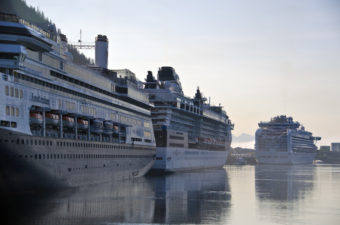
Cruise ships in port in Juneau in August 2012. (Photo by Heather Bryant/KTOO)
A Florida lawsuit is challenging the Centers for Disease Control and Prevention’s pandemic rules for cruise ships. Federal officials say if the lawsuit succeeds and the court tosses the CDC restrictions, it would have the unintended consequence of banning cruises to Alaska this summer.
The state of Florida sued the CDC in April, aiming to eliminate the agency’s pandemic restrictions on cruise ship travel. Those rules are outlined in the CDC’s evolving Framework for Conditional Sailing, often called the conditional sailing order.
Florida, along with the states of Texas and Alaska, is asking a federal judge in Tampa to throw out that order. The state argues the agency has overstepped its authority.
But lawyers for the CDC say Congress implicitly approved the agency’s cruise ship rules when it passed a law last month waiving a requirement for Alaska cruises to stop in Canada. As the law passed, several cruise lines announced plans to sail to Alaska starting in late July.
That law, the Alaska Tourism Restoration Act, applies only to cruises from Washington to Alaska prior to next April and only applies to cruises approved by the CDC under the conditional sailing order.
And so, the CDC argues, if there’s no conditional sailing order, that would “end cruising in Alaska for the season.”
The argument goes like this: Without the conditional sailing order, the Alaska Tourism Restoration Act can’t apply. That would leave the 19th-century Passenger Vessel Services Act in place. It requires Alaska-bound cruises to stop in Canada, but Canada’s ports are closed this summer.