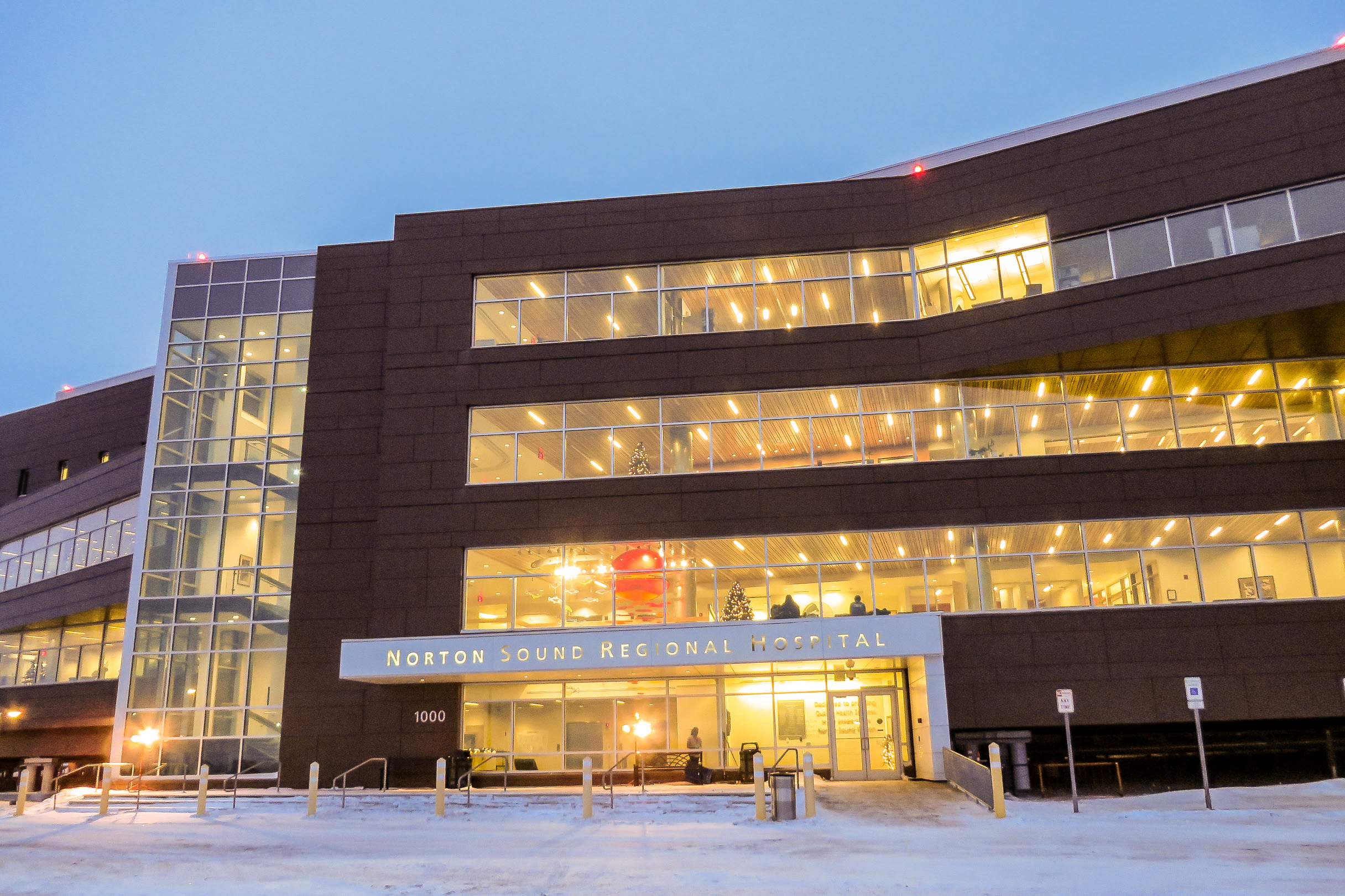
Nome’s Norton Sound Regional Hospital. (Photo by Laura Kraegel/KNOM)
Norton Sound Health Corp. announced Tuesday that the Bering Strait region has its first confirmed case of COVID-19.
At this time, NSHC is not sharing information on which of the sixteen communities in the region the patient is from, according to public relations manager Reba Lean. However, the individual is reportedly self-isolating and is in contact with the state’s Section of Epidemiology.
“In our region, every community is so small, and as soon as we identify the location, people start making assumptions and guesses, and it becomes a violation of privacy,” said Lean.
Lean also said that the regional hospital has been preparing for this situation for weeks, and their existing policies and regulations will remain in place to keep the coronavirus contained. The corporation learned of the diagnosis on Tuesday.
“Confirmed patients and even presumed-to-be-confirmed patients, we ask them to self-isolate,” said Lean about the region’s policy.
NSHC encourages everyone to continue following the local and state health mandates, which include wearing face coverings when going out in public.
The latest mandate issued by Gov. Mike Dunleavy’s administration allows the state to utilize non-congregate shelters for housing specific groups of people.
Bethel Regional High School students dance at their graduation ceremony in May 2016. (Photo by Dean Swope/KYUK)
Governor Mike Dunleavy has closed public schools through the rest of the school year.
For the 9,606 high school seniors across the state who make up the class of 2020 that means final sport seasons have been cut short and proms and graduations have been postponed at best or canceled at worst.
But despite such an abrupt end to a highly anticipated school year, some seniors are taking these transitions in stride.
Back in January, when the first case of COVID-19 was detected in the United States, students had just started the second half of their school year. For seniors that meant ensuring they were on track for graduation, thinking about what colleges they were going to or what jobs they would prepare for, and how they would make most of their last year with their closest friends before moving on to the next phase in their lives.
Love Katoanga is 17. She attends Alaska Middle College School in Anchorage. The schools is a partnership between the Anchorage School District and the University of Alaska Anchorage where she earns credit toward both her high school diploma and an associate’s degree, attending classes at the UAA campus.
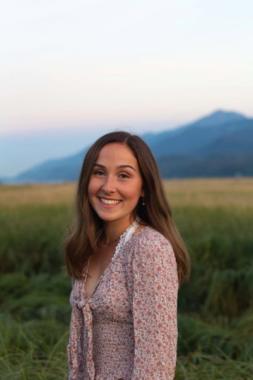
Love Katoanga is a senior at Alaska Middle College School. She says she hopes to learn from the change caused by the coronavirus crisis and is looking forward to pursuing a college degree. (Photo courtesy of Love Katoanga)
She said she’d heard about the coronavirus at the time but wasn’t really that concerned.
“I honestly didn’t think this pandemic would do anything to affect me,” she said. “I was like ‘Oh, it’s like on the other side of the world, no way they’re going to come near us.’”
She said it wasn’t until she started getting emails about an extended spring break, and then another one about schools being closed until May 1st, and then another one about prom being cancelled that she started to worry.
“It’s just like okay, wow. So this affected me directly. Me, me myself and I,” she said.
Katoanga had an idea of how her senior year would go. She says she was really looking forward to graduation and a graduation party and prom night with her best friend.
“Now, I feel like kind of lost,” she said. She is still waiting on some college admission decisions but she isn’t sure when they’ll come. “I don’t know. It’s just very confusing time, right now.”
Even though she’s still processing these rapid changes, thinking about going to college and getting her Bachelor’s degree in English keeps her in good spirits.
Katie McKenna is a senior at Juneau-Douglas High School in Juneau. She says journaling and thinking of ways to help others has kept her from “moping around” about the fact that the coronavirus crisis has upended major milestones of her senior year. (Photo courtesy of Katie McKenna)
Katie McKenna, a senior at Juneau-Douglas High School in Juneau, said ending her school year this way is a bit of a shock. Her district hadn’t even had spring break yet when school closure began.
“So we didn’t really get to say goodbye to anybody,” she said. She grew up with many of the students in her class, even starting kindergarten with some of them. “And that’s probably the last time I’ll be spending a lot of time with them.”
McKenna is the president of the student council, on the track team, an officer in her school’s National Honor Society and an environmental activist.
She’s deciding between different offers from universities but canceled campus visits and student preview days have her considering other options.
“I’m also thinking about a gap year just because I’m interested in it,” she said. “But also because if schools are going to be doing online classes in the fall, I would want to make sure I got the most out of my four years.”
She said her biggest worry though isn’t really about her future, though. She worries about mostly about the future of her community as a whole.
She had been following the coronavirus story since early January and hopes that officials and citizens learn from this event, she said.
“I have frustration kind of watching this unraveling, even with my peers, they weren’t taking the social isolation seriously,” she said. “It’s frustrating to watch this happen in New York, and then Europe, and then move on and not see a reaction come out at, state level and community level.”
McKenna said her worries come in waves that are hard to predict. Sometimes she does get sad or scared. But she said she keeps reminding herself of one important point.
“I kept reminding myself why we’re doing this and what the reason behind this was,” she said. “I can take not having a track season to end my senior year so other people have a better chance to live. When you frame it that way, it totally puts it in perspective.”
Both Katoanga and McKenna said they are thinking of ways to still be able to mark those major milestones personally with their families and friends.
The Anchorage School District has convened an ad-hoc committee of teachers and students to think about what celebrations are feasible. But the Juneau School District will not have a graduation ceremony. Other districts like the Matanuska-Susitna Borough School District are planning to host graduations online.
Katoanga and McKenna said it’s comforting just knowing that they’re in the same boat as thousands of other seniors across the state, and millions across the country.
The pandemic is one of the last few things that bonds the class of 2020 together, even though they’re apart.
Juneau Police Department vehicle. (Photo by Quinton Chandler/KTOO)
The confined living situations introduced by the pandemic — while necessary for slowing the spread of COVID-19 — can increase the likelihood of domestic violence for some Alaskans.
Kelsey Eggert, a Juneau-based lawyer for Alaska Legal Services Corp., said reports of domestic violence are up.
“We’ve now seen an uptick in Juneau,” Eggert said. “After extended confinement in this very stressful situation in which the whole world has changed, there is an increase in domestic violence. And unfortunately, it’s also a lot harder to get help at the moment.”
“If you’re confined with your abuser, and they’re not leaving, how do you call a resource to get help or information?” she added.
Eggert recommends anyone experiencing domestic violence to call the National Domestic Violence Hotline — that number is 800-799-7233.
Having a safety plan is also a good idea, Eggert said.
“Have a person that you can text a certain word, and they know that you’re in trouble and they can maybe call the police for you,” she said. “Have a person who you can go to and stay on their couch for a bit if you’re really afraid.”
She said she often tells clients: “If you feel really unsafe, call 911.”
For community members who may know someone who has experienced domestic violence, Eggert recommended checking in with them.
“You don’t have to ask them if there’s been domestic violence,” she said, “but check in with them.”
Alaska Legal Services also deals with another area of concern for many Alaskans: a worsening financial situation. With reduced hours or not being able to work from home, paying bills and covering rent or a mortgage are suddenly more difficult.
For renters, a state bill passed to keep people who are struggling to make rent from being evicted. According to Alaska Legal Services Executive Director Nikole Nelson, court hearings for tenants who are behind on rent have also been stalled.
“The idea behind this is that we really don’t want people becoming homeless during a pandemic, because that’s not going to create a healthy situation for any of us,” she said.
That doesn’t mean renters are completely off the hook, however. Ultimately, tenants will have to agree on a repayment plan with their landlords. And Nelson recommends people struggling to pay their mortgage talk to their banks — further protections during the pandemic prevent banks from foreclosing upon homes right now.
This transmission electron microscope image shows particles of SARS-CoV-2, the coronavirus that causes the disease known as COVID-19. (Image courtesy of National Institute of Allergy and Infectious Diseases Integrated Research Facility)
A woman in her 30s from the Matanuska-Susitna Borough has died from COVID-19, according to data from the state Department of Health And Social Services.
She is the ninth Alaskan whose death is linked to the disease, and the first from Mat-Su. Two of the Alaskans died out of state.
The state health department also reported that another eight Alaskans were diagnosed with COVID-19 on Monday, bringing the total to 285. The number who have recovered from the disease rose by 13, to 98. The total number of hospitalizations remained unchanged, at 32.
The department reported that the woman who died acquired COVID-19 locally. A health department spokesman said he did not immediately have more information.
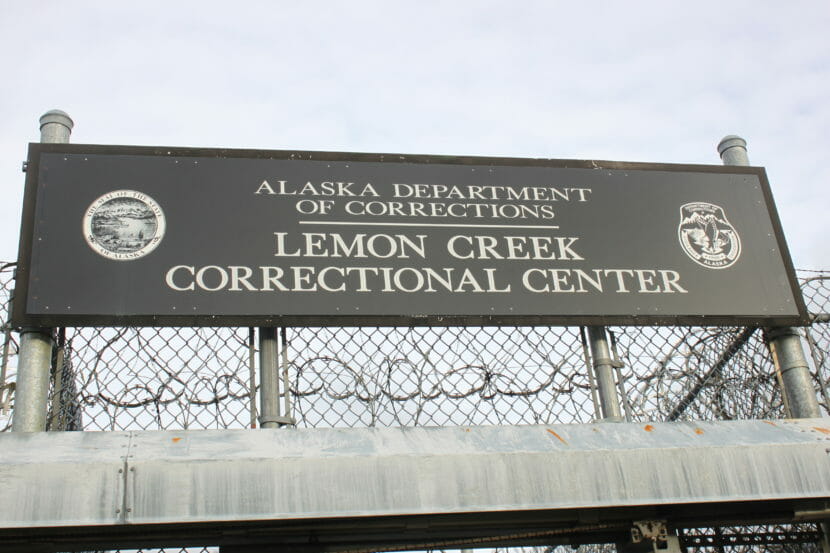
Of the new cases, five of the Alaskans are from the Municipality of Anchorage, one is from the Prince of Wales-Hyder area, one is from the Mat-Su Borough and one is an employee at the Lemon Creek Correctional Center in Juneau. It’s the fourth correctional officer at the prison who has tested positive for the disease.
More than 8,300 tests have been administered in Alaska.
Across the United States, the Centers for Disease Control and Prevention reported more than 575,000 COVID-19 cases and 22,252 deaths.
Two more people who work at Juneau’s jail have tested positive for COVID-19. That means six staff at the facility have the virus. (Read more)
Original story
Four recent confirmed cases of COVID-19 in Juneau are all correctional officers at Lemon Creek Correctional Center.
According to the Alaska Department of Corrections, there are currently no known cases of COVID-19 among inmates at the facility.
All staff and inmates have been issued cloth face masks.
According to a release from the City and Borough of Juneau, the new cases were reported on Friday, Sunday and Monday. The results from the latest confirmed case came in Monday but will be included in Tuesday’s statewide numbers due to reporting protocols.
State epidemiologists are working with the department to trace close contacts among the facility’s inmates and staff.
The facility implemented a response plan but it has not shared the details of that plan, citing security issues.
In an email Monday, DOC spokesperson Sarah Gallagher wrote that 32 staff members at the facility have been tested since last week when the first case was confirmed. Four inmates have also been tested. All four had negative results.
As of Monday, the inmate population at the facility was 217 inmates, according to DOC — down from 248 a month ago. The facility also has about 85 staff working four shifts under normal circumstances.
Juneau has now had 17 confirmed cases of COVID-19. Ten of those cases have recovered.
Alaska Gov. Mike Dunleavy speaks at a news conference in Anchorage about COVID-19, Thursday, April 9, 2020. (Creative Commons photo by Alaska Governor’s Office)
Updated story — Tegan Hanlon, Alaska Public Media
State officials on Monday announced a plan to use university dorms, hotel rooms and other buildings to temporarily quarantine and isolate health care workers and some homeless families if needed.
Alaska Department of Health and Social Services Commissioner Adam Crum said the new mandate gives the state access to federal funding to help pay for the temporary housing for specific groups.
“First responders and health care workers who need to quarantine safely without exposing their families,” he said. “Homeless families with at least one member who tested positive for COVID-19 and homeless individuals who require quarantine or isolation.”
Crum outlined the latest mandate at a news conference Monday evening.
Gov. Mike Dunleavy also announced that five more Alaskans tested positive for COVID-19 on Sunday, bringing the total number of cases to 277. The state reported one more hospitalization and no new deaths. At least 85 Alaskans have recovered from the disease.
“Alaska is doing pretty good dealing with this virus compared to other locales,” Dunleavy said.
Four of the newly-diagnosed Alaskans are from the Anchorage area and one is an employee at the Lemon Creek Correctional Center in Juneau. A total of four of the workers at the prison have been diagnosed with the disease so far.
At the news conference, Dunleavy said he’s monitoring the state’s COVID-19 cases to determine when to restart sectors of Alaska’s economy. He said he plans to work with local governments and industry leaders to determine when to reopen businesses and communities.
“This is going to be the week that we’re going to start talking about the economy,” Dunleavy said. “And how we are going to be able to re-enter an era of normalcy, or at least as close to it as possible. We may not get back totally to where we were before this virus, but it’s our goal to get our life back, our economy back, to as close as possible.”
Dunleavy said he’s going to put Alaskans’ health first. He said the state could open a few sectors at a time and then monitor how that impacts the number of COVID-19 cases in Alaska. Depending on the results, it could relax additional restrictions or not.
“We’re not going to do anything unilaterally,” Dunleavy said.
Dr. Anne Zink, Alaska’s chief medical officer, said one of her focuses is testing. About a month ago, the state estimated it needed somewhere between 2.5 million and 3 million tests, Zink said, and “we are a long way from that right now.”
“I think we’re going to need enough tests to be able to test all Alaskans multiple times for numerous reasons, and so that’s what we’re shooting for,” Zink said.
She said one of the biggest obstacles is the availability of the chemicals needed for the testing, known as reagents. The availability of swabs and vials that the swabs go into are also limitations.
“We are literally looking at how to manufacture every part ourselves,” she said.
She underscored that the global pandemic will not be over soon, and thanked Alaskans for the work they’ve done so far to help slow the spread of the virus in the state.
“This disease doesn’t go away tomorrow,” she said. “This disease doesn’t go away if we start to open things up. This is going to be a long haul.”
Original post — Jeremy Hsieh, KTOO
Gov. Mike Dunleavy’s latest COVID-19 press conference is scheduled for 5 p.m.
Health and Social Services Commissioner Adam Crum and Chief Medical Officer Dr. Anne Zink will also participate by videoconference. Dunleavy has been holding these briefings almost daily since March 10.
Press briefings notwithstanding, the state has been sharing COVID-19 data on testing, confirmed cases, local counts and recoveries on this interactive online data hub. Additional public health information about COVID-19 in Alaska — including the 14 public health mandates in effect — are available at coronavirus.alaska.gov.
Correction: An earlier version of this story understated the number of public health mandates that had been issued as of Monday afternoon. There were 13, not 12. Later, a 14th mandate was issued.
Close
Update notification options
Subscribe to notifications
Subscribe
Get notifications about news related to the topics you care about. You can unsubscribe anytime.