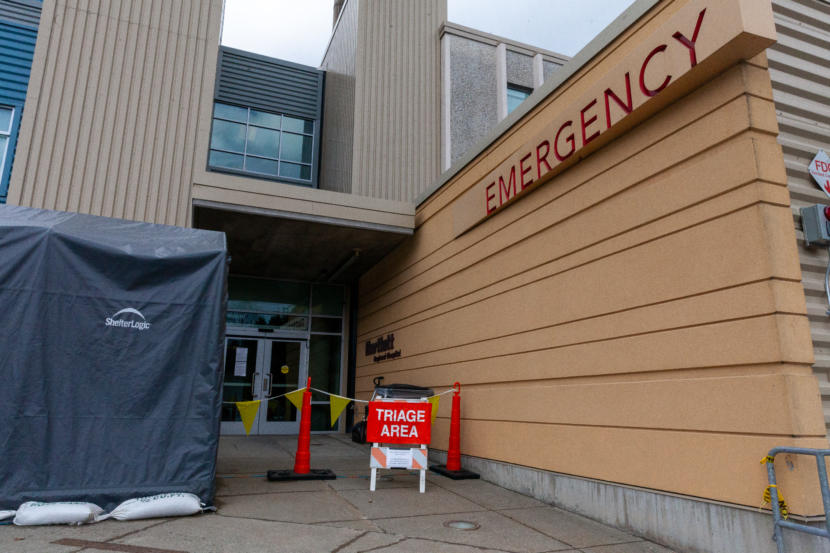
A triage tent is set up to screen patients for symptoms of COVID-19 outside on Monday, April 7, 2020, at Bartlett Regional Hospital in Juneau, Alaska. (Photo by Rashah McChesney/KTOO)
Bartlett Regional Hospital has also spent about $600,000 on equipment, supplies and labor preparing for the pandemic. Chief Financial Officer Kevin Benson said it’s not clear if and when the hospital will be reimbursed for that money, but it’s exploring options to recoup funding through FEMA, the newly-passed federal CARES Act or an insurance claim for business interruption.
“I think the bigger concern for us, from a financial impact, is the loss of revenue,” Benson told the hospital’s finance committee on Friday.
By the end of March, the hospital was short about $2.3 million in revenue, Benson said, and it’s lost about the same amount in the first 9 days of April. The total revenue shortfall for April is expected to be $4 million, he added.
The statewide ban on non-urgent and elective procedures extends through June 15.
Correction: This story has been updated to show that the hospital lost about $2.1 million in revenue in the first nine days of April.
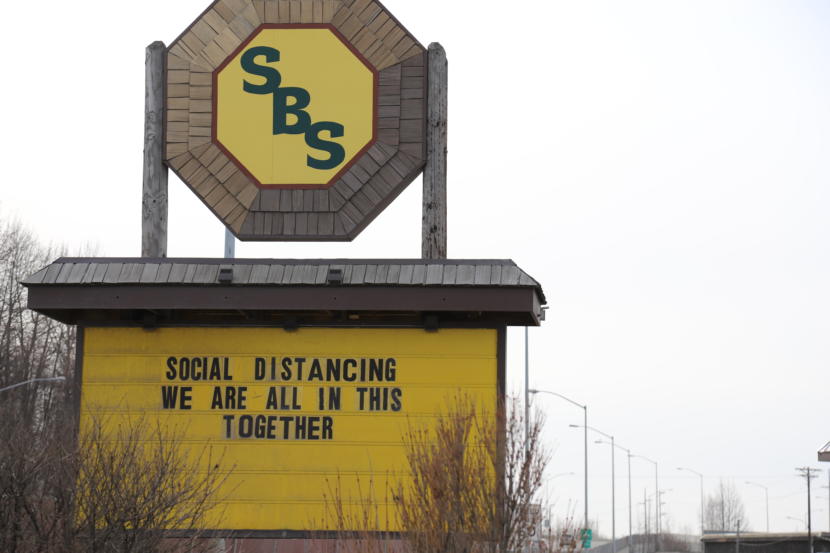
Spenard Builders Supply uses its sign to share a hopeful message to Anchorage on April 7th, 2020. (Photo courtesy Hannah Lies/Alaska Public Media)
From unemployment insurance to small business loans, many Alaskans have been forced, suddenly, to navigate a myriad of social benefits, including those in the recently-passed federal CARES Act.
Here’s the latest on some programs that are available to help:
Unemployment insurance: Unemployment Insurance is a state-administered, federally funded program that recently had benefits boosted in the CARES Act. You can earn up to $370 a week, plus up to $75 for each dependent if you apply on the state’s website, and many of the usual requirements have been waived or modified. State administrators are advising self-employed people and those working in the gig economy to wait until the department has finalized the administration of the program. The department says that might not happen until early to mid-June.
Small business loans: Many affected small businesses could be eligible for the Payment Protection Program, which offers loans and grants for employers who agree to keep employees on their payrolls. You’ll have to apply at your bank and many details are still being worked out, but you don’t need any collateral and there’s a chance you can get that loan forgiven if you meet the conditions. The U.S. Small Business Administration is offering $10,000 ‘loans’ with fewer requirements than usual, as well as the possibility that you won’t ever have to pay them back. There’s some things you need to know before you get started that we’ve included in the link below. Local programs might be able to help as well, so check with your community’s government for more options.
Food assistance: The Food Bank of Alaska says it’s ready for the challenge of providing more meals to more people who have recently found themselves in a position where they can’t afford food. Their website has an online map where you can find pantries around the state. There are also meals delivered to kids around the state through a variety of partners. Additionally, there are federal programs such as SNAP (Supplemental Nutrition Assistance Program) and WIC (Women, Infants & Children) that you can apply for through the state’s website.
Direct payments: Regardless of what you apply for, as long as you’ve paid your taxes and your income isn’t over $75,000, you’ll be getting a direct $1200 “economic impact payment” from the federal government as part of the CARES Act. That money should start being sent out in mid-April, according to the most recent information on the IRS website. Also, $1000 PFDs.
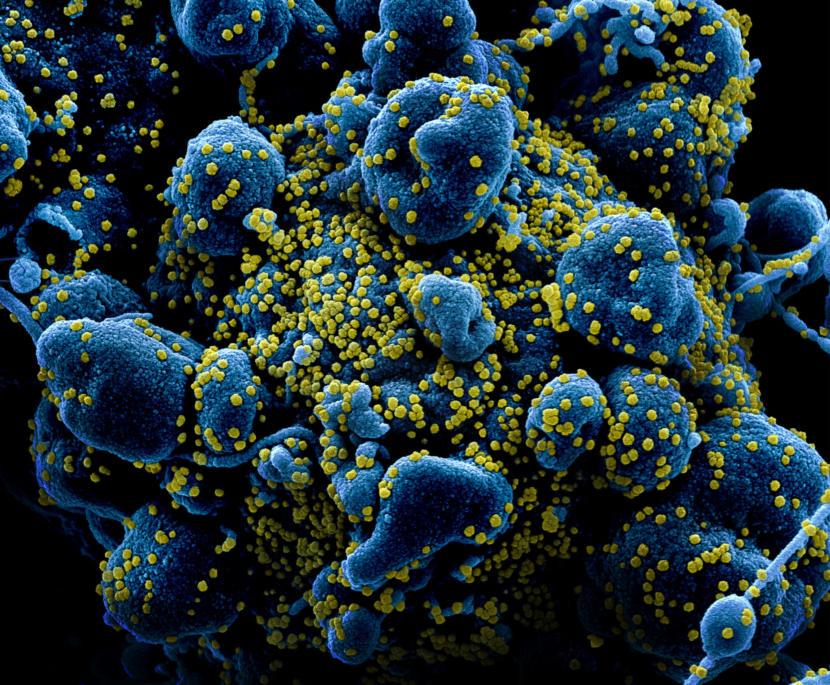
Colorized scanning electron micrograph of an apoptotic cell (blue) heavily infected with SARS-COV-2 virus particles (yellow), isolated from a patient sample. Image captured and color-enhanced at the NIAID Integrated Research Facility (IRF) in Fort Detrick, Maryland. (Photo courtesy NIAID)
Eleven more Alaskans were diagnosed with COVID-19 on Friday. The newly diagnosed Alaskans are nine people from Anchorage, and one each from the Matanuska Susitna Borough and Prince of Wales island.
A Sealaska corporate logo adorns the roof of the Southeast Alaska Native corporation’s headquarters in Juneau on May 2, 2018. (Photo by Jeremy Hsieh/KTOO)
Story updated Saturday, April 11 at 8:50 a.m.
Sealaska Corp. is pledging $1 million to communities of its 22,000 shareholders impacted by the COVID-19 pandemic.
CEO Anthony Mallott said the company has been in a good position to help their most vulnerable populations — especially Elders and youth — in Native villages and in areas with concentrations of shareholders, like Anchorage and Seattle.
“We know that a million dollars pales in comparison to the government stimulus,” said Mallott. “If we can help entities, first off, make sure they’re getting access to that government stimulus, and then use our million to offer it to areas that have unmet needs that the government stimulus doesn’t cover.”
The first round of relief will go to first responders and Native villages that were already impacted by recent ferry service delays.
Sealaska Board Chair Joe Nelson said the company will see if communities need more assistance after they get the relief.
“I’m sure we’ll assess the needs down the road here as things do evolve, because obviously there’s going to be lingering impacts and residual impacts and things that are just going to continue for quite a while here, as far as the economy and all these other issues,” said Nelson.
The first half of the money was expected to be dispersed starting Friday. The second half will be utilized to assist shareholder entities in the coming months.
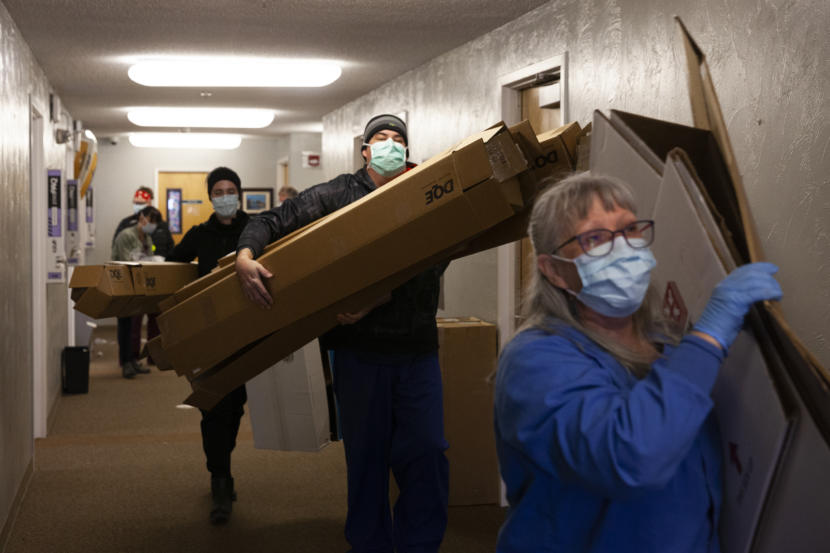
Hospital staff move equipment into the Rainforest Recovery Center on April 6. City officials converted the drug and alcohol rehabilitation center into an emergency spillover shelter for COVID-19 patients at Bartlett Regional Hospital. The shelter is designed to house patients who don’t need critical medical care. (Photo by Rashah McChesney/KTOO)
All patients in the residential substance abuse program at Juneau’s city-owned hospital were discharged last month.
According to Bartlett Regional Hospital Chief Behavioral Health Officer Bradley Grigg, Rainforest Recovery Center suspended inpatient operations in response to the COVID-19 pandemic.
Patients in recovery come from throughout Southeast Alaska and all over the state, making travel a concern as health restrictions tightened in March.
It took about two weeks to safely discharge the 11 patients they had at the time. Some went to live with family or in shelters, and a few were placed in temporary housing.
“We’re continuing to work with several of those individuals, both in Juneau and out of our region, for that matter, working with other providers for folks who are in temporary housing,” Grigg said.
Even though its doors are closed, Rainforest Recovery Center has expanded virtual services since patients left three weeks ago.
Grigg said the program has historically not had an outpatient program, but they now have 20 people receiving services remotely.
“It was not something we anticipated,” he said. “But we’re grateful that people are reaching out and are coming to us for help. And we’re going to be there for them.”
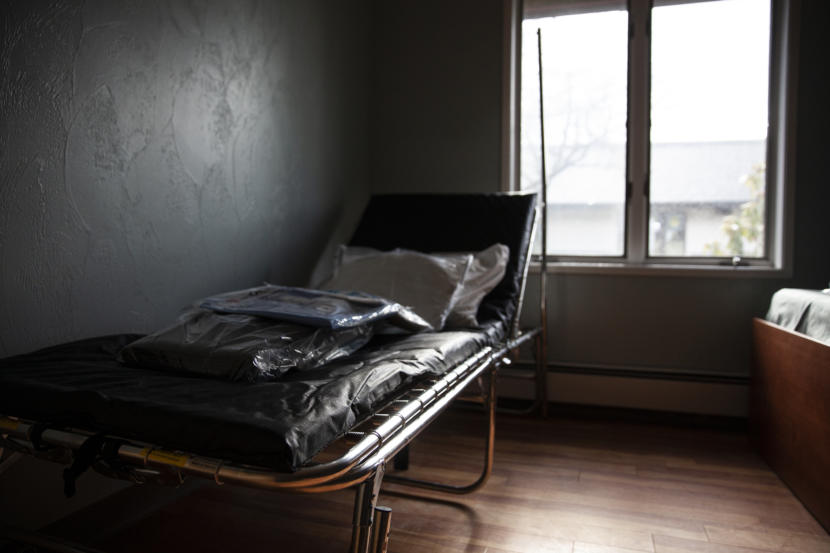
A cot inside of the Rainforest Recovery Center on April 7 in Juneau. City officials converted the drug and alcohol rehabilitation center into an emergency spillover shelter for COVID-19 patients at Bartlett Regional Hospital. The shelter is designed to house patients who don’t need critical medical care. (Photo by Rashah McChesney/KTOO)
Staff are conducting individual and group sessions with patients over the phone and via Skype and Zoom. And they’re looking for ways to make services accessible to those who may not have access to those technologies.
Grigg said they’re also trying to be flexible to patient’s needs.
“In a normal outpatient setting, we may only see them an hour a week, and in some of these cases we’re spending five to 10 hours a week with folks to make sure they’re OK, they’re sober, their needs are being met,” Grigg said.
The hospital has since converted Rainforest Recovery into an alternate care unit in case of a surge in COVID-19 cases. It has space for up to 35 patients.
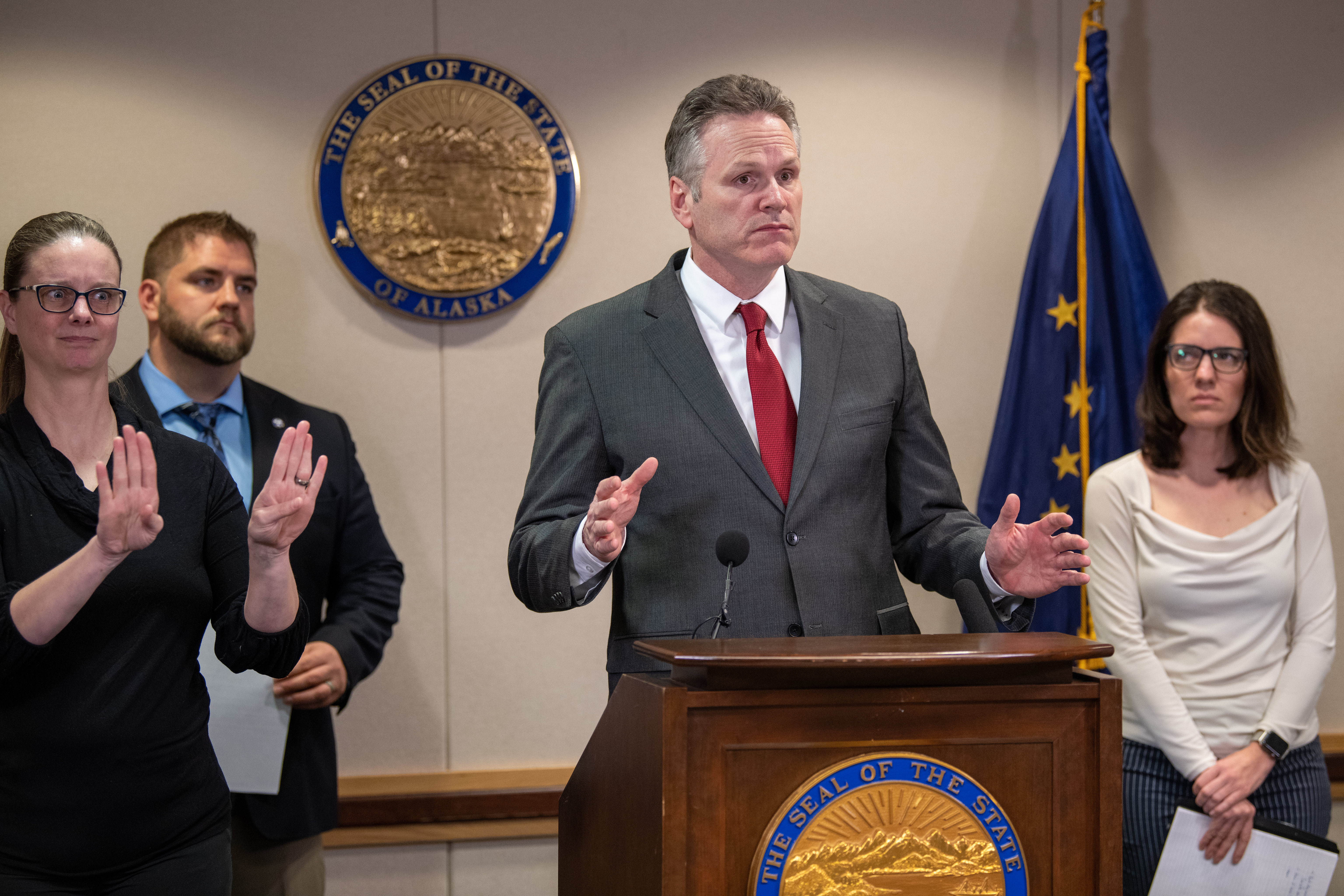
Gov. Mike Dunleavy speaks about the state’s COVID-19 response from the Atwood Building in Anchorage on March 20. Also pictured: Health and Social Services Commissioner Adam Crum, Chief Medical Officer Dr. Anne Zink and an unidentified sign language interpreter. (Creative Commons photo courtesy Alaska Governor’s Office)
Gov. Mike Dunleavy’s latest COVID-19 press conference is scheduled for 5 p.m.
The governor and Dr. Robert Onders of the Alaska Native Tribal Health Consortium will outline plans to treat rural Alaskans with coronavirus.
Typically in these briefings, Dunleavy, Chief Medical Officer Dr. Anne Zink and Health and Social Services Commissioner Adam Crum have shared updates on the number of people in the state with confirmed cases, announced public health mandates and explained the administration’s strategy and rationale.
The number of Alaskans who have recovered from the disease rose to 55, up from 49 on Wednesday. Of the 11 new cases, three are from the Municipality of Anchorage, four are from the Fairbanks North Star Borough, one is from the Kenai Peninsula Borough, two are from Matanuska-Susitna Borough and one is in Juneau.
More than 7,400 tests have been administered in the state.
Dunleavy’s administration has imposed 12 public health mandates that have reshaped daily life across Alaska to combat the spread of the virus. Those mandates and other Alaska-specific COVID-19 resources and information are available at coronavirus.alaska.gov.