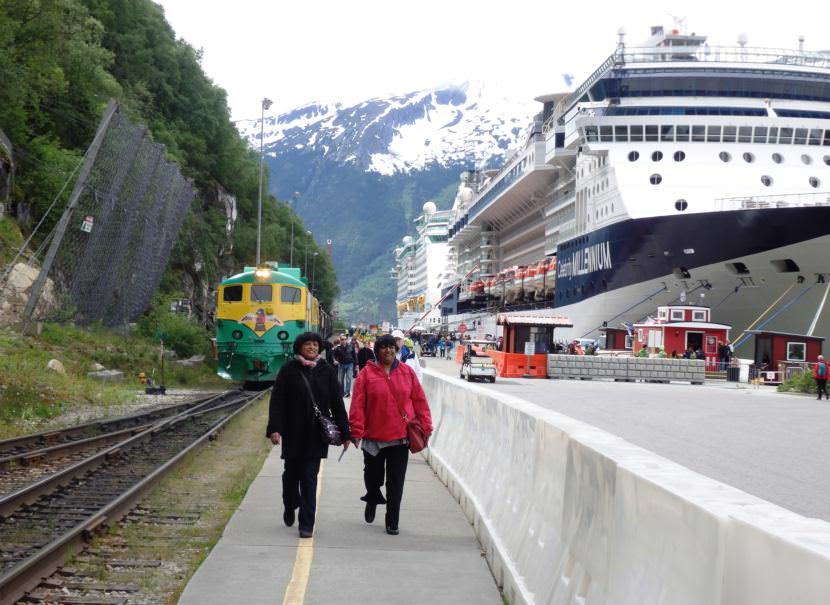
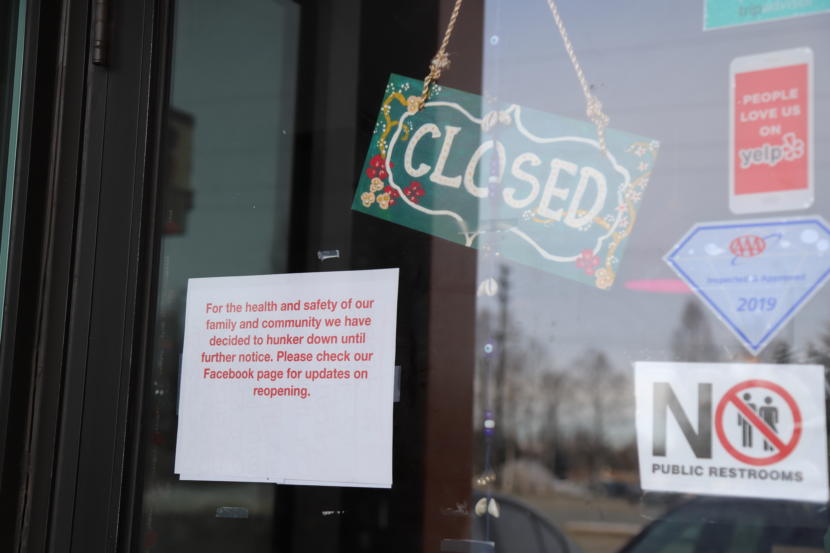
Hundreds of people stood in line to checkout in Costco on Tuesday, March 17, 2020, in Juneau, Alaska. (Photo by Rashah McChesney/KTOO)
The grocery delivery service Instacart has surged in popularity during the COVID-19 pandemic. Last week, Instacart shoppers across the country went on strike, demanding more safety protections and better pay.
Some longtime Instacart shoppers in Alaska agree with the strike. But others are happily filling orders at a time when jobs are scarce.
MJ Riemann’s family is taking Anchorage’s hunker down order really seriously, avoiding unnecessary trips to public places. Riemann is a small business owner and said a big medical bill could be “ruinous” for her family.
But they need to eat. So when Riemann realized she could get her groceries delivered through an app on her phone, she was intrigued.
“I can’t help but want to use the service,” said Riemann, “because I really don’t want anyone in my family going into public spaces right now. We’re being super careful.”
Riemann said she does feel conflicted about asking someone else to shop for her. She said she hopes the company is looking out for its shoppers.
Instacart has a lot of new customers like Riemann. According to the company, customers are ordering more groceries than ever through the app. And people are signing up to be paid shoppers in huge numbers, too.
People like Mike Volz.
“Right before it got nuts, I got on board,” said Volz. “And then it got crazy where — I mean every order you get hand sanitizer and toilet paper, or the shelves are bare of basic items like beans and rice. It got pretty crazy trying to go shopping for about a week and a half or so there.”
Volz, who worked for many years as a dental assistant, likes the flexibility of the job — he can choose which orders to accept, when he wants to work, and how often.
And, he said, he’s making some good money. Recently, Volz said he made more than $1,600 in one week, before taxes. He said there’s enough work that he could put in 12 hour days every day if he wanted to.
On March 30, when Instacart workers across the country went on strike, Volz kept working.
“I like working for a living,” said Volz. “People still need their groceries, and with everything going on, I’d rather go out myself and make sure they have what they need, versus more people being out in the public and putting themselves needlessly at risk.”
In a public post on March 27, the organization Gig Workers Collective called on Instacart to provide personal protective equipment and hazard pay. They also said Instacart should extend and expand sick pay for workers impacted by COVID-19.
Instacart has defended its policies in public posts, and in an emailed statement the company said its offering sick leave for shoppers diagnosed with COVID-19, or placed in mandatory quarantine. It also said shoppers can accrue sick pay, and they can earn bonuses for working right now.
Marie Johnston has been shopping for Instacart since it launched in Alaska in 2018, and she runs a Facebook group for workers. But a few weeks ago, she stopped taking orders.
She said as more people signed up to work for Instacart, she saw her pay go down. She said she supports the strike.
“Unfortunately there have been a lot of changes over the last few years with the way Instacart pays us,” said Johnston. “Because there are so many people that are available and wanting to get as much money as they possibly can, which is understandable with the current situation that we’re dealing with. They’re continuing to pay us less and less every single day.”
Johnston said she initially wasn’t worried about her own safety. But eventually, she became concerned about potential exposure to the virus at stores. Between that and the issue of lower pay, she said she decided it wasn’t worth it to keep working.
Amber McClelland is also a longtime shopper who recently called it quits for now. She said she worried about the cost and availability of the cleaning supplies she felt she needed to keep herself and her customers safe.
“So you have to have all of these extra costs and supplies,” said McClelland. “That’s a fear in itself: Am I going to run out of these things? Am I not going to be able to keep myself safe, keeping customers safe? With those supplies dwindling here in town, it is a scary thought. I’m going to run out of supplies to protect me and my family as well.”
Instacart said it’s taking steps to reduce contact between shoppers and customers and distributing hand sanitizer. Though Johnston said when she tried to request a bottle, it appeared to be out of stock.
On April 2, Instacart said it would go a step further and allow shoppers to order a free “health and safety kit.” The kit includes a face mask, hand sanitizer, and a thermometer.
The trans-Alaska Pipeline runs alongside the Dalton Highway near the Toolik Field Station on June 9, 2017, in the North Slope Borough. (Photo by Rashah McChesney/Alaska’s Energy Desk)
Updated story — April 10, 2020
Pick one: a pizza or a barrel of Alaska North Slope crude. For less than $20, you could have had either one Tuesday.
Prices have rebounded since then– sort of. Now you’d have to buy a pizza and a cheap six-pack before you got into the $25-ish range where Alaska North Slope Crude is hovering now. None of this is exactly ideal for Alaska’s bottom line.
What happened? The $18.21 price per barrel was a mistake. The Department of Revenue has revised it’s report and that price bumped up to $24. But state analysts are expecting prices to drop into the teens next week.
Dan Stickel, Alaska’s chief economist, says there are a few reasons why prices are so low right now.
The first is supply: There’s too much oil on the global market. Russia and Saudi Arabia stopped limiting their production and the price war between the two countries has triggered a major drop in the price of oil.
The second is demand: The COVID-19 pandemic has upended everything. In a time of social isolation and quarantine people just aren’t driving or flying as much as they used to. The U.S. Energy Information Administration reported this week that gasoline consumption could go down by 25% in the next few months. And that it could take 18 months for domestic fuel demand to return.
And, there’s another wrinkle in the supply chain: There’s less demand on the West Coast refineries that process Alaska’s oil. But even if they wanted to produce more, Stickel says they have other problems.
“We’ve heard of coronavirus infections in the refineries that are reducing their ability to work,” he said. “Everyone’s sick with coronavirus; you can’t refine oil.”
There’s another reason for that sudden price drop, but is a bit tricky to pin down because there aren’t a lot of details about exactly what happened.
There is no spot price for Alaska North Slope Crude. Instead, the daily prices are estimated by comparing it to these other types of crude.
“The way that the oil market works is there’s benchmark crude which are widely traded crudes with a known location and quantity and quality,” said Stickel.
West Texas Intermediate has been the most followed benchmark crude in the Americas for a long time. Another one is Brent Crude, which comes from the North Sea. The state compares Alaska’s crude to that one a lot because they’re similar types of crude and they’re transported the same way.
So when people buy and sell Alaska’s crude they do it against these benchmarks. And there are assessment services that monitor all of the transactions and then they publish estimates of the prices for some of the lesser traded crudes like Alaska’s.
What happened when we ended up at $18 per barrel is that someone, somewhere sold some Alaska North Slope Crude at a huge discount, dragging the price down.
But, we’ll probably never know who did that, or why. Stickel says that information is typically held pretty tightly.
What is clear is that there is a ton of volatility in the oil markets right now and because Alaska North Slope Crude prices are estimated this way, it’s getting harder for assessment services to figure out the clear value of Alaska’s oil. So, we can expect to see prices jump up and down for a while.
Original story — Published April 9, 2020
Alaska North Slope oil prices tumbled to $18.21 a barrel on Tuesday.
On Wednesday, economists at the state’s Department of Revenue were working to identify what drove the price down and what they could expect going forward.
Chief economist Dan Stickel says there are a few reasons why prices dropped that quickly.
First, there’s a glut of oil on the global market. Russia and Saudi Arabia stopped curtailing their production. The price war between the two countries has triggered a major drop in the price of oil. That glut also means that Alaska North Slope crude is seeing new competition in the West Coast markets it traditionally serves.
Second, the COVID-19 pandemic has caused a huge drop in demand. In a time of social isolation people just aren’t driving or flying as much as they used to. The U.S. Energy Information Administration put out a forecast on Wednesday that showed a 25% decline in motor fuel use in the first quarter of 2020. That decline is expected to continue.
Stickel says refineries on the West Coast are also producing less, in part because many refinery workers are sick with COVID-19.
He hopes this is a temporary drop and that prices will rebound to what the Department of Revenue forecast on Monday. But that report has oil prices expected to stay under $30 a barrel through June.
This is a developing story. Check back for updates.
Correction: A previous version of this story said oil prices tumbled on Monday — they fell to $18.21 on Tuesday.
A Ravn Alaska De Havilland airplane at Ted Stevens Anchorage International Airport. (Creative Commons photo by Sunnya343)
Alaska’s largest rural airline is $90 million in debt and could be forced to sell its assets and shut down permanently, putting rural travel and supply lines in peril unless the government or new investors come to the aid of the bankrupt company, according to documents filed in federal court.
As the coronavirus pandemic batters the aviation industry, the teetering RavnAir Group may have obtained a $12 million loan that leaves “some hope that there may still be a rescue,” Tobias Keller, a Ravn attorney, said Tuesday at a bankruptcy hearing in Delaware.
“Ravn is actively working with government officials to secure funding. And if funding were obtained, we may be able to come up with a restructuring,” Keller said. But without relief, he added, the loan will give Ravn a “brief runway” to prepare for an “orderly liquidation.”
The developments at Tuesday’s hearing raise new questions about the fate of Ravn, and about what might replace it in the more than 100 Alaska communities it served before the pandemic.
Ravn provided the only scheduled passenger service to more than 20 of its destinations, and dozens of its communities lack any road access. Its 72 planes are grounded, and its workforce of 1,300 has shrunk to 39.
The company is majority-owned by a pair of East Coast private equity companies and often criticized by customers and leaders in rural Alaska, who say Ravn was rarely responsive to local concerns. Officials with Ravn and the private equity companies, J.F. Lehman & Co. and W Capital Partners, did not respond to requests for comment.
Some of Ravn’s communities, meanwhile, are in limbo, sorting through immediate, serious problems as they wait to see if the company will resume service, or whether it will have to be replaced by other airlines.
On the Bering Sea island of St. Paul Thursday, for example, there was a woman pregnant with twins who needed to fly to the mainland. But the only way to Anchorage right now was chartering a plane at a cost of $9,000 or more, said Amos Philemonoff, the president of the local tribal government there.
“I think everybody’s feeling apprehensive without any air service out here, and apprehensive as well about what the future holds,” Philemonoff said. “All we’ve got is conjecture at this point. I don’t know what to believe at this point, without sitting in the bankruptcy proceedings.”
A ‘liquidity crisis’
At stake is a company with more than $200 million in annual revenue. Ravn’s bigger planes flew from Anchorage to a network of regional hubs, and then its smaller ones would fly from those hubs to remote villages. Destinations ranged from the North Slope to the Yukon-Kuskokwim Delta to the major Aleutian fishing port of Dutch Harbor.
The company’s statewide breadth offered customers the convenience of booking tickets on its different airlines through a single platform, and it also gave the company access to what appeared to be a diverse, resilient market: If demand dropped off in one region of the state, the company could count on others to sustain it.
But when the pandemic hit, Ravn’s reach became a vulnerability, as the spread of the disease prompted Gov. Mike Dunleavy to restrict travel across the entire state. Another issue was Ravn’s dependence on passenger service, which generates 54% of the company’s revenue, according to bankruptcy filings.
The coronavirus arrived at a time when Ravn was already vulnerable, according to filings: The company tends to run at a loss during the winter and spring, and strong financial performance in the summer and fall tourist season is “essential” to Ravn’s survival, Chief Financial Officer John Mannion said in a sworn statement.
As concern about the pandemic spread, bookings dropped sharply and rural hubs and villages started telling Ravn, along with other airlines, to stop carrying passengers in an effort to limit the spread of the coronavirus, Mannion said. By mid-March, the company faced a “liquidity crisis,” he added.
At the end of March, even after two rounds of layoffs and service cuts, the company didn’t have enough cash to make its payroll. It also couldn’t find investors, given reduced demand combined with uncertainty about when the pandemic would relent, Mannion said.
No government aid yet
Before filing for bankruptcy, the company spoke to “high-ranking representatives” of the state and federal government for help, Mannion said.
While Dunleavy administration officials had contact with Ravn, “the governor’s office can’t approve loans or offer any financing,” Jeff Turner, a spokesperson for the governor, wrote in an email.
Turner said Ravn, like any other business, would have to approach the state’s economic development agency, the Alaska Industrial Development and Export Authority, for financing. AIDEA spokesperson Karsten Rodvik said the authority has not received a formal application or request from Ravn.
At the federal level, grants under the recently passed relief bill, the $2 trillion CARES Act, can only go toward paying workers — not to pay down the company’s debt. For that reason, Ravn had initially appeared uninterested in seeking such grants, according to U.S. Sen. Dan Sullivan.
“At the end of the day, the investors and bank syndicate and private equity group that ultimately owned Ravn didn’t seem to want any additional help,” Sullivan told participants in an online Alaska Chamber conference last week. “That might be a lesson for all of us Alaskans: Don’t count on the Wall Street guys to look out for our concerns.”
Ravn ultimately did apply for CARES Act relief last week. It also held an hour-long phone call late last month with aides to Alaska’s Congressional delegation and representatives from the U.S. Department of the Treasury, according to a letter by the delegation to Treasury Secretary Steven Mnuchin.
But it’s uncertain when Ravn’s federal aid applications could be granted or how soon money could be released, Mannion, Ravn’s chief financial officer, said in his statement.
A spokesperson for Sullivan, Mike Anderson, said in an email that the senator and his staff have worked “relentlessly” to make sure Ravn and other Alaska airlines can take advantage of the federal assistance to pay employees.
“His primary concerns are that rural Alaska is provided necessary services, and that Alaskans keep their jobs,” Anderson said. “He continues to hope that during this national crisis, Ravn is able to find a way to rehire the Alaskan employees and serve Alaskans who most need their services.”
Lenders wanted liquidation
By the time the pandemic arrived, Ravn had borrowed $91 million from its group of unnamed lenders, according to the company’s bankruptcy filings. That debt is looming over the bankruptcy proceedings, where many of the lenders think they would be better off if Ravn’s assets were sold immediately, David Neier, an attorney for the lenders, said at Tuesday’s hearing.
That’s in part because Ravn’s property that can be sold to pay back the $90 million is only worth about one-third of that amount, Neier said.
Adding another $12 million loan on top of that — which the judge authorized at Tuesday’s hearing — “was extremely difficult and extremely contested” among the lenders, Neier added. The lenders were troubled by the fact that half of the money was going toward paying wages that had already been earned by Ravn employees’, rather than protecting the value of Ravn’s assets that could be sold to pay down the company’s $90 million debt, Neier said.
While the bankruptcy buys Ravn time to plan its next steps, even that process is being complicated by the pandemic itself: Two people working with the company can’t get to Alaska because the state requires travelers to quarantine themselves for two weeks after arriving, Neier said.
“There’s very little information that’s been able to get collected,” he added.
As the bankruptcy case plays out, state and federal officials say they’re committed to restoring flights to the places that have lost them. In the Yukon-Kuskokwim Delta, remaining air carriers have been working to replace Ravn’s service, but that’s had the effect of reducing flights in other communities that weren’t immediately impacted by the company’s shutdown, Tiffany Zulkosky, a spokesperson for Yukon-Kuskokwim Health Corp., said in an email.
It could take weeks or a month for other airlines to add the planes and pilots needed to keep up with demand, she added. In the mean time, YKHC has chartered flights to move patients and supplies, though that option is “cost-prohibitive and not a long-term solution,” Zulkosky said.
In the long run, residents of communities served by Ravn should expect service to return — whether it’s provided by Ravn or a successor company, said Danny Seybert, who used to run PenAir, one of Ravn’s airlines, before PenAir went through its own bankruptcy. The aviation industry is defined by turmoil, Seybert added.
“Alaska is littered with failed airlines. And for every failed airline that goes away, somebody else steps up and starts another,” he said. “In every single case, the market comes back with people who step in and step up and take care of the markets — some sooner than others.”
Tourists walk on Skagway’s railroad dock in summer of 2016. The cliff, where a rockslide occurred Aug. 26, is adjacent to Skagway’s biggest cruise ship dock. (Photo by Emily Files/KHNS)
Despite a federal “no sail” order, Carnival Cruise Line is offering a 7-day sailing through Southeast Alaska in early July. That was news to Skagway Mayor Andrew Cremata, whose small town is virtually shut down in hopes of avoiding a spike in coronavirus cases.
“I would hope that Carnival Cruise Lines reaches out to us in this community before they set sail,” Cremata said.
There aren’t any confirmed COVID-19 cases in Skagway and the town wants to keep it that way. Skagway’s health clinic has two ventilators. There’s no hospital. But the remote community’s economy is based on cruise tourism and it planned for an all-time high in cruise ship visitors this year. So did Juneau and Ketchikan, the other Alaska ports on the itinerary.
“We want cruise ships to come here,” Cremata said. “We want the passengers to come here we need them to, but we also want good partners. And we want to work with people and cruise ship companies that respect the people in this community and, above all else, respect their health.”
So far cruise season in Alaska has been on hold. Coronavirus fears have closed ports up and down the Pacific. The Centers for Disease Control and Prevention (CDC) recommends Americans avoid cruise ship travel because risk of disease transmission is higher on board the ships. On Thursday, CDC issued a 100-day extension to its March “no sail” order for cruise ships.
It’s not just Carnival. Other lines, like Norwegian Cruise Lines and Royal Caribbean are also taking bookings for a cruise season that Southeast Alaska communities aren’t even sure will happen.
Juneau City Manager Rorie Watt said Carnival’s port call in Juneau is far from a sure thing.
“I would say that we would say that it’s speculative at this time,” he said. “We have not taken up the question of how or when we’ll be ready for ships to come.”
Watt thinks it’s likely the cruise line is taking the temperature of the market. He said Juneau has not yet decided on future community protocols for any cruise ships.
It’s unclear how many people have booked Carnival’s trip, but the company’s website shows up to 50 people eyeing the sailing at a time.
Mike Tibbles, the industry’s spokesperson in Alaska, said he can’t speak for individual lines, but until a cruise line announces a cancellation, that trip would still be open for booking.
If the season is on hold until mid-July, Tibbles said it will affect hundreds of sailings and cost Alaska communities $428 million in direct passenger spending.
The CDC could roll back the hundred day extension if the agency sees fit or the federal emergency declaration is lifted, but that wouldn’t really change things for Alaska’s cruise season as Canada’s ports are still closed through July 1.
Coast Alaska’s Jacob Resneck contributed to this story.
Businesses all over Alaska have been shuttered due to the COVID-19 pandemic. (Photo courtesy Hannah Lies/Alaska Public Media)
Alaska’s chief medical officer said that when it comes to loosening restrictions in the state, much depends on learning who has the coronavirus.
“When we’re thinking of, ‘how do we open things back up,’ testing is a key component of that, and so making sure that we’re testing broadly around the state is really, really important to do,” said Dr. Anne Zink.
The state has started publicly providing information on how many people in each borough or area have been tested. The percentage of residents tested ranges from a low of .07 percent in Aleutians East Borough to 1.71 percent in Fairbanks North Star Borough.
Zink said it’s important to test in different geographic areas to understand where the state should be devoting supplies and attention.
“If we don’t know that it’s there, it’s hard for us to know how much personal protective gear that we need; how many hospital beds we need; are the social mitigation strategies that you all are doing and all this time and effort really helping. And the data that we’re showing looks like it’s really making a gigantic difference.”
Zink said one measure of whether the state is doing enough testing is whether the percentage of tests that come back positive is low. Alaska has had a relatively low percentage compared with other states. But that number has been rising in recent days, which Zink said she’s concerned about. Through Wednesday, 3.2 percent of the more than 7,200 tests done in the state have been positive.
Zink said the state can lower that percentage by practicing social distancing and hand washing. She also said that investigating each case to learn who people who test positive for the virus have had close contact with is important.
As part of the effort to broaden testing, the state has expanded the symptoms in the guidelines for who should be testing, while leaving the decision to test up to providers. Alaskans could be tested if they have two or more of the following new symptoms: chills; diminished sense of taste or smell; diarrhea; fatigue; fever; headache; muscle or joint aches; nausea; shaking; runny nose; sore throat; or sputum (mucus) production.
Zink said that the more public health workers investigate cases, the more they’re amazed at how mild the symptoms can be.
Even though the state is expanding testing criteria — Zink said testing supplies remain tight.
Gov. Mike Dunleavy said state officials will discuss ideas next week about how to get society and businesses in Alaska up and running again. He said the goal will be to give Alaskans genuine hope. He said the approach will be led by the state’s medical team.
“We all know that we cannot continue to live like this — nobody wants to live like this,” Dunleavy said.
Corrections officers wait outside of a cell during a weekly inspection at the Lemon Creek Correctional Center in Juneau on June 18, 2016, in Juneau. (Photo by Rashah McChesney/KTOO)
A staff member of Juneau’s Lemon Creek Correctional Center has tested positive for COVID-19.
In mid-March, Lemon Creek had about 248 prisoners and 76 staff. In an evening media release, the state’s Department of Corrections says this is the first person working for the department who has tested positive for the virus.
Staff at the jail told inmates they had been exposed late Thursday.
Lemon Creek Correctional Center staff implemented a response plan and “took swift action to protect the health and welfare of inmates and staff at the facility.”
However, it’s not clear what that action is — no one from the jail, or the Department of Corrections answered afternoon and evening emails or phone calls seeking clarification on what specific actions they took to protect inmates, whether masks and gloves are available for inmates and staff, and whether inmates have the ability to socially isolate from one another.
There have been restrictions in place at corrections facilities statewide due to the pandemic — visitors haven’t been allowed in almost a month. And, they’ve waived copays for prison-based health services. In late-March all facilities started screening employees and contractors for fever at the start of each shift.
And, people at Department of Corrections facilities statewide — including at Lemon Creek — have begun sewing cloth face coverings for staff and inmate use.
According to state testing data, 17 inmates had been tested for COVID-19 as of yesterday. Of those, 11 tests were negative and 6 are still pending.
Alaska has more than 4,700 inmates statewide.
Close
Update notification options
Subscribe to notifications
Subscribe
Get notifications about news related to the topics you care about. You can unsubscribe anytime.