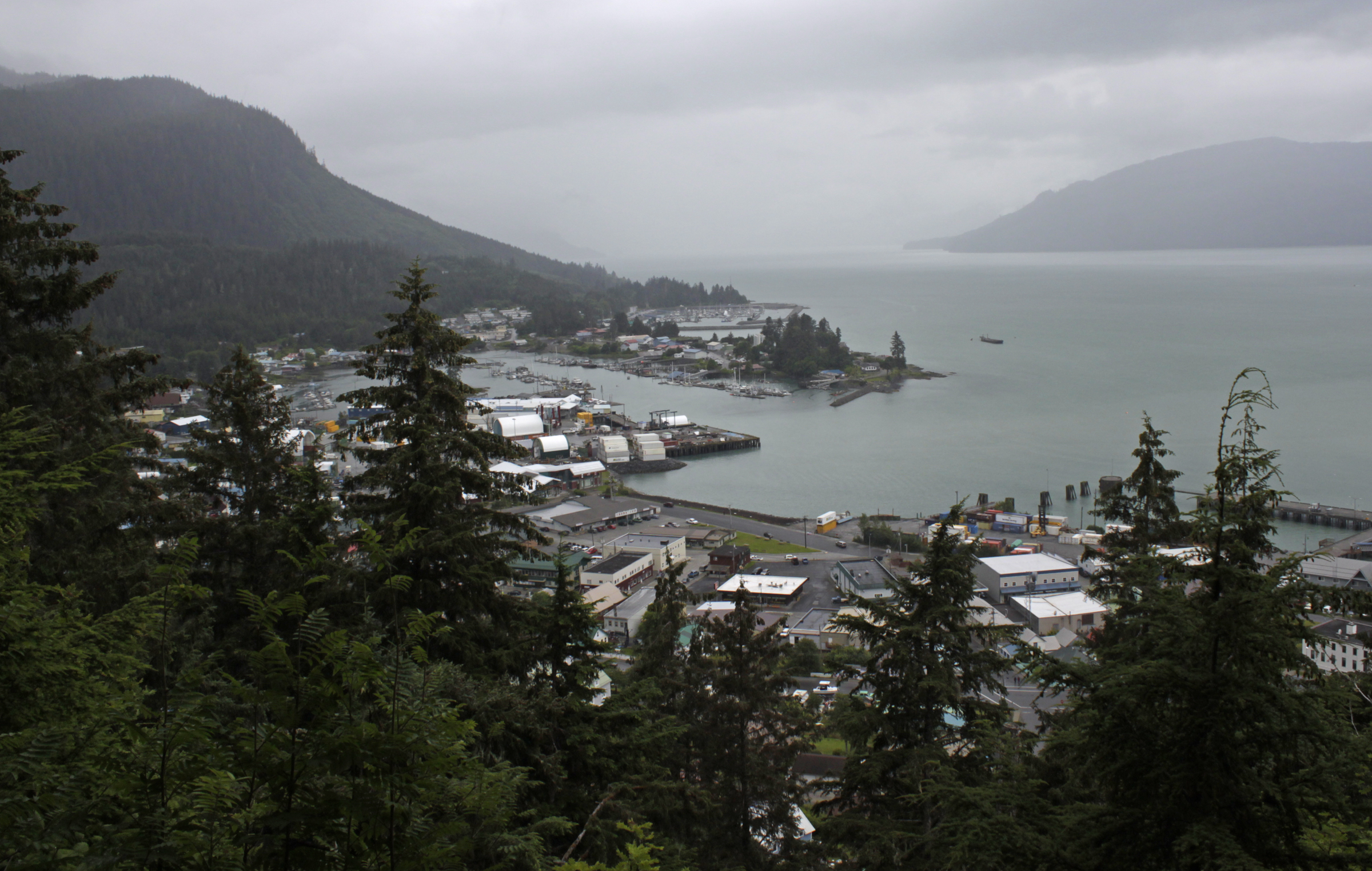
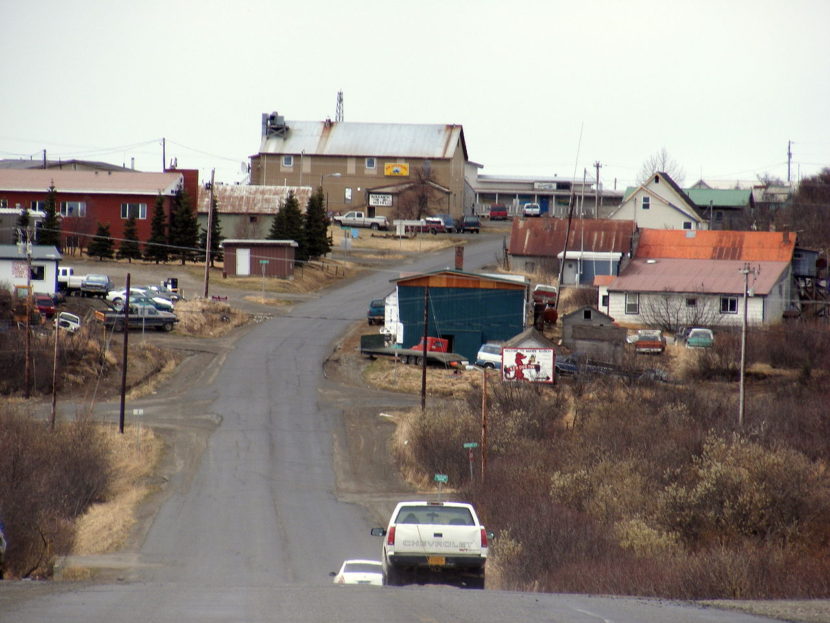
Wrangell as seen from Mount Dewey on July 24, 2014. (Creative Commons photo by James Brooks)
Wrangell’s proposed restrictions on people arriving at the island community have been shelved after the state said the Southeast city doesn’t have the authority. City leaders had wanted to coordinate the flow of commercial fishermen and fish plant workers expected to arrive for the season.
A state health mandate restricts all nonessential travel except to workers in critical industries. That mandate supersedes local restrictions. But it allows smaller, isolated towns with limited health care facilities to add restrictions to ward against an outbreak of COVID-19.
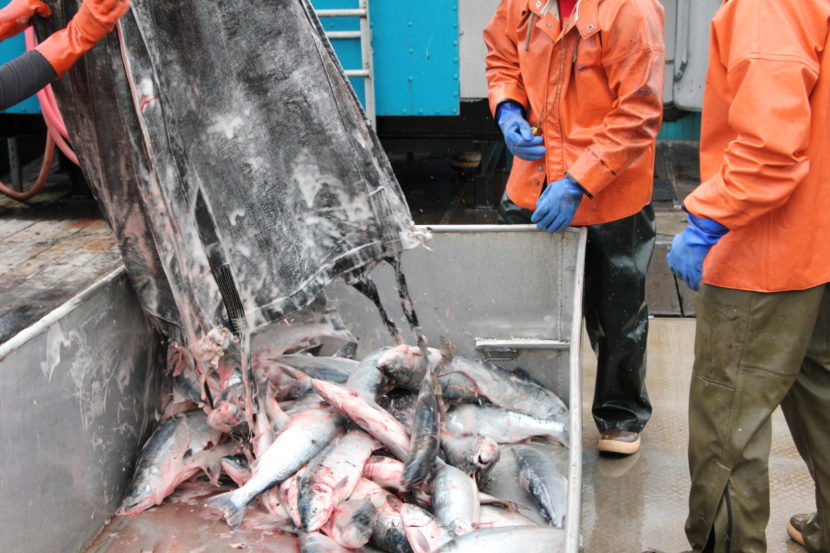
In Wrangell, commercial salmon fishing gets going in mid-June. Around that time more than 30 seasonal fish plant workers from out-of-state work in Wrangell’s sole fish processor. The plant manager says the workers will self-quarantine for 14 days before coming into town.
Elected officials wanted copies of mitigation plans that employers in critical industries – skippers and processors – have filed with the state to secure exemptions to travel restrictions. So far state public officials haven’t shared these plans with local authorities.
That doesn’t sit well with assembly member David Powell. He says a few infected people arriving in Wrangell could snowball.
“And then all of a sudden we could have 10 to 20 cases in here because we didn’t do something,” Powell says.
He wants to see these local mandates in place as soon as possible. But the city recently got word from the state that it lacks the authority to make its own rules.
On Wednesday, an email arrived from the state’s unified command stating that Wrangell Medical Center qualifies as a “hub” hospital as defined in the health mandate.
That frustrated Wrangell Mayor Steve Prysunka. Wrangell’s hospital is run by the tribal health organization SEARHC – whose regional hub hospital for COVID-19 cases is Mt. Edgecumbe Medical Center in Sitka.
But the mayor says — in the state’s eyes at least — his island town of 2,400 people is not a “small community” since it has a hub hospital.
“We just don’t meet that, and it doesn’t matter what SEARHC thinks it is, all that matters is what the state says it is,” Prysunka says.
The measure ultimately failed 5-2. The assembly did not want to move forward and risk legal action from the state or industries down the line. But Powell was among those that wanted to keep pushing.
“I still feel that this is still critical to the safety of our community and that there is no reason why we would not take action,” he says.
The Alaska Journal of Commerce reported this month that Cordova enacted restrictions similar to what Wrangell had proposed. And the two are very similar communities. Both are off the road system, have fewer than 3,000 residents and have health care facilities categorized as “critical access hospitals,” which the state classifies as hub hospitals.
The seafood industry has been watching this unfold in a number of fishing towns across Alaska.
United Fishermen of Alaska Executive Director Frances Leach says the industry isn’t taking its exemptions for granted. The fishing fleet is working to take steps to minimize any health risks.
“We respect and appreciate the communities for hosting us every summer, and we’re working diligently on letting the communities know it is a concern,” Leach says.
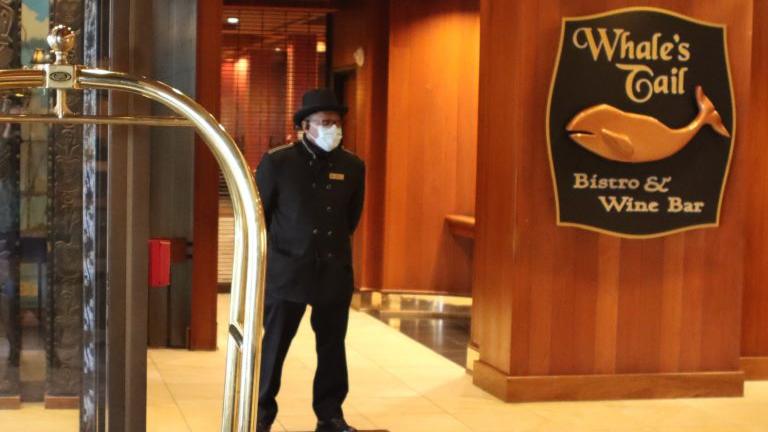
Mike Davis, a doorman, works in an empty lobby at the Hotel Captain Cook on Friday. (Tegan Hanlon/Alaska Public Media)
At the Hotel Captain Cook in Anchorage, demand collapsed quickly over the past month.
“One minute we have a hotel that has a lot of staff in it and restaurants that are open and the feel-good buzzing noise going on,” said Raquel Edelen, vice president of operations at the Captain Cook. “And now we’re a hotel that is quiet.”
As the coronavirus continues its unrelenting spread, halting most travel, hotels across the globe are feeling the strain. In Anchorage, it’s no different. To keep their doors open, some hotels say they’re shifting their business model — transforming from tourist havens to quarantine sites.
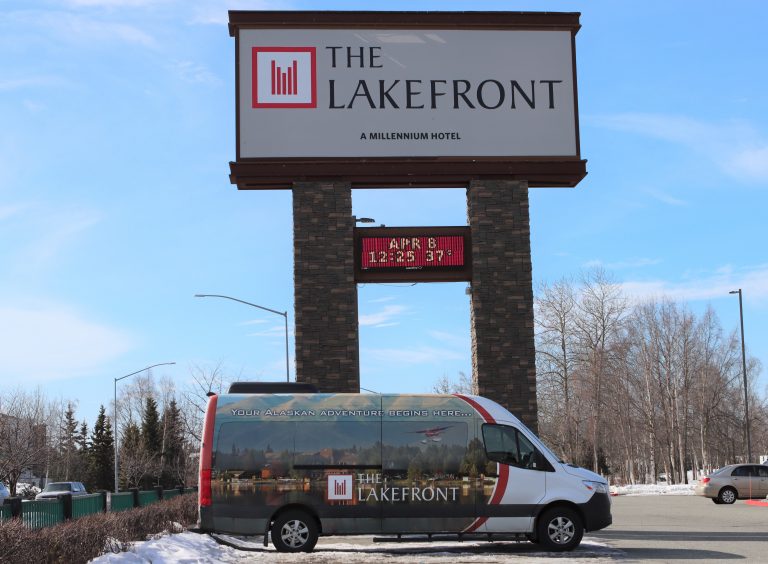
“The quarantine business is sustaining us, albeit at much lower rates, but it’s a business that we think is vital to the essential services provided in the state,” said Greg Beltz, general manager at The Lakefront Anchorage hotel near the city’s major airport.
At the Captain Cook, The Lakefront and other hotels, the global pandemic has also meant fewer guests, quiet lobbies and massive layoffs at a time when the businesses would normally be ramping up for a busy summer tourist season.
“We’re working every day trying to figure out how we can keep another housekeeper working or keep a server working,” Edelen said.
The Hotel Captain Cook in downtown Anchorage. (Tegan Hanlon/Alaska Public Media)
The Captain Cook is a 546-room landmark in downtown Anchorage that also has several restaurants, bars and gyms. But those were shut down, or limited to take-out last month as government mandates tumbled out in response to the pandemic.
“It’s a huge impact,” Edelen said.
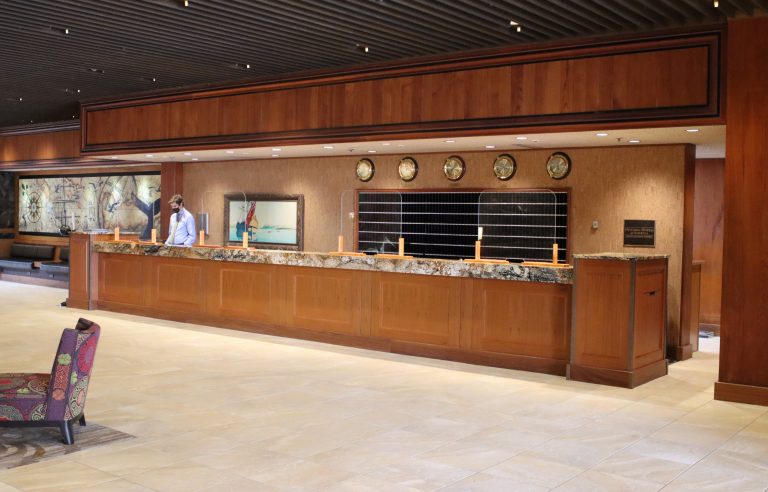
The hotel laid off roughly two-thirds of its staff, shrinking to under 100 employees. On a recent weekday morning, the hotel’s spacious lobby was nearly empty, the remaining employees wearing face masks.
Ryan Marcey, a front desk clerk, works in a quiet lobby at the Hotel Captain Cook on Friday. (Tegan Hanlon/Alaska Public Media)
Instead of tourists, the hotel is now mostly serving three groups: Airline crews, oil employees and Anchorage workers, including those in health care, who are choosing to distance themselves from family.
“Alaska Airlines, FedEx, ConocoPhillips, we’re grateful for them,” Edelen said.
The hotel is housing the Conoco workers in a separate tower, she said. The governor mandated that people arriving in Alaska quarantine themselves for two weeks, and Conoco is having its out-of-state workers stay at the Captain Cook before flying to the North Slope oil fields.
The hotel has also created a new “sanitation squad” — a team of housekeepers charged with deep cleaning the hotel, from its walls to its elevator buttons to its railings.
“We’re cleaning all of our public bathrooms, I mean, three times an hour to make sure that people know that those things are clean constantly,” Edelen said.
Fletcher’s, one of the restaurants at the Hotel Captain Cook in Anchorage, is closed to dine-in service but continues to offer take-out. (Tegan Hanlon/Alaska Public Media)
Similar practices are going on at hotels across the city, said Alicia Maltby, president and chief executive of the Alaska Hotel and Lodging Association.
Housekeepers are leaving fresh sheets and towels outside of hotel rooms, instead of going inside. They’re wearing face masks and gloves. If they can, they’re waiting at least three days to clean the rooms after guests leave. Some hotels are also locking their lobby doors, so the public can’t just walk in.
“It’s a whole change in the game of how they are servicing rooms and doing checkouts and what the check-in process looks like and the security of the hotel properties,” Maltby said.
Anchorage hotels may be hovering around 30% occupancy on average, Maltby said, though she described that as a generous estimate. Meanwhile, a few hotels have decided to temporarily close, including the Westmark downtown.
“This pandemic is going to affect the industry worse than 9/11 and the 2008-2009 recession combined,” Maltby said.
The Westmark Anchorage has closed temporarily during the coronavirus pandemic. (Tegan Hanlon/Alaska Public Media)
State economists expect the impact to only grow as hotels don’t hire like they normally would for summer tourism.
“There won’t be the job gains that we typically have,” said Neal Fried, an economist with the Alaska Department of Labor and Workforce Development.
Last April, Anchorage hotels employed about 3,400 workers, with that number rising to nearly 4,000 by August, Fried said. The state, as of Thursday, did not yet have data on how many total hotel jobs were eliminated in recent weeks.
Neither did Marvin Jones, the president of UNITE HERE Local 878, a union that represents Alaska hospitality workers. Over the past few weeks, Jones said, he’s received dozens of phone calls from members who were suddenly laid off as the pandemic crushed business.
“I do have a rough time sleeping at night, because I know what I’m dealing with during the day,” he said. “And my phone starts early in the morning and it continues to late at night.”
In his 30 years in the industry, Jones said, “I have not seen anything that even comes close to what we’re dealing with right now.”
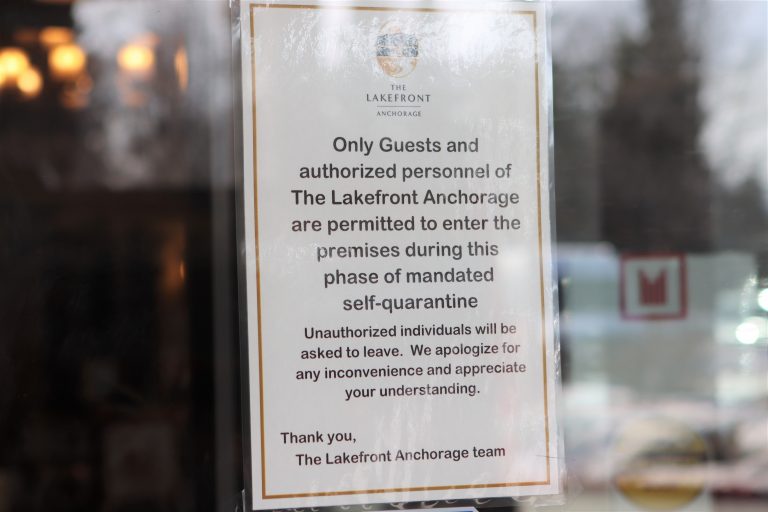
A sign at The Lakefront Anchorage alerts the public that only guests and authorized personnel can enter the building. (Tegan Hanlon/Alaska Public Media)
Instead of hiring, The Lakefront Anchorage has laid off about 70% of its staff, and it’s down to around 40 employees, said Beltz, the general manager.
“We’re not seeing any tourism-related travelers, people that are sightseeing, for obvious reasons — everybody’s hunkered down,” he said.
The number of rooms filled at The Lakefront depends on who’s quarantining, he said.
Keith Osowski wasn’t quarantining yet, but he recently stayed at The Lakefront after flying into Anchorage from South Dakota, where he goes to college. His classes were all moved online.
Osowski said he had just one night in the city before going home to Kodiak, and he didn’t want to stay at his brother’s apartment, worried he could be carrying the virus. So he went to The Lakefront, where he hardly saw anyone.
“It was just the person sitting at the counter, and it just seemed kind of dead,” Osowski said.
The Lakefront Anchorage photographed on Wednesday. (Tegan Hanlon/Alaska Public Media)
Beltz said he’s trying to remain positive despite the quiet hotel. But he can’t help thinking about how long it will take for business to rebound.
“The main thing that’s going through my head, you know, is what’s to come?” he said. “When are we going to see tourism have some type of bounce back?”
Reach reporter Tegan Hanlon at thanlon@alaskapublic.org or 907-550-8447.
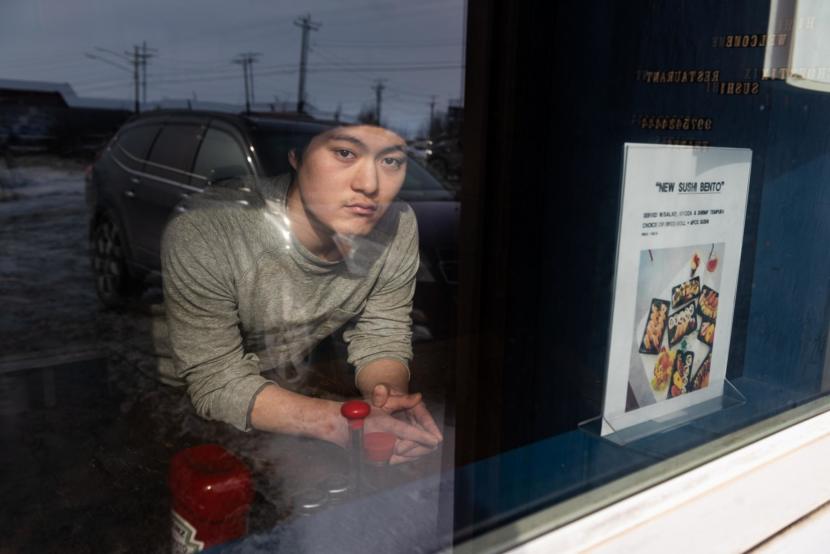
Alex Kim, owner of Chopstix Sushi Restaurant, says he may have to return to Korea if business doesn’t pick-up. Bethel restaurants are in peril following mandates that restrict business to delivery and pick-up orders amidst the COVID-19 outbreak. March 31 in Bethel. (Photo by Katie Basile/KYUK)
Restaurants all over the nation are being ordered to close their doors to avoid spreading the coronavirus, and it’s no different in Bethel.
Limited to delivery and takeout, Bethel restaurants report that their sales are a fraction of what they are normally. Many Bethel restaurant owners are from Korea, and some say that they are considering returning to their home country, where the COVID-19 outbreak now seems to be on the decline.
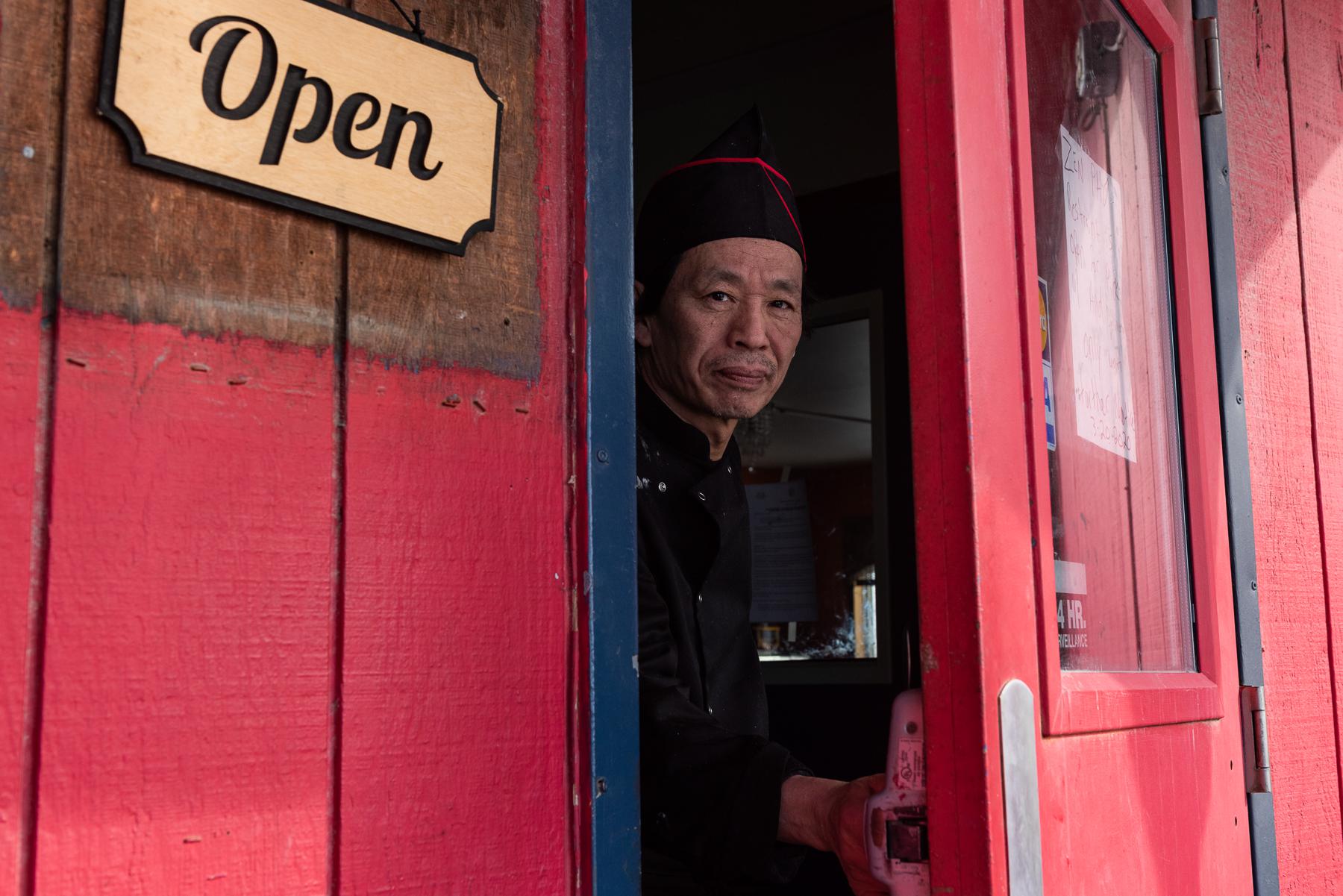
“It’s really bad, almost shut down,” said Thae “TJ” Jeoun, owner of Zen Restaurant on Tundra Street. He says that ever since his restaurant was restricted to just delivery and pickup, sales have been around 30% of what they normally are. Jeoun adjusted his employees’ schedules, full time workers have become half-time, but he says that at this rate, he’ll have to lay off workers soon.
“Because the water bill, the electric bill is all the same,” Jeoun said.
Since closing Zen Pho Restaurant to dine-in eating, owner Thae “TJ” Jeoun says his sales are 30% of what they would normally be. March 31 in Bethel. (Photo by Katie Basile/KYUK)
Chopstix Sushi Restaurant has already laid off most of its staff. Owner Alex Kim says that what is usually a five-man operation has been reduced to just him and his dad, and they’re still mostly waiting around. The other day, the restaurant received five orders total. He says that if he gets one customer every hour, that’s good for now.
An added challenge for Kim last week was feeling like he couldn’t wear a mask to protect himself from the coronavirus. In Korea, where he’s from, he says that it’s normal for healthy people to wear masks. But in Bethel, he worried that his few remaining customers would think that he was sick and be scared off. Unable to wear a mask and facing a reduction in business, Kim said that it was a difficult time for him.
In just the past few days, though, Kim said that Bethel’s attitude toward wearing masks has become more accepting as the coronavirus threat in Alaska has grown. Still, if business remains the same for two more weeks, Alex says that he’ll have to close his doors and go back to family in Atlanta or even Korea, now that the coronavirus outbreak in the country seems to be dying down.
Hae Sook Min, owner of Bethel Airport Restaurant, said that it was just a few weeks ago when she was the one calling her family in Korea every day, asking if they were okay. Now, she says it’s reversed. Her family has been calling her as the number of COVID-19 cases in the U.S. has soared.
Min says that she doesn’t know why her restaurant is still open. Orders are less than a quarter of what they are normally. Her workers still come to work, and that’s why she says that she’s still opening the doors. She has already had to lay off two employees.
Min says that she wants to think positively. If her restaurant can just make it until June or July, she thinks they’ll be all right.
Colorized scanning electron micrograph of an apoptotic cell (blue) heavily infected with SARS-COV-2 virus particles (yellow), isolated from a patient sample. Image captured and color-enhanced at the NIAID Integrated Research Facility (IRF) in Fort Detrick, Maryland. Credit: NIAID https://www.flickr.com/photos/niaid/49680384281/
Another 15 people tested positive for COVID-19 on Saturday, bringing the cumulative case count for the state up to 272.
At least five of the new cases were reported in the Anchorage area and three in the Mat-Su Valley — the highest single-day case count for the Mat-Su Valley to date.
Two more cases were reported in the Fairbanks area, and one case was reported in both the Juneau and Ketchikan boroughs.
The remaining three cases have not yet been included in the health department’s updates. No new deaths were reported on Saturday.
Nationwide, the United States passed Italy as the country with the highest number of deaths linked to the coronavirus on Saturday
A westward view of downtown Naknek in the summer. (Creative Commons photo by Todd Arlo)
The Naknek Native Village Council, the South Naknek Village Council, and the King Salmon Tribe have joined Dillingham city and tribe in a call for the governor to put extreme protective measures in place or consider closing the world’s most valuable and productive sockeye salmon fishery.
“The Tribal Organizations of Naknek, King Salmon, and South Naknek, consider this pandemic to be of utmost importance. Our people, and our culture are at risk,” the tribes said, adding that they are prepared to take more stringent measures.
Naknek and King Salmon are on the same road system, on the east side of Bristol Bay, with an off-season population of under a thousand residents. Dillingham is to the west, with a population of around 2,300 and a small 16-bed hospital — the only one in the region.
During the summer, processors bring in thousands of employees; thousands of independent fishermen come to the region as well.
In the letters, the groups pointed out that there is no hospital in the Bristol Bay Borough, and extremely limited medical resources and infrastructure. Moving forward with the fishing season goes against all guidance on how to prevent an outbreak.
Lorianne Rawson, the tribal administrator for South Naknek, said that most of the village’s residents are elderly or immunocompromised, and that they needed to protect those people. The community also had historical experience with this, she said. Her own grandfather survived the flu pandemic of 1919.
“When the Spanish flu arrived, it decimated the village, and the remaining survivors then moved to South Naknek. Historically, it has wiped out our people, and we just don’t want it to happen again,” she said.
Rawson is also concerned about the fishermen coming into the region, saying that plans to quarantine in boats weren’t realistic.
“Their boats are in boat yards. Their boats don’t have a bathroom. They have no way to shower, they can’t do laundry, and they can’t go to the store to get their food. So how are they going to effectively quarantine on their boats? That’s not going to happen,” she said.
The Naknek council said much the same in its letter, writing, “There is no way to prevent a potential mass disease situation when processors employ several thousand people, working in close proximity, living in bunk houses, confined to closed campus-style operations. We must consider that a potential mass-outbreak would be disastrous.”
The King Salmon Tribe said that the Bristol Bay Borough is unequipped for a pandemic of this proportion, and calling the borough’s quarantine plan “inadequate.” Joni O’Domin is an administrative assistant for the tribe.
“Our health care system here is way too small. We have to go through Kanakanak or Camai, and they have a two bed emergency room, down at Camai, or trauma room. And it’s just too small here,” she said.
The Bristol Bay Borough Assembly passed an ordinance this week mandating a 14-day self-quarantine for anyone traveling into King Salmon and Naknek, and granting the borough police the authority to enforce it, as well as the six-foot social distancing mandate.
Curyung Tribal Council Second Chief Gayla Hoseth in Dillingham said that the processors’ plans don’t adequately address how they would handle an outbreak.
“That needs to be shown to all the communities before they even come into the area, of what their plan of action is going to be if somebody gets sick. And where are they going to receive their health care, and what is going to be the plan for health care for them,” she said
Sockeye salmon delivered in Bristol Bay. (File photo courtesy KDLG)
Meanwhile, the big processors gearing up to operate in Bristol Bay’s salmon fishery this summer have laid out aspects of their safety protocols that they say will allow them to participate safely in the upcoming season amid the coronavirus pandemic.
“We are writing to you to confirm our commitment that we are prioritizing the health and safety of the communities and tribal councils of Bristol Bay,” they wrote in a letter to the region’s communities.
The eleven companies are:
North Pacific Seafoods
Alaska General Seafoods
Trident Seafoods
Peter Pan Seafoods
Silver Bay Seafoods
Icicle Seafoods
Ocean Beauty Seafoods
E&E Foods
Leader Creek Fisheries
Deep Sea Fisheries
Copper River Seafoods.
“Honestly, we’re not yet sure how this is all going to shake out,” said Chris Pugmire, the general manager of Icicle Seafoods. He said that the company understands the communities’ position, and that they are in talks with local leaders.
“Our plan is to continue preparing for the season as if it is going to happen, and in so doing, we are and will continue to work with the communities to ensure that every reasonable precaution is being take to protect the health, safety and wellbeing of everyone in Bristol Bay,” he said.
An industry task force has set guidelines for participating seafood companies and other stakeholders to use. The processors say that they will incorporate those guidelines into their individual plans. Seven of the processors have been posted their plans on the Bristol Bay Borough’s website, which range widely in their level of detail.
The companies say in their joint letter that all employees will be verbally screened before being given flight information. Workers will also be medically screened at the Anchorage or Seattle airports, and people won’t be allowed in or out of the processor campuses. Employees arriving from other locations must comply with a 14-day quarantine.
The processors also say that each company has the capacity to isolate and care for employees who develop COVID-19 symptoms.
“We will work closely with Camai Community Health Center to keep employees safely isolated from the community while still ensuring they receive proper medical care,” they write.
Employees will be medically screened before the start of each work shift. Processors say they will also try to keep social distancing measures in place as much as possible: they’ll stagger coffee and meal breaks, ban group gatherings, and limit the number of plant workers that do necessary business with the local community.
They note that their list of precautions is not definitive, and that plans will continue to evolve as the situation changes, and through discussion with communities and tribal councils.
In a press conference Thursday evening, Dunleavy said that the state has a team working to determine whether a fishing season could take place this year. He said that the team was working with local officials, tribal leaders, fishermen and processors.
As of Friday morning no cases of COVID-19 have been reported in the region.
Demand is so high for Paycheck Protection loans to help businesses impacted by the COVID-19 pandemic that some banks are suspending new applications. (Photo courtesy Hannah Lies/Alaska Public Media.)
Demand is so high for Paycheck Protection loans and grants that some banks are calling a time out.
Both First National Bank of Alaska and Northrim Bank say they’re already inundated and have suspended accepting new PPP applications. AlaskaUSA Federal Credit Union is limiting applications to members only.
The bottleneck is becoming evident just as the PPP opens to a wider swath of the population: Self-employed Americans and independent contractors are allowed to turn in their applications starting April 10, assuming they can find a lender willing to accept them.
Congress created the $350 billion Paycheck Protect Program last month to help keep small businesses afloat during the COVID-19 economic shutdown. The government-guaranteed loans and grants are a centerpiece of the $2.2 trillion CARES Act.
But the coronavirus relief funds are not flowing freely. At a telephonic town hall Thursday, Alaska’s U.S. senators heard from several business owners who said they’ve been unable to get financial help from CARES Act programs.
A commercial fisherman told them the state turned him down for unemployment benefits, even though Congress specifically expanded eligibility to include fishermen.
Sen. Lisa Murkowski said it will take time for lenders and government agencies to retool so they can disburse the money Congress appropriated. And, she said, Congress needs to do more.
“The need is unprecedented,” she said. “We’re trying to be as responsive as we can. But we know that there are gaps. We know we have undershot in certain areas … where we know we have not anticipated the need appropriately and we need to put more resources in.”
Both she and Sen. Dan Sullivan say Alaskans who are having trouble accessing CARES Act programs should contact their offices.
Close
Update notification options
Subscribe to notifications
Subscribe
Get notifications about news related to the topics you care about. You can unsubscribe anytime.