
Alaska coronavirus news

Live updates and information on COVID-19 in Juneau and Alaska

5 things to know about business Paycheck Protection Program loans

Many restaurants in Anchorage continue to offer takeout following the suspension of dine-in service on March 16. (Photo by Abbey Collins/Alaska Public Media)

Many Alaska businesses on the edge of survival are looking to the Small Business Administration’s Paycheck Protection Program for a lifeline.

The PPP is a major element of the $2 trillion coronavirus relief bill Congress passed last month, offering government-backed loans that can turn into grants if certain conditions are met.

A lot of details aren’t fixed yet. New guidelines emerge almost daily. But Alaskans have been pummeling their bankers for answers, so here are five things you should know.

1. Apply at a bank or credit union. Preferably your own.

“There’s so many inquiries right now, there’s so many people coming in, that we’re really encouraging those Alaskans that are here, that they really look at their existing banks and their financial institutions. Because that’s where they’re going to get the fastest service,” said Chad Steadman, corporate lending director at First National Bank of Alaska.

Demand for the PPP is so high that a lot of banks, including First National and Northrim Bank Alaska, are prioritizing applications from customers they already do business with.

The loans require no collateral, but banks still have to check out the applicant. Steadman said if you already have a business loan or even just a checking account through a bank, the bank already has information on you, so that’s the place to start.

You don’t have to pay the bank any administrative fees for this loan. The government pays the bank 5% of the loan amount (or less, if the loan is over $350,000).

2. Yes, your loan could become a grant. But there are conditions.

If you keep the same number of employees (or rehire those you’ve furloughed), and if you spend the money on payroll, insurance, mortgage interest and a few other qualifying expenses, you could have the full amount of the loan forgiven.

At least 75% of the loan amount must be spent on payroll to get full forgiveness, and you’ll have eight weeks to spend it from the date the loan is made.

3. The maximum loan amount you’ll get is equal to two-and-a-half times your average monthly payroll.

Steadman said it’s a point of confusion: You can spend PPP money on a range of expenses, but the amount you will get is based on your payroll.

What if you’re a sole proprietor and you have no payroll, no employees and take no salary for yourself? If so, Steadman said, the PPP is probably not for you.

“Actually, I had this conversation with a customer just the other night,” Steadman said. The customer told him, “‘I own a bed-and-breakfast, and I don’t pay myself wages. I have been impacted by COVID-19. What can I do?’ Well, from our understanding of the rule at this point, not much, because it is based off that payroll information.”

A business owner without payroll might be better suited for an Economic Injury Disaster Loan Emergency Advance, which offers a $10,000 “loan advance” that’s really a grant.

But…

4. Maybe PPP can help a business that doesn’t pay wages or salary.

It is not entirely clear what counts as a “payroll” expense to determine the loan amount. The SBA rules say “net earnings from self-employment” will count.

Steadman was pretty sure the Paycheck Protection Program wouldn’t suit that customer who owns a B&B. But later he spoke to an SBA representative who told him that rental property owners and the like can use net earnings in place of regular payroll.

And yet, Steadman wasn’t sure that’s the SBA’s final answer.

Which brings us to…

5. The rules are in flux.

This is especially true of guidelines for how self-employed and independent contractors can use the Paycheck Protection Program. The application period for them opens April 10. Steadman said he hopes to have clearer guidance by then.

 

Dunleavy administration extends school closures through the end of the school year

UpdateAndrew Kitchenman, KTOO and Alaska Public Media

Gov. Mike Dunleavy announced on Thursday that schools would remain suspended through the end of the school year. No traditional classes will be held, though schools are providing distance learning.

Dunleavy, state Health Commissioner Adam Crum and state Chief Medical Officer Dr. Anne Zink announced updates to previous health mandates at the daily COVID-19 news briefing.

Many schools are scheduled to hold their last day during the week of May 18.

Dunleavy also announced that school districts will be able to keep more money in savings as they head into next school year.

Crum said that dental elective procedures will be suspended until further notice.

The state mandates requiring that people remain at their homes, closing nonessential businesses and restricting travel in the state were extended by 10 days, through April 21. The state will reevaluate those mandates by then.

Original storyRashah McChesney, KTOO

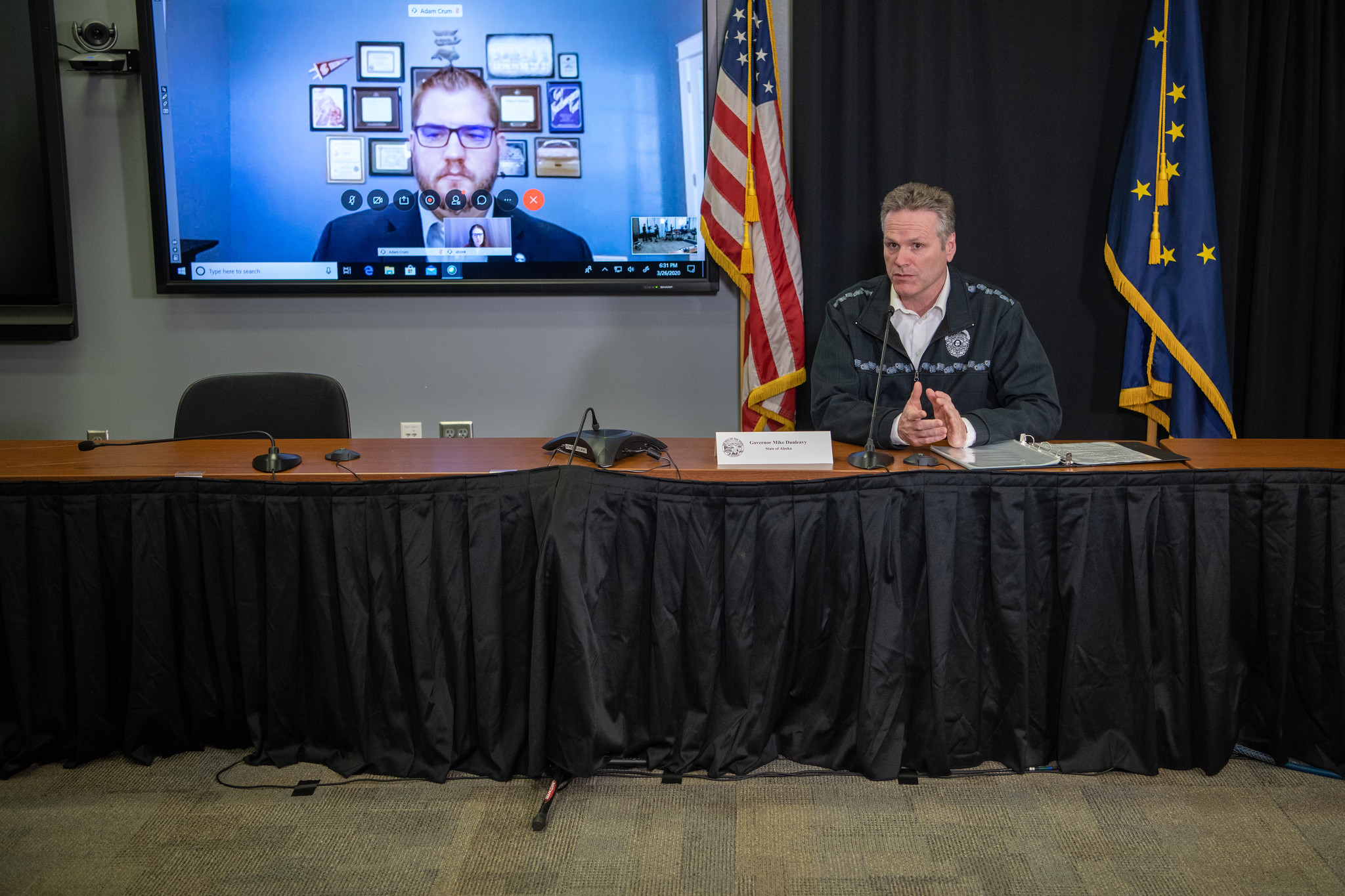
Gov. Mike Dunleavy speaks at a news conference on COVID-19 in Anchorage on March 26. Health and Social Services Commissioner Adam Crum spoke remotely and appeared on a TV screen to the governor’s right. (Creative Commons photo courtesy Alaska Governor’s Office)

Gov. Mike Dunleavy’s latest COVID-19 press conference is scheduled for 5 p.m.

The governor, Health and Social Services Commissioner Adam Crum and Chief Medical Officer Dr. Anne Zink have been holding these briefings almost daily since March 10.

They’ve shared updates on the number of people in the state with confirmed cases, announced public health mandates and explained the administration’s strategy and rationale.

To date, they’ve imposed 12 public health mandates that have reshaped daily life across Alaska to combat the spread of the virus. Those mandates and other Alaska-specific COVID-19 resources and information are available at coronavirus.alaska.gov.

During Thursday’s press conference, Dunleavy’s administration is expected to announce changes to some of those mandates.

The number of Alaskans diagnosed with COVID-19 grew by nine on Wednesday, to 235, according to the state Department of Health and Social Services.

The state reported no new deaths and no new hospitalizations. The number of Alaskans who have recovered from the disease jumped to 49, up from 32 a day earlier.

Of the nine new cases, four are from the Municipality of Anchorage, two are from the Fairbanks North Star Borough, one is from the Kenai Peninsula Borough and one is from Matanuska-Susitna Borough.

More than 7,200 tests had been performed in Alaska by the end of the day Wednesday.

You can watch Thursday’s press conference live on this post, the governor’s Facebook or Livestream pages, or on 360 North television.

The headline for this story has been updated.

Skagway resident stranded in Argentina as coronavirus stalls international travel

Meghan March, pictured right, and her travel companion Alexandra Falls in Montevideo, Uruguay. (Photo courtesy Meghan March)

Travel restrictions meant to slow the spread of the novel coronavirus mean one Skagway resident is stranded nearly 8,000 miles from home.

The plan was an extended trip through South America while it was winter in Skagway. Meghan March didn’t anticipate a pandemic would virtually shut down international tourism while she was away.

“We’ve tried to get out multiple times now, but we’ve had no luck,” said March.

March and her Canadian travel partner headed south in late February, before there was a widespread understanding of the dangers of the novel coronavirus. They spent a couple weeks in Brazil with March’s family, toured Uruguay, and then got on a boat to Buenos Aires, Argentina.

Their plan was to visit Peru next, but by then the spread of the coronavirus had countries shutting down their borders. They couldn’t get to Peru. They couldn’t even get back to March’s family in Brazil. They were stuck.

“It’s really been pretty crazy, because I think it was shortly after that, that the president here in Argentina decided that they were going to do a quarantine and a travel ban as well. And there’s been a lot of misinformation, so we figured that we were stuck here,” she said.

But March said she’s found some commercial flights out. The only problem is, every time she rebooked her flight, it got canceled.

She said the U.S. embassy suggested a flight to Miami, but that was too costly and stranded her in the wrong corner of the nation. Currently, she has a flight booked with travel vouchers from her original flight for April 14, a day after Argentina’s travel ban is scheduled to end.

March said she feels safe and comfortable for now. Buenos Aires is under shelter-in-place orders, and there are fewer than 2,000 confirmed cases of the virus in Argentina.

“Everything seems to be pretty calm here. There’s still toilet paper on the shelves and other essential items and such, so people aren’t really freaking out here,” she said. “The owner of the building or the apartment that we’re renting has been very, very kind in allowing us to stay here.”

March is not the only Alaskan stuck overseas. U.S. Sen. Dan Sullivan’s office is aware of over 60 people who got stranded by coronavirus. According to his Alaska office, most of them are home now, but more than a dozen may need repatriation assistance.

For March, when or how that assistance is going to come is unclear.

The U.S. embassy in Argentina had listed one flight out of the country — to Brazil, which offers direct flights to the United States. The embassy website said: “If you need to leave Argentina, you should strongly consider booking this flight, otherwise you should be prepared to remain abroad for an indefinite period.”

On Thursday, the embassy announced that the flight had been canceled.

New unemployment benefits are here, but laid-off workers are having trouble applying

Nathaniel Floto worked as a printer technician in Fairbanks before work dried up and he was laid off. Now he’s been applying for unemployment benefits for three weeks, without a response from the state. (Photo courtesy of Nathaniel Floto)

Even after new benefits were added to the federal unemployment insurance program, many Alaskans are still reporting difficulty accessing those benefits due to problems with the state’s application system.

It’s been causing headaches for people like Nathaniel Floto, a printer technician in Fairbanks. When coronavirus hit in town, many of the small businesses and schools his company had contracts with shut down.

“There was nothing for me to do for eight hours, and then nothing for me to do for four hours, and then just nothing to do,” he said.

Eventually, his employer was forced to lay him off and helped him get started in applying for unemployment insurance. That was two weeks ago, and he still hasn’t gotten any help.

He’s gotten busy signals from the state’s Department of Labor and Workforce Development at times, and at others he’s been passed off to employees who say they’ll get back to him. Sometimes he’s been told to email, then is told that he can’t email the department because of issues with sending personal information.

Others report days of being unable to get past the initial Department of Labor phone message.

Many workers have taken to listing frustrations about the unemployment filing system on social media, with stress rising as bills mount and checking accounts dwindle.

The Department of Labor says it’s working hard to fix the issues. Cathy Muñoz, deputy commissioner of the Department of Labor, said it has been a quick adjustment.

“Before the COVID-19 health emergency struck, we were at the lowest level of unemployment in the history of our state. So you can imagine we went from very low filings to very high filings almost overnight,” said Muñoz.

The department has brought in new staff, some of whom came out of retirement, and made IT changes to accommodate recently-passed legislation that added benefits and loosened documentation requirements. Those benefits are included in House Bill 308, which tripled the payment for dependents, extended eligibility periods and will add up to $600 a month in payments.

The new rules will also waive a key requirement of traditional unemployment insurance, which requires that employees be actively seeking new work. But the online application for people who have already applied didn’t reflect those changes as of Wednesday.

Muñoz said the department has quickly brought on new staff to deal with the surge in applications — reported at a record-setting 14,500 for the week ending on March 28. It now has 100 staff working on processing applications, with 50 more to come soon.

They’re making progress, she said.

“We track filings on a weekly basis, so as of March 21 … we processed for that week only 13,774 applications. The week prior to that ending the 14th of March, we processed 7,400 applications,” she said.

But there are still technical limitations which might explain why Alaskans have been kicked off phone lines after being told to call: The system can only hold 250 people on the lines at one time.

“We’re expanding that capacity now, so we hope to be able to address, to more readily be able to respond to people that are online, but we’re doing the best we can,” she said.

So far, that hasn’t helped people like Floto, who applied for the third time on Monday. He’s currently waiting for the department to send his former employer a loss-of-employment verification form, since state law still requires that to be done via snail mail. As of Wednesday, Floto said his employer hadn’t received anything.

He said it’s been frustrating.

“I’m mad because I need help, but at the same time there’s people that need it more than me, and I understand they’re busy,” he said.

On Monday, he did see some updates to the online filing system and was finally able to select “coronavirus” as the reason he lost his job, but otherwise he hadn’t made any progress.


Aniak is preparing for 2 possible disasters at once: COVID-19 and flooding

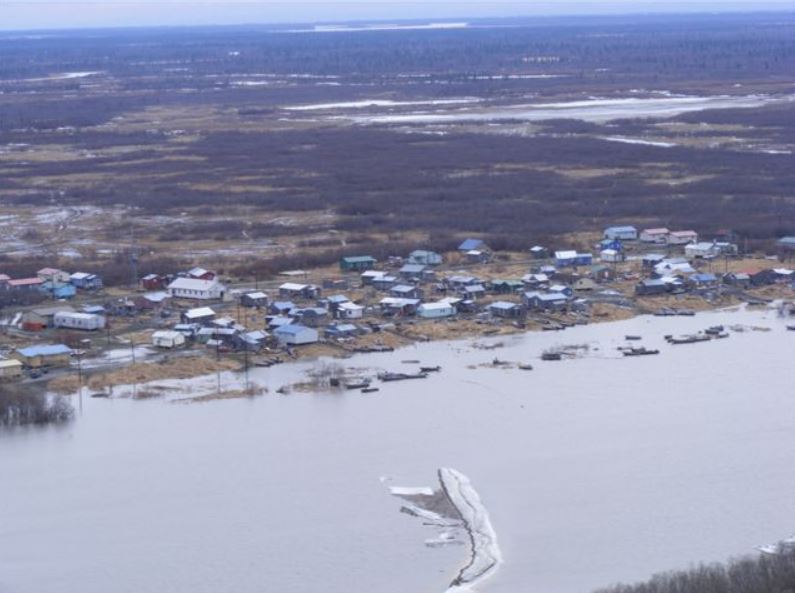
Flooding in Aniak in May 2009. (Photo courtesy flood.alaska.gov)

As COVID-19 is spreading across Alaska, spring is approaching and the countdown to river breakup is beginning.

On the Kuskokwim River, that breakup is expected to be more dramatic and more destructive than recent years, with possible flooding from ice jams.

The Middle Kuskokwim community of Aniak is preparing for two possible disasters at once.

The city of Aniak, the Native Village of Aniak and the Kuspuk School District have been meeting over the phone to answer two key issues:

“Where to have a care center for COVID-19 patients, (and) where to have a place for people who are not infected if we have a flood and they need to be evacuated,” explained Erica Kameroff, Aniak’s incident commander, mayor and tribal council member.

The current plan is that flood evacuees will go to the Aniak Junior Senior High School, and COVID-19 patients will go to the Joe Parent building, a former dormitory located next to the high school.

The two emergencies could happen simultaneously.

The National Weather Service estimates “above average flood potential” for the Kuskokwim River. Snow and ice conditions taken in March match those from 2009, a year when ice jams flooded Kuskokwim communities.

Ice jams happen when temperatures rise quickly, melting snow in a rush and cracking ice into bergs. Along the river, communities like Aniak have reported more snow than has been seen in recent years.

“Considering how much snow we have gotten — and we are still getting, because it was snowing away this morning — it does bring concerns,” Kameroff said.

Meanwhile, on April 6, the Yukon-Kuskokwim Health Corp. reported its first confirmed case of COVID-19 in the region.

To prepare for the worst, the community asked a question that Kameroff said was hard to even bring up: Where would they put the bodies of anyone who dies from COVID-19 until the ground thaws enough to bury them?

After careful thought, the group decided on the city’s sewage lift stations.

“Because they’re secluded, and nobody really has access to them but certain employees,” Kameroff explained.  “And they can lock them up so that nothing would be bothered or tampered with.”

Aniak has no confirmed cases of COVID-19 and is enforcing travel restrictions in the hopes of keeping it that way. Residents are ordered to hunker down at home, and they can only travel out for essential reasons. Returning residents must quarantine for 14 days, and the only nonresidents allowed to enter the community are workers employed in critical infrastructure or essential needs. Before those workers can travel to Aniak, though, the employers of those workers must submit 14-day quarantine plans and have them approved by the city.

Kameroff said that Aniak’s isolation will not protect it from the coronavirus, but vigilant community action will give the city its best shot at prevention.

“We can all do our part by staying apart,” she said. “And as hard as that is in our culture, that is what is needed.”

Digital drag: Gigi Monroe takes Juneau’s drag scene online

(Image courtesy of Gigi Monroe)

“Performing in drag is a necessary creative outlet for me,” said Gigi Monroe, a local drag queen and wig stylist on Tuesday’s Juneau Afternoon. “It has the power to inspire, comfort, and entertain, even when we cannot gather physically,” said Monroe.

Monroe is one of many artists whose livelihoods are cast into uncertainty as events countrywide are canceled in response to COVID-19. Performers have been forced to find creative ways to connect to their audiences, with many turning to online broadcasting.

Monroe’s appearance on KTOO’s daily talk show was to promote an online solo drag performance on Thursday, April 9, at 7 p.m. The performance is pay-as-you-can.

Monroe has been doing drag for 16 years and has produced countless shows in Juneau. Thursday will be her second broadcast performance.

“Half the fun of a drag show is getting up close and personal,” admitted Monroe. But on Thursday, viewers will get a first: They’ll be able to see makeup and wardrobe transformations in between musical numbers — a process typically reserved for backstage.

Monroe is optimistic about the experience of watching a performance from home. Her show will be hosted on Stageit, a platform dedicated to live music broadcasting, where viewers can interact closely with the performer through a chat interface and tipping system.

“It’s BYOB!” Monroe said. ”Feel free to dress up, feel free to wear your sweatpants. You can get up and dance in your living room with me. … You can do whatever you want to do.”

Juneau’s drag scene has been a source of vitality for the local LGTBQIA+ community. Monroe hopes that other performers and artists continue to create, undeterred by the circumstances.

“I’m really hoping that some of the other performers, locally, are inspired to get their act together, so we can do some broadcasts live from our living rooms,” Monroe said. “If you want to hear it, make it known, get those requests out there!”

The full interview can be heard below:

Site notifications
Update notification options
Subscribe to notifications