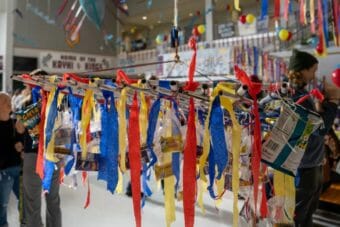
Children grab for goodies attached to a pabitin at Ketchikan’s Fil-Am Festival on Oct. 15. (Photo by Eric Stone/KRBD)
Community members in Ketchikan came together last weekend to celebrate Filipino American History Month at the second annual Fil-Am Festival. The event recognizes the contributions and history of Filipino Americans in Ketchikan and around the country.
Ten-year-old Zofia Volkmann opened the festival — which took place at the local high school — with a performance of the Philippines’ national anthem on stage in the high school’s auditorium. High schooler Logenn Merrill followed it up with a performance of “The Star-Spangled Banner” on the violin.
Then came a round of speeches — the superintendent, both of Ketchikan’s mayors, plus some other political figures — including featured guest speaker Rep. Mary Peltola.
“I stand here today and say with great confidence that fellow Filipino Americans helped build Alaska, and they continue to build Alaska from our hospitals, to our factories, our armed forces, and to our real estate markets,” Peltola said. “To put it simply, the history of the Filipino American experience in Alaska is the history of Alaska itself, and it should never be forgotten.”
Peltola joked about a friend of hers who was born and raised in the Lingít village of Yakutat.
“When they went to college at UCLA, they realized for the first time that adobo was not a Lingít dish,” she said.
Mary Peltola smiles while giving a speech at Ketchikan’s 2022 Fil-Am Fest. (Photo by Eric Stone/KRBD)
Out in the commons, political figures were all over the place — lieutenant governor candidates Heidi Drygas and Jessica Cook, Lisa Murkowski aide Chere Klein, and state House candidates Dan Ortiz and Jeremy Bynum were shaking hands ahead of the Nov. 8 general election.
“I love the fact that they’re coming to our table,” said Alma Manabat Parker, who helped organize the event. “It’s truly our table — you can see and smell the food.”
She says boosting voter engagement in the Filipino community is one of her goals as head of the Ketchikan Wellness Coalition’s Sama Sama Tayo program.
“That’s how I proposed this invite,” she said. “Come to us as an opportunity to hear our voices in our own space around our own people.”
Alma Manabat Parker welcomes attendees to Ketchikan’s 2022 Fil-Am Fest. (Photo by Eric Stone/KRBD)
Sama Sama Tayo is a grant-funded initiative that aims to improve health care for Filipinos in Ketchikan. And there are some booths you might expect from a health-focused program — PeaceHealth Ketchikan is offering blood pressure checks, and the local public health office is running a vaccination clinic. Another nonprofit has a booth with resources for children with learning disabilities.
But Parker says health isn’t just about what shows up on a medical chart.
“Health is mind, body and soul, and our culture is part of that,” she said.
And it’s around everywhere you look. It’s in the air — the smell of Filipino dishes like lumpia and adobo and pancit and more.
The Kusyna ni Mel crew. (Photo by Eric Stone/KRBD)
Danielle Rodriguez is working one of the booths — Kusyna ni Mel, or Mel’s Kitchen. It’s been popular — not even midway through the festival, they’ve sold out of chicken adobo. Rodriguez says she’s glad folks are enjoying the food.
“We want to share our culture and our food with people, and I think food is the best way to share that,” she said.
Among the many highlights is sisig — deep fried pork belly with garlic, onions, ginger and a citrus fruit called calamansi.
“Like a Philippine lemon-lime,” Rodriguez explains.
But there’s much more than food. There’s Filipino trivia. There’s bingo. And on one side of the commons, there’s a rack hanging just a few feet off the floor. It’s decorated in the red, white, blue and yellow of the Philippines’ flag, strung up with streamers, candy and treats.
A pabitin awaits its time in the spotlight at Ketchikan’s 2022 Fil-Am Fest. (Photo by Eric Stone/KRBD)
It’s called a pabitin — it’s a little like a Filipino piñata, except instead of swinging a stick at a papier-mache animal, kids jump to grab the goodies dangling from the structure. Children gather round.
On a balcony high above, a man jerked the pabitin up and down as the kids grabbed for goodies.
KRBD had a booth, too. We set up a mic with a list of questions, and we got a few takers.
Frederick, 28, told us what Fil-Am meant to him.
“Fil-Am to me is being able to enjoy and share my Filipino culture in an open environment,” he said. “I think it’s important to celebrate heritage to keep culture and tradition alive for future generations.”
Grant EchoHawk, 47 and a member of Ketchikan’s Borough Assembly, said he was glad for the chance to learn more about the Filipino community.
“It gives all of the rest of us that are not of Filipino descent an opportunity to learn about Filipino history, culture, foods and all the great things that make the Filipino community really, really shine,” he said.
Ryan McHale, 27, said he’d like to see Filipino history in Alaska more widely understood.
“I wish more people knew more about how and why our community is as diverse as it is,” he said.
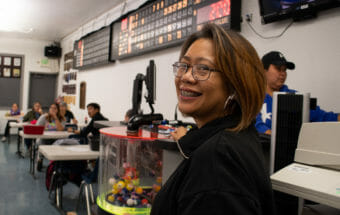
Charlie Jose poses for a photo at his booth at the 2022 Fil-Am Fest. (Photo by Eric Stone/KRBD)
At another booth, pediatrician Charlie Jose has a table with an array of photo prints he took in the Philippines over the summer. There’s a photo of a dragon fruit orchard. Another features a bunch of bananas hanging outside his family’s home.
“If you’ve ever tasted a banana in the Philippines, and you taste a banana in the U.S., it’ll never be the same experience,” Jose said.
He says he’s glad to have this space to celebrate Filipino history and culture — especially for younger people.
“It’s hard to reconnect with your roots in the Philippines if you’ve lived primarily here,” he said. “You also lose some of that culture when you emigrate. I’m an immigrant myself, and I know that I’ve lost some of my culture, so it’s nice to reconnect in different ways, and this is the perfect opportunity to do that.”
Ketchikan High School Fil-Am Club President Zarina Cabillo agrees.
“The kids here don’t really know anything about the culture because they grew up here, and having this festival is just really, really, really good for them,” she said.
She says she’d like to see more people learn the Filipino language, Tagalog, and become certified as translators.
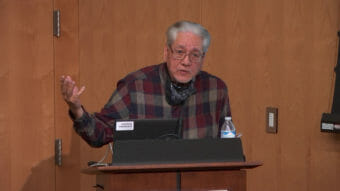
Oscar Peñaranda speaks at the Alaska State Museum on Oct. 7, 2022 (KTOO screenshot)
Canneries are a big part of Alaska’s history. Throughout the 20th century, waves of immigrants – primarily from the Philippines – came to work alongside Alaska Native people in the canneries.
The Mug Up exhibit at the Alaska State Museum in Juneau highlighted this history for the last six months.
The exhibit features lots of historic films and photos. There are black and white posed photos from the turn of the 20th century, and more candid photos taken by friends from the 1960s, 70s and 80s. Some panels explore the histories of the different labor movements that swept through Alaska’s canneries.
There’s even a recreation of a bunkhouse, with a door covered in names of the workers who slept there from the 1980s to 2009.
Next to it, a mess hall, with a hand-painted table, and a handwritten weekend menu. The backdrop is a photo of young women in hairnets smiling around a table, a few holding cigarettes.
Cannery workers gather on the Diamond NN Cannery dock for a “mug up” in ca. 1976. Mug Up or coffee break gave cannery workers a 15-minute reprieve from the monotony of slime line work and canning machines. (Photograph by Mike Rann)
Jackie Manning is the exhibit’s curator. Her favorite thing is a little cart used to serve coffee to workers during what was called Mug Up time. That’s where the exhibit gets its name.
“When I went up to Bristol Bay, and I saw that little Cushman cart – is what it’s called – and heard the stories about how diverse the canary crew was, and how important that mug up time was for camaraderie and everybody meeting and taking their breaks. And just all the different languages you’d hear on the docks,” she said.
Oscar Peñaranda moved from the Philippines to Canada and eventually to California before coming to Alaska to work in a Bristol Bay cannery in the 1960s. And he kept coming back. He worked 15 summer seasons in Alaska, before deciding to stay in San Francisco full-time.
Now, he’s a historian. He founded the San Francisco chapter of the Filipino American National Historical Society and wrote about his experiences as an Alaskero – the term for Filipinos who worked in Alaska’s canneries.
For Filipino American History Month, Peñaranda was in Juneau last week for the closing of the exhibit. He recognized some names and faces in the exhibit, like the Filipino union leaders who formed the Alaska Cannery Workers Association. They were murdered in 1981, and he said that’s when he stopped going to work in Alaska.
Peñaranda worked at the cannery for 14 years, even after he started teaching at San Francisco State University and James Logan High School in California.
He said he kept going back for the comradery.
“But the thing was, we didn’t feel like we had to get in touch between seasons,” he said. “Because we were gonna go the next season and catch up. That’s part of the reason why we kept going.”
Peñaranda’s language skills helped him to prosper at the cannery. He speaks four Filipino languages, as well as English, Spanish and some Italian.
“Language is how you see the world. You know two languages, you get two ways of seeing the world,” he said.
It allowed him to work as a sort of peacekeeper between different groups at the cannery.
The labor movements happening in the canneries paralleled his life in San Francisco in the winters. In 1968, he participated in strikes at San Francisco State University that led to the forming of the school’s College of Ethnic Studies.
Peñaranda went on to teach literature and Filipino language in high schools and colleges.
He’s now 78, and he’s thinking of returning to Bristol Bay next summer to work with an old friend. It would be the first time he will have worked at a cannery since he stopped over 40 years ago.
His friend is also in his late 70s and he operates the palletizer – the machine that puts all the cans into pallets to ship out.
Another reason Peñaranda said he kept going back to cannery work was the chance to be a new version of himself.
“When you go work in the canneries and go to Alaska, you can reinvent yourself – you’ll be a completely different you. You don’t like the way you are in San Francisco? Come to Alaska. Make your own reputation.”
So, a different Oscar Peñaranda may return next summer.
This story is part of KTOO’s participation in the America Amplified initiative to use community engagement to inform and strengthen our journalism. America Amplified is a public media initiative funded by the Corporation for Public Broadcasting.
America Amplified
KTOO is amplifying the voices of Filipinos in Alaska. We want to hear from you. What stories would you like to share or learn more about?
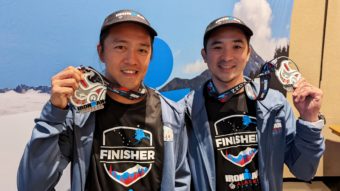
Ironman Alaska finishers Richard Secretaria of New Jersey, left, and Joseph Paray of New York pose for a photo with their medals at Centennial Hall in Juneau on Aug. 8, 2022. (Photo by Jeremy Hsieh/KTOO)
Funny thing about people who subject themselves to swimming in 56-degree water, biking 112 miles in the rain and running a marathon on the same day: they grin as they talk about it.
“It was wet all the way, pouring down, rain was pouring,” said Joseph Paray, a registered nurse from New York who completed his first full Ironman triathlon in Juneau last Sunday. “The wind was brutal. The elevation of the climb is brutal.”
His friend Richard Secretaria, a medical tech from New Jersey, was also a finisher. He was almost giddy as Paray talks about it. Secretaria said his bike got so dirty, it looked like he was mountain biking instead of racing on the road.
It almost sounds like they’re complaining, but they really enjoyed their time in Juneau. In part because they said they were representing the Philippines when they raced. When they first arrived, they introduced themselves on an Ironman Alaska Facebook group.
“Everybody’s sending us messages, like, ‘How can we meet each other?’ Like, we feel like we’re celebrities here,” Secretaria said, laughing.
“The support of the Filipino communities in Juneau? They rock, man,” Paray said. “It was like it was like back home. They were everywhere!”
Of course, they’re supporting Juneau, too, with their visit. Last year, when a local travel organization was negotiating to host the Ironman Alaska triathlon, boosters predicted up to 1,500 athletes would come, plus friends, family and support staff. It would be an economic boon.
The number of people to actually attempt the inaugural Ironman Alaska ended up falling well short of that. Ironman said there were 850 athletes, of whom 62 were locals.
And yet, another early estimate — that the event would pump $7 to $9 million into the local economy — appears to be on the money.
Like most of the athletes, Paray and Secretaria didn’t come alone. An Ironman official said that on average, each participant brought about three people with them. Paray and Secretaria brought their significant others, and they were here for seven nights.
The two couples split a hotel room and car rentals that they booked early on, before registration for the race had even opened. At first, they booked six nights, but later decided to add a seventh. By then, the per-night rate had doubled to almost $350.
Besides Ironman events, they visited the Mendenhall Glacier, rode the Goldbelt Tram and ate at local restaurants.
“Not to mention, you still have to buy, you know, some stuff. You know, souvenirs,” Secretaria said.
“Souvenirs, yeah!” Paray said. “You’ve been to Alaska! You need some remembrance.”
They figure each couple spent around $4,000 on the trip.
City Finance Director Jeff Rogers was also an Ironman finisher. On Monday, he was browsing the swag at a pop-up shop at Centennial Hall.
“I got a jacket and a hat, ‘cause the hat I run in is falling apart, and a couple of water bottles,” Rogers said.
The cashier rang him up for just under $200, which includes about $10 of city sales tax.
From hosting Ironman, Rogers is expecting a noticeable bump in the city’s revenue from sales tax and the extra 9% tax on hotel rooms and short-term rentals.
“I think a big weekend of a couple thousand people in town certainly has an impact, not only on city revenue but just on the health of local businesses. And certainly a lot of people rented out their houses, trying to help and be generous, but also put a little money in their pockets,” he said. “So I think the economic impact will be big.”
City officials and race organizers aren’t aware of any formal economic impact studies underway around the event. But Meilani Schijvens, who runs the economic publications firm Rain Coast Data in Juneau, was personally interested in the race. She had the athlete tracking app, was following threads about it on Facebook and was game to share a rough economic impact estimate of her own.
“To be clear, I have not done a study on this, right?” she said. “These are just my numbers, because I obsess over all these things, and I love, like, trying to figure these things out.”
But she has done robust analyses in the past, backed by surveys and more ground-truthing, to get at what the typical independent traveler spends during a visit. To build some spending assumptions for this event, Schijvens looked at the Ironman schedules, participant numbers, Facebook chatter — even the weather.
“A typical independent traveler, we would assume they all went on an excursion,” Schijvens said. “And I just decided 20% of them went on excursions, partly because we had an atmospheric river. And a lot of the excursions were closed down, like the helicopter tours people definitely would have gone on.”
All together, she figures the out-of-town participants and their travel companions put roughly $8 million directly into Juneau’s economy.
The race organizers also spent a lot in the community. Liz Perry runs Travel Juneau, the city’s destination marketing organization. It partnered with Ironman to host the event.
Perry said the Ironman organizers used local vendors as much as possible, from the logo design by local artist Crystal Kaakeeyáa Worl to the port-a-potties from Alaska Waste.
Which means some of the athletes’ registration fees and the licensing fee Travel Juneau paid Ironman to host the event also came back to the community. Travel Juneau paid $50,000 this year, and will pay $125,000 in 2023 and again in 2024.
Perry said volunteers representing local nonprofits may also get some cash grants from the Ironman Foundation. And there were a lot of volunteers — Ironman said more than 1,400.
“So the entire community has benefitted from this, from top to bottom,” Perry said. “So that ripple effect is going to be really impactful for the whole city.”
There’s even free word-of-mouth from all the proud Ironman participants themselves. Paray and Secretaria both said they plan to come back.
“Maybe not for the race, but for vacation,” Paray said. “Yeah, this is a must. I must tell my friends, I will tell everyone who I meet, ‘Yeah, go to Juneau, go to Alaska. It’s a really nice place.’”
They said their triathlon club back home is eager to hear how it went.
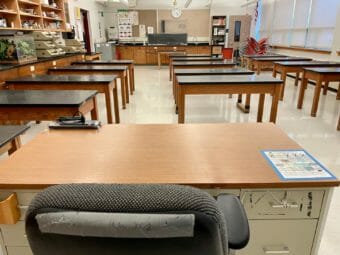
An empty classroom at Juneau-Douglas High School: Yadaa.at Kalé in Juneau on Wednesday. With the new school year approaching, school districts throughout the state are struggling to properly staff schools and classrooms. (Photo by Lisa Phu/Alaska Beacon)
Bobby Bolen is trying to fill around 50 teaching positions at the North Slope Borough School District.
“This is our focus 24 hours a day right now — to get classrooms staffed for students,” Bolen said.
Bolen is the brand-new human resources director at the North Slope Borough School District, which has around 2,000 students in 12 schools, some of which start as soon as Aug. 8. He’s exploring options like long-term substitutes and the prospect of international teachers to round out the district’s usual teaching staff of around 170.
“Our worst-case scenario would be distance delivery. That’s obviously not our goal and that’s not our preference, but you know, we do have some experience with it as a result of COVID, so if we have to revert to it to get some initial schools started, then we’re prepared to do that,” Bolen said.
With the new school year approaching, school districts throughout the state are struggling to properly staff schools and classrooms. The national teacher shortage, which pre-dates the pandemic, is uniquely felt in Alaska, which has historically relied on recruiting teachers from the Lower 48.
“We’re in the worst place with this that Alaska has ever seen,” said Lisa Parady, executive director of the Alaska Council of School Administrators.
“What I’m hearing from administrators is that many districts are not staffed. People are working overtime to try to find high-quality educators for our students, and we are at an all-time high in Alaska for turnover at every level,” Parady said.
Other public employers, including the state government, are struggling to fill positions. But the scale of the problem for some school districts is particularly large. According to the Alaska Teacher Placement website, a statewide education job clearinghouse, around 1,100 jobs are open in school districts around Alaska. That includes all areas and levels of school and education staff, from principals, teachers and special education staff to paraeducators, support staff and sports coaches to language teachers, counselors and speech pathologists.
Toni McFadden, manager of Alaska Teacher Placement, said the severity of the issue has been years in the making, “creeping up on us and getting bigger and bigger and bigger.”
The trend can be seen in the declining attendance of the spring job fair Alaska Teacher Placement holds every March.
“Back in the 80s and even the early 90s, there were 1,000-plus candidates looking for jobs. This year, we had about 75 candidates at the spring fair that are looking for jobs,” McFadden said.
“Now, did it go from 1,100 to 75 in one year or two years? No. Every year, it’s just fewer and fewer and fewer. So, this is a problem that’s been going on probably for 15 years or more, but it’s just getting to the point where it’s so severe now that districts are really struggling and they’re desperate to find qualified teachers to put in front of their children.”
A solution from afar
One solution to the teacher shortage in Alaska: hiring teachers from the Philippines.
This past school year, 20 of Kuspuk School District’s 39 teachers were from the Philippines, KYUK reported. The district includes villages along the Kuskokwim River. Gov. Mike Dunleavy last October thanked more than 100 Filipino teachers who came to Alaska to fill positions throughout the state.
The Bering Strait School District started hiring teachers from the Philippines two years ago because there was no one else to fill the vacancies, Chief School Administrator Susan Nedza said. And it’s worked out. Thirty of the district’s returning staff are from the Philippines with J-1 visas, the type of visa given to teachers who are part of a work-based exchange program to the U.S.
“They have years and years of experience, wonderful training. They fit in amazingly. We’ve had no complaints,” Nedza said.
Other districts currently interested in hiring J-1 visa teachers to fill vacancies may have a harder time. The U.S. State Department sent an email in June to sponsor agencies, which facilitate the visa process for the international teachers, saying that teachers placed in rural Alaska “may require additional monitoring and support.”
It said, “exchange teachers may not be fully prepared for the location of their placement” and asked sponsors to ensure “exchange teachers placed in ‘less traditional’ locations are aware of the unique circumstances of those placements, situations they may encounter as a result (e.g., extreme weather, possible challenges in finding certain goods and services, travel considerations, etc.), and who and how to contact sponsor representatives for support and to report any situations affecting their health, safety, and welfare.”
After that email, a few of the sponsor agencies the district works with said they would no longer be placing teachers in Alaska, according to Nedza.
“I’ve asked these companies to, ‘Yeah, go ahead, take a look at the State Department comment. And, of course, you should be monitoring your teachers. Of course, you should make sure that they’re cared for. Of course, you should check on their situation in their job spots. But don’t blacklist Alaska because of some strange misconception,” Nedza said.
“So that’s added a twist this year” to the hiring problem, she said.
Still, Nedza has been able to hire six new J-1 visa teachers from the Philippines for this coming school year. That means 36 of her roughly 250 certified staff members will be from abroad.
Nedza started out with 40 openings going into this school year. She’s down to about three. So, for the moment at least, Nedza is feeling good about staffing. Without those 36 staff from the Philippines though, “I don’t know where we would be,” she said.
(A State Department spokesperson said the department doesn’t comment on leaked internal communication with sponsors, though it “constantly monitors and supports our exchange visitors’ experiences to ensure the health, safety, and welfare of all our participants.”)
Candidates ‘ghost’ or turn down offers
Securing someone to fill a position doesn’t guarantee an educator in the classroom. That’s something school administrators — like Kenai Peninsula Borough School District Superintendent Clayton Holland — have recently experienced for the first time.
“A couple people just didn’t show up. They committed to be with us and didn’t even arrive, didn’t say anything,” Holland said. “It’s a term I’ve heard about now; I guess it’s called ghosting.”
A number of factors are driving the national teacher shortage — burnout, fewer people going into the teaching field, low pay — all of which were exacerbated by the pandemic.
“It’s kind of magnified in Alaska,” said Alaska Teacher Placement’s McFadden. Some Alaska-specific factors include harsh climate, vast geography and isolation, and a lack of amenities.
Since Alaska has relied on recruiting from other states, “people coming from outside of Alaska, the change is just very different for them,” McFadden said.
Florida educator Wayne McKnight, who is 62 years old, was looking for something different when he almost accepted a teaching job in Teller. He has spent 35 years as a behavioral specialist and isn’t ready to retire.
“I was looking for an adventure. I was looking to continue to make an impact on students and I wanted a different kind of experience,” McKnight said. “Alaska definitely appealed to me.”
He was “very excited” when he got the offer letter. To make an informed decision, he talked to returning staff in Teller, who he said “had wonderful experiences.” Ultimately, McKnight didn’t think he “could withstand the weather” and didn’t want to risk the possibility of not being able to fly back home for the holidays due to weather-related travel issues.
He said it was a “difficult decision” to turn the offer down. Unlike some others, McKnight did not ghost anyone. He communicated that he would not be accepting the job.
What the state is doing about the problem
There was another reason McKnight didn’t accept the teaching job in Teller. A day after receiving the offer, he contacted Alaska’s teacher certification office and learned for the first time that he’d be required to take a test and specific courses. His credentials, training and experience from 35 years as an educator in Florida weren’t enough.
“Quite frankly and bluntly, I was not willing to take the extra steps to meet the Alaska requirements that they subjected their employees to, especially when someone’s coming from out of state,” McKnight said, though he added he understands the reasons for the requirements.
Senate Bill 20 changes requirements for testing. It awaits transmittal to the governor.
“In the instances of those individuals coming to us fully licensed with a regular certificate, one of the things that was required was to go through some additional testing,” said Sondra Meredith, administrator for teacher certification at Alaska Department of Education and Early Development.
“We’d have teachers with numbers of years of experience who would need to go back and do additional testing. Senate Bill 20, when it’s fully implemented, will provide a faster route and those testing requirements will be removed,” Meredith said.
Another legislative effort, House Bill 19, which also passed and is awaiting transmittal to the governor, “will open up additional opportunities for world language speakers and Native language speakers to be able to be given more responsibilities in our language immersion schools,” Meredith said.
The state also continues to issue emergency licenses to provide districts “maximum flexibility” when it comes to hiring individuals who may not have all the teacher preparation requirements but have an inclination to teach and the district feels confident having in front of a class, Meredith said.
“At the state level, in the certification realm, we’re trying to find ways to maintain rigor, but also to lessen the barriers,” she said.
The two required courses that McKnight mentioned — Alaska studies and Alaska multicultural coursework — are currently still a requirement.
Alaska used to be more competitive in attracting teachers
Administrators and education experts alike mentioned lack of a pension as a hindrance to recruiting teachers. Those experts include Juneau School District Superintendent Bridget Weiss.
“Alaska used to be super attractive to educators because we had a really good retirement system. That’s not the case anymore. Our retirement system is just not up to speed,” Weiss said.
The state no longer provides pensions to newly hired teachers. Instead, it offers a defined-contribution retirement plan. House Bill 220, which would’ve reopened the state’s closed pension programs for teachers, got some traction in the Legislature but didn’t pass.
In an effort to improve teacher retention and recruitment in Alaska, Gov. Mike Dunleavy formed a working group to identify the root causes of the issues and propose solutions. Based on survey results of Alaska teachers, the group recommended restructuring retirement options as one of its six action plan items.
The other items include strengthening working conditions, developing leadership, enhancing recruitment efforts and opportunities, creating pathways to develop paraprofessionals who work alongside teachers and school administrators, and streamlining certification and recertification.
Some of this work is already happening.
Several districts, including in the Kenai Peninsula and Bering Strait, already have ‘grow your own’ programs that allow districts to fill positions from within, in an effort to become less reliant on recruiting from outside Alaska.
Holland, superintendent in the Kenai Peninsula, said his district, which has 23 open teaching positions, is helping paraeducators pay for teacher preparation college courses.
“I think the state needs to start looking at some funding. That would be one of our legislative priorities – can there be an allocation to support programs like this?” said Holland.
Even with these kinds of efforts, Juneau superintendent Weiss doesn’t think it’s enough.
“I think that all those efforts are going to be for naught if we cannot compete with our retirement system,” Weiss said.
In Fairbanks, North Star Borough School District Chief School Administrator Karen Melin said she’s not worried about filling the 70 vacant teacher positions.
“I’m not worried because I’m pretty convinced we’re not going to be able to fill them at this point. This is our current reality. We’re going to start the school year short of positions,” Melin said. “So, how do we successfully deliver an excellent education to our students given our current reality?”
That brainstorming is happening now. Ideas include contacting retired teachers, looking at substitute lists, and only offering classes at one high school if it’s close to another.
Melin said the teacher shortage is a symptom of a larger problem.
“The greater problem is the way that we do public education. We’re not able to sustain ourselves as a public education system. So what does that mean for what we have to do different? That to me is the bigger question,” she said. “Yes, we will always need to have teachers. But I think fundamentally, the occupation has shifted, and so fundamentally, as a larger system, we need to think about how we shift with it.”
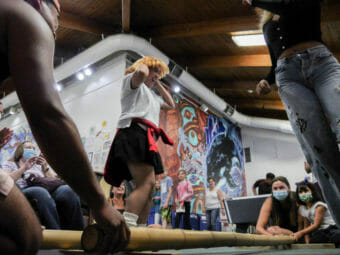
Ell Pecson tries out tinikling at the Zach Gordon Youth Center in Juneau on June 29, 2022. (Photo by Paige Sparks/KTOO)
Filipino dance groups used to be a big deal in Juneau. There were multiple troupes who practiced regularly and performed at the Filipino Community Hall. They even danced at high school basketball games. But that was 15 years ago.
Participation waned over the years, but David Abad, who grew up in Juneau’s Filipino community, wants to revive it. So he set up a workshop at Juneau’s Zach Gordon Youth Center called Tinikling 101.
Tinikling is a traditional folk dance from the Visayas region of the Philippines. Two people get on either end of two long bamboo poles and clap them together. Dancers jump in and out of the poles in between claps, deftly keeping from getting their ankles whacked. They look like the dance’s namesake tikling bird trying to avoid a foot snare set by rice farmers.
Abad bought the 8-foot long bamboo poles for the workshop on Etsy.
David Abad teaching tinikling to youth at the Zach Gordon Youth Center in Juneau on June 29, 2022. (Photo by Paige Sparks/KTOO)
“They were really hard to find,” he said. It was especially hard to get someone to ship them to Alaska.
The clinic started with some inspiration. The group of about a dozen kids watched a video of a group of college students performing the dance to the song “Dolla Sign Slime” by hip-hop artist Lil Nas X, rather than the traditional Spanish rondalla. The choreography is truly impressive. They are fast on their feet, jumping in and out of the poles while spinning or even kneeling down between the poles for a split second before escaping. The crowd in the video cheered, and so did the kids watching at the clinic.
“These are my tinikling goals,” Abad said.
When it was time for the group to try it out, Abad asked for volunteers to be the clappers — the people who tap the poles twice on the ground and then snap them together in the middle.
“When I was a dancer, I didn’t used to think about the clappers,” Abad said. “But they are so important because they get to control the speed. They are super crucial.”
It took awhile to get the rhythm down: Click, click, clap. Click, click, clap. But once it got going, you could see it getting stuck in everyone’s head.
Kay Roldan said she could feel it in her body. She used to dance with Abad back in the day, but it’s been at least ten years since she’s done it. This clinic was the first time she’d seen anyone bring out the sticks in Juneau since she was a teenager.
Jennifer Lagundino brought her 5-year-old daughter Daryl.
“Her dad is Filipino, and she’s been asking to learn Filipino dance,” Lagundino said.
Daryl Lagundino learning tinikling at the Zach Gordon Youth Center in Juneau on June 29, 2022. (Photo by Paige Sparks/KTOO)
Daryl sat in front of her mom and wrapped her tiny hands around the fat bamboo pole while they worked it together. But it wasn’t long before she wanted to be the dancer, too. She said she knew ballet already — and she was very light on her feet as she jumped on her tiptoes in and out of the poles. She seemed instantly converted.
The clinic lasted for two hours. Everyone tried both roles — clapper and dancer — a few times. People were sweaty and panting after their turn.
Abad was lit up. He wants people to get back into tinikling. He wants to teach and coach and choreograph for a troupe.
When he was young, in the early 2000s, there were at least 50 Filipino kids who danced regularly. When they danced at the Filipino Community Hall, he says they were proud. But when they started dancing at high school basketball games and other non-Filipino spaces, he said it became more of a secret for him. He stopped dancing in high school.
So the small crowd was inspiring to him. There wasn’t just interest, there was enthusiasm — from Filipino kids and kids who said they were “kinda” Filipino, and one who said tinikling made them wish they were Filipino.
America Amplified
KTOO is amplifying the voices of Filipinos in Alaska. We want to hear from you. What stories would you like to share or learn more about?
This story is part of KTOO’s participation in the America Amplified initiative to use community engagement to inform and strengthen our journalism. America Amplified is a public media initiative funded by the Corporation for Public Broadcasting.
Known to most as Uncle Rey, Reynaldo Caparas was a beloved member of the Juneau community. We collected your memories of Rey on this page. See your stories.
Taking your driver’s test is a rite of passage. But if you’re like most people, you might not remember much about it except maybe the parallel parking. And you probably don’t even remember the person sitting in the seat next to you with their foot hovering over the emergency brake pedal.
That is, unless you grew up in Juneau in the last 20 years, where many teenagers took their driving test with Reynaldo Caparas, known to most as Uncle Rey.
Caparas’ daughter, Marina Banks, says that of all the things her dad was to her and to the community, he would really love to be remembered as “the DMV guy.”
Caparas was born in 1955 in Manila, Philippines. When he was a young man in his 20s he got a job on a cruise ship, first as a line cook and then as an entertainer.
“Oh my gosh,” Banks said. “My dad had a very strong voice. I would say my dad was an alto kind of singer. And he just loved the spotlight for sure.”
Reynaldo Caparas with his wife Melba and daughters, Marina (left) and Maureen (right) in the mid-1990s. (Photo courtesy of Marina Banks)
After a few years of visiting Juneau on the ship, he decided to immigrate. Banks says that was partly because there were so many Filipinos in the community already, but mostly because he met his wife Melba and decided to stay and start a family.
In the 1980s and 1990s, he worked at hotels around town and at the ticket counter for Delta Airlines. He had a gift for customer service. He got energy from helping people.
He eventually landed a job with the state at the DMV, where he worked for 20 years making people laugh in one of the most unlikely places.
Banks said the family got their dad a fart machine one year.
“And he brought it into the DMV,” she said. “And he would place it in random spots in the office when there was like a long line. And my dad had the little remote and he would like play it, and it sounded like someone farted in the corner. And my dad thought that was so, so funny.”
He retired from the DMV at the end of April and spent his time at the other place a lot of people knew him from: the gym. He was a regular at the Alaska Club in the valley. Even in his 60s he would play basketball with high school kids, telling them he would live to be 100.
That’s where he was when he collapsed in mid-May. According to one family member, he told the paramedics that he hadn’t had a chance to enjoy his retirement yet. But he died later at the hospital of a pulmonary embolism. And that’s been hard for the family to swallow because he was so healthy.
About 10 years ago, his daughter says, he started eating really healthy. He stopped eating pork and white rice — staples of Filipino food. He switched to brown rice and fish, and he exercised a lot.
Caparas had COVID-19 earlier this year, and Banks, who is a nurse, thinks maybe that contributed to the blood clot that killed him.
“From all the things I’ve read, COVID has shown to kind of mess with the clotting factor in the blood,” she said. “And it’s just crazy, because my dad was so healthy. And I think that’s why most of us are just so, so devastated. And just so in disbelief because my dad was the healthiest person we know.”
But there’s some comfort in blaming COVID for his death, she says. It’s just something to kind of explain the suddenness of it, which is so hard to process.
In the Filipino Catholic tradition, mourners pray with the body for nine days. The Caparas family didn’t do that, exactly. Instead they hosted two days of long viewings, where dozens of people came to pay their respects.
But after the viewings, Marina says the strangest thing happened. The family came home and the room filled with the scent of flowers and her dad’s cologne. She says he always wore way too much, but it made the smell unmistakable.
“And so my mom would just sit in there and talk to my dad, you know, let him know that we’re here,” she said.
By morning the smell would be gone, but it returned the next night when they got back from the viewing. Banks says that since they are not ready to let him go, they will hold on to him this way until even the scent of him has moved on.
Reynaldo Caparas died on May 16, 2022. He was 66 years old. He leaves behind his wife, six children and eight grandchildren.
This story is part of KTOO’s participation in the America Amplified initiative to use community engagement to inform and strengthen our journalism. America Amplified is a public media initiative funded by the Corporation for Public Broadcasting.
Your memories of Reynaldo Caparas
I am the eldest of his kids. Me and my dad were like brothers. We had the same style, clothes and shoe size. We had the same speaking voice as when I speak with someone on the phone I sounded like him. – Lots of people will mistakenly greet me as my dad. When I still work at the Vital Records Office some of our clients will just stop talking and will ask me if I am related to this “Rey” from the DMV because I sounded and looked like him. When I said “He is my dad”, they will be astounded but so happy to know because my dad just sent them over to get a birth certificate, then a guy who just looks like him will greet them over at my office. – There were times I’ve been jokingly bumped, tapped from my back then the person will say “oops sorry, I thought you’re my friend Rey”. Then I would just say It is ok, he is my dad. Then they will laugh by surprise as according to them I look like him. -My dad is the best. I call him “PAPA,” as we Filipinos call our fathers. Even though we have a lot in common, still I cannot duplicate what he had done in his beloved Juneau. But I will try to follow his footsteps and I promised him that I will continue his good legacy.
Herbie Caparas
I’ve known Rey for a long time. Aside from the DMV we always hung out in the gym sauna and shared funny stories. I will miss Rey. Our town lost a very good man.
Andy Khemelev
He is wonderful neighbor for the last 14 years! Always stop to say ? hello and chit chat! Helped me wonderfully at the DMV! He will be missed in the neighborhood!
Christy Montero
My 61 yr old brother Tom came to Juneau from Kake to perform the DMV road test. My son Jason drove Tom over to DMV, showed the registration/insurance paperwork. Tom climbed behind the wheel and Rey got in the passenger seat. Tom took off, stopped behind the Stop sign entering Glacier Highway then jumped out and started driving on the side of the road on the bike lane. A big trucker hauling a container blasted his horn, Tom kept driving down that bike lane and poor Rey couldn’t figure out how to open the door of the Nitro (to jump out and save his life). Tom said he thought he was doing pretty good driving and couldn’t figure out “why?” Rey was searching the door panel so desperately. When they arrived safely back at the DMV parking lot he told Tom “you passed, you don’t need to come back,” probably to avoid a repeat performance.
Joleen Wheeland
I used to live next door to the DMV and when the DMV would close my son would go across the street and kick the ball around. Rey always would kick it around with him a few times. He was a sweet man. He will be missed
Kelli Patterson
Rey’s the only reason I ever passed my drivers license test! I think he may have looked the other way on one or two forgotten blinkers. He’ll be missed by everyone who walked in that DMV building.
Ryan Hoover
I took my driver’s test with Rey when I was 19. He was the best! Always smiling and so friendly. There was a part of my test I’ll never forget. We were at the stop light by Safeway. He had a neighbor in the car right next to us and they were yelling back and forth in conversation. Laughing with eachother. He was such a great spirit and after that point he always greeted me by first name and a smile. My condolences.
Mekayla Lytle
I got to work with Rey at the DMV for the last 10 years.He always had the biggest smile, the biggest heart and the biggest amount of food at potlucks. Rey always brought us spring rolls, pancit, adobo and many other dishes and it was always enough to feed a army. He made the DMV a pleasant place to work and he is very missed. My heart goes out to his family. I still can’t believe he is gone. ❤️
Celeste Walker
My son went for his driver’s test as soon as he turned 16, he was so excited. Something went wrong with my car and it had to be fixed before we could take the test. I felt so horrible that my son would need to reschedule. Rey stepped in and offered to stay on shift if we could make it back that day. That kindness was above and beyond and we were so appreciative and my son got to walk away with his driver’s license. I’ll always remember his kindness.
Laura Lundborg
I am from Hoonah. I was traveling to Juneau and had to update my license. I had to catch the ferry back and had little time to go to the DMV. I showed up at 4:55 and was told by another employee that I would have to come back tomorrow, Rey stepped in and I told him my situation and he helped me renew my license then and there. He always asked about Hoonah and said he worked there years before. He was such a personable person. Prayers and comfort to his family. I will miss seeing him whenever I go to the DMV ❤️
Gina Norris
I remember Rey from the DMV – I don’t remember ever engaging with him outside the DMV. When the line was super long and I had an unusually difficult transaction (like when my mom passed away in PA and I brought her car back and tried to register it here) I would sit there with my lucky rabbit’s foot and four leaf clover and hope Rey called my number. Rest In Peace Rey. You were a good man.
Mari Meiners
My daughter was a careful driver but excited about getting her license soon after turning 16. The first time she tested she was failed not on driving but because there was a small crack in her windshield. That set her back for a bit because the tester was not kind about it. Next time she got up courage to try to test again, luckily Rey was available to take her out. She did, well maybe, roll through a stop sign without coming to a total dead stop, but Rey could tell she knew how to handle the car and pay attention to traffic and signals. Nearly 10 years later she is still a good and careful driver, respects the speed limit and always wears her seatbelt. Going through a teen rite of passage like this with a kind generous spirit can really set the tone for how important kindness is at every level of life and human interaction. Rey was not a push-over, but he recognized competency and quality of attention and he made room for small human errors that are correctable. I’m probably over-stating this situation because I really only knew Rey in the context of these several interactions at the DMV, but clearly I’m not alone in deeply appreciating the WAY he did his job, and his life. I’m so sorry for the Caparas family and I hope you can take some small comfort in appreciating how much Rey was admired and respected.
Emily Kane
Seeing Rey always took the anxiety out of going to the DMV for me. Even with my mask on Rey would recognize me and call me by name. It was like seeing family. He had such a great smile and really lit up the room. I will remember how he made people feel special, and helped lift people’s spirits in the midst of all their paperwork. Condolences to his family.
Richard Lyon
Rey was the best! There was not any complicated DMV situation that he could not solve. And do it in such a warm hearted and thoroughly competent way. He inspired our admiration and great respect. A rare human being for sure! God bless his family, what a loss to our community but most especially to them.
Gail O’Dell
Rey was the kindest man at the DMV with a broad smile and warm sense of humor. I remember him talking to our son about the importance of taking your driving privileges seriously. Rey even went so far as to kindly remind our son that ‘mom or dad’ can just as easily take away the privilege if he didn’t drive responsibly and that he should respect our rules. Rey was firm, but kind hearted and took extra care when serving folks at DMV. We’ll sure miss Rey’s energy and welcoming smile. Sending heartfelt condolences to his family.
Mary Johns
Rey gave both my kids their driver’s tests and was so kind to them. He was also wonderful to me when there were glitches in getting my international flight ID. I never saw him without a smile.
Caroline Malseed
I first had the pleasure of meeting Rey and his wife, Melba, when both of our youngest daughters became friends. They were both extremely shy, and just starting Kindergarten. Over the years, they became like family to us, sharing in celebrations, birthdays and all sorts of events. My youngest daughter, Courtney, eventually spent a whole month in the Philippines with them when she was 16. Their family is, and always will be, very dear to us. Thank you for all the memories and sharing your family with us, Rey. You will be forever missed.
Rowena Brockway (Reeves)
I am so sad to hear this. We loved Rey. He was a smiling, funny warm person. He was the bright spot of the DMV. He made a difference in our community. My heart does out his family. Rey was one awesome guy.
Michele Stuart Morgan
I am so grateful I went to the DMV in April and Rey helped me. We reminisced about the Mendenhaven neighborhood they lived in and all the families that are still here. Rey was my driving instructor at 16 and also happened to own the parked car I slid into one of my first winters driving… Even though the side of his suburban was dented up, he laughed and gave me a big hug as I sobbed and apologized. Rey made sure to send his condolences when my mother passed away. He truly brought light and love to Juneau. Thank you Uncle Rey for the memories, laughs, and most of all – love. You are greatly missed…
Lacey Derr
We met Rey through Melba they were a wonderful couple they even asked us to come to there home in the Philippines and stay it looked like a mansion we pray that the family will feel the love all around them Rey was a wonderful man and God seen that and needed his help in heaven ,Melba their is know words on how I feel for you Amen❤?❤?❤
Shirley & Frank Jessup
I met Rey at DMV through my work as I was title processor for true North Federal credit Union. He was always pleasant and kind to everyone. He always made me feel really good because he told me a dressed very snappy and certainly didn’t look my age which does wonders for an older lady. He will be greatly missed. My condolences to his family who I know he truly loved him as he was always bragging about his children and his wife.
Bonnie Tourtillotte
I like many Juneauites took my first driving test with Rey. He was very kind and encouraging when I did the parallel parking in a long pickup truck as it was the only car at the time that fit the requirements for a road test that my family had. I had the pleasure of taking another “road” test with him in July of 2021 when I decided to finally take my road test to get my motorcycle license. It had rained quite a bit the night before as I drove my motorcycle there while my husband monitored my driving and sponsored my trip. The morning of my test I arrived ready to test. The parking lot was wet that morning and Rey was hesitant to let me test citing safety concerns. We talked it over and discussed how it often rains in Juneau and riders/drivers should be prepared for inclement weather and a variety of conditions. This discussion also allowed me to catch up with Rey and hear about his grandkids. I went to school at JDHS with Marina and we were in many pre-nursing classes together at UAS. So I got to hear updates on her life and what a joy it was for him to have grandchildren (which was heartwarming for me as I had just recently found out I was pregnant with my first baby). He expressed excitement about retirement and all that he would do when not at the DMV. Ultimately he let me take my road test for the motorcycle, and it was the start of a fun summer commuting to work at Bartlett. I also interacted with him as I got my real ID, shortly before he retired. I always loved that his desk even as a “public” facing desk had so much personality and things that reflected Rey. He often had the radio playing and was either humming or outright singing at low volume as he did various transactions and interactions with DMV patrons. He was a Juneau icon and I know he is very missed. Melba, Marina, Maureen and the rest of the Caparas family, I am so sorry for your loss and wish you all comfort and happy memories to share with one another as you remember him.
Morgan Ramseth
Like many people, I knew Rey from the DMV, and would always try to get in his line and also would try to get a call in to him if I had a minor question. Always helpful and efficient. But I first met Rey on the tennis court where he was a great player and competitor. He was always fun to play with or against and became a friend. We always talked about the hope that someday after his retirement I would visit him in the Islands. What a great loss to his family, friends, and the community.
Aric Ludwig
Rey always greeted me at the DMV by my name and asked me how I was doing. He remembered my siblings, and was very kind, it was so important for me to be seen by a member of the community, this meant a lot to me. He helped me with my driving test, and registering so many vehicles, we used to joke about that. He was an amazing person. Know that he is missed by myself and this community. Thank you for his service, kindness and connection.
Monika Kunat
Rey just helped me renew my driver’s license in April. I’m so very sorry for your loss. Thank you, KTOO for sharing this lovely tribute.
Katy Jordan
Uncle Rey used to be our kababayan in near town where we lived in the Philippines. When his family and mine get to know each other we became closed family friends. He used to be my dad and uncle of my kids in Juneau. Whenever we had a chance to have some swrious conversations, he always gives advices eapecially to my kids. He’s been so kind, loving and respectable person i’ve ever knew, that’s why maybe lots of people love him so much. Day before we left for vacation going to Philippines, me and one of my son (Janus) went to their house and i’d never knew that, that will be our last conversation and the last time will be seeing each other. He even told my son to pick him up coz he’ll be the one to go with him on his road test. Sadly coz it won’t happen annymore ?. But we know uncle that you’ll be there to guide us. Thank You for Everything. You will always be remembered. We Love You Uncle.
Maryliz Del Rosario
Rey was head clerk at the Baranof when I met him. He could always find a room for me. It was always a pleasure to see him, wherever he was. I will remember him well, and I am happy he stayed around so you could know he is okay.
Tom Abel
Bit of a funny story. I was trying to get my drivers license ? failed the test 3 times and then 4th try he asks what route I wanted to drive ? such a great sense of humor. He was such a great guy! Rip Reynaldo ??♥️ Samson and I just seen him 4/25/22. So very sad ? Your smiling face will be missed next time I visit the DMV ?
Angelia McMurren
I remember Rey as a compassionate, sharp witted and strong person, too bad they take the good ones first. Rest in Heaven Rey.
Nick Paguio
He was a great guy! He gave me my driver’s test and I was so nervous. But he was so calm, chill, easy going that it helped me relax. When we got back to the DMV, I remember him saying “So I hate to tell you, but…” he suddenly smiled and held out his hand to shake mine “…you passed.” I laughed, shook his hand, and it such a good moment. I liked that he diffused my nerves with humor and he knew his job so well. Lots of respect for him.
Laura Hales
Rey was a part of the DMV family that I was with for 9 years. It didn’t matter what part of the state you worked at, we all knew Rey and his humor. He will be missed.
Jason Davies
He was so kind in taking care of me. I was worried and upset. My husband just had been rushed to the hospital with heart issues and I was told to put handicap plates on our autos right away.
I will always remember his calming manner.
Susanne Williams
We met Rey through mutual friends and knew him socially and from gatherings and events. He always remembered your name, always made sure everyone felt at home. He would offer you lunch and share a kind word. Our oldest son played tennis with him. Two of our kids did their driver’s test with him. He was a first class person and had a wide sphere of friends, from kitchen helpers to college professors. You either knew Rey or knew someone who knew Rey. He will be missed. Perhaps they can put something up in the DMV office to commemorate his time and service there. He was a master of the small acts of kindness that help us all make it through our days.
Karina Reyes & Mike Boyer
Rey was such a wonderful person rey gave me my test when I was getting my CDL he gave my daughter her test when she was getting her license he will be missed dearly.i did have a chance to talk to him the night before he passed we were down at marine park getting some food at Bernadette’s he always greeted me with a smile RIP Rey
Timothy Howard
He was the most Genuine Man anyone could ever have met. I don’t recall the year we met, since he treated you as a lifelong friend, he would ask about my Mother and brother.
George Carteeti
“Kuya” (means older brother in the Philippines) Rey, his wife Melba, another friend and I would play Mahjong (a Filipino-Chinese game) all evening long while eating delicious Filipino food made by the husband and wife duo.
Whenever I’m at the DMV office, I always felt so good to see Kuya Rey sitting on that first chair at the front desk ready to help, My youngest daughter, Ela, was one of his last students the day he retired. I was in shocked when I heard about his passing that day. He will be missed so much.
Our deepest condolences to the whole Caparas Family. We love you Kuya Rey!
Pia Mateo
I remember Rey from the JRC. We would always talk if he was on his way to play tennis or after he finished a match. He would always kid me since I was a 49er fan, and they were not winning. He was a great guy and always had a smile on his face. I will miss seeing his smiling face and talking about sports. RIP my friend.
Joe Ver
My first CDL test what made t&h class that put students on the road. They were recognized by dept. Of education truckers of america state of alaska to be known as legal class. I will always remember him giving me my chance to drive truck will be missed.
Frederick Johnson
I met Rey when we all lived in sitka, when my Daughter was 4-5 I would let her sit on my lap in the car drive around Mt Edgecumbe school grounds in the summer, we would see him driving sometimes, he would point @ me ?? then when she was old enough 2 get a license, we went into the DMV in Jnu, he saw us said what’s up guy’s? We told him, he told the lady there I want 2 do this road test Plz I have known this girl since she was what mom ? I said 4 maybe 5yrs old, he said yes they live in sitka so I know them ?? When they got back from the road test looking @ my Daughter 2 see her reaction, she was looking sad them 2 looking @ me then both started laughing ? I said aye, he said No mom she passed Mom did perfect wonder y Mom? he was smiling, he started telling ppl in the dmv I remember her when she was on mom’s lap driving so she did good, he always said so good 2 see u all, or same thing want 2 get us in his line, it is so sad when I saw that he past ? he will be missed especially when we have 2 go 2 the DMV, looking 4 him his smile RIP Rey u will be missed ?
Love & Hugs 2 his Family ?
Carolyn Jack
Rey was my Co-worker, and my friend. I worked side by side with him the last 3 1/2 years. (seemed like much longer) He was a great Man, and an awesome co-worker. He was my Mentor. My primary trainer for road testing. For standard driver licenses and CDL licenses. He had so much knowledge and great input and feedback. Always happy to help and able to guide, and be a back up if need be. Even though he retired, last day was May 6th of this year. He stopped by a couple times. The last time, was the Friday before his passing. He brought us pancit. Rey, you’re missed, but you will never be forgotten.
Jordan Gray
He was excellent providing customer service. He always had a smile. I am grateful that he was kind & patient. This is sad news. Condolences to his loved ones and especially his family!
Marvin Sharon
Rey was so nice. I was always anxious about the lines, people, etc. But whenever I saw Rey, I’d smile & relax. He was a trip. I knew him in many ways & he was always nice, helpful & funny. R.I.P U lovely person. U are 4ever missed. ??
Shannon G
What a great guy! He made our trips to the DMV enjoyable. We will miss you Rey and your good humor!
Our condolences to your family.
Jeff Brown & Maureen Conerton
I didn’t know Rey on a personal level but my one and only encounter with him was a memorable one! Rey and my Dad were friends. I was flying up from Kake to do my drivers test & my Dad told me about his buddy Rey that worked at DMV before I went. I got to the DMV – nervous about my driving test. Rey was nice and even more friendly when I told him that my Dad told me to tell him hello! We went out and did the driving test and honestly parallel parking is not my strong suit haha but we got it done & he told me that I passed & when I was leaving DMV the last thing he said to me (in a serious manner) was “Tell your Dad to send fish!” I laughed and said “Ok, will do!” … Later, I called my Dad to tell him that I passed my test and after I told my Dad about Rey’s request for fish, I jokingly asked my Dad if he and Rey talked before my test & made a deal for him to pass me! My Dad’s only response was “Oh yeah, I need to send him fish!” ?
Always heard nice things about him! My sister also worked with his daughter. My deepest condolences & my heart goes out to his family & friends! ♥️
Rissa Jackson
The man was a saint, he always asked me about my mother, and when she passed he gave me his sincere condolences. I could tell he was serious because he got choked up. My mom was pretty good at picking out true honest people, and He was nothing different. That’s why him and my mother were good friends even after they hadn’t worked together for years. He gave me my motorcycle test, we weren’t able to do it the first attempt because of weather, and I remember giving him a hard time about there not being that much rain on the ground, and he looked at me and said, ”Leo if the ground is wet, we can’t proceed!” He was very serious because he wanted me to be safe and to pass, he knew a couple of the maneuvers would be difficult on wet asphalt. I came in the following week and passed with flying colors. He was so proud of me and tried to set up a time where we could both go out riding together as he had a motorcycle as well. Unfortunately I guess we will never get to, although I will have him in my thoughts when I ride from now on. Rest in peace sir, I will see you when it is my time to go. Until then you will be in my heart.
Leonard Sims JR
Nov 11,2011 when I get my driver’s license in Juneau, Kuya Rey is the one gave me the test,He is so sweet and very kind ,I remember he asked me how long do I stay here I said this is my first year,He talked about the life in Juneau and how the people are so nice…and when I passed he said this is your lucky year 11/11/11….and I won’t forget that Rest in peace Kuya Rey at least now you know the SECRET ….
Elvira Morgan
Met Rey at the DMV and as soon as I mentioned my P.O.B he smiled and we started joking. He was indeed a peoples person Very nice gentlemen Condolences to the Family and the Juneau community.
Umesh
Oh my goodness! This truly breaks my heart!! It was always so nice seeing him at DMV.
May God be with his family and friends. <3
Kathy Thomas
Rey always was extremely helpful to me over the last 20 some years at DMV. Always with a smile and good advice, as recently as the first 3 months of 2022 I was in DMV three times and Rey was there, remembered who I was and gave me shortcuts and advice that smoothed along transactions. DMV and Juneau will be hard put to replace Rey. R.I.P.
Wayne Fleek
I’ve known Rey for a long time. Aside from the DMV we always would run into each other either at the gym or around town. I will miss Rey, he always had a smile on his face.
Miguel (Mike) Lopez
Close
Update notification options
Subscribe to notifications
Subscribe
Get notifications about news related to the topics you care about. You can unsubscribe anytime.