
NPR News

Boeing’s quality control draws criticism as a whistleblower alleges lapses at factory

Alaska Airlines N704AL, a Boeing 737 Max 9, which made an emergency landing at Portland International Airport on January 5 is parked at a maintenance hanger in Portland, Ore. on January 23, 2024. One of two door plugs on the emergency exit door blew out shortly after the plane took off from Portland. (Patrick T. Fallon/AFP via Getty Images)

WASHINGTON — Concerns about quality control at Boeing are mounting, as new revelations from an alleged whistleblower suggest mistakes at the company’s factory led to a fuselage panel blowing off an Alaska Airlines jet in midair earlier this month.

No one was seriously injured when the panel known as a door plug blew off at 16,000 feet. But the dramatic incident has renewed questions about Boeing’s manufacturing processes, and whether the company is prioritizing speed and profit over safety.

Now a self-described Boeing employee claims to have details about how the door plug on that Boeing 737 Max 9 was improperly installed. Those new details, which were first reported by the Seattle Times, were published in a post on an aviation website last week.

“The reason the door blew off is stated in black and white in Boeing’s own records,” wrote the whistleblower, who appears to have access to the company’s manufacturing records. “It is also very, very stupid and speaks volumes about the quality culture at certain portions of the business.”

According to the whistleblower’s account, four bolts that are supposed to hold the door plug in place “were not installed when Boeing delivered the plane, our own records reflect this.”

Investigators at the National Transportation Safety Board have already raised the possibility that the bolts were not installed. The NTSB is still investigating the incident. If the whistleblower’s description is accurate, investigators may be able to confirm it by looking at Boeing’s records.

Boeing declined to comment on the whistleblower allegations, citing the ongoing investigation.

Boeing CEO Dave Calhoun speaks with reporters as he arrives at the office of Sen. Mark Warner on Capitol Hill January 24, 2024 in Washington, DC. Calhoun is meeting with senators after Boeing was forced to ground the 737 Max 9 aircraft fleet after an accident earlier this month. (Drew Angerer/Getty Images)

Those allegations came to light just as Boeing CEO Dave Calhoun was visiting Capitol Hill Wednesday, where he is seeking to reassure lawmakers and the public.

“We believe in our airplanes,” Calhoun told reporters. “We have confidence in the safety of our airplanes. And that’s what all of this is about. We fully understand the gravity.”

NPR has not verified the identity of the whistleblower.

But this person’s explanation of problems in the manufacturing process that led to the door plug blowout seem credible to Ed Pierson, a former senior manager at Boeing’s 737 factory in Renton, Wash.

“It definitely seemed accurate to me,” said Pierson, who now directs the non-profit Foundation for Aviation Safety. “And it doesn’t surprise me, because this is the kind of stuff that we had seen, I had seen in the past.”

“This is symptomatic of what happens when you rush production,” Pierson said. “People are put under this kind of pressure, and they’re forced to take shortcuts. And that’s where these mistakes are made.”

The Alaska Airlines incident is another major setback for Boeing, which was still working to rebuild public trust after the crashes of two Boeing 737 Max 8 jets in 2018 and 2019 that killed 346 people.

After the latest Alaska Airlines incident, the Federal Aviation Administration grounded 171 Boeing 737 Max 9 planes with similar door panel configurations.

Alaska and United Airlines have canceled thousands of flights as they wait for final inspection instructions from regulators. The CEOs of both airlines criticized Boeing in separate interviews on Tuesday.

“I’m more than frustrated and disappointed,” Alaska Airlines CEO Ben Minicucci told NBC News. “I am angry.”

“It’s clear to me that we received an airplane from Boeing with a faulty door,” he said.

That is exactly what the Boeing whistleblower alleges. Their post describes in detail how the door plug was removed for repairs and then replaced at the Boeing factory. The four bolts that hold the door plug in place should have been reattached, the whistleblower writes.

But they were not, the whistleblower says, because of communication problems between employees who work for Boeing and those who work for Spirit AeroSystems, the company that built the fuselage and door panel.

The whistleblower describes the safety inspection process at Boeing’s 737 factory in Renton as “a rambling, shambling, disaster waiting to happen.”

Boeing’s 737 factory teams in Renton are scheduled to hold what the company is calling a “Quality Stand Down” on Thursday, allowing production to pause for a day so employees can take part in special training sessions.

But it’s clear the company will have to do more than that to rebuild its reputation.

Senator Maria Cantwell (D-Wash.), the chair of the Senate Committee on Commerce, Science and Transportation, met with Calhoun on Wednesday.

“I made it clear that quality engineering and a commitment to safety always have to be the top priority,” Cantwell said in a statement.

Cantwell says she plans to hold hearings to investigate the root causes of the door plug blowout.

“The American flying public and Boeing line workers deserve a culture of leadership at Boeing that puts safety ahead of profits,” she said.

Copyright 2024 NPR. To see more, visit https://www.npr.org.

Exclusive: The Education Department says it will fix its $1.8 billion FAFSA mistake

Myrna Aguilar and her son, David Thornton, at their home in Southern California. Thornton received a federal Pell Grant for his first year at Cal Poly Pomona but isn’t sure why the FAFSA, the application for federal student aid, says he doesn’t qualify for one next year. (Gabriella Angotti-Jones for NPR)

Families have a lot of questions right now about how much help they’ll get paying for college — questions that financial aid offices can’t yet answer.

That’s because this year’s Free Application for Federal Student Aid (FAFSA) is months behind schedule. And to make things really complicated, it includes a mistake that would have cost students $1.8 billion in federal student aid.

We covered the mistake in detail here. In a nutshell: The U.S. Education Department’s FAFSA math, for deciding how much aid a student should get, is wrong.

In practice, this mistake would make some students and families appear to have more income than they really do, and that means they would get less aid than they should. And not just federal financial aid but also all sorts of state and school-based aid.

On Tuesday, a department spokesperson confirmed to NPR that the department will fix this mistake in time for the 2024-2025 award year, though the spokesperson could not provide details on how or how quickly the fix will be made. For the first time, the department also gave a sense of just how much federal student aid is at stake: $1.8 billion.

“The Biden-Harris Administration is committed to making higher education possible for more students, including through ensuring students qualify for as much financial aid as possible,” the spokesperson said in a statement.

The FAFSA mistake had college financial aid offices worried

“The polite way to say it is, wow. I mean, I was shocked.”

That’s how Brad Barnett, the financial aid director at James Madison University in Virginia, describes learning about the mistake.

“I get that there’s complexities in building and programming a new system. OK. But forgetting to put the right numbers into a table that now has created all this consternation and delays really surprised me.”

The FAFSA is new this year because Congress passed a law ordering the Education Department to make sweeping changes. The idea was to make it easier to fill out and to give more lower-income families access to federal aid. Families like Myrna Aguilar’s.

“I am a single parent. In addition to my son, my mom lives with us, so we’re a multigenerational family, which is awesome,” Aguilar told NPR.

Aguilar’s son, David Thornton, is studying mechanical engineering at Cal Poly Pomona in Southern California, where he just finished his first semester.

“It was fun,” Thornton says, wearing a hooded sweatshirt emblazoned with “Cal Poly Pomona College of Engineering.” “There were a lot of events that I really enjoyed. My classes were very interesting. Stressful, but interesting.”

Thornton got lots of help paying for college, including a $1,500 Pell Grant from the U.S. government. Pell Grants are for lower-income students and don’t need to be paid back. That’s important because after Thornton filled out the new FAFSA a couple of weeks ago, the Education Department sent him an email with a surprise: Next year, it says, he’s going to lose that $1,500 Pell Grant, though it’s unclear why.

“That actually is equivalent to an extra mortgage payment,” Aguilar says. “That’s, you know, inconvenient.”

She insists this won’t keep her son from returning to Cal Poly, which he loves. She’ll save and fill the gap, if that’s what it takes. But she wants to know: Why did this happen?

It could be because of the department’s FAFSA mistake. Financial aid experts tell NPR it’s difficult at this point to know for certain.

“We’re in a situation where we really can’t help students or their families,” says Charles Conn, a top aid administrator at Thornton’s university, Cal Poly Pomona. “They’re getting some information from the Department of Ed. We’re not.”

Because of this year’s big FAFSA overhaul, Conn says, the Education Department is really behind, and it’s telling colleges they won’t be getting any financial aid data for students like Thornton until the end of this month, at the earliest.

“[That] really cripples our office and our ability to fulfill our role, which is to help students and their families make sense of all of this,” Conn says. That includes helping Thornton and Aguilar understand what happened to his Pell Grant.

With no details on the fix, financial aid timelines are still in the air

The Education Department says it will fix the FAFSA mistake this year, but it did not clarify how or when. And it’s unclear what impact any fix would have on universities’ financial aid timelines.

Before the department shared its decision, NPR spoke with a dozen financial aid experts and administrators across the U.S. — at colleges big and small, public and private — to hear how they think the department should manage a potential fix.

“I don’t know what the best option is. None of them are good,” says Karen Krause, the executive director of financial aid for the University of Texas at Arlington.

Option 1: The Education Department can try to fix this quickly, before it sends any student FAFSA data on to colleges.

The problem with that option is that even a quick fix will take time, further delaying the student data that universities need. Without that data, colleges can’t even begin to come up with financial aid offers to send to families.

“It’s nausea-inducing,” says Christina Tangalakis, who manages student aid for Glendale Community College, in Glendale, California.

There’s also an Option 2, she says, where the fix takes long enough that the department has to go ahead and send colleges data it knows is wrong, with a promise to update the data as soon as it can. That way, colleges can at least give families something, a kind of starting point. But Tangalakis worries that for many lower-income students, those preliminary award letters would be too low.

“How many students will be discouraged by what they see on paper and not even attend?” Tangalakis says.

We heard this fear a lot.

“Our students absolutely are relying on this,” says Scott Skaro, the financial aid director at United Tribes Technical College, in North Dakota.

He says tribal colleges will be hit especially hard by this uncertainty because more than 80% of their students qualify for a federal Pell Grant.

“[Students] may just go find some low-paying job that’s gonna pay the bills now, and they’ll just give up on school,” Skaro worries.

Robert Muhammad, director of financial aid at Howard University, shares that concern.

“Some students may truly feel defeated and decide not to pursue their education at this time.”

Most of the financial aid experts told NPR that they want the department to hurry up and make this fix now, before any award letters go out.

Is that realistic? Tangalakis, of Glendale Community College, says that shouldn’t matter.

“When we were headed to space, Kennedy said we do things because they’re hard. This is something hard, but it’s necessary.”

Many students have just over three months left before they’re expected to commit to a college. But colleges say that in the best case, it will still be weeks before they can begin sending out financial aid offers.

At this point, for families, universities and the Education Department, the clock isn’t just ticking. It’s roaring.

Copyright 2024 NPR. To see more, visit https://www.npr.org.

Transcript :

MARY LOUISE KELLY, HOST:

Families have a lot of questions right now about how much help they’ll get paying for college. These are questions that school financial aid offices cannot answer. That is because this year’s Free Application for Federal Student Aid, FAFSA – it’s months behind. And to make things worse, the U.S. Education Department made a $1.8 billion mistake that would have especially hurt lower-income students. The Ed Department now tells NPR in an exclusive it will fix this mistake soon. NPR’s Cory Turner has the latest on that fix and why it matters.

CORY TURNER, BYLINE: The FAFSA is brand-new this year because Congress passed a law telling the Education Department to redo it. The idea was to make it easier to fill out and to give more families access to federal student aid – families like Myrna Aguilar’s.

MYRNA AGUILAR: I am a single parent. In addition to my son, my mom lives with us. So we’re a multigenerational family, which is awesome.

TURNER: Myrna’s son, David Thornton, is studying mechanical engineering at Cal Poly Pomona in Southern California, where he just finished his first semester.

DAVID THORNTON: It was fun. There were a lot of events that I really enjoyed. My classes were very interesting – stressful but interesting.

TURNER: And he got lots of help paying for school, including a $1,500 Pell Grant from the U.S. government. Pell grants are for lower-income students and don’t need to be paid back. And that’s important because after David filled out the FAFSA this year…

THORNTON: It was on January 7.

TURNER: …The Education Department sent him an email with a surprise.

THORNTON: Based on the eligibility criteria, you don’t appear to be eligible for a federal Pell Grant.

TURNER: It said he’s going to lose his $1,500 Pell Grant next year.

AGUILAR: That actually is the equivalent to an extra mortgage payment. That’s, you know, inconvenient (laughter).

TURNER: Myrna says it won’t keep David from returning to Cal Poly, but she’d love to know why it happened. And so would David’s school.

CHARLES CONN: We’re in a situation where we really can’t help students or their families. They’re getting some information from the Department of Ed. We’re not.

TURNER: I called Cal Poly Pomona’s financial aid office for David. And I talked with Charles Conn, one of the school’s top administrators. And he said because of all of these big FAFSA changes, the Ed Department’s really behind this year. And it’s saying schools won’t be getting financial aid data for students like David until the end of this month at the earliest.

CONN: And it really cripples our office and our ability to fulfill our role, which is to help students and their families make sense of all of this.

TURNER: Looming over all of this is the mistake we mentioned in the intro. The Education Department’s FAFSA math for deciding how much aid a student like David should get is wrong. The department didn’t take into account the high inflation of the past few years.

BRAD BARNETT: The polite way to say it is, wow. I mean, I was shocked.

TURNER: Brad Barnett is financial aid director at James Madison University in Virginia. And why does this mistake matter? Well, it may explain David’s disappearing Pell Grant. For several months now, experts have voiced concerns about this mistake, making some students and families appear like they have more income than they really do, and that could mean they get less financial aid than they’re entitled to by law. Again, Brad Barnett.

BARNETT: I get that there’s complexities in building and programming a new system. OK. But forgetting to put the right numbers into a table that now has created all of this consternation and delays really surprised me.

TURNER: Just a few hours ago, as this story was being finalized, the department confirmed to NPR that it will make this fix this year, though it could not provide details on how or how quickly the fix would be made. If left unfixed, the department said the mistake would have cost students $1.8 billion in federal student aid. Before this confirmation, I spoke with a dozen financial aid experts and administrators across the country at schools big and small, public and private, to hear how they think the department should go about this fix. And Karen Krause, the director of financial aid for the University of Texas Arlington, summed it up this way.

KAREN KRAUSE: I don’t know what the best option is. None of them are good.

TURNER: Option one – the Ed Department can try to fix it quickly before it sends any student FAFSA data on to colleges. The problem with that option is even a quick fix will probably take time. And without that data, schools can’t even begin to come up with financial aid offers to finally send to families.

CHRISTINA TANGALAKIS: It’s nausea-inducing, actually.

TURNER: Christina Tangalakis manages student aid for Glendale Community College in Glendale, Calif. She says option two is the department’s fix takes long enough that it has to go ahead and send colleges FAFSA data it knows is wrong but promises to update it as soon as it can. That way, colleges can at least give families something, a kind of starting point. But Tangalakis worries for some lower-income students, those preliminary award letters would be too low.

TANGALAKIS: Well, how many students will be discouraged by what they see on paper and not even attend?

TURNER: I heard this fear a lot.

SCOTT SKARO: Our students absolutely are relying on this.

TURNER: Scott Skaro is financial aid director at United Tribes Technical College in North Dakota. And he says tribal colleges will be hit especially hard by this uncertainty because more than 80% of their students are eligible for a federal Pell Grant.

SKARO: They may just go find some low-paying job that’s going to pay the bills now, and they’ll just give up on school.

TURNER: I heard the same from Robert Muhammad, director of financial aid at Howard University.

ROBERT MUHAMMAD: Some students may truly feel defeated and decide not to pursue their education at this time.

TURNER: And while the Education Department tells NPR it will fix this mistake this year, it did not clarify which of these options it might use. As for financial aid folks, most told me they want the department to hurry up and make this fix now before any award letters go out. Is that realistic? Christina Tangalakis at Glendale Community College says realistic shouldn’t really matter now.

TANGALAKIS: You know, when we were headed to space, Kennedy said, we do things because they’re hard. This is something hard, but it’s necessary.

TURNER: Many students have just over three months left before they’re expected to commit to a college, but colleges say best case, it will still be weeks before they can begin sending out financial aid offers. At this point, for families, schools and the education department, the clock is ticking. Cory Turner, NPR News.

(SOUNDBITE OF ELMIENE SONG, “MARKING MY TIME”) Transcript provided by NPR, Copyright NPR.

The FAA says airlines should check the door plugs on another model of Boeing plane

A United Airlines Boeing 737-900ER arrives at Los Angeles International Airport in 2019. (Mario Tama/Getty Images)

The Federal Aviation Administration is recommending that airlines visually inspect the door plugs of more Boeing planes after a similar panel blew off a jet in midair earlier this month.

The safety alert issued late Sunday recommends that airlines operating Boeing’s 737-900ER jets inspect the door plugs “as soon as possible” to make sure they’re properly secured after some airlines reported unspecified issues with the bolts.
The 737-900ER is not part of Boeing’s newer Max series, but it has the same optional door plug design as the Boeing 737 Max 9, according to the FAA.

More than 170 of the newer jets have been grounded since Jan. 5, when a door plug blew off a 737 Max 9 plane operated by Alaska Airlines. That plane had only been flying for a few months, according to investigators at the National Transportation Safety Board.

The Boeing 737-900ER model has over 11 million hours of operation and about four million flight cycles, according to the FAA.

Boeing delivered roughly 500 of the 737-900ER planes between 2007 and 2019. None have experienced significant problems with their door plugs, according to the FAA.

The FAA’s safety alert says some airlines have “noted findings with bolts during the maintenance inspections” of their 737-900ER planes but doesn’t elaborate on what the findings were. The agency says it continues to evaluate data involving the mid-cabin door plug, and may order additional actions if necessary.

Alaska Airlines, United Airlines and Delta Air Lines all said they have begun checking the door plugs on their fleets of 737-900ER planes. None of the carriers said they expect any disruption to their operations.

Regulators are still studying the data from initial inspections of 40 Max 9 jets while they work to develop final inspection instructions for the planes. The FAA says safety, not speed, will determine when the Max 9 can fly again.

Copyright 2024 NPR. To see more, visit https://www.npr.org.

Case brought to Supreme Court by herring fishermen may gut federal rulemaking power

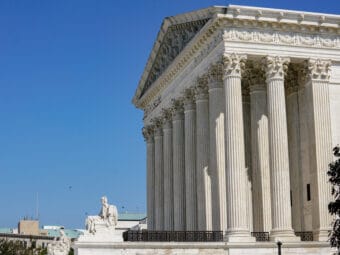
The U.S. Supreme Court will hear arguments Wednesday in a case that could imperil the ability of federal agencies to make rules. (Catie Dull/NPR)

The U.S. Supreme Court will hear a case Wednesday that could eviscerate the way the federal government regulates, well, everything. A system in place for decades has governed how judges review curbs on air and water pollution, gun safety measures and workplace protections.

But all of it could be upended by a conservative supermajority on the court at the request of an unlikely set of plaintiffs: a group of herring fishermen based in Cape May, N.J.

One of them is Bill Bright, a first-generation fisherman whose family has followed him to the sea.

My boys are working on the boats,” Bright said. “And my daughters, we have a shoreside business and they run that. So we’re all, the whole family is, in the seafood business 100%.”

Bright said he welcomes regulations to keep the herring population strong in the Northeastern United States. But he said the fisheries service went too far when the government mandated that vessel owners like him had to pay for observers on the boats to make sure they’re following the rules.

“We have this hanging over our head and we’re not under any illusion,” Bright said. “Once they start charging us for the monitor, that’s never going away.”

A case with broad implications

The case has implications far beyond the fishing industry and has attracted support from conservative legal foundations, the Gun Owners of America, and a trade group for electronic cigarette-makers, among others.

David Doniger, a senior attorney at the Natural Resources Defense Council, a nonprofit advocacy group, said those organizations have a specific goal in mind.

“The real purpose of it is to enfeeble the federal government so that we don’t have the capacity to deal with modern problems, and the billionaires and big companies can just do what they want and not be checked,” Doniger said.

In 1984, Doniger argued — and lost — an environmental law case involving the energy giant Chevron and the Environmental Protection Agency at the Supreme Court. Then, the court upheld a move by the Reagan-era EPA.

But the facts of that case are overshadowed by a system it enshrined, about the way judges evaluate federal regulations under legal challenge. It’s come to be known as the Chevron doctrine.

Judges are supposed to follow a two-step procedure. First, they’re supposed to ask whether the law is clear when someone challenges a federal rule. Then, if the law is not clear, if there’s an ambiguity, the court is supposed to defer to the agency interpretation if it’s reasonable.

In practice, that’s meant that courts often defer to people inside federal agencies who are experts on things like pollution, banking and food safety.

Whom to defer to?

Paul Clement, a former solicitor general in the George W. Bush administration, has argued more than 100 times before the Supreme Court. He represents the herring fishermen.

“Can’t think of a better way to mark the 40th anniversary of the Chevron decision than with an overruling,” Clement said. “In our view, this really has gotten out of control.”

He said the current system means Congress never has to weigh in and reach a compromise on the toughest policy questions, because one side or the other can just wait for a change in the executive branch every four or eight years, and the rules will swing back and forth based on the views of the political party in power.

“I think it’s really as simple as this: which is when the statute is ambiguous, and the tie has to go to someone, we think the tie should go to the citizen and not the government,” Clement added. “And one of the many problems with the Chevron rule is it basically says that when the statutory question is close, the tie goes to the government, and that just doesn’t make any sense to us.”

Conservatives on the Supreme Court, including Justices Clarence Thomas and Neil Gorsuch, have been critical of the Chevron approach for years now. Gorsuch even wrote that Chevron deserves a “tombstone.”

Don McGahn, the White House counsel for former President Donald Trump, made deregulation a top priority.

McGahn told a conservative audience during the Trump years that Gorsuch’s writings on the administrative state drew the attention of the White House —and that Trump nominated other judges who shared that outlook.

“There is a coherent plan here, where actually the judicial selection and the deregulatory effort are really the flip side of the same coin,” McGahn said.

An integral part of the law

The Biden administration is defending the fishing regulation and the Chevron doctrine as a “deeply ingrained” part of administrative law — one that people rely on for crucial health and safety regulations.

The current solicitor general, Elizabeth Prelogar, said in court papers that the monitoring program for the herring fishermen is not operating due to a lack of funds and that vessels that already paid for monitors have been reimbursed by the federal government, so the actual stakes for the herring fishermen may be low.

Overruling that 1984 case would represent a “convulsive shock to the legal system,” she added.

Doniger, the environmental advocate, said this case is about far more than fishing regulation. The hidden agenda, he argued, is protecting big oil, big gas, and big financial industries.

“The herring boats are just, you know, they’re just a front,” he said. “I mean, they’re kind of a red herring.”

A decision by the Supreme Court is expected this summer.

Copyright 2024 NPR. To see more, visit https://www.npr.org.

Martin Luther King Jr. was once considered ‘radical.’ Here’s how he came to be lauded

During his lifetime, the Rev. Martin Luther King Jr.’s views were considered radical by much of the white establishment, including the government. King was the subject of several FBI surveillance investigations, designed to collect subversive material on him. (Chick Harrity/AP)

Martin Luther King Jr. Day is approaching quickly – Monday, Jan. 15 — and this year, the federal holiday falls on the actual birthday of the celebrated civil rights leader who was assassinated more than a half a century ago.

As the United States commemorates the Rev. Martin Luther King Jr.’s legacy, here are a few things to know about the holiday honoring the slain activist and his fight against inequality and racial injustice.

The Rev. Martin Luther King Jr., accompanied by Rev. Ralph D. Abernathy (center), is booked by city police Lt. D.H. Lackey in Montgomery, Ala., on Feb. 23, 1956. (Gene Herrick/AP)

From subversive to hero

This year marks 56 years since the activist was assassinated.

Today, King is widely lauded as a hero who led a nonviolent crusade against racist segregation policies and horrendous brutality against Black people. But at the time, his views were considered quite radical by much of white America, including the government. (He was the subject of several FBI surveillance operations, designed to collect subversive material on King.)

The Pew Research Center found that by 1966 — two years after he’d received the Nobel Peace Prize — 63% of Americans had an unfavorable opinion of King, “including 44% who viewed him highly unfavorably.” Today, 81% of American adults say he had a positive impact on the country.

Jonathan Eig, author of King: A Life, told NPR in 2023 that King, a pastor who followed in his father’s footsteps, was a protest leader who did not like conflict.

Even as he sat at the helm of anti-segregation protests, including the Montgomery bus boycott and the march from Selma, Ala., to the state capitol, Eig said King “is always going out of his way to avoid conflict with people who are his elders. … And he really doesn’t like conflict.”

Eig added: “He has to push himself really out of his comfort zone to argue, to debate, to really challenge some of the leaders of this country.”

The rising full moon passes behind the Martin Luther King Memorial and the Washington Monument. MLK Day is the only federal holiday dedicated to volunteer service. (J. David Ake/AP)

The road to a federal holiday

The fight to declare MLK Day a federally recognized holiday was a long slog for its champions, who began the campaign almost immediately after King’s assassination on the balcony of a hotel in Memphis, Tenn., on April 4, 1968.

It was President Ronald Reagan who eventually signed a bill in 1983 that added Martin Luther King Jr. Day to the list of federal holidays, commemorating King’s contribution to the civil rights movement. Still, it wasn’t officially observed until 1986.

But there were still several holdouts who refused to recognize the holiday at the state level. Most notably, Arizona opposed it until a referendum was passed in 1992, after the state lost an estimated $500 million in revenue when the NFL moved the 1993 Super Bowl game to California in protest.

Why January and why Mondays?

The holiday always lands on the third Monday of the month, roughly around the time of King’s actual birthday, Jan. 15. The timing is also in line with the Uniform Holiday Act of 1968, which ensures a long weekend for workers.

In 1994, under then-President Bill Clinton, it became the only federal holiday dedicated to volunteerism, after Congress passed the King Holiday and Service Act. Americans are encouraged to observe the day “with acts of civic work and community service” in honor of King’s legacy.

Copyright 2024 NPR. To see more, visit https://www.npr.org.

Popular myths about sleep, debunked

Does it matter what time you go to bed? Sleep scientist Rebecca Robbins identifies commonly held beliefs about sleep — and debunks misconceptions. (Photo Illustration by Becky Harlan/NPR)

Sleep has a huge impact on our health. It helps our brains function, protects against heart disease and supports our immune system. And without it we would die.

Although for something so important, we aren’t formally taught how to do it right, says Rebecca Robbins, a sleep scientist at the Brigham and Women’s Hospital and an assistant professor of medicine at Harvard Medical School. “In America, you learn about nutrition or sex ed in school, but never about sleep.”

It may be why only a third of Americans get the recommended amount of sleep each night, according to the U.S. Centers for Disease Control and Prevention.

To help educate the public about healthy sleep, she and her colleagues identified popular myths about sleep and debunked them in a 2019 paper published in the journal Sleep Health. They looked at statements such as “many adults need only 5 or less hours of sleep” and “it does not matter what time of day you sleep.” And they found that these claims had “a limited or questionable evidence base.”

Robbins walks through some of these myths with Life Kit — and shares some much-needed tips on how to get better sleep.

MYTH 1: It doesn’t matter what time of day you sleep

“Unfortunately, the time of day does matter,” says Robbin. Our circadian rhythm — the internal circuitry that guides the secretion of the essential sleep hormone melatonin — is “significantly influenced by natural sunlight in our environment.”

When the sun comes up and we go outside, that sunshine “stops the floodgates of melatonin and switches the ‘on’ phase of our circadian rhythm,” she says.

“Conversely, going into a dark environment is what allows for the secretion of melatonin,” she adds.

Because of the importance of light, individuals who commonly work on overnight schedules or outside the typical 9 to 5 p.m. window can experience health issues, says Robbins. One study published in the journal Occupational Medicine in 2011 found that physicians and nurses who worked during these shifts were more likely to experience an increase in negative health outcomes such as diabetes and breast cancer.

They may be able to get good sleep that supports their health if they are “very diligent about the exposure they get to natural sunlight,” she says. For example, avoiding sunlight in their work environment as they approach the end of their shift, wearing sunglasses on the drive home to protect their eyes from the sunrise and sleeping in a room with very thick blackout curtains.

MYTH 2: One night of sleep deprivation will have lasting effects

If you had a bad night of sleep, don’t stress — just get back to your normal sleep routine as soon as possible, says Robbins. (Photo Illustration by Becky Harlan/NPR)

Your sleep isn’t going to be perfect every night, says Robbins. “Every now and then we might struggle. If we experience some stress during the day, our sleep suffers that night.”

Sleep deprivation, or lack of sleep for at least 24 hours, can lead to short-term adverse effects such as a lapse in attention or an increase in resting blood pressure, write Robbins and her colleagues in their research paper.

But they likely resolve with recovery sleep. So if you have an off night, don’t beat yourself up about it, says Robbins. Instead, try to get back on track with your normal sleep schedule as soon as possible.

MYTH 3: Being able to fall asleep anytime, anywhere is a good thing

Being able to fall asleep in random places … like your desk … isn’t a good thing. It takes a well-rested, healthy person about 15 to 20 minutes to fall asleep, says Robbins. (Photo Illustration by Becky Harlan/NPR)

“It’s a myth that a good sleeper would be able to hit the pillow and fall asleep right away,” says Robbins. “This is because sleep is a process.”

It takes a well-rested, healthy person about 15 to 20 minutes or maybe a little bit longer to fall asleep, she adds.

If you’re able to fall asleep immediately, it may be a sign of a chronically sleep-deprived state, write Robbins and her colleagues in their study. “If you were starved for food and sat down at any opportunity to eat a huge meal and ate voraciously, that would probably be a sign you’re not getting enough nutrition. It’s the same thing with sleep.”

MYTH 4: You can survive on less than 5 hours of sleep

Not getting a full night’s sleep — about 7 to 9 hours — can result in weight gain, obesity, diabetes and hypertension. (Photo Illustration by Becky Harlan/NPR)

Some people brag about needing only a few hours of sleep at night. That may come from the notion in our high-performing society that “well-rested people are lazy,” says Robbins — “which is a myth.”

The reality is that adults need about 7 to 9 hours of sleep a night, she says. “That’s where we see the most optimal health [outcomes]: improved heart health, longevity and brain health into our older years.”

Sleeping less than 7 hours a night can result in weight gain, obesity, diabetes and hypertension, according to a statement from the American Academy of Sleep Medicine and Sleep Research Society. It’s also associated with impaired immune function, impaired performance and increased errors — like “sending an email to the wrong person or entering incorrect numbers in a spreadsheet,” says Robbins.

So if you can, try to hit that goal of sleeping 7 to 9 hours as many nights of the week as possible, she adds. You’ll know that you’ve hit your sweet spot when you “wake up feeling refreshed, have energy throughout the day and are not reaching for coffee or energy drinks in the afternoon.”

MYTH 5: Watching TV is a good way to relax before bedtime

Watching a show on a device that emits heat, like a laptop positioned on your stomach, can deter your ability to fall asleep, says Robbins. (Photo Illustration by Becky Harlan/NPR)

Some people like to wind down before bed by watching TV. But that’s not a good idea, says Robbins. “You’re starting to associate your bed with things other than sleep.”

Watching a show on a device that emits heat, like a laptop positioned on your stomach, can also deter your ability to fall asleep. “Keep the body cool as you approach bedtime,” she says. Your bedroom should ideally be under 70 degrees. Hotter temperatures can lead to “tossing and turning, sleep disruption and more nightmares.”

In addition, watching upsetting programs like the nightly news could cause the stress hormone cortisol to spike in your body and “hinder your ability to power down,” she says.

But if watching 20 or 30 minutes of a comforting TV show like Friends or Seinfeld is a big part of your sleep routine and helps you relax before bed, then “carry on,” she adds. If your sleep routine “isn’t broken, don’t worry about fixing it.”

MYTH 6: Exercising within 4 hours of bedtime will disturb your sleep

If you want to exercise before bedtime, go for it — it can reduce stress and may help you fall asleep, says Robbins. (Photo Illustration by Becky Harlan/NPR)

For many years, sleep experts told people to “avoid exercise close to bedtime,” says Robbins, because it can raise body temperature, heart rate and adrenaline levels, leading to poor sleep. “But we actually don’t have any good data to back that up.”

What the research does show is that exercise and sleep appear “mutually beneficial,” write Robbins and her colleagues in their paper. One analysis of several research papers found that people who consistently exercised saw “small to moderate improvements in sleep.”

“Exercise releases endorphins which are mood elevators that can help with the No. 1 cause of sleep difficulties: stress,” she says.

For that reason, Robbins encourages people to exercise — even if it’s close to bedtime. “If that’s the only time you can get a workout in, go for it.”


The audio portion of this episode was produced by Clare Marie Schneider. The digital story was written by Malaka Gharib and edited by Clare Marie Schneider and Meghan Keane. The visual editor is Beck Harlan. We’d love to hear from you. Leave us a voicemail at 202-216-9823, or email us at LifeKit@npr.org.

Listen to Life Kit on Apple Podcasts and Spotify, and sign up for our newsletter.

Copyright 2024 NPR. To see more, visit https://www.npr.org.
Site notifications
Update notification options
Subscribe to notifications