In this April 30, 2021, file image taken by the Mars Perseverance rover and made available by NASA, the Mars Ingenuity helicopter, right, flies over the surface of the planet. (NASA via AP)
NASA is looking for four people to join its yearlong mission in a Mars simulator, as the agency continues research for human exploration of the planet.
The agency is already halfway through the first of three of its planned CHAPEA, or Crew Health and Performance Exploration Analog, missions. As the agency continues to collect data from it, applications are live for its next four-person cohort to live and work from a 3D-printed, 1,700-square-foot facility at NASA’s Johnson Space Center in Houston.
Starting in spring 2025, participants will undergo some of the trials and tribulations of life on the Red Planet, “including resource limitations, equipment failures, communication delays, and other environmental stressors,” NASA said.
Crew members will additionally have to do spacewalks, operate robots, exercise, grow crops and maintain the facility, known as the Mars Dune Alpha.
Details about pay will be discussed during the screening process, NASA said.
To qualify, applicants must be U.S. citizens or permanent residents, be between 30 and 55 years old, nonsmokers and speak English proficiently. Additionally, the agency is primarily looking for those with experience in science, technology, engineering or mathematics, known as STEM.
You can have at least four years of professional STEM experience, but must also either have a bachelor’s degree in STEM or have completed military officer training. If you have a master’s degree in STEM, you must have at least two years of professional STEM experience or at least 1,000 pilot hours. You may also be considered if you’ve gotten through two years of a STEM doctoral program.
Applicants who have a medical degree or have done a test pilot program also have a chance.
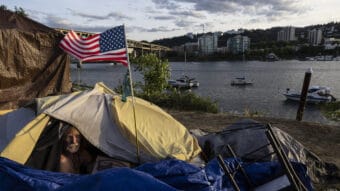
A man named Frank sits in his tent with a river view in Portland, Ore., in 2021. A lawsuit originally filed in 2018 on behalf of homeless people in the Oregon city of Grants Pass is set to go before the U.S. Supreme Court in April. (Paula Bronstein/AP)
In April, the U.S. Supreme Court will hear a major case that could reshape how cities manage homelessness. The legal issue is whether they can fine or arrest people for sleeping outside if there’s no shelter available. The 9th U.S. Circuit Court of Appeals has deemed this cruel and unusual punishment, and this case is a pivotal challenge to that ruling.
The high court declined to take up a similar case in 2019. But since then, homelessness rates have climbed relentlessly. Street encampments have grown larger and have expanded to new places, igniting intense backlash from residents and businesses. Homelessness and the lack of affordable housing that’s helping to drive it have become key issues for many voters.
The case, Grants Pass v. Johnson, could have dramatic implications for the record number of people living in tents and cars across the United States.
An Oregon town banned camping and the use of sleeping bags and stoves on public property
In the small city of Grants Pass, Oregon, homeless people say the city broke the law when it aggressively tried to push them out over the past decade. To discourage people from sleeping in public spaces, the city banned the use of stoves and sleeping bags or other bedding. But during several years when she had lost housing, Helen Cruz says she needed to live in city parks because they’re close to the jobs she had cleaning houses.
“We’re not out there because we want to be,” she says. “We don’t have a choice. There’s no place to go.”
Grants Pass has no homeless shelter that’s open to everyone. A religious mission takes in a few who agree to attend services. That left Cruz racking up thousands of dollars in fines, which she remains unable to pay.
“And I keep getting mail from Josephine County court saying, ‘You owe this. If you don’t pay this, it’s going to collections,'” she says, “which has destroyed my credit.”
A lawsuit originally filed in 2018 on behalf of homeless people in Grants Pass said the situation there was part of a larger crisis, as homelessness rates around the U.S. were high and growing. It accused the city of trying to “punish people based on their status of being involuntarily homeless.” The 9th Circuit agreed, saying the city could not ban people from sleeping outside with “rudimentary protection from the elements” when there was nowhere else for them to go.
The same appeals court also sided with homeless people in a landmark 2018 case out of Boise, Idaho, which the Supreme Court later declined to take up.
Critics say the Grants Pass ruling is a major expansion over the Boise one, since it forbids not just criminal penalties but civil ones. Advocates for homeless people don’t see much difference, since some in Grants Pass who couldn’t pay their fines were eventually jailed.
Grants Pass petitioned the Supreme Court. And its appeal has drawn support from dozens of local and state officials across the West and elsewhere who urged the justices to take this case. Among those filing such friend-of-the-court briefs are Republican-led states like Idaho, Montana and Nebraska and Democratic-led cities like Los Angeles and San Francisco, plus a separate brief from California Gov. Gavin Newsom.
Officials say the law has paralyzed their efforts to manage a public safety crisis
States and cities contend these rulings have contributed to the growth of tent encampments.
“These decisions are legally wrong and have tied the hands of local governments as they work to address the urgent homelessness crisis,” Theane Evangelis, the attorney representing Grants Pass, said in a statement. “The tragedy is that these decisions are actually harming the very people they purport to protect.”
Evangelis and others say sprawling tent camps pose a threat to public health and safety. Those living in them often face theft or assault and are at risk of being hit by passing vehicles. And they note that encampments have led to fires, disease, environmental hazards and high numbers of people overdosing on drugs and dying on public streets.
“It’s just gone too far,” California Gov. Gavin Newsom said last year at a Politico event in Sacramento. “People’s lives are at risk. It’s unacceptable what’s happening on the streets and sidewalks. Compassion is not stepping over people on the streets.”
Critics also say the 9th Circuit’s rulings are ambiguous and have been interpreted too broadly, making them unworkable in practice.
“We need to have clarity,” says Seattle City Attorney Ann Davison, who wrote a legal brief on behalf of more than a dozen other cities plus the National League of Cities.
For example, what exactly constitutes adequate shelter? And what about when a bed is open, but someone refuses to go? Local officials say that this happens a lot, and some acknowledge that people might have good reasons to not want to go to a shelter. Yet Davison says court rulings essentially require cities to build enough shelter for every person without housing, something many places can’t possibly afford.
They also argue that homelessness is a complex problem that requires balancing competing interests, something local officials are better equipped to do than the courts.
“We are trying to show there’s respect for the public areas that we all need to have,” Davison says. “And we care for people, and we’re engaging and being involved in the long-term solution for them.”
Advocates say punishing homeless people won’t solve the problem
Attorneys and advocates for the homeless plaintiffs argue that the 9th Circuit rulings are far narrower and less restrictive than cities claim.
“It’s interesting to me that the people in power have thrown up their hands and said, ‘There’s nothing we can do, and the only solution we can think of is to arrest people,'” says Jesse Rabinowitz of the National Homelessness Law Center. “That’s simply not true.”
He and others say the rulings do allow cities to regulate encampments. They can limit the time and place for them, ban the use of tents, even clear them out. And plenty of cities do that, though they often face lawsuits over the details of what’s allowed.
Grants Pass did what’s not allowed, which is ban camps everywhere all the time, says Ed Johnson of the Oregon Law Center, which represents those suing the city. He says that would basically make it illegal for people to exist.
“It’s sort of the bare minimum in what a just society should expect, is that you’re not going to punish someone for something they have no ability to control,” he says.
The reason they can’t control being homeless, Johnson says, is because Grants Pass — like so many cities around the U.S. — has a severe housing shortage and unaffordable rents. He says that cities are blaming the courts for decades of failed housing policies and that fining and jailing people only makes the problem worse.
“When we criminalize people, we know it impacts their ability to get a job,” says Ann Oliva, CEO of the National Alliance to End Homelessness. “It impacts their ability to get housing in the long run if they have a criminal record.”
Some cities that side with Grants Pass say they have invested heavily to create more affordable housing, even as homelessness rates keep going up. That’s a long-term challenge they’ll still face, whatever the Supreme Court decides.
Copyright 2024 NPR. To see more, visit https://www.npr.org.
What you see depends a lot on what you’re looking at, according to one crime analyst. (Robyn Beck/AFP via Getty Images)
In 2020, the United States experienced one of its most dangerous years in decades.
The number of murders across the country surged by nearly 30% between 2019 and 2020, according to FBI statistics. The overall violent crime rate, which includes murder, assault, robbery and rape, inched up around 5% in the same period.
But in 2023, crime in America looked very different.
“At some point in 2022 — at the end of 2022 or through 2023 — there was just a tipping point where violence started to fall and it just continued to fall,” said Jeff Asher, a crime analyst and co-founder of AH Datalytics.
In cities big and small, from both coasts, violence has dropped.
“The national picture shows that murder is falling. We have data from over 200 cities showing a 12.2% decline … in 2023 relative to 2022,” Asher said, citing his own analysis of public data. He found instances of rape, robbery and aggravated assault were all down too.
Yet when you ask people about crime in the country, the perception is it’s getting a lot worse.

A Gallup poll released in November found 77% of Americans believed there was more crime in the country than the year before. And 63% felt there was either a “very” or “extremely” serious crime problem — the highest in the poll’s history going back to 2000.
So what’s going on?
What the cities are seeing
What you see depends a lot on what you’re looking at, according to Asher.
“There’s never been a news story that said, ‘There were no robberies yesterday, nobody really shoplifted at Walgreens,'” he said.
“Especially with murder, there’s no doubt that it is falling at [a] really fast pace right now. And the only way that I find to discuss it with people is to talk about what the data says.”
There are some outliers to this trend — murder rates are up in Washington, D.C., Memphis and Seattle, for example — and some nonviolent crimes like car theft are up in certain cities. But the national trend on violence is clear.
NPR spoke to three local reporters — from Baltimore, San Francisco and Minneapolis — to better understand what is happening in their communities.
“We’ve seen two years now of crime incrementally going down, which I think is enough to say there’s a positive trend there,” said Andy Mannix, a crime and policing reporter for the Star Tribune in Minneapolis.
Rachel Swan, a breaking news and enterprise reporter for the San Francisco Chronicle, says there are “two really visible crises” in the downtown area: homelessness and open-air drug use.
“And honestly, people conflate that with crime, with street safety,” she said. “One thing I’m starting to learn in reporting on public safety is that you can put numbers in front of people all day, and numbers just don’t speak to people the way narrative does.”
In Baltimore — a city that’s battled a perception of being dangerous — it’s a similar story.
Lee Sanderlin is an enterprise reporter with The Baltimore Banner and says there are pockets of violent crime — but that’s not the case for the entire city.
“That’s a battle that the city’s leaders have had to fight with certain media outlets, with residents,” Sanderlin said. “People who don’t live in Baltimore, who live out in Baltimore County or neighboring counties, they certainly have a perception.”
Unraveling the reasons
Asher, the crime analyst, says there is no one reason why violent crime is going down.
“It’s a really hard question to answer, and I always caveat my answer with [saying that] criminologists still aren’t sure why violent crime went down in the ’90s,” he said. “We can kind of point to what some of the ingredients probably are even if we can’t take the cake and tell you what the exact recipe is.”
For cities like San Francisco, Baltimore and Minneapolis, there may be different factors at play. And in some instances, it comes as the number of police officers declines too.
Baltimore police are chronically short of their recruitment goal, and as of last September had more than 750 vacant positions, according to a state audit report.
“Our new police commissioner has been pretty open about the fact … that while they want to hire more officers, they have to do the job with the people they have,” Sanderlin said.
In Minneapolis, police staffing has plummeted. According to theStar Tribune, there are about 560 active officers — down from nearly 900 in 2019. Mannix said the 2020 police killing of George Floyd resulted in an unprecedented exodus from the department.
He said that the juxtaposition of crime going down at the same time as police numbers dropped was “very confusing to a lot of people.”
“The reality is there’s a lot of things that factor into crime,” he said. “It’s not just how many police there are. That’s definitely one variable.”
In Minneapolis, the city is putting more financial resources into nontraditional policing initiatives. The Department of Neighborhood Safety, which addresses violence through a public health lens, received $22 million in the 2024 budget.
In San Francisco, police there say they’ve been better at making arrests.
Meanwhile, Sanderlin said Baltimore voted for a new prosecutor who vowed to be tough on crime; the police say they are targeting violent hotspots; and the mayor’s office is connecting would-be offenders with housing assistance and employment.
“Put all of that in the blender with a generally better economy, more people are sort of getting back to a pre-pandemic way of life, and that probably has something to do with it,” Sanderlin said.
But changing the view of crime is about playing the long game, he added.
“Crime affects people very personally. The only way to get people to change their perceptions on a macro scale is for progress to continue.”
Copyright 2024 NPR. To see more, visit https://www.npr.org.
The Supreme Court will hear the case against the abortion pill mifepristone on March 26. It’s part of a two-drug regimen with misoprostol for abortions in the first 10 weeks of pregnancy. (Anna Moneymaker/Getty Images)
A scientific paper that raised concerns about the safety of the abortion pill mifepristone was retracted by its publisher this week. The study was cited three times by a federal judge who ruled against mifepristone last spring. That case, which could limit access to mifepristone throughout the country, will soon be heard in the Supreme Court.
The now retracted study used Medicaid claims data to track E.R. visits by patients in the month after having an abortion. The study found a much higher rate of complications than similar studies that have examined abortion safety.
Sage, the publisher of the journal, retracted the study on Monday along with two other papers, explaining in a statement that “expert reviewers found that the studies demonstrate a lack of scientific rigor that invalidates or renders unreliable the authors’ conclusions.”
It also noted that most of the authors on the paper worked for the Charlotte Lozier Institute, the research arm of anti-abortion lobbying group Susan B. Anthony Pro-Life America, and that one of the original peer reviewers had also worked for the Lozier Institute.
The Sage journal, Health Services Research and Managerial Epidemiology, published all three research articles, which are still available online along with the retraction notice. In an email to NPR, a spokesperson for Sage wrote that the process leading to the retractions “was thorough, fair, and careful.”
The lead author on the paper, James Studnicki, fiercely defends his work. “Sage is targeting us because we have been successful for a long period of time,” he says on a video posted online this week. He asserts that the retraction has “nothing to do with real science and has everything to do with a political assassination of science.”
He says that because the study’s findings have been cited in legal cases like the one challenging the abortion pill, “we have become visible – people are quoting us. And for that reason, we are dangerous, and for that reason, they want to cancel our work,” Studnicki says in the video.
In an email to NPR, a spokesperson for the Charlotte Lozier Institute said that they “will be taking appropriate legal action.”
Role in abortion pill legal case
Anti-abortion rights groups, including a group of doctors, sued the federal Food and Drug Administration in 2022 over the approval of mifepristone, which is part of a two-drug regimen used in most medication abortions. The pill has been on the market for over 20 years, and is used in more than half abortions nationally. The FDA stands by its research that finds adverse events from mifepristone are extremely rare.
Judge Matthew Kacsmaryk, the district court judge who initially ruled on the case, pointed to the now-retracted study to support the idea that the anti-abortion rights physicians suing the FDA had the right to do so. “The associations’ members have standing because they allege adverse events from chemical abortion drugs can overwhelm the medical system and place ‘enormous pressure and stress’ on doctors during emergencies and complications,” he wrote in his decision, citing Studnicki. He ruled that mifepristone should be pulled from the market nationwide, although his decision never took effect.
Matthew Kacsmaryk at his confirmation hearing for the federal bench in 2017. (AP)
“I don’t think he would view the retraction as delegitimizing the research,” says Mary Ziegler, a law professor and expert on the legal history of abortion at U.C. Davis. “There’s been so much polarization about what the reality of abortion is on the right that I’m not sure how much a retraction would affect his reasoning.”
Ziegler also doubts the retractions will alter much in the Supreme Court case, given its conservative majority. “We’ve already seen, when it comes to abortion, that the court has a propensity to look at the views of experts that support the results it wants,” she says. The decision that overturned Roe v. Wade is an example, she says. “The majority [opinion] relied pretty much exclusively on scholars with some ties to pro-life activism and didn’t really cite anybody else even or really even acknowledge that there was a majority scholarly position or even that there was meaningful disagreement on the subject.”
In the mifepristone case, “there’s a lot of supposition and speculation” in the argument about who has standing to sue, she explains. “There’s a probability that people will take mifepristone and then there’s a probability that they’ll get complications and then there’s a probability that they’ll get treatment in the E.R. and then there’s a probability that they’ll encounter physicians with certain objections to mifepristone. So the question is, if this [retraction] knocks out one leg of the stool, does that somehow affect how the court is going to view standing? I imagine not.”
It’s impossible to know who will win the Supreme Court case, but Ziegler thinks that this retraction probably won’t sway the outcome either way. “If the court is skeptical of standing because of all these aforementioned weaknesses, this is just more fuel to that fire,” she says. “It’s not as if this were an airtight case for standing and this was a potentially game-changing development.”
Oral arguments for the case, Alliance for Hippocratic Medicine v. FDA, are scheduled for March 26 at the Supreme Court. A decision is expected by summer. Mifepristone remains available while the legal process continues.
Copyright 2024 NPR. To see more, visit https://www.npr.org.
Measles is on the rise around the world, and even experts who saw it coming say the increase is “staggering.”
The World Health Organization said in December that its European region (which extends into parts of western and central Asia) saw an “alarming” increase in measles cases – from under a thousand in 2022 to more than 30,000 last year.
John Vertefeuille, director of the U.S. Centers for Disease Control and Prevention’s Global Immunization Division, said in a statement that the numbers are “staggering.”
The WHO’s most recent global numbers, released in November, reveal that measles cases increased worldwide by 18% to about 9 million, and deaths rose 43% to 136,000, in 2022 compared to 2021. Some 32 countries had large, disruptive outbreaks in 2022, and that number ticked up to 51 in 2023, Dr. Natasha Crowcroft, WHO’s senior technical adviser for measles and rubella control, told NPR.
The worrying uptick in measles outbreaks and deaths is, “unfortunately, not unexpected given the declining vaccination rates we’ve seen in the past few years,” noted John Vertefeuille of the CDC in his statement. “Urgent, targeted efforts are critical to prevent measles disease and deaths.”
Measles is one of the most contagious infectious diseases, and also one of the most preventable: two doses of vaccine in childhood is 97% protective. WHO estimates that some 61 million doses were missed or delayed in 2021. In 2022, about 83% of the world’s children received one dose of measles vaccine by their first birthday – the lowest proportion since 2008, when the rate was also 83%.
“We’re going to see outbreaks any time we have an accumulation of people who haven’t been vaccinated,” says Cyndi Hatcher, unit lead for measles elimination in the African Region at the CDC. “When you have immunization disruptions, measles is always going to be one of the first epidemics that you see.”
Low-income countries continue to have the lowest vaccination rates – five sub-Saharan African countries have rates below 50% for the first dose.
“Measles is called the inequity virus for good reason. It is the disease that will find and attack those who aren’t protected,” says Dr. Kate O’Brien, WHO director for immunization, vaccine and biologicals.
In Ethiopia, for example, conflict and weaknesses in the rural health system have taken a toll on vaccination rates, says Dr. Ngozi Kennedy, UNICEF’s Ethiopia health manager.
“We have a lot of pastoral communities that are often on the move so they may not know how to, or may not be able to, get to health centers for the vaccine. Also, as a result of the protracted conflicts, services are often disrupted with populations and even some health-care workers being displaced,” she says.
Children who don’t get their vaccines on schedule are at risk of death and serious illness, particularly children under age 5 who are at highest risk for severe complications including pneumonia, encephalitis (brain swelling) and death. Measles can also put children at higher risk for other potentially fatal childhood diseases – such as diarrheal diseases and meningitis – because the virus can cause the immune system to forget its learned defenses against other pathogens.
“I think that people may have forgotten how dangerous measles can be if they haven’t seen cases before,” Hatcher says.
But global health experts didn’t forget, and many predicted that outbreaks would be coming.
“During the pandemic, when everything was locked down, there wasn’t much measles being spread … because no one was going anywhere,” says WHO measles and rubella senior technical adviser Dr. Natasha Crowcroft. “It’s the usual human thing that no one does anything until the problem starts. It’s really hard to sell prevention.”
Last year a coalition including the Bill & Melinda Gates Foundation and Gavi, the Vaccine Alliance, launched “The Big Catch-Up” – an effort to get vaccination rates back up to at least their pre-pandemic levels. (Editor’s note: The Gates Foundation is one of the funders of NPR and this blog.)
Kennedy says efforts continue in Ethiopia to shore up vaccination rates. Health workers there have begun to track childhood immunizations electronically in hopes of keeping more children current, and the country has prioritized 14 “equity zones” to catch kids up on their shots.
But the CDC’s Cyndi Hatcher says much more needs to be done.
“I think we need to be very honest with ourselves at the global level,” she says. “Are we truly committed to making [measles] a public health priority and do we have the resources that we need to make full immunization a reality at the global level, the regional level but especially at the country and community level?”
Fran Kritz is a health policy reporter based in Washington, D.C., and a regular contributor to NPR. She also reports for the Washington Post and Verywell Health. Find her on X (Twitter): @fkritz
Copyright 2024 NPR. To see more, visit https://www.npr.org.
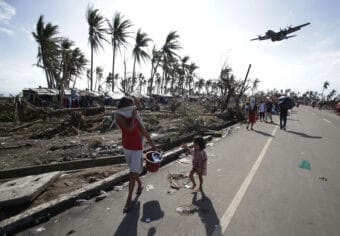
Residents of Tacloban in the central Philippines in 2013, after Typhoon Haiyan devastated the area. Scientists are renewing calls for a new Category 6 designation for the the most powerful hurricanes and typhoons, such as Haiyan. (Aaron Favila/AP)
Hurricanes are rated on a scale from one to five, depending on their wind speeds. The higher the speed, the higher the category. But as climate change makes powerful storms more common, it may be necessary to add a sixth category, according to a new paper published by leading hurricane researchers.
The current five point scale, called the Saffir-Simpson scale, was introduced in the 1970s and is used by forecasters around the world including at the National Hurricane Center in Florida. Under the scale, storms with maximum wind speeds of 157 miles per hour or higher are designated as Category 5 hurricanes.
Category 5 storms used to be relatively rare. But climate change is making them more common, research shows. And some recent Category 5 storms have had such high wind speeds that it would make more sense to assign them to a Category 6, if such a category existed, the authors argue.
The authors of the new paper, James Kossin of the First Street Foundation and Michael Wehner of the Lawrence Berkeley National Laboratory, have been studying the effects of climate change on hurricanes for decades. They propose that Category 5 should include hurricanes with maximum sustained winds of 157 to 192 miles per hour, and that a new Category 6 should include any storm with wind speeds above 192 miles per hour.
Under the new scale, Category 6 hurricanes would be exceedingly rare right now. For example, it might apply to 2013’s Typhoon Haiyan devastated the Philippines with wind speeds around 195 miles per hour. In fact, scientists in Taiwan argued at the time that Haiyan necessitated a new category designation.
Four other storms since 2013 would qualify for Category 6 status, including 2015’s Hurricane Patricia, which hit Mexico, and three typhoons that formed near the Philippines in 2016, 2020 and 2021.
But other powerful storms wouldn’t make the cut. For example, Hurricane Irma had sustained winds around 185 miles per hour when it hit the U.S. Virgin Islands in 2018 as a Category 5 storm. The wind damage from Irma led some residents to suggest that the storm should have been given a Category 6 designation by forecasters, because they felt that they hadn’t been adequately warned about the extraordinarily dangerous wind. But under the new proposed scale Irma would remain a Category 5 storm.
Similarly, Hurricane Dorian had wind speeds of about 185 miles per hour when it made landfall in the Bahamas in 2019. It was, and would remain, a Category 5 storm.
And the new scale would do little to convey the particular danger from storms such as Hurricane Harvey, Hurricane Florence or Hurricane Ida, which fit cleanly into the current wind speed scale, but caused deadly flooding from extreme rain. Climate change is to blame – studies have found that hurricanes and other storms are dropping more rain because a warmer atmosphere can hold more water.
The National Hurricane Center, which handles official category designations for hurricanes that threaten the United States and its territories, has not weighed in on the question of adding a Category 6. The center has done other things to update hurricane forecasts in response to climate change, however, including new storm surge forecasting tools, and upgrades that allow forecasters to predict the intensity and location of storms earlier, so people have more time to prepare and evacuate.
Copyright 2024 NPR. To see more, visit https://www.npr.org.
Close
Update notification options
Subscribe to notifications
Subscribe
Get notifications about news related to the topics you care about. You can unsubscribe anytime.