
A Joann store is seen in Tigard, Ore., in August 2020. The arts and crafts retailer announced Monday that it was filing for bankruptcy. (Ted Hsu/Alamy Stock Photo)
Joann — the craft store chain formerly known as Jo-Ann Fabrics — has filed for bankruptcy amid ongoing financial troubles.
But DIYers need not worry just yet: The company’s more than 800 stores nationwide will remain open and its website will stay active as the Hudson, Ohio-based company restructures its finances.
“We remain committed to our suppliers, partners, Team Members and other stakeholders, and are focused on ensuring we continue to operate as usual so we can continue to best serve our millions of customers nationwide,” Joann’s chief financial officer Scott Sekella said in a statement.
Joann and certain affiliates have filed for Chapter 11 bankruptcy in the U.S. Bankruptcy Court for the District of Delaware.
As part of the court-supervised bankruptcy process, Joann expects to receive $132 million in new financing. It said it will also slice its funded debt by about $505 million, but that “customers[,] vendors, landlords, and other trade creditors will not see any disruption in services.”
Additionally, Joann will become a private company again and will be delisted from the Nasdaq stock exchange, just two years after it went public in March 2021.
The company said in an SEC filing earlier that year that the COVID-19 pandemic had spurred growth in the sewing and broader crafting industry, with people across the U.S. fashioning their own masks and using the additional time at home for DIY pursuits.
“[W]e view the significant number of new customers and increased engagement by new and current customers as a very encouraging signal for the future of our business,” the company said.
But in September 2023, during a sales slump, Joann announced that it was restructuring its field and corporate operations and laying off an unknown number of workers, Retail Dive reported.
The company said in a December earnings report that its third-quarter net sales had dipped by 4.1% compared to the same period the year before, and its long-term debt was roughly $1.2 billion.
Copyright 2024 NPR. To see more, visit https://www.npr.org.
Boeing 787 Dreamliners are built at the aviation company’s North Charleston, South Carolina, assembly plant on May 30, 2023. The plant is located on the grounds of the joint-use Charleston Air Force Base and Charleston International Airport. (Photo by Juliette MICHEL / AFP) (Photo by JULIETTE MICHEL/AFP via Getty Images)
Police in Charleston, S.C., are investigating the death of John Barnett, a former Boeing quality control manager who became a whistleblower when he went public with his concerns about serious safety issues in the company’s commercial airplanes.
Barnett’s body was found in a vehicle in a Holiday Inn parking lot in Charleston on Saturday, police said. One day earlier, he testified about the string of problems he says he identified at Boeing’s plant where he once helped inspect the 787 aircraft before delivery to customers.
Police say officers were sent to the hotel to conduct a welfare check after people were unable to contact Barnett, who had traveled to Charleston to testify in his lawsuit against Boeing.
“Upon their arrival, officers discovered a male inside a vehicle suffering from a gunshot wound to the head,” police said in a statement sent to NPR. “He was pronounced deceased at the scene.”
The office of Charleston County Coroner Bobbi Jo O’Neal said that Barnett, who had been living in Louisiana after retiring from Boeing, died “from what appears to be a self-inflicted gunshot wound.”
Charleston police say detectives are actively investigating the case and are awaiting a formal cause of death as they try to determine the circumstances surrounding Barnett’s death.
Barnett, who spent decades working for Boeing at its plants in Everett, Wash., and North Charleston, S.C., had repeatedly alleged that Boeing’s manufacturing practices had declined — and that rather than improve them, he added, managers had pressured workers not to document potential defects and problems.
Barnett, 62, made international headlines in April of 2019 when he and other former Boeing employees spoke to The New York Times about what he called shoddy manufacturing problems at Boeing. Barnett accused the company of adopting a culture that prioritized raw numbers and profits over quality — and by extension, passenger safety.
“As a quality manager at Boeing, you’re the last line of defense before a defect makes it out to the flying public,” Barnett told the newspaper. “And I haven’t seen a plane out of Charleston yet that I’d put my name on saying it’s safe and airworthy.”
By the time the article appeared, Barnett had already filed a whistleblower complaint against Boeing, saying that his attempts to raise quality and safety problems had been ignored and that he was punished for continuing to flag them.
Copyright 2024 NPR. To see more, visit https://www.npr.org.
The Zeitfeld (Time Field) clock installation by Klaus Rinke is seen at a park in Düsseldorf, Germany, in 2019. (Maja Hitij/Getty Images)
Twice a year, every year, the ritual returns as literal clockwork: the start and end of daylight saving time.
Millions of Americans, with grunts or glee, tap at their devices or wind their watch hands, manually — and mentally — changing the time to reflect a change in seasons.
In recent years, lawmakers have talked about this timeworn tradition being on its last legs. A raft of bills on the federal and state levels that take aim at the biannual time changes are waiting for action or stalled, at least for now.
Here’s a look at where things stand.
What’s the status of that Senate bill to end time changes?
In March 2022, the Senate passed the Sunshine Protection Act. The intent behind the bill was to make daylight saving time permanent starting in the spring of 2023.
And at first, it looked as though it might become a reality. The Senate passed the bill through an expedited process and with unanimous consent — legislative rarities in this day and age.
But the bill wasn’t taken up in the House. Members cited higher priorities, like a budget deficit and the war in Ukraine, but there was also a growing chorus of criticism about the bill’s approach (more on this below).
Sen. Marco Rubio, R-Fla., reintroduced the bill in March 2023, and it was sent to the Senate Committee on Commerce, Science and Transportation, but there has been no notable movement on it since. A companion bill, introduced by Rep. Vern Buchanan, R-Fla., is similarly stuck in committee at the House level.
Even if either bill manages to pass both chambers, it’d still need to be signed by President Biden, who hasn’t indicated how he leans on the issue.
So for now, the tradition remains intact.
Who observes daylight saving time?
All states but two — Hawaii and Arizona (with the exception of the Navajo Nation) — observe daylight saving time. The U.S. territories of American Samoa, Guam, Puerto Rico, the Virgin Islands and the Northern Mariana Islands also don’t change their clocks.
What’s the argument against the Sunshine Protection Act?
When the Sunshine Protection Act was first debated in a House subcommittee, experts said switching to permanent daylight saving time would do everything: save lives, reduce crime, conserve energy and improve health.
But the medical community has taken issue with how the bill proposes to make the change — specifically, that it mandates all states adopt permanent daylight saving time rather than sticking to standard time.
Doctors and scientists argue that standard time is better for our health. Our internal clock is better aligned with getting light in the morning, which, in turn, sets us up for better sleep cycles.
The bill’s sponsors aren’t budging though. Rubio is still pushing for permanent daylight saving time.
And the biggest argument for this approach may be an economic one. The idea is that having more light in the evenings encourages people to go out and do things — i.e., spend money.
The nation’s convenience stores, for example, told a congressional subcommittee that they see an uptick in spending when clocks are set to daylight saving time.
Could the states adopt their own time-change rules?
With federal legislation stuck in a holding pattern, states could take up the issue, but they’re still subject to some federal limitations.
The Uniform Time Act, which was passed in 1966, says that states can enact permanent standard time but not permanent daylight saving time.
At least 550 bills and resolutions have surfaced concerning time changes at the state level in recent years, according to a tally from the National Conference of State Legislatures (NCSL). So the same debate that’s happening at the federal level is playing out in statehouses across the United States.
Save Standard Time, a nonprofit that works to end daylight saving time, regularly updates a detailed chart with the exact status of state bills.
Which states are trying to end daylight saving time?
In 2023, at least 29 states considered legislation related to daylight saving time.
At least half of those states have enacted or passed measures pledging to switch to permanent daylight time if Congress changes the rules to allow for such an action.
Several of those states were also actively considering legislation that would end daylight saving time, but by switching the state to year-round standard time, according to the NCSL.
Last month, an Oregon bill to keep most of the state in Pacific Standard Time for the entire year didn’t advance in the state’s Senate. But supporters agreed to amend the bill to say that Oregon will end daylight saving time only if California and Washington make the same change within the next 10 years.
Lawmakers in Oregon’s neighboring states of Idaho, California and Washington proposed similar bills.
When will daylight saving time end?
That’ll be Sunday, Nov. 3. Mark your calendars.
Copyright 2024 NPR. To see more, visit https://www.npr.org.
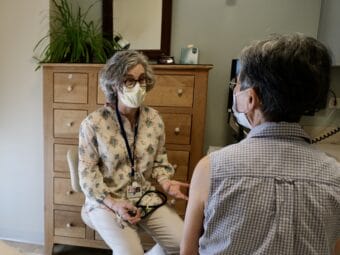
Dr. Louise Aronson, a geriatrician and author, speaks with a patient at UCSF’s Osher Center for Integrative Health in San Francisco. (Julia Burns)
A recent study found that older people spend an average of 21 days a year on medical appointments. Kathleen Hayes can believe it.
Hayes lives in Chicago and has spent a lot of time lately taking her parents, who are both in their 80s, to doctor’s appointments. Her dad has Parkinson’s, and her mom has had a difficult recovery from a bad bout of Covid-19. As she’s sat in, Hayes has noticed some health care workers talk to her parents at top volume, to the point, she says, “that my father said to one, ‘I’m not deaf, you don’t have to yell.'”
In addition, while some doctors and nurses address her parents directly, others keep looking at Hayes herself.
“Their gaze is on me so long that it starts to feel like we’re talking around my parents,” says Hayes, who lives a few hours north of her parents. “I’ve had to emphasize, ‘I don’t want to speak for my mother. Please ask my mother that question.'”
Researchers and geriatricians say that instances like these constitute ageism – discrimination based on a person’s age – and it is surprisingly common in health care settings. It can lead to both overtreatment and undertreatment of older adults, says Dr. Louise Aronson, a geriatrician and professor of geriatrics at the University of California, San Francisco.
“We all see older people differently. Ageism is a cross-cultural reality,” Aronson says.
Ageism creeps in, even when the intent is benign, says Aronson, who wrote the book, Elderhood. “We all start young, and you think of yourself as young, but older people from the very beginning are other.”
That tendency to see older adults as “other” doesn’t just result in loud greetings, or being called “honey” while having your blood pressure taken, both of which can dent a person’s morale.
Aronson says assumptions that older people are one big, frail, homogenous group can cause more serious issues. Such as when a patient doesn’t receive the care they need because the doctor is seeing a number, rather than an individual.
“You look at a person’s age and say, ‘Ah, you’re too old for this,’ instead of looking at their health, and function, and priorities, which is what a geriatrician does,” says Aronson.
She says the problem is most doctors receive little education on older bodies and minds.
“At my medical school we only get two weeks to teach about older people in a four-year curriculum,” she says.
Aronson adds that overtreatment comes in when well-meaning physicians pile on medications and procedures. Older patients can suffer unnecessarily.
“There are things…that happen again and again and again because we don’t teach [physicians] how to care about older people as fully human, and when they get old enough to appreciate it, they’re already retired,” says Aronson.
Kris Geerken is co-director of Changing the Narrative, an organization that wants to end ageism. She says research shows that negative beliefs about aging – our own or other people’s – are detrimental to our health.
“It actually can accelerate cognitive decline, increase anxiety, it increases depression. It can shorten our lifespans by up to seven-and-a-half years,” she says, adding that a 2020 study showed that discrimination against older people, negative age stereotypes, and negative perceptions around one’s own age, cost the health care system $63 billion a year.
Still, beliefs can change.
“When we have positive beliefs about age and aging, those things are all flipped,” Geerken says, and we tend to age better.
Geerken conducts anti-ageism trainings, often over Zoom, including trainings for health care workers. She also advises older adults on how to push back if they feel their medical concerns are being dismissed with comments like, “It’s to be expected at your age.”
Leslie Pelton is vice president at the Institute for Healthcare Improvement, which launched the concept of Age-Friendly Health Systems in 2018, along with the John A. Hartford Foundation.
She describes the effort as one in which every aspect of care, including mobility, mental health and medication, is centered on the needs and desires of the older adult.
Pelton says 3,700 sites across the US – including clinics, hospitals, and nursing homes – are now designated age-friendly.
She describes the system as “a counterbalance to ageism, because it requires that a clinician begins with asking and acting on what matters to the older adult, so right away the older adult is being seen and being heard.”
That sounds great to Liz Schreier. Schreier is 87 and lives in Buffalo. She walks and does yoga regularly. She also has a heart condition and emphysema and spends plenty of time at the doctor. She lives alone and says she has to be her own advocate.
“What I find is a disinterest. I’m not very interesting to them,” she says. “And I’m one of many – you know, one of those old people again.”
She goes from specialist to specialist, hoping for help with little things that keep cropping up.
“I had a horrible experience with a gastroenterologist who said I was old, and he didn’t think he wanted to do a scope on me, which was a little insulting,” she says.
She later found one of his colleagues who would.
Schreier says navigating the health care system in your 80s is tough. What she and her peers are looking for from health care workers, she says, is kindness, and advice on how to stay active and functional no matter how old they are.
Copyright 2024 NPR. To see more, visit https://www.npr.org.
A unfinished Boeing 737 Max sits outside Boeing’s manufacturing facility in Renton, Wash., on Feb. 27, 2024. The top federal safety investigator says Boeing still has not provided key information that could shed light on what went wrong when a door plug blew off an in-flight 737 Max 9 in January. (Jovelle Tamayo for NPR)
WASHINGTON — More than two months after a door plug panel blew off a Boeing 737 Max 9 jet in midair, the top federal safety investigator says Boeing still has not provided key information that could shed light on what went wrong.
National Transportation Safety Board chair Jennifer Homendy told the Senate Commerce Committee on Wednesday that Boeing has not revealed who was responsible for failing to reattach the door plug properly at the company’s factory near Seattle.
“It’s absurd that two months later, we don’t have that,” Homendy said.
The NTSB said in its preliminary report last month that four key bolts which are supposed to hold the door plug in place were missing when the plane left Boeing’s factory last year. The report found the door plug was opened to allow for repair work on misdrilled rivets on the fuselage while the plane was being assembled.
But Homendy says the NTSB is still unable to determine who opened and closed the door plug.
“Boeing has not provided us with documents and information we have requested numerous times,” Homendy told the committee.
“Are you telling us that even two months later you still do not know who actually opened the door plug?,” asked Senator Ted Cruz (R-Texas), the committee’s ranking member.
“That’s correct, Senator. We don’t know,” Homendy replied. “And it’s not for lack of trying.”
After looking through emails and text messages, Homendy said investigators believe the work on the door plug took place on two days in mid-September.
The NTSB has asked Boeing to provide documentation of when it was performed and by whom, Homendy said. But Boeing has told investigators that “they can’t find it,” she said.
Investigators have also been seeking the names of the 25 Boeing employees who are part of the team that opens and closes door plugs. But so far, Homendy says the plane-maker has not provided those names.
In this National Transportation Safety Board handout, plastic covers the exterior of the fuselage plug area of Alaska Airlines Flight 1282 on January 7, 2024 in Portland, Ore. A door-sized section near the rear of the 737 Max 9 blew off 10 minutes after it took off from Portland on January 5. (NTSB via Getty Images)
A Boeing spokesman disputed Homendy’s account in an emailed statement to NPR. “Since the first moments following the Alaska Airlines Flight 1282 accident, we have worked proactively and transparently to fully support the NTSB’s investigation,” said Boeing’s Connor Greenwood.
“Early in the investigation, we provided the NTSB with names of Boeing employees, including door specialists, who we believed would have relevant information. We have now provided the full list of individuals on the 737 door team, in response to a recent request,” Greenwood said.
Mounting frustration with the company seemed to cross party lines at Wednesday’s hearing.
Senator Cruz called the company’s response to investigators “unacceptable.” He asked the NTSB to report back in a week to say whether Boeing had agreed to share the names and documents that investigator’s requested.
It’s possible that the records the NTSB is seeking now do not exist, Homendy said. If they don’t, that would raise serious questions about the company’s quality control practices, she said.
“We have been informed that they have a procedure to maintain documents on when work is performed and including when door plugs are open, closed or removed,” she said. “We have not been able to verify that. And without that information, that raises concerns about quality assurance, quality management, safety management systems within Boeing.”
Boeing also acknowledged the possibility that the documents the NTSB is seeking may not exist.
“If the door plug removal was undocumented there would be no documentation to share,” Greenwood said in his statement. “We will continue to cooperate fully and transparently with the NTSB’s investigation.”
Could woolly mammoths walk again among humans? Scientists are working to resurrect the extinct species. (Mark Garlick/Getty Images/Science Photo Library)
A biotech company that hopes to resurrect extinct species said Wednesday that it has reached an important milestone: the creation of a long-sought kind of stem cell for the closest living relative of the woolly mammoth.
“This is probably the most significant step in the early stages of this project,” said George Church, a geneticist at Harvard University and the Massachusetts Institute of Technology who co-founded Colossal Biosciences in Dallas.
The woolly mammoth was a big, shaggy species of elephant that roamed the tundra before going extinct thousands of years ago. Colossal has been working to bring the mammoth, the dodo bird and other extinct species back to life using the latest cloning and genetic engineering techniques.
And now the company says scientists have for the first time created induced pluripotent stem cells for the mammoth’s closest living relative: Asian elephants. The company plans to describe the work in a scientific paper that will be posted on the bioRxiv preprint server. It hasn’t been peer-reviewed, but the company says that’s in progress.
A steppingstone from modern elephant to mammoth
The achievement is still far from the ultimate goal of creating herds of giant hairy beasts roaming in the wild again, but Church said it’s a major step. “This is kind of like asking Neil Armstrong if he plans to go to Mars — kind of misses the point he just landed on the moon on Apollo 11,” Church said.
Scientists can now try to use cloning techniques and gene editing to manipulate the cells in the hopes of someday creating elephants with key traits of mammoths, such as their heavy coats and the layers of fat that enabled them to survive in cold climates.
“We don’t necessarily need to bring back a perfect genome of a mammoth, because we want one that has certain things that mammoths didn’t have. Like we want them to be resistant to the herpesvirus that is causing a huge fraction of infant elephants to die,” Church said.
Technical possibility raises ethical concerns
But some scientists object to the whole idea of trying to revive extinct animals.
“What are you going to get out of this?” asked Karl Flessa, a professor of geosciences at the University of Arizona. “First of all, I think you’re going to get a bit of a freak show in a zoo somewhere. And then if you’re going to release a herd into the Arctic tundra, is that herd going to go marching off to its second extinction in the face of global warming?”
“I think it’s irresponsible,” Flessa added.
But Church and his colleagues defended the project.
“Some people think it’s a bad idea because there will be only one lonely cold-adapted elephant. That’s not our intention,” Church said. “It’s to have them fully socialized in large herds. Some people think it’s a bad idea because it takes money away from conservation efforts, when in fact we’re injecting money into conservation efforts.”
Church said the woolly mammoth program could lead to new ways to protect endangered species like Asian elephants by expanding their habitat and helping scientists study the animals.
Researchers say the work will advance conservation
“We’re very, very excited that we have derived the first elephant induced pluripotent stem cells,” said Eriona Hysolli, who heads Colossal’s mammoth project. “These cells will benefit the elephant conservation community just as much as being engineered to bring back the woolly mammoth.”
Reintroducing elephants with woolly mammoth traits could also help fight global warming by restoring ecosystems in ways that would help reduce the amount of carbon being released into the atmosphere, Church said.
Some scientists say the creation of the specialized elephant stem cells is a noteworthy scientific achievement.
“Producing induced pluripotent stems has proved to be very difficult for some species — notoriously the elephant,” said Oliver Ryder, director of conservation genetics at the San Diego Zoo Wildlife Alliance. “It’s a great advancement to have been able to accomplish this for elephants.”
The cells can be used to study the biology, reproduction and health of elephants, he said.
“It opens up new possibilities for conserving species’ genetic diversity, preventing extinction and contributing to the sustainability of species,” Ryder said. “There’s an enormous potential.”
While that may be true, others argue that using the cells to try to bring back mammoths is misguided.
“What I find troubling is bringing back some sort of a surrogate that is part- mammoth, part-elephant,” said Joseph Bennett, an associate professor of biology at Carleton University in Ottawa, Canada. “Bringing that back as something that would somehow be portrayed as conservation would be a difficult sell on my part.”
Others agree.
“There are so many species going extinct today. We’re actually not going to be able to help any of them if we’re thinking about the woolly mammoth. We need to focus on the species here today. Living animals versus fossils is really where our focus should be,” said Gabriela Mastromonaco, senior director of wildlife science at the Toronto Zoo. “It’s just a distraction.”
Copyright 2024 NPR. To see more, visit https://www.npr.org.
Close
Update notification options
Subscribe to notifications
Subscribe
Get notifications about news related to the topics you care about. You can unsubscribe anytime.