NPR News

First over-the-counter birth control pill heads to stores

Opill is the first birth control pill available over the counter in the United States. (Perrigo Company)

Opill, the first oral contraceptive pill to be available without a prescription in the U.S., has shipped to retailers nationwide. It will be sold online and in the family planning aisle of drugstores, convenience stores and supermarkets later this month, the manufacturer announced Monday.

The drug itself has been around for decades, but manufacturers have been working nine years toward making it available over the counter. Here’s what else to know about Opill.

What’s in it?

Opill is a daily progestin-only pill, meaning there’s no estrogen in it. That’s why this kind of pill is sometimes called a mini-pill.

This isn’t a new kind of birth control pill. The drug substance was originally approved for prescription use in 1973, according to the Food and Drug Administration. But this is the first birth control pill that has been approved for use without a prescription from a health care provider.

“We have been working on it for nine years and got approval in July 2023 from the FDA to move forward. And it’s been kind of full-steam ahead since that day,” says Triona Schmelter, an executive at Perrigo, which manufactures Opill.

Is it safe? And does it work?

Yes. Like many other oral contraceptives, it’s 98% effective at preventing pregnancy if taken correctly. It should start to work 48 hours after taking the first dose. Potential side effects include headaches, bloating and cramping.

The FDA convened its panel of outside experts to advise it on this approval back in May, and the panel voted unanimously in favor of approval.

They said that the labeling alone was enough for people to be able to use Opill correctly without a doctor’s help.

“The progestin-only pill has an extremely high safety profile, and virtually no one can have a health concern using a progestin-only pill,” Dr. Sarah Prager, a professor of obstetrics and gynecology at the University of Washington School of Medicine, told NPR in July when Opill was first approved by the FDA.

Where will it be sold?

Major retailers will sell Opill where you’d typically find condoms and pregnancy tests.

“Today we start shipping Opill to our retailers for their brick-and-mortar stores,” says Schmelter. It will be available in the coming weeks in-store in the family planning aisle, she says, as well as on online marketplaces and Opill.com.

How much will it cost?

A month’s supply of Opill has a recommended retail price of $19.99. It will be a little cheaper to buy in bulk, however, with a three-month supply costing $49.99. Opill.com will also sell a six-month supply for $89.99.

Although birth control pills are available to people with insurance without a copay due to the Affordable Care Act, not everyone wants their birth control pill to show up on their insurance, so they may choose to pay out of pocket.

Schmelter says Perrigo has also set up a patient assistance program for people who don’t have insurance and can’t afford Opill.

Who is this for?

This is for people who want to prevent pregnancy but perhaps aren’t able to visit their health care provider to get a prescription. They may be in between medical appointments, or they may be teens who otherwise aren’t able to access reproductive health care.

“It doesn’t require a doctor’s visit, which means it doesn’t require time off work or potentially a babysitter or finding a doctor,” Schmelter says. “You can walk into any local retailer and, in the family planning section, pick it up at your convenience.”

“When it comes from Opill.com, the packaging will be discreet,” Schmelter says. “It’s nobody’s business but your own.”

Copyright 2024 NPR. To see more, visit https://www.npr.org.

‘Everything is rising at a scary rate’: Why car and home insurance costs are surging

Ezra Croft from North Carolina saw his annual homeowners’ insurance surge to $1,600, a $700 increase. Many others across the country are also seeing surging auto and home insurance premiums. (Courtesy of Ezra Croft)

Ezra Croft has never filed an insurance claim, and his house in Raleigh, North Carolina isn’t close to a stormy coastline or a fire-prone forest.

So Croft was surprised when his annual homeowner’s insurance premium shot up to $1,600, or $700 dollars more than he was paying just a couple of years ago.

“I’m a middle income guy,” Croft says. “Don’t make a ton of extra money. At this point I’m teetering on the point of inaffordability.”

Similar complaints can be heard all over the country. On average, insurance companies sought to raise homeowners’ premiums by more than 11% last year, according to S&P Global Market Intelligence.

Auto insurance premiums are climbing even faster, far outpacing overall inflation.

Take Paul Morro. His auto insurance bill just jumped by $600 a year.

“Here’s the kicker,” Morro says. “My wife and I both work from home. So we have no commute to speak of.”

He’s bracing himself for the bill to insure his house, in Herndon, Va.

“It just feels like everything is rising at a scary rate,” Morro says.

Why insurance costs are surging

Insurance companies insist they’re just playing catch-up, after two years of big losses. For every dollar in home and auto premiums they collected last year, insurance companies paid an average of $1.10 in claims and expenses, according to the Insurance Information Institute.

“Nobody wants to have that higher-price bill,” says Sean Kevelighan, the institute’s CEO. But he added companies “need to price insurance according to the risk level that’s out there.”

Inflation is partly to blame for those big payouts. The cost of fixing or replacing damaged homes and cars has jumped sharply in recent years as a result of rising labor and material prices.

Even as those prices start to level off, though, insurers are having to contend with a mounting toll of natural disasters, and not just in the usual places like Florida and California.

A car remains in the wreckage after a house and garage were abruptly destroyed by a landslide as an atmospheric river storm inundates the Hollywood Hills area of Los Angeles on Feb. 6, 2024. A spate of natural disasters is helping lead to soaring insurance premiums across the country. (David McNew/AFP via Getty Images)

Last year, there were around two dozen severe storms in the U.S. with billion-dollar price tags, spreading lightning, hail and damaging winds through many parts of the country.

“While a lot of these storms don’t make national headlines, they do tend to be very costly at the local level,” says Tim Zawacki, principal research analyst for insurance at S&P Global Market Intelligence. “And the breadth of where these storms are occurring is something that I think the industry is quite concerned about.”

As a result, insurance premiums are likely to keep climbing this year even as overall inflation cools.

Insurers have a lot of pricing power

While state regulators have some power to limit those price hikes, insurance companies tend to get their way. Regulators know that if they move too aggressively to limit premiums, insurance companies might stop offering coverage altogether.

“The insurance companies have become really aggressive in their bullying,” says Doug Heller, director of insurance for the Consumer Federation of America. “You’ve heard a lot about companies that are threatening to pull out of the market if they don’t get what they want. Generally speaking that bullying has worked.”

Douglas Heller, director Of insurance at the Consumer Federation of America, speaks during a Senate Banking Committee hearing about the property insurance market on Capitol Hill in Washington, D.C., on Sept. 7, 2023. (Anna Moneymaker/Getty Images)

Last week, the Treasury Department hosted a roundtable with consumer and environmental groups to discuss the ways climate change is rattling insurance markets. The department also plans to host a meeting on the topic with insurance industry stakeholders.

Customers can sometimes save money by shopping around. Alicia Pitorri switched insurance carriers after the cost of her family’s auto policy jumped more than a thousand dollars.

“It was Liberty Mutual,” she says with a rueful laugh. “We’ve since switched to State Farm since the renewal went up so much.”

Pitorri, who lives in Nashville, says while she managed to shave a few hundred dollars off the bill, she’s still paying a lot more than she did two years ago.

“What can you do?” she asks. “You need insurance. You can’t have a vehicle or a house without them. So you have to pay for it. And you figure out where you can cut other things to make sure you can drive around.”

Going without insurance

Auto insurance is required in nearly all states. And lenders typically require homeowners who have a mortgage to carry insurance as well. Still, as premiums keep climbing, more people are scaling back their coverage or even going without.

Ezra Croft considered dropping his homeowners’ coverage, but ultimately decided to pay the higher premium.

“I’m fairly good at home repairs, but if something like a tree fell on my house or a tornado or a fire, I don’t know what I would do,” Croft says.

A survey by the Insurance Information Institute last year found 12% of homeowners had no insurance, up from 5% four years earlier. Going without coverage is risky, though, for both individuals and communities.

“Insurance is an important product, not only for economic stability but for community resilience,” says Heller. “We are very concerned that these escalating premiums are going to lead to escalating rates of uninsured drivers and homeowners, which makes us all quite vulnerable.”

Copyright 2024 NPR. To see more, visit https://www.npr.org.

These companies tried a 4-day workweek. More than a year in, they still love it

A U.K. four-day workweek pilot has shown lasting benefits more than one year later. (Dragon Claws)

The four-day workweek is proving to be the gift that keeps on giving.

Companies that have tried it are reporting happier workers, lower turnover and greater efficiency. Now, there’s evidence that those effects are long lasting.

The latest data come from a trial in the U.K. In 2022, 61 companies moved their employees to a four-day workweek with no reduction in pay.

They began it as a six-month experiment. But today, 54 of the companies still have the policy. Just over half have declared it permanent, according to researchers with the think tank Autonomy, who organized the trial along with the groups 4-Day Week Campaign and 4 Day Week Global.

Follow-up surveys help to explain the four-day workweek’s success.

Improvements in physical and mental health, work-life balance, and general life satisfaction, as well as reductions in burnout, have been maintained over the past year, says sociologist Juliet Schor of Boston College, who’s part of the research team. Workers report higher job satisfaction now than before the trial began.

“The results are really stable. It’s not a novelty effect,” she says. “People are feeling really on top of their work with this new model.”

Similarly positive results are emerging from other four-day workweek trials, including in the U.S., Schor says.

“Doesn’t happen by magic”

At a recent webinar, participating companies shared their experiences and tips for success.

“It absolutely doesn’t happen by magic,” says Nicci Russell, CEO of the London-based water conservancy non-profit Waterwise. “You can’t just drop a day and carry on as usual, because how stressful would that be?”

Russell says after some initial teething problems, they managed to find efficiencies that allow all 10 employees to take Fridays off. They keep all meetings to 30 minutes and make sure those meetings start on time. They block off focus time on their calendars — sometimes even declaring Monk Mode Mondays. They’re more mindful of the emails they send and of the time they spend going through their inboxes.

“I only do my emails now at certain times of the day. I’m not drawn into them all day, every day,” she says.

At the end of the pilot, the staff at Waterwise were unanimous in their desire to continue the four-day week. A majority said they wouldn’t consider a five-day-a-week job again unless presented with a significant pay raise.

“It’s brilliant for retention, which is super important in a teeny organization like ours,” says Russell.

No one-size-fits-all

One important finding, researchers say, is that there is no one-size-fits-all recipe when it comes to the four-day workweek.

At Merthyr Valleys Homes in South Wales, giving everyone Fridays off wouldn’t have worked, says Ruth Llewellyn, who led the pilot at the housing cooperative.

With 240 employees working in roles from customer service to home repairs and maintenance, they decided to keep their operations running from Monday through Friday.

“For us, the thought of dropping repair service for our tenants one day a week meant that we wouldn’t be providing the same service,” Llewellyn says.

Instead, employees work a variety of schedules depending on individual and team needs. Some have a set day off every week, while others are on a rolling schedule. Some employees work two half-days, and some still work five days a week but shorter hours, allowing them to drop off and pick up their children from school.

The teams found time savings in different places. Some of the trades staff found they could reduce travel time to and from the building supplier with better planning around which materials they needed. Customer-facing teams found they could address smaller issues quickly over the phone.

Employees are more motivated, employee performance has held consistent, and absences for illnesses have fallen, Llewellyn says.

Yet the company is not committing to the four-day workweek forever — at least, not yet. Hoping for still more data, it extended the pilot and will re-evaluate the results later this spring.

“We’re really hopeful at that point that we can make it permanent,” says Llewellyn.

Why companies fail

Of the 61 U.K. companies that joined the 2022 pilot, only a few have discontinued the four-day workweek.

At one small consultancy, although the staff reported improved morale and the company reported a boost in efficiency, there were problems managing client and stakeholder expectations, according to feedback collected after the pilot.

Researchers suggest that better external communications and more flexibility in adapting the policy to challenging conditions might have made a difference.

“There is a suggestion that the organisation did not give the policy enough of a chance, and indications of a change of heart on the issue from management,” the researchers wrote.

Copyright 2024 NPR. To see more, visit https://www.npr.org.

Transcript :

AILSA CHANG, HOST:

The four-day workweek for five days of pay is proving to be the gift that keeps on giving. Companies who are trying it report happier workers, lower turnover and greater efficiency. NPR’s Andrea Hsu reports on the latest research coming out of those trials.

ANDREA HSU, BYLINE: Around this time last year, early results from a large trial in the U.K. caused a hullabaloo. Of 61 companies that had moved to a four-day workweek with no reduction in pay, 92% said they would continue with it. Now another whole year has passed, and all but a few have either made it permanent or extended their trials. Boston College sociologist Juliet Schor is part of the research team.

JULIET SCHOR: People are feeling really on top of their work with this new model.

HSU: She says the gains are not a novelty effect, and they’re not limited to the U.K. Survey data from elsewhere, including here in the U.S., show lasting improvements in things like physical and mental health and work-life balance.

SCHOR: The results are really stable.

HSU: A couple of the U.K. employers talked about their experiences in a webinar hosted by the researchers. Nicci Russell, who leads a water conservation nonprofit in London, says she realized early on…

NICCI RUSSELL: You know, if we close on a Friday, nobody dies. We aren’t doctors. We’re not running a chip shop.

HSU: Still, they were busy, so to make it work, they now keep all their meetings to half an hour. They block off focus time in their calendars. They’re more mindful about email.

RUSSELL: So I only do my emails now at certain times of the day. I’m not sort of drawn into them all day every day.

HSU: All 10 people at the company loved the changes. Most of them said they wouldn’t consider a five-day-a-week job again without a significant raise.

RUSSELL: It’s brilliant for retention, which is super-important in a teeny organization like ours.

HSU: Now, one thing the researchers have learned is that there’s no one size fits all. Giving everyone Fridays off wouldn’t have worked for the housing cooperative in South Wales where Ruth Llewellyn works. They have 240 employees working in roles from customer service to home repairs and maintenance.

RUTH LLEWELLYN: We still operate a Monday to Friday service because, for us, the thought of dropping a repair service for our tenants one day a week meant that we wouldn’t be providing the same service.

HSU: So employees work a variety of schedules. Some have a set day off, and for others, it changes.

LLEWELLYN: We’ve also got people that do two half-days, people that do five days shorter hours, which allows them to do things like drop the children at school and pick them up.

HSU: Llewellyn says there are fewer sick day call-outs, and employee performance has been consistent. Still, they want to collect more data, so they extended their pilot for another year.

LLEWELLYN: We’re really hopeful at that point that we can make it permanent.

HSU: Now, the researchers did talk about one of the very few companies where the experiment failed. A small consultancy struggled with managing client and stakeholder expectations. Although employees were happier, management had a change of heart. The researchers suggest that better planning and more flexibility might have changed that outcome. Andrea Hsu, NPR News.

(SOUNDBITE OF SWEET CHARLES SONG, “YES IT’S YOU”) Transcript provided by NPR, Copyright NPR.

How Portugal eased its opioid epidemic, while US drug deaths skyrocketed

Dr. João Goulão, director-general of the General Directorate for Intervention on Addictive Behaviours and Dependencies General Directorate, is widely credited with shifting Portugal’s addiction response toward a focus on health care and treatment. Overdose deaths have plummeted. (Lea Suzuki/San Francisco Chronicle/ via Getty Images)

Talk to people addicted to street drugs in Lisbon, Portugal’s capital, and you hear confusion and dismay over the carnage of overdose deaths taking place an ocean away in the U.S.

Ana Batista, a soft-spoken woman in her 50s who’s been addicted to heroin for years, said she hasn’t lost a single friend or family member to a fatal overdose.

“No, no, no,” she said, speaking at a safe drug consumption clinic, where she had come to inject under the supervision of nurses and counselors.

Liliana Santos, 41, a woman with a sad weathered face who had come to the clinic to smoke heroin, voiced similar bafflement.

Had she lost friends or family? “No.” Had she overdosed herself? She shook her head: “No, no.”

The contrast is striking. In the U.S., drug deaths are shatteringly common, killing roughly 112,000 people a year. In Portugal, weeks sometimes go by in the entire country without a single fatal overdose.

Ana Batista, who asked that her face not be photographed, comes to a drug consumption clinic in Lisbon almost every day where she can use heroin under medical supervision. “It’s different, very different,” Batista said, adding that she feels safer and less alone. (Tilda WIlson/NPR)

Portugal has roughly the same population as the state of New Jersey. But while New Jersey alone sees nearly 3,000 fatal drug overdoses a year, Portugal averages around 80.

“The statistics really speak for themselves,” said Miguel Moniz, an anthropologist at the Institute of Social Sciences, University of Lisbon, who studies addiction policy in the U.S. and Portugal.

An opioid crisis and a pivot toward healing

What’s different in Portugal? In the late 1990s, the country faced an explosion of heroin use. The drug was causing roughly 350 overdose deaths a year and sparked a wave of HIV/AIDS and other diseases linked to dirty needles.

Portugal offers people in addiction an integrated network of services, including vans where residents can use street drugs under medical supervision. (Tilda Wilson/NPR)

Portugal’s leaders responded by pivoting away from the U.S. drug war model, which prioritized narcotics seizures, arrests and lengthy prison sentences for drug offenders.

Instead, Portugal focused scarce public dollars on health care, drug treatment, job training and housing. The system, integrated into the country’s taxpayer-funded national health care system, is free and relatively easy to navigate.

“Someone who has problematic drug use isn’t someone who is a criminal or someone who has a moral failing,” Moniz said, describing Portugal’s official view of addiction.

“They’re someone who has a health problem, a physical or a mental health problem,” he said. “That’s a tremendous societal shift.”

Many U.S. drug policy experts who’ve studied the Portugal model say it’s clear parts of it worked far better than the tough-on-crime philosophy embraced by U.S.

“I think they showed that when you make [addiction treatment] services extremely available to people who are struggling with problems of drugs, you get a lot of good outcomes,” said Dr. Keith Humphreys, an addiction expert at Stanford University.

“The police is always our friend”

There’s one other big difference. Beginning in 2001, Portugal’s national addiction strategy decriminalized personal drug use and reinvented the role of police.

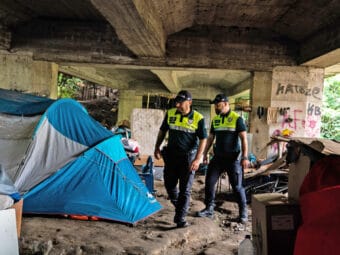
Municipal Police in Porto, Portugal regularly patrol areas used by drug consumers. Police in Portugal don’t arrest people who use drugs. Instead they have a strong track record referring people in addiction to counseling and treatment. (Demetrius Freeman/The Washington Post via Getty Images)

Cops still work aggressively to break up major drug gangs and arrest people committing drug-related crimes like theft. They also disrupt open-air drug markets like the ones that have emerged in some U.S. cities.

But when street cops in Portugal encounter people using small, personal-use amounts of drugs, there’s no arrest. Instead, police schedule meetings for drug users with teams of counselors.

While these sessions aren’t compulsory, police are trained in strategies designed to encourage people to attend.

“In the beginning, most policemen were very, very skeptical about this policy,” said Artur Vaz, who leads Portugal’s national police unit focused on drug trafficking.

In the U.S., this role for law enforcement, serving as a bridge to social service programs, has faced a backlash and is often seen as ineffectual.

In Oregon, for example, where small amounts of drugs were decriminalized in 2020, police regularly hand out information cards referring people to a drug counseling hotline. Court data shows drug users rarely call.

In Portugal, by contrast, government data shows roughly 90% of people referred to drug counseling sessions by police do turn up, at least for an initial session.

“Most [Portuguese] police have come to believe this is a balanced approach,” Vaz said. “People who consume drugs should be treated by the health system, not the criminal system.”

As a consequence, people living with addiction face far less stigma, rarely serve jail or prison time, and don’t live with criminal records.

Ronnie Duchandre, who is addicted to alcohol and hashish, and also smokes crack, says police in Portugal are “our friends” and serve as part of the social safety network that helps drug users recover. (Brian Mann/NPR)

Ronnie Duchandre, who is addicted to alcohol and hashish and sometimes smokes crack cocaine on the streets of Lisbon, told NPR he views police as helpful.

“The police is always our friend, as long as you speak with them properly,” Duchandre said. With support from Portugal’s system, he predicted that he would recover from his drug use.

“It’s not in one day that we reach the bottom,” he said. “We can also go up and it’s the same process, slowly up and up.”

Dr. João Goulão, Portugal’s national drug czar, said street cops have emerged as a vital link between the most vulnerable drug users, like Duchandre, and opportunities for treatment.

“Through the intervention of police, this is a unique opportunity to meet face-to-face with people we otherwise would not see,” he said.

Liliana Santos, who lives in Lisbon, Portugal, is addicted to crack cocaine and heroin. It’s a hard life but unlike drug users in the U.S., she has free access to healthcare, which means she has a much lower risk of overdose or death compared with people living with addiction in the U.S. (Brian Mann/NPR)

Portugal’s formula: less stigma, fewer penalties, access to care

Police referrals are only one of many pathways to drug treatment in Portugal.

“Decriminalizing drug use is a good step,” Goulão said. “The more you have other kinds of responses available, the better.”

Experts here say people who use drugs are constantly nudged toward health care and addiction treatment, including methadone programs and housing.

A person addicted to heroin prepares to inject at a consumption clinic in Lisbon, under the supervision of nurses. People in Portugal are 45 times less likely to die from an overdose compared with people in the U.S. (Brian Mann/NPR)

The results are striking. Over the last 20 years, Portugal cut drug deaths by 80% and reduced the number of HIV/AIDS and hepatitis cases in half.

During that same period, U.S. drug deaths exploded by more than 500%, according to the Centers for Disease Control and Prevention.

Researchers predict unless America somehow changes course, the overdose crisis will kill a total of 2.2 million people in the U.S. by the end of this decade.

Could elements of Portugal’s system save lives in the U.S.?

A debate is underway in the U.S. over whether elements of Portugal’s system could save lives here.

“If we stopped arrests and did nothing else, that’s a positive intervention because of the well-documented harms of incarceration [on people with addiction],” said Morgan Godvin, a former heroin user who now studies drug policy in Portland, Ore.

A growing number of cities and states around the U.S. have begun to de-emphasize drug war-era policies, shifting away from drug arrests and funding more treatment.

California voters approved Proposition 14 a decade ago, reducing drug possession from a felony to a misdemeanor. In 2020, Oregon voters decriminalized personal-use amounts of drugs and provided more funding for health care and counseling.

Advocates of those changes hoped they would quickly reduce drug deaths and serve as a model for the rest of the U.S., but implementation has been rocky, and in many places fatal overdoses have risen.

Critics say drugs were fully or partially decriminalized before other social programs, like the ones in Portugal, were in place and widely available to pick up the slack.

“We still suck at access to voluntary treatment,” Godvin acknowledged, speaking of drug policy reforms in Oregon. “We need a vast voluntary system, so that people can engage with treatment when they want it.”

A tidal wave of U.S. drug deaths and a backlash against programs designed to help them

Drug policy experts say these relatively new experiments have been crippled by a lack of funding, by strict U.S. drug laws that make some harm reduction measures illegal, and by this country’s complicated, costly and often poorly regulated addiction treatment system.

The spread of deadly fentanyl and a national surge in homelessness have also led to a spike in highly visible drug use, sparking a backlash among many voters and politicians who want streets, neighborhoods and parks cleaned up quickly.

There are now efforts underway to recriminalize drugs, and toughen law enforcement’s response, in California and Oregon.

Humphreys, at Stanford University, says he still supports dramatically expanding access to addiction care, similar to Portugal’s model.

But he doesn’t support decriminalization and believes police and criminal courts in the U.S. will need to play a more aggressive role forcing people with severe addiction off the streets and into treatment.

“They don’t have relationships, they’re isolated, so if there’s no law [enforcement] pressure, there’s no pressure at all,” he said.

Miguel Moniz, the anthropologist at the Institute of Social Sciences, University of Lisbon, disagrees. He says the data shows Portugal’s approach, combining decriminalization and health care, is more humane and more successful.

People in Portugal are now 45 times less likely to die from drug overdoses, compared with people in the U.S. — and street crime in cities like Lisbon has dropped.

Drug-related street crime in Portugal has dropped along with overdoses. “There’s an impression in the U.S. that if you decriminalize drugs, it’s a wild west,” said Miguel Moniz at the Institute of Social Sciences, University of Lisbon. “That hasn’t been the case in Portugal.” (Brian Mann/NPR)

“There’s an impression in the U.S. that if you decriminalize drugs, it’s a Wild West where everyone uses drugs,” Moniz said. “That hasn’t been the case in Portugal.”

But as the death toll from the U.S. overdose crisis mounts, Moniz voiced skepticism that American policymakers will have the political will or patience to pivot to a focus on health care and social services.

“There’s a different political environment in the U.S,” Moniz said. “The way health care is funded is completely different. The role of police in American society is different. So to talk about the Portuguese experience [being adopted in the U.S.] is complicated.”

— Tilda Wilson, an NPR Kroc Fellow, contributed field reporting. Inês Pereira Rodrigues provided translations.

Copyright 2024 NPR. To see more, visit https://www.npr.org.

FTC and 9 states sue to block Kroger-Albertsons supermarket merger

Kroger first announced its plans to buy Albertsons in October 2022. (Rogelio V. Solis/AP)

U.S. regulators and nine state attorneys general are suing to stop the $24.6 billion merger of Kroger and Albertsons, the country’s two largest supermarket chains.

The companies have presented the deal as existential to surviving in the grocery business today. But the lawsuit, filed in federal court in Oregon on Monday, says it’s anticompetitive.

The Federal Trade Commission argues that Kroger’s purchase of its biggest grocery-store rival would form a colossus that would lead to higher prices, lower-quality products and services, and “eliminate fierce competition” for both shoppers and workers.

The companies have argued that together they could better face stiffening competition from Amazon, Walmart, Costco and even dollar stores. In fact, Kroger on Monday argued the FTC’s rejection of the merger would lead to higher food prices and fewer grocery stores.

“This decision only strengthens larger, non-unionized retailers like Walmart, Costco and Amazon by allowing them to further increase their overwhelming and growing dominance of the grocery industry,” a Kroger spokesperson said in a statement.

Kroger and Albertsons had cushioned their pitch to regulators with a plan to sell off up to 650 stores in areas of the country where they overlap. But the FTC says the proposed sale of stores is inadequate and “falls far short of mitigating the lost competition between Kroger and Albertsons.”

In the months leading up to the agency’s decision, some supermarket employees, state officials and lawmakers had argued the merger would reduce options for customers and employees, farmers and food producers. Unions — the Teamsters and the United Food and Commercial Workers International — have expressed concerns about the tie-up.

Ohio-based Kroger is the biggest U.S. supermarket operator with more than 2,700 locations; its stores include Ralphs, Harris Teeter, Fred Meyer and King Soopers. Idaho-based Albertsons is the second-largest chain with nearly 2,300 stores, including Safeway and Vons. Together, the two employ some 720,000 people across 48 states and overlap particularly in the West.

The FTC, which had reviewed the deal for more than a year, says in a press release that an executive from one of the two chains “reacted candidly” to the proposed merger by saying: “You are basically creating a monopoly in grocery with the merger.”

Attorney generals of Arizona, California, the District of Columbia, Illinois, Maryland, Nevada, New Mexico, Oregon and Wyoming are joining the FTC in its lawsuit to block the deal.

The attorneys general of Washington and Colorado already have filed their own lawsuits to stop Kroger from buying Albertsons. But the companies’ plan recently won support of one local union chapter — representing workers in Oregon, Idaho and Washington — which argued that Albertsons’ owner would likely sell the company anyway, potentially to a worse outcome.

Kroger and Albertsons, trying to convince regulators that the merger wouldn’t reduce local competition, had agreed to sell hundreds of stores in overlapping markets to C&S Wholesale Grocers, a supply company that runs some Piggly Wiggly supermarkets.

C&S agreed to buy retail locations as well as some private brands, distribution centers and offices. The company said it was “committed to retaining” the stores’ existing workers, promising to recognize the union workforce and keep all collective bargaining agreements.

In recent years, many antitrust experts — including those now at the FTC — have questioned the effectiveness of divestitures as a path to approve mergers.

“C&S would face significant obstacles stitching together the various parts and pieces from Kroger and Albertsons into a functioning business—let alone a successful competitor against a combined Kroger and Albertsons,” the FTC says in its release.

When Albertsons itself merged with Safeway in 2015, for example, the FTC required it to sell off 168 stores as part of the deal. Within months, one of its buyers filed for bankruptcy protection and Albertsons repurchased 33 of those stores on the cheap.

Copyright 2024 NPR. To see more, visit https://www.npr.org.

Federal appeals court revokes Obama-era ban on coal leasing

A mechanized shovel loads a haul truck that can carry up to 250 tons of coal at the Spring Creek coal mine, April 4, 2013, near Decker, Mont. On Wednesday, Feb. 21, 2024, a U.S. appeals court struck down a judge’s 2022 order that imposed a moratorium on coal leasing from federal lands. (AP Photo/Matthew Brown, File)

A federal appeals court has lifted a moratorium on new coal leasing on federal land that dates back to the Obama administration.

A three judge panel in the 9th Circuit Court of Appeals Wednesday tossed the moratorium saying it was now moot. It’s the latest decision in a series of legal back-and-forths that date back to 2016 when then-Interior Secretary Sally Jewell moved to halt all new coal leasing on federal land as part of a strategy to address climate change.

President Trump’s Interior Secretary Ryan Zinke ended the Obama moratorium, a move that was challenged by environmental groups and tribes. A court then reinstated the ban on new leases in 2022.

Wednesday’s latest ruling tossing that out appears to be largely on a technicality. The judges noted that the original challenge was to a Trump-era policy that is no longer in place as President Biden’s Interior Secretary Deb Haaland had revoked it already.

Rich Nolan, president and CEO of the National Mining Association called the ruling a victory. “Important projects can once again advance and support the production of affordable, reliable power to the grid, while creating jobs and economic development,” Nolan said in a written statement.

Even as demand for coal has slumped nationwide, mining companies have pushed federal land managers to open up more land for exploration particularly in the western United States, citing its location as a possible continued export market to countries such as China.

It’s not yet clear how President Biden will respond to Wednesday’s ruling or how soon new leasing could resume on federal public land.

Environmentalists and tribes are pressing the Biden administration to intervene again and launch a new federal review of the coal leasing program.

In a statement, William Walksalong of the Northern Cheyenne Tribe in the coal-rich Powder River Basin in Montana said the administration needs to “step up” and live up to its promises to protect the climate.

“We will fight tirelessly to protect our reservation and its air and waters and the Cheyenne way of life,” Walksalong said.

Copyright 2024 NPR. To see more, visit https://www.npr.org.
Site notifications
Update notification options
Subscribe to notifications