NPR News

NTSB says key bolts were missing from the door plug that blew off a Boeing 737 Max 9

Alaska Airlines N704AL, a 737 Max 9, which made an emergency landing at Portland International Airport on January 5 is parked on the tarmac in Portland, Oregon, on January 23, 2024. (Photo by Patrick T. Fallon / AFP)

WASHINGTON — The National Transportation Safety Board says four key bolts were “missing” when a door plug blew off an Alaska Airlines flight in midair last month. That’s one of the findings from the NTSB’s preliminary investigative report released Tuesday.

The Boeing 737 Max 9 jet had departed Portland, Ore. and was climbing through 14,800 feet when the door plug explosively blew out. It resulted in a rapid depressurization and emergency landing back at Portland.

No one was seriously hurt, but the January 5th incident has renewed major questions about quality control at Boeing and its top suppliers.

In its 19-page report, the NTSB says four bolts that were supposed to hold the door plug in place were not recovered. Nevertheless, investigators say “the observed damage patterns and absence of contact damage” on the door panel and plane itself indicate the four bolts were “missing” before the door plug was ejected from the plane.

The door plug was originally installed by contractor Spirit AeroSystems in Wichita, Kan. and then shipped to Boeing’s factory in Renton, Wash. for assembly. Once it arrived in Washington, the NTSB says damaged rivets were discovered on the fuselage which required the door plug to be opened for repairs. After that work was completed by Spirit AeroSystems personnel at the Boeing plant, the four bolts were not reinstalled, according to photo evidence provided to the NTSB by Boeing.

The report does not say who was responsible for the failure to ensure the bolts were reinstalled.

The incident has touched off another crisis for Boeing. The troubled plane maker was still working to rebuild public trust after 346 people died in two 737 Max 8 jets that crashed in 2018 and 2019.

In a statement, Boeing said it would review the NTSB’s findings expeditiously.

“Whatever final conclusions are reached, Boeing is accountable for what happened,” Boeing CEO Dave Calhoun said in a statement. “An event like this must not happen on an airplane that leaves our factory. We simply must do better for our customers and their passengers.”

The NTSB investigation is ongoing and may take a year or more before a final report is completed.

The Alaska Airlines 737 Max 9 incident came up during a Congressional hearing on Capitol Hill Tuesday. The administrator of the Federal Aviation Administration, Michael Whitaker, told lawmakers on the House Transportation and Infrastructure Committee this latest 737 accident has created several issues for the FAA.

“One, what’s wrong with this airplane? But two, what’s going on with the production at Boeing?,” Whitaker said. “There have been issues in the past. And they don’t seem to be getting resolved. So we feel like we need to have a heightened level of oversight to really get after that.”

a man
Federal Aviation Administration Administrator Michael Whitaker testifies before the House Transportation and Infrastructure Committee on February 6, 2024 in Washington, D.C. (Photo by Kevin Dietsch/Getty Images)

Whitaker says the FAA has sent about 20 inspectors to Boeing’s Washington facilities, and six to the Spirit AeroSystems factory in Wichita, Kan. where the 737 fuselages are produced. And he said some inspectors may have to remain at those factories permanently.

“Going forward, we will have more boots on the ground closely scrutinizing and monitoring production and manufacturing activities,” Whitaker said. “I do anticipate we will want to keep people on the ground there. We don’t know how many yet. But we do think that presence will be warranted.”

The FAA is in the midst of a six-week audit of production at both facilities, and an employee culture survey at Boeing. Whitaker testified that the agency will wait until those are complete before making any decisions about a permanent inspection plan.

Copyright 2024 NPR. To see more, visit https://www.npr.org.

How are atmospheric rivers affected by climate change?

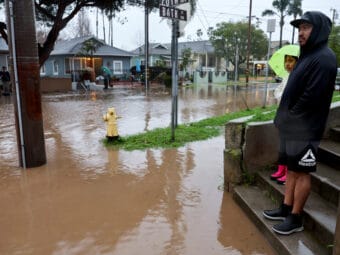
Residents stand along a flooded street in Santa Barbara, California, as a powerful atmospheric river pummels the region. The storm has caused landslides, power outages, and road and airport closures across Southern California. (Mario Tama/Getty Images)

The second atmospheric river to hit the West Coast in as many weeks has stalled over Southern California, dumping more than 9 inches of rain over 24 hours in some areas near Los Angeles. Streets are flooded in Santa Barbara and Los Angeles; creeks are raging like rivers; and rainfall records in Los Angeles County are nearing all-time records.

At least three people were reported to have died due to storm-related injuries, including two people killed by fallen trees. As of Tuesday morning, the severe weather had knocked out power for more than 150,000 Californians.

The National Weather Service said Los Angeles received nearly half of its average seasonal rainfall in just two days, but the storm isn’t over yet.

Areas east and south of Los Angeles could see several more inches of rainfall through Wednesday. That includes San Diego, which was inundated a few weeks ago by a different storm.

Atmospheric rivers are well-known weather phenomena along the West Coast. Several make landfall each winter, routinely delivering a hefty chunk of the area’s annual precipitation. But the intensity of recent atmospheric rivers is almost certainly affected by human-caused climate change, says Daniel Swain, a climate scientist at the University of California, Los Angeles.

Climate change has made the ocean’s surface warmer, and during an El Niño year like this one, sea water is even hotter. The extra heat helps water evaporate into the air, where winds concentrate it into long, narrow bands flowing from west to east across the Pacific, like a river in the sky, Swain says. An atmospheric river can hold as much as 15 times as much water as the Mississippi River.

Human-driven climate change has primed the atmosphere to hold more of that water. Atmospheric temperatures have risen about 2 degrees Fahrenheit (just over 1 degree Celsius) since the late 1800s, when people started burning massive volumes of fossil fuels. The atmosphere can hold about 4% more water for every degree Fahrenheit warmer it gets. When that moist air hits mountains on the California coast and gets pushed upwards, the air cools and its water gets squeezed out, like from a sponge.

Swain estimates those sky-rivers can carry and deliver about 5 to 15% more precipitation now than they would have in a world untouched by climate change.

That might not sound like a lot, but it can—and does—increase the chances of triggering catastrophic flooding, Swain says.

In 2017, a series of atmospheric rivers slammed into Northern California, dropping nearly 20 inches of rain across the upstream watershed in less than a week. The rainfall fell in two pulses, one after another, filling a reservoir and overtopping the Oroville dam, causing catastrophic flooding to communities downstream.

The back-to-back atmospheric rivers that drove the Oroville floods highlighted a growing risk, says Allison Michaelis, an atmospheric river expert at Northern Illinois University and the lead of a study on the Oroville event. “With these atmospheric rivers occurring in succession, it doesn’t leave a lot of recovery time in between these precipitation events. So it can turn what would have been a beneficial storm into a more hazardous situation,” she says.

It’s not yet clear if or how climate change is affecting those groups of storms—”families,” as one study calls them.

It’s also too early to say exactly how much more likely or intense climate change made the current storms on the West Coast. But “in general, we can expect them to all be intensified to some degree” by human-driven climate change, Michaelis says.

Scientists also don’t yet know if climate change is affecting how often atmospheric rivers form, or where they go. And climate change doesn’t mean that “every single atmospheric river storm that we are going to experience in the next couple of years will be bigger than every other storm” in history, says Samantha Stevenson, an atmospheric and climate scientist at the University of California, Santa Barbara.

But West Coast communities do need to “be prepared in general for dealing with these extremes now,” says Stevenson. “Because we know that they’re a feature of the climate and their impacts are only going to get worse.”

Copyright 2024 NPR. To see more, visit https://www.npr.org.

A new FAFSA setback means many college financial aid offers won’t come until April

U.S. Secretary of Education Miguel Cardona has led the department through a massive FAFSA overhaul mandated by Congress about three years ago. (Colin Myers/Claflin University/Getty Images)

Families and students will have to wait even longer for financial aid offers from colleges and universities.

On Tuesday, the U.S. Department of Education announced yet another delay in the already-turbulent FAFSA (Free Application for Federal Student Aid) timeline: The department says it won’t be sending students’ FAFSA data to schools until the first half of March. Previously, it had said it would start sending that data in late January.

For more than 17 million students, the FAFSA is the key to unlocking government dollars to help cover the cost of college, including federal student loans, work-study and Pell Grants for low-income students.

This new, four-to-six-week delay puts schools in a difficult bind as colleges can’t determine what financial aid students should get until they receive the government’s FAFSA data.
There is some good news: One big reason for the delay is that the department is fixing a $1.8 billion mistake in the FAFSA that could have especially hurt lower-income students. Proceeding without a fix would have, at best, confused many lower-income borrowers. At worst, it would have taken money out of their pockets and likely discouraged some from enrolling in college.

When that fix was announced, Justin Draeger, president and CEO of the National Association of Student Financial Aid Administrators (NASFAA), said it was “the right thing to do.”

Undersecretary of Education James Kvaal said in a statement Tuesday, “Updating our calculations will help students qualify for as much financial aid as possible. Thank you to the financial aid advisers, college counselors, and many others helping us put students first.”

Kvaal and the department know this delay will hit college financial aid offices especially hard and further compress their timeline for sending out financial aid offers. Draeger tells NPR that if schools don’t receive FAFSA data until early to mid-March, many of them likely won’t be able to send financial aid offers to students until April. For many of those students, that leaves less than a month before they’re expected to commit to a college.

Charles Conn, a top aid administrator at Cal Poly Pomona, tells NPR he is “relieved” the Education Department is fixing that $1.8 billion mistake, but “our hearts sank as we learned that schools will now not begin receiving FAFSA data until the first part of March, at the earliest.”

“It’s going to be difficult to get aid offers out to prospective students before April,” says Brad Barnett, the financial aid director at James Madison University in Virginia. “It’s unfortunate that these delays could impact whether a prospective student goes to college at all this fall, or at the very least where they go.”

The problem for schools — which, by extension, is now a problem for families too — is that, because this year’s FAFSA is the result of a massive overhaul, financial aid offices aren’t entirely sure what to expect from the data they’ll be receiving. Ideally, they’d like several weeks to understand the new datasets and do some quality control of the new financial aid process.

“Schools are furiously reworking their timelines to see just how quickly they could turn around financial aid offers for students, to get them accurate aid offers as soon as possible,” says Draeger of NASFAA. But he points out, “This could be more difficult for under-resourced institutions that lack the funding, staffing, or technology capabilities of their peers.”

This new setback gives schools very little room for error.

Scott Skaro, the financial aid director at United Tribes Technical College, in North Dakota, says this new FAFSA timeline will be tough on tribal colleges, where more than 80% of students are low income and qualify for a federal Pell Grant.

“This is pretty devastating news,” says Skaro.

It’s good, he says, that the department is acting to make sure students get all the aid they’re entitled to, but not being able to make aid offers to prospective students until April or May could also do real harm.

“Our students rely on the peace of mind that comes with grant aid. And this uncertainty may lead them away from education. I don’t want the seniors of 2024 to be just a lost generation.”

He worries that the longer seniors have to wait to know if college is affordable, the harder it will be for some to resist “the temptations to just find some entry-level job and give up on additional schooling. I just worry how many there are out there.”

Copyright 2024 NPR. To see more, visit https://www.npr.org.

The IRS is piloting new software that could let you file your taxes for free

The Internal Revenue Service building is seen on April 15, 2019, in Washington, D.C. (Zach Gibson/Getty Images)

The Internal Revenue Service is piloting a new program this year that aims to help Americans file their taxes directly to the government for free.

Known as Direct File, the service will be open to certain filers in select states at the start so the IRS can test the program with a smaller group of users and make tweaks before opening it up to a larger group of taxpayers in the future.

This year’s tax season begins today, when the IRS begins accepting and processing tax returns.

Last year, the IRS began developing a free tax filing service months after receiving an influx of $80 billion from the Inflation Reduction Act, which was signed into law by President Joe Biden.

The free service has gotten pushback from Republicans and TurboTax maker Intuit, which called it a “solution in search of a problem.” But the IRS has maintained that Direct File will make what can be a complex and costly endeavor simpler and free.

The IRS previously partnered with private companies to create another free tax filing program called Free File, but only about 2% of eligible taxpayers use it.

Who is eligible to use the IRS’ new tax filing service?

At the outset, only federal and state employees in certain tax situations will be eligible to participate in the Direct File pilot program, CNN reported.

Additionally, the pilot will only be open to people who lived in these states in 2023: Arizona, California, Florida, Massachusetts, Nevada, New Hampshire, New York, South Dakota, Tennessee, Texas, Washington, and Wyoming.

The pilot is further limited by a user’s tax situation. People who itemize their deductions, earn gig or business income, or claim certain tax credits aren’t eligible to participate right now.

The service is available in both English and Spanish.

The IRS said it’s starting with a limited number of users to follow software launch best practices and that it expects to gradually open up the program to more people and will provide updates about that process on its website.

How does Direct File work?

Direct File will be available to users on a computer, tablet or smartphone. You don’t have to download any software.

The IRS is also offering live chat support — with an option for a follow-up phone call — to people who need help using Direct File.

There’s one major caveat to the pilot program: it only helps users prepare federal tax returns.

The IRS said most states without an income tax as well as states that have the ability to develop a state-run tax filing service (or already have one) are participating in the pilot.

Users living in Arizona, California, Massachusetts and New York will be directed to a state-support tax filing tool to prepare their state returns.

Copyright 2024 NPR. To see more, visit https://www.npr.org.

JN.1 takes over as the most prevalent COVID-19 variant. Here’s what you need to know

The Centers for Disease Control and Prevention estimates that up to 86% of new COVID-19 cases stem from the latest mutation, JN.1. The most recent COVID vaccines are expected to help lower chances of serious illness or hospitalization from JN.1. (Rogelio V. Solis/AP)

A new, fast-spreading variant of COVID-19 is sweeping across the nation, making it the most widely circulating iteration of the virus in the U.S. and around the world, according to the Centers for Disease Control and Prevention.

The mutation, called JN.1, is a subvariant of Omicron that was first detected by the World Health Organization in late August. At the time it appeared to be spreading slowly but as temperatures have dipped, JN.1 has spiked.

In mid-October, CDC data shows JN.1 made up about 0.1% of all COVID-19 cases around the country. As of Jan. 20, the CDC estimates that’s now up to approximately 86%.

“Most likely, if you’re getting COVID right now, you’re getting this particular variant mutation,” Eyal Oren, a director and professor of epidemiology at the School of Public Health at San Diego State University, told NPR.

Oren added that one of the reasons for the latest surge is that the virus continues to evolve so rapidly that “our immune systems have not been able to keep up.”

Another reason is that “not enough Americans are vaccinated,” according to the CDC. Earlier this month, only 11% of children and 21% of adults were reported to have received the updated COVID-19 vaccine. Meanwhile, only 40% of adults age 65 and older, which are the highest risk group, have gotten the updated vaccine in the last year.

The CDC says COVID-19 vaccines can reduce severe illness and hospitalizations.

The low rates for COVD-19 vaccinations, along with those against influenza and respiratory syncytial virus (RSV), are of such great concern that the CDC issued an alert to health care workers last month. The combination of rising flu, RSV and COVID cases “could lead to more severe disease and increased healthcare capacity strain in the coming weeks,” the agency predicted.

People may be wrongly assuming that the current COVID booster won’t protect them from JN.1 or other new strains, Oren said. But the most recent vaccines from Pfizer-BioNTech, Moderna and Novavax are all expected to help lower chances of serious illness or hospitalization from JN.1.

What are the symptoms of JN.1?

CDC data indicates that this strain is no more severe than previous iterations, and the list of symptoms remains consistent with what they have been for COVID-19 in recent years: fever, chills, coughing, muscle aches, shortness of breath, sore throat, congestion, headaches, fatigue, and losing one’s taste or smell.

Oren noted that most of the list consists of ailments that could be confused with those caused by other viruses common during winter months, including the flu, RSV or the common cold.

“That’s why it’s so important to get vaccinated and to get tested [for COVID], particularly if someone is at higher risk of severe outcomes,” he said.

How to stay safe

Oren urged all people, but especially those in high-risk categories, to take precautions by wearing masks, avoiding crowded places, and washing their hands. “And if you’re sick stay home,” he said.

The CDC reported that over the last 4 weeks, hospitalizations among all age groups increased, by 200% for influenza, 51% for COVID-19, and 60% for RSV.

The federal government offers free rapid COVID-19 tests through the mail. Four free tests can be ordered at COVIDTests.gov and will be delivered by the U.S. Postal Service.

Copyright 2024 NPR. To see more, visit https://www.npr.org.

Housing is now unaffordable for a record half of all US renters, study finds

A new Harvard University report finds that housing was unaffordable for a record half of renters in 2022. And a softening rental market might not help those who struggle most. (Matt Rourke/AP)

Over the past two years, Genuine Campbell was shocked at how rent for her two-bedroom apartment in Philadelphia just kept going up — from $1,300 a month to $1,600. She’s a single mom of four, and right as her rent was rising, her hours as a hotel valet were getting cut.

Add in utility costs plus inflation, and every month brought a wrenching decision.

“Do you want to pay the bills and then give half the rent, or do you want to try to do the whole rent and then be back on bills?” she says.

Campbell says the area isn’t even safe enough for her kids to play outside, but the rents are still way out of line with what she can make. “You have to work in, like, maybe a hospital or [as a] police officer … just to keep up with the rent,” she says.

In fact, more such households and many others also now struggle to pay rent, according to a newly released report from the Joint Center for Housing Studies of Harvard University. It finds that in 2022, as rents spiked during the COVID-19 pandemic, a record half of U.S. renters paid more than 30% of their income for rent and utilities. Nearly half of those people were severely cost-burdened, paying more than 50% of their income.

“We actually saw increases across every single income category that we look at, which sort of surprised us,” says Whitney Airgood-Obrycki, a senior research associate with the center and the report’s lead author.

Since 2019, the biggest jump in unaffordability was for households making $30,000 to $74,999 a year. Even among those working full time, a third of all renters were still cost-burdened.

For renters making under $30,000 — who already faced the most severe struggle to afford housing — Airgood-Obrycki “didn’t think it could possibly get that much higher.” But the report found it did nudge up, to an all-time high of 83% who are cost-burdened. She says the amount of money they have left over for all other household expenses has plummeted by nearly half, to just $310 a month.

And she says the compromises people traditionally make to get cheaper rent aren’t guaranteed these days.

“So you might not be living in as good of a neighborhood. You might be commuting farther. You might be sacrificing the quality of your school system,” Airgood-Obrycki says. “And often what we’re seeing is that even when people are attempting to make these trade-offs, they still end up paying too much for housing.”

As the Harvard report notes, U.S. homelessness rates hit a record high last year. The Biden administration and housing experts link that squarely to a severe housing shortage that has helped drive up prices.

“We simply don’t have enough homes that people can afford,” says Jeff Olivet, executive director of the U.S. Interagency Council on Homelessness. “And when you combine rapidly rising rent — that it just costs more per month for people to get into a place and keep a place — you get this vicious game of musical chairs.”

A cooling housing market isn’t likely to help those struggling the most

The double-digit rent hikes of the past few years are finally easing, and rents have even come down in some cities that saw the biggest jumps. A record number of apartments are also under construction, and as they come online, tight vacancy rates will loosen.

Still, prices for many people are still higher than before the pandemic, and the building boom is not likely to change that.

“What we are building is at the high end, because of the increased cost of construction and because we have a lot of demand from higher-income renters,” says Airgood-Obrycki. Most new apartments over the last decade have gone for $1,400 a month or higher, “and that’s not affordable to the majority of renters.”

At the same time, she says the market has lost millions of low-rent units for $600 a month or less. And these trends are continuing a long-term, growing gap in what people can afford. Since 2001, the Harvard report notes, median rents have risen by 21% while the median annual income for renters has risen just 2%.

The upshot is that millions more people qualify for federal housing subsidies. But those have been chronically underfunded, and the amount available has fallen further behind the need.

In Philadelphia, Campbell moved her family out of their unaffordable apartment and in with friends this month. She’s making a bit more working as a driver with Lyft, and also does people’s hair on the side.

Her plan is to stay until she gets her tax refund to help with a fresh start. She has already started looking around for a cheaper place, and hopes to find something for $1,000 or $1,100 a month.

“It’s like you’re dreaming of a fairy tale,” Campbell says. “But I’m going to try to find something that I can handle.”

Copyright 2024 NPR. To see more, visit https://www.npr.org.
Site notifications
Update notification options
Subscribe to notifications