
NPR News

How many friends do Americans have? A survey crunched the numbers

Can your bestie be a health benefit? (Getty Images)

New research has delved into what friendship in the U.S. looks like, including just how many friends the average American has.

Who are they? Friends can be anyone from the folks in your Dungeons & Dragons group, the neighbors in your weekly potluck, or that chatty classmate you started hanging out with from your ceramics course.

What are the key findings?

  • According to Pew, 61% of adults in the U.S. say that having close friends is essential to living a fulfilling life — that’s more than those who cited marriage, children or money.
  • A slim majority of adults surveyed (53%) said they have between one and four close friends. 38% said they had about five or more.
  • Of those friend-having adults, 72% expressed high levels of satisfaction with their friendships. Turns out comradery with your favorite people can leave you feeling content!
  • The survey respondents that reported larger groups of friends also felt more satisfied with the quality of their friendships compared to those with fewer close friends. Maybe those fellas from that famous ’90s sitcom about friendship were onto something.
  • Generally, people talk most about work (shocker!), family and current events. But that frequency can also change depending on gender.
  • Women surveyed reported discussing family life, as well as mental and physical health, at higher rates than men. Men are more likely than women to talk to their close friends about sports and current events.

Want more on people? Listen to Consider This on how Los Angeles is using AI to combat homelessness.


What are people saying? There’s a lot to be said about how we relate to each other in today’s world, especially after the pandemic shook up our routines.

In May, the U.S. Surgeon General released an advisory on the epidemic of loneliness in the United States, which found that lacking connection can increase the risk for premature death to levels comparable to smoking 15 cigarettes a day. Here’s what Surgeon General Vivek Murthy had to say on All Things Considered about it:

In the last few decades, we’ve just lived through a dramatic pace of change. We move more, we change jobs more often, we are living with technology that has profoundly changed how we interact with each other and how we talk to each other … And you can feel lonely even if you have a lot of people around you, because loneliness is about the quality of your connections.

Here’s author Lydia Denworth, who wrote a book on friendship, on how they positively impact us mentally and physically:

They can change your cardiovascular system, your immune system, how you sleep, your cognitive health. How could this thing that exists entirely outside the body affect whether you’re likely to catch a virus? And yet that’s exactly what we now know that social connection does. We thought of loneliness as this difficult emotion, but just an emotion. And we think of friends as this lovely thing — but it is actually a matter of life and death.

And Hanne Collins says forging little connections is a good place to start. Collins helped co-author a study on the importance of talking to strangers in your everyday life, a factor titled “relational diversity”:

It’s about this mix. It’s about connecting with people who are close to you, who are maybe less close to you, who connect you with other people, who provide different kinds of support. Essentially, the idea is that the more diverse your social portfolio, the happier you are and the higher your well-being.

So, what now?

  • Don’t know where to start with making friends? Life Kit’s got you covered.
  • You read my whole article, which by journalist terms, automatically makes us friends now. Love you, bestie!

Learn more:

Copyright 2023 NPR. To see more, visit https://www.npr.org.

FBI: ‘I am not okay,’ off-duty Alaska Airlines pilot said before trying to turn off jet’s engines

An Alaska Airlines plane, like this one operated by Horizon Air, had to divert to Portland, Ore. on Sunday after an off-duty pilot tried to turn off the engines in flight. (Ted S. Warren/AP)

An off-duty Alaska Airlines pilot now faces federal charges for interfering with the crew of a flight that had divert Sunday to Portland, Ore. after he allegedly attempted to switch off the plane’s engines in mid-air.

The flight, operated by Horizon Airlines, had taken off from Everett, Wash. around 5 pm Sunday evening and was headed to San Francisco. The Embraer 175 jet had more than 80 passengers and crew on board.

The off-duty pilot, Joseph David Emerson, was traveling in the flight deck jump seat sitting behind the pilot and first officer. According to a federal affidavit, the crew said Emerson gave “zero indication of anything wrong” during the initial stages of the flight.

They said he was chatting about the weather and various types of airplanes. At some point as the jet moved south over Oregon, the first officer observed Emerson throw his headset across the cockpit and exclaim, “I am not okay.”

That’s when the pilots say Emerson grabbed the two red engine shutoff handles. The affidavit says the pilot grabbed Emerson’s wrist and they “physically engaged” for an estimated 25-30 seconds and then Emerson “quickly settled down.”

The pilot asked Emerson to leave the cockpit and he then walked to the back of the airplane. Emerson allegedly told a flight attendant, “You need to cuff me right now or it’s going to be bad.” The attendant cuffed his wrists and during the descent into Portland, according to the FBI, and he “turned towards an emergency exit door and tried to grab the handle.”

In an interview with an FBI agent, another flight attendant said she heard Emerson say “I messed everything up” and that “he tried to kill everybody.”

During an interrogation, Emerson told the FBI that he had a “nervous breakdown” and had not slept in 40 hours. He said he’d felt dehydrated and tired. He told the agent that he pulled both emergency shut off handles because “I thought I was dreaming and I just wanna wake up.”

The FBI agent says Emerson denied taking any medication, although they did talk about the use psychedelic mushrooms. Emerson said “it was his first time taking mushrooms,” according to the FBI affidavit — though it was not immediately clear if he was actually under the influence of mushrooms during the flight.

Emerson allegedly told the FBI that he had become depressed about six months prior.

Even before these latest details became public, the incident was renewing concerns across the aviation industry about the mental health of pilots, and whether they are getting the kind of treatment they need.

Many pilots are wary of seeking treatment for mental issues, aviation experts say, because they are concerned that they could be grounded by federal regulators if they do.

“Pilots are wired to deal with situations and get the job done,” says Dennis Tajer, a veteran pilot and a spokesman for the Allied Pilots Association, which represents over 15,000 pilots at American Airlines.

Tajer says pilots have a lot invested in their training and careers, and are afraid of losing it.

“You think that your job is at stake, the income for your family is at stake,” Tajer said. “If I don’t have the mental fitness to get this done, I’m going to be grounded, lose my job, lose my home. And these are all awfulizing thoughts that the pilots go through that stop them from getting the care that they need if they need it.”

The stigma around seeking mental health care has diminished over time, Tajer says, but it has not gone away completely.

Federal regulators are clearly aware of the issue. The leaders of the Federal Aviation Administration have urged pilots to come forward and get treatment if they need it, saying they will not automatically lose their medical clearance to fly as a result.

“Even if you need to take medication to stay well, you may be able to get a special issuance from my office,” says Susan Northrup, who oversees the pilot medical certification process at the FAA, in a video posted on the agency’s web site.

“The most important thing is that you receive treatment early so that you can get better,” Northrup says. “We don’t want you to get worse because you’re afraid of losing your medical certificate.”

Emerson has been flying for Alaska Airlines for 10 years and has been a pilot since 2001.

In addition to the federal charge, he also faces 83 state counts of attempted murder, among other charges, including reckless endangerment and endangering an aircraft.
Copyright 2023 NPR. To see more, visit https://www.npr.org.

Bond markets are being hit hard — and it’s likely to impact you

A trader works at the New York Stock Exchange on Oct. 11. Bond yields are surging, threatening to raise borrowing costs across the economy. (Angela Weiss/AFP via Getty Images)

There is a sharp sell-off in the bond market, and it has big implications on both the economy and people’s pocketbooks.

Yields on U.S. government bonds, especially the 10-year Treasury note, determine the interest rates that people pay on a lot of their debt, including mortgages and credit cards.

And a key bond yield hasn’t been this high since 2007.

Several factors are driving the sell-off, including stronger-than-expected economic data and the government’s worsening finances.

Here is what you need to know about it.

How bad is the sell-off?

In 2022, the bond market suffered its worst year on record, as the Federal Reserve started raising interest rates aggressively to fight high inflation.

This year, the picture hasn’t improved much.

“It’s been a very difficult period in time for folks invested in Treasurys,” says Katie Nixon, the chief investment officer for wealth management at Northern Trust. “It’s been bad.”

After fluctuating at the beginning of the year, bond prices have been hit especially hard in recent weeks, sending their yields sharply higher.

Bond prices and yields have an inverse relationship, meaning prices fall when yields rise, and vice versa.

The yield on the 10-year Treasury note — widely considered to be one of the least-risky investments in the world — briefly broke above 5% on Monday. It hadn’t been that high since June 2007, when George W. Bush was in the White House and Ben Bernanke was running the Federal Reserve.

It’s a jarring trend given that, for years, the U.S. economy benefited from ultralow interest rates.

What’s driving the most recent bond sell-off?

A big reason is that economic data has been stronger than forecast.

Although a stronger economy is good news generally, the Fed right now needs a cooler economy to bring down inflation.

That means the Fed may need to continue keeping rates high for a while longer, given that inflation still remains above the Fed’s inflation target of 2%.

Wall Street is also worried about the U.S. government’s growing debt levels, a big reason why Fitch Ratings decided to downgrade the country’s bond rating by one notch from the previous top-rated AAA to AA+.

The U.S. budget deficit surged in the latest fiscal year, in part over increased spending and slowing tax revenues.

There are also more technical reasons.

A big one is that there is less demand for bonds from an institution that has been one of their biggest buyers for years: the Fed.

During the COVID-19 pandemic, the central bank bought trillions of dollars’ worth of fixed-income securities. But since 2021, it has been reducing the size of that portfolio as a way to help reduce inflation by removing some of the money from the financial system.

“Making conditions even more challenging is the absence of the Fed as a buyer of first, last or any resort,” according to Nixon.

Why do bond markets matter?

Bond yields are critical to the economy because they influence interest rates that people pay on credit cards, car loans and home mortgages.

Higher yields also reverberate across companies, by raising the cost of debt for businesses.

The higher borrowing costs could take a toll on the economy as people, as well as companies, reduce their spending in the face of high interest rates.

Take the housing sector, for instance. It is a critical part of the economy, and mortgage rates are some of the most sensitive to interest rates.

Right now, the average rate on a 30-year, fixed-rate mortgage is 7.63%, according to Freddie Mac. That’s the highest it has been since 2000 — and it’s fueling a drop in existing-home sales since people who bought property when mortgage rates were lower are reluctant to give up their lower rates.

Interest rates on credit cards are also rising, and so are the interest rates on car loans. According to the Federal Reserve Bank of New York’s latest “Quarterly Report on Household Debt and Credit,” credit card balances stand at $1.03 trillion — a record high.

In addition, many banks are heavily invested in government bonds, which could make them susceptible to rising yields.

This year, Silicon Valley Bank and two other regional lenders collapsed in part because of concerns about the health of their bond investments. That set off bank runs.

It’s not just banks, though. People with retirement portfolios also have a lot of their nest eggs tied up in bonds, making what has happening critical.

What’s the outlook for bond markets?

A lot will depend on inflation and the Fed’s approach to interest rates.

Wall Street is betting the central bank could be done raising interest rates this year, given that inflation has continued to come down and policymakers have lifted them so aggressively already.

Now, investors and economists are trying to figure out how long the Fed is going to keep interest rates elevated.

Not too long ago, bond investors were expecting that the Fed could start cutting interest rates as early as this year to avoid tipping the economy into a recession.

But now that the economy has proved sturdier than expected, many of them are getting used to the idea that rates could be “higher for longer.”

John Canavan, the lead analyst at Oxford Economics, says investors are now “much more pessimistic on rates, as we adjust for Fed policy, adjust for the stronger economy and adjust for the risk that inflation is more difficult to pull down than expected.”

That said, things could change. Bonds tend to do well in periods of elevated uncertainty, and right now there are a lot of worries about the world, as Russia’s invasion of Ukraine continues and Israel is in a war with Hamas.

Should geopolitics worsen, bonds could see a boost.

But as of now, most investors don’t expect the bond market to improve substantially anytime soon.

Copyright 2023 NPR. To see more, visit https://www.npr.org.

An off-duty pilot tried to shut down a plane’s engines in flight, Alaska Airlines says

An Alaska Airlines Embraer 175 jet, similar to this one, was forced to make an unexpected landing Sunday night after an off-duty pilot who was riding in the cockpit allegedly attempted to disable the aircraft’s engines. (Ted S. Warren/AP)

An Alaska Airlines flight was forced to make an unexpected landing Sunday night after an off-duty pilot who was riding in the cockpit allegedly attempted to disable the aircraft’s engines.

“I’ll just give you a heads-up. We’ve got the guy that tried to shut the engines down out of the cockpit,” one of the pilots said to air traffic controllers in audio posted by LiveATC.net. “It doesn’t seem like he’s causing any issue at the back. I think he’s subdued.”

The flight, which was operated by Horizon Airlines, took off from Everett, Wash. around 5 pm Sunday evening. The Embraer 175 jet had to be diverted from San Francisco to Portland, Ore. where it landed safely.

In a statement, Alaska Airlines described the incident as “a credible security threat related to an off-duty Alaska Airlines pilot who was traveling in the flight deck jump seat.”

“The jump seat occupant unsuccessfully attempted to disrupt the operation of the engines,” according to the statement, before “the crew secured the aircraft without incident. ”

It’s routine for off-duty pilots, flight attendants and other airline staff to catch a ride in the jump seat behind the pilot and first officer.

The off-duty pilot was arrested after the plane landed at Portland International Airport. Authorities there have identified him as Joseph David Emerson. He’s now facing 83 counts of attempted murder, among other charges, including reckless endangerment and endangering an aircraft.

The Federal Aviation Administration said it is supporting law enforcement investigations into the incident.

“All passengers on board were able to travel on a later flight,” Alaska Airlines said. “We are grateful for the professional handling of the situation by the Horizon flight crew and appreciate our guests’ calm and patience throughout this event.”

Copyright 2023 NPR. To see more, visit https://www.npr.org.

A seasonal viral stew is brewing with flu, RSV, COVID and more

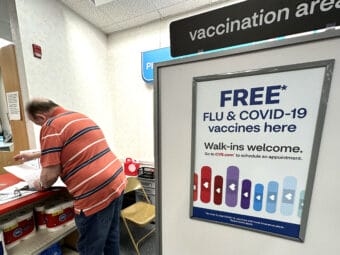
Flu and COVID-19 vaccinations are now available across the U.S., including at this CVS pharmacy in Palatine, Illinois. (Nam Y. Huh/AP)

As the weather cools down, health officials are gearing up for a new season of sickness. It’s the time for gathering indoors and spreading respiratory viruses.

So what is brewing in the viral stew?

There’s the big three to start: the flu, respiratory syncytial virus (RSV) and COVID-19. “These are the three that cause the most utilization of the health care system and the most severe disease,” says Dr. Demetre Daskalakis, acting director of the Centers for Disease Control and Prevention’s National Center for Immunization and Respiratory Diseases.

Last year, 40% of U.S. households were hit with at least one of these viruses, according to a survey from KFF, a nonprofit health policy research group.

And there are other viruses in the mix, says Marlene Wolfe, an epidemiologist and assistant professor at Emory University. There are rhinoviruses and non-COVID coronaviruses — both can cause the common cold.

There are parainfluenzas — in a different family from flu-causing influenzas — which can cause croup and pneumonia in children. And there’s enterovirus D68, which caused a national respiratory illness outbreak in 2014.

There’s also human metapneumovirus, a relatively new virus first identified in 2001. It’s in the same family as RSV and has similar symptoms.

Wastewater data reveals a fuller viral picture

Wolfe says that data from a wastewater study showed that human metapneumovirus circulated a lot last winter. In California, where the samples were collected, it could have been a fourth virus added to the tripledemic mix.

Wolfe co-leads WastewaterScan, a program that provides a granular, real-time look at circulating pathogens, based on testing wastewater samples from around the United States.

A lot of these viruses have the same cold- and flu-like symptoms: coughing, sneezing, aches, fevers, chills. These infections may not lead to doctor’s visits, but they cause sickness and misery. Analyzing wastewater data, collected from community-level sewage plants, means researchers are starting to see the full picture of what’s circulating.

That means data comes in “even from people who are just mildly sick and sipping tea at home,” Wolfe says. The wastewater information helps show how these different viruses intersect, Wolfe says.

Knowing what’s circulating locally could help health care workers and hospital systems plan for surges. “If you have multiple of these viruses [surging] at the same time, that could be worse for individuals and worse for the systems that are trying to take care of them,” she says.

It’s still early in the season. So far, national data shows there are medium levels of COVID-19 going around and low levels of other respiratory viruses in most of the country, though some southeastern states are seeing increases in RSV.

Vaccination can lower disease risk

That means it’s a good time to get protected, says Daskalakis, of the CDC. “We can attenuate the level of disease, make it less severe through vaccination,” he says, describing the effect of the vaccines as “taming” the disease, “turning a lion into a little pussycat.”

This season, updated COVID-19 and flu vaccines are available for those age 6 months and up. For RSV, there are vaccines for older people and pregnant people, and preventive shots for newborns.

There may not be medical interventions for the other winter viruses, but “we have really good commonsense strategies” to help prevent them, Daskalakis says, including good ventilation, washing your hands, covering your sneezes and coughs and staying home when sick to reduce the chances of passing on illnesses.

The CDC expects hospitalizations during the 2023-2024 viral season to be similar to last year — better than the height of the COVID-19 pandemic, but worse than the years before it. Still, hospitals could be in trouble if these viruses all peak at once. The CDC says vaccines — as well as collective common sense — can help keep those levels down.

Copyright 2023 NPR. To see more, visit https://www.npr.org.

4 key takeaways from the FBI’s annual crime report

Police tape is pictured at a crime scene in Monterey Park, Calif., in January 2023. (Frederic J. Brown/AFP via Getty Images)

Homicide rates in the U.S. fell significantly last year, according to newly released FBI data. But reports of hate crimes and property theft increased.

The FBI’s Crime in the Nation analysis compiles annual crime statistics from more than 15,000 law enforcement agencies across the country. These agencies submit data voluntarily and participation is uneven. Still, the report is the most complete view of reported crime trends nationwide.

Here are four major points from the data for 2022.

Homicides are down but still higher than they were pre-pandemic

The homicide rate fell significantly last year, by slightly more than 6% compared with 2021.

Many experts were anticipating a drop, which confirms nationally what they were hearing about fewer reported homicides on the local level. In 2020, the U.S. saw the largest rise in killings in more than a century. Homicide numbers have since dropped, but they still aren’t back to where they were in 2019, before the pandemic. Data from other researchers suggests the decrease will continue for 2023.

Understanding exactly why homicides rose so dramatically in 2020 – or why they’re falling now – is complicated, and there are likely many factors. But there are theories that intuitively make sense, says Ames Grawert, justice program senior counsel at the Brennan Center for Justice.

“The disorder of the pandemic and the stress that caused on all of our social institutions, the way it shut down key parts of communities like violence intervention programs, schools, libraries, things like that, you shouldn’t understate the impact of those things,” Grawert says.

An increase in guns as well as de-policing, or law enforcement disengaging from proactive police work, may have also played a role in the spike, says Justin Nix, an associate professor of criminology and criminal justice at the University of Nebraska Omaha.

“But I would also say that in 2020, that one year spike was historic,” says Nix. “So it shouldn’t be super-surprising a couple of years later that we have a not historic, but a pretty drastic decline in the homicide rates.”

Overall, reports of violent crime – including rape and aggravated assault – also fell last year. In the crimes that were documented, guns were a commonly used weapon, and both victims and offenders were mostly in their 30s or younger.

Property and car thefts are going in the wrong direction

Reports of larceny, which basically means stealing, and motor vehicle theft both increased significantly last year, by about 8% and 11%, respectively.

Experts trace the rise in motor vehicle thefts to a TikTok trend that exposed security vulnerabilities in Hyundai and Kia vehicles and made them easier to steal. But Grawert says the rise in car thefts and shoplifting, a form of larceny, should be taken in context.

“Property crime has been on a more or less downward path for almost 30 years,” Grawert says. “The 2022 data in that context is kind of a rebound. It’s not necessarily an increase over the pre-pandemic baseline.”

Property crime, however, tends to be less reliably reported than homicide or other violent crime data.

Hate crimes are up, but we need better data

Reports of hate crimes have been on the rise for decades.

Last year, there were more than 11,000 reported hate crimes, which are motivated by certain aspects of a victim’s identity, including race, religion, sexual orientation and gender identity. Black people, Jewish people and gay men were the most likely to be targeted.

All crimes tend to be undercounted, and that’s especially true for hate crimes partly because they rely on the discretion of police, says Insha Rahman, vice president for advocacy and partnerships at the Vera Institute of Justice.

“Many jurisdictions don’t accurately capture what is a hate crime or not, and it is a much harder crime to accurately capture because it requires sussing out intent,” Rahman says. “That is just a much more nebulous thing than, say, was property taken, was somebody injured.”

In 2017, James Cullen, then a researcher at the Brennan Center, highlighted this problem.

“According to the FBI, there were zero hate crimes in Mississippi in 2015. None. That is unbelievable, in a literal sense. We should not believe it,” Cullen wrote.

“Shaky is an understatement,” Nix said when describing the hate crime data.

Even if a crime is not coded as a hate crime, that doesn’t necessarily mean it’s going unprosecuted. In many cases, the crime itself – like intimidation, assault or vandalism – is what appears on paper.

But Rahman says marginalized communities don’t need statistics to understand the rise.

“There’s a very real fear that particular communities have in this country that they are more likely to be targeted,” she says. “The stabbing of a 6-year-old Muslim boy or swastikas on a synagogue up on the Upper East Side of Manhattan, those are the things that really drive perception and fear, more so than these numbers.”

Prepare for a spin cycle

Republicans have been quick to blame Democrats for increases in crime – a political refrain that’s not always backed up by data. Both Alabama and Massachusetts, states at different ends of the political spectrum, saw violent crime rise last year, while Florida and Rhode Island saw it fall.

“When we say crime, what are we talking about? Are we talking about the scariest stuff, homicides and robberies? Well, this report gives us reason, at least at the national level, to be optimistic, though that might not be true in your own backyard,” says Nix, of the University of Nebraska Omaha. “If we are worried about having our property stolen, then this report gives us reason to be a little bit concerned that it’s going in the wrong direction. And again, that might not be true in your own backyard.”

What’s more, how people think about crime and the level of crime being reported aren’t always aligned. For instance, a poll from last October indicated most people surveyed thought violent crime was increasing nationwide.

“People’s views of crime sort of get stuck in the past. I’ve heard some policymakers on fairly big stages talk about crime as if it was still 2020,” Grawert says.

“It’s a real problem that our understanding of crime lags reality, and it means we’re always a little behind the times in making policy and in talking about public safety.”

Copyright 2023 NPR. To see more, visit https://www.npr.org.

Site notifications
Update notification options
Subscribe to notifications