NPR News

3 cities face a climate dilemma: to build or not to build homes in risky places

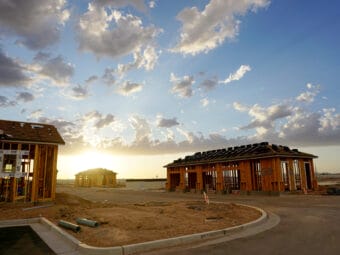
New homes are under construction in June at a housing development near Buckeye, Ariz. A growing number of local governments are considering limits on homebuilding in the face of floods, droughts and wildfires driven by climate change. (Mario Tama/Getty Images)

With climate-fueled disasters killing hundreds of Americans annually and costing communities billions of dollars, a growing number of local governments are asking a basic question: Are there some places where people shouldn’t build homes?

It’s one of the most difficult choices a community can make. Local governments typically want more housing, not less, because budgets are generally funded by the property taxes from those homes. At the same time, a nationwide housing shortage is creating even more pressure to build.

“[If] you’re a local government, of course you want to develop,” says Katharine Mach, who studies climate change and housing at the University of Miami. “You’re building a community. You’re supporting livelihoods. You’re supporting tourism oftentimes. [And] there’s the pragmatic dimension of, you need the property taxes.”

As a result, putting limits on homebuilding can feel like a non-starter for the local officials who generally control land-use decisions.

But with often deadly extreme-weather disasters on the rise, the problem can no longer be ignored. In the last five years, floods, wildfires, severe storms and droughts have caused more than $580 billion in damage and killed hundreds of people. And some states are passing laws that put conditions on future growth.

NPR visited three places that are grappling with the question of how to stop building homes in harm’s way — with varying degrees of success. Whether it’s flooding, wildfires or drought that threatens a community, similar conversations are now playing out across the United States.

California: Building homes in places that could burn

Two things are painfully apparent for many California cities: the massive statewide housing shortage and a growing danger from wildfires.

With some of the most expensive housing in the U.S., California’s cities face requirements to build more housing to boost supply. But where to put it is tricky. About one-quarter of California is at high risk of burning, according to state wildfire authorities. And as the climate gets hotter, tens of thousands of homes have been lost in destructive wildfires in the last five years alone.

With few statewide regulations, navigating housing needs and wildfire risk falls to local governments, like Santee, Calif., a largely suburban town on the outskirts of San Diego.

Santee is nestled next to miles of open space, and at the edge of town, a major new development of almost 3,000 homes, known as Fanita Ranch, is being planned. For years, residents like Van Collinsworth have fought the project, which would be tucked away in the golden, shrubby hills. As a wildfire inspector by day who examines flammable brush, he knows the city is at risk. It barely escaped the 2003 Cedar Fire, which destroyed more than 2,000 homes.

“I don’t think the project should be built — that’s the bottom line,” he says. “I don’t think developers and decision-makers are willing to acknowledge that we are living in a new era of extreme weather and really grapple with what that means for the desire to build and build and build.”

Collinsworth directs Preserve Wild Santee, an environmental group that joined several others to file a lawsuit to stop the development after the city approved it in 2020. A judge agreed, finding that the developer didn’t adequately analyze how long it would take residents to evacuate during a fire or whether they could do so safely.

The developer, HomeFed Corp., proposed the project again in 2022, this time with a phased evacuation plan that works by zones, so neighborhoods could be cleared more efficiently. Houses would be built with fire-resistant materials and have fire sprinklers. Inspectors would check that flammable vegetation was cleared twice per year, something that would be paid for by homeowners association fees. Those funds would also ensure vegetation was cleared around the outskirts of the community, creating a buffer.

“Other parts of the country are in a hurricane zone, and they have codes and standards that say, if you build to these standards, you can go ahead and build a home,” says Kent Aden, senior vice president of HomeFed. “We have all these standards for building in wildfire zones, but there seems to be a resistance to allow projects to move forward that meet or exceed those standards.”

In 2023, the City Council approved the project again, with several members saying they were satisfied with the wildfire safety measures after local fire officials supported the plan.

“We tried to take everything we can learn from the fires plus even more, making it, in my opinion, the best example of what can be done to make a defensible community,” Aden says.

Collinsworth and environmental groups filed a second lawsuit to halt the project, and it will be heard in court next year. It’s one of several lawsuits aimed at stopping developments in California, and some of these suits were supported by state Attorney General Rob Bonta. He recently released guidance for cities about how to analyze wildfire risk.

Still, while California leads the nation in some wildfire policies, like building codes for individual homes, there are few statewide laws about making development decisions in high-risk zones. Those decisions fall to local governments alone. A bill now being considered from state Sen. Ben Allen would require developers to analyze fire behavior and create evacuation plans in cooperation with local fire authorities as part of their projects.

Previous legislative bills requiring local governments to create standards for approving housing in risky areas have failed amid pushback from the building industry.

“If we site houses and infrastructure in places better, safer, that makes it easier to keep people safe as climate change intensifies into the future,” Mach says. “But it’s not as if we have easy choices of just building in the safe places, because there are no places that are devoid of hazards right now.”

Arizona: Limiting growth where water is scarce, with a catch

Located in a desert, cities around Phoenix are constantly facing questions of water supply — not just at water management agencies but also at city councils considering where to develop. That’s because Arizona has one of the most powerful laws in the country linking water with the decision to build.

In Casa Grande, about an hour south of Phoenix, Mayor Craig McFarland knows his city’s future is linked to water. Housing is already in high demand. Industry is moving into the area, with both a battery and an electric car manufacturer offering thousands of jobs near town.

“We have this huge need for workforce housing, and that workforce housing needs a place to go,” McFarland says. “And so that’s why all of a sudden the rush is on.”

But whether that housing can be built is a question. A two-decade drought in the Southwest has triggered cutbacks to Arizona’s water supply, as climate change strains the Colorado River, one of the state’s biggest water sources. Underground aquifers are the state’s other major water source. But in Pinal County, where Casa Grande is located, overpumping of aquifers is a big concern.

So when it comes to development, McFarland consults a map that looks like a patchwork quilt. Some parcels of land are blue, which means a water supply would be ensured for new homes. But many other parcels are white. There, developers would have to find their own water supply in order to build. State law limits growth where water is in short supply, requiring new subdivisions to show they have 100 years of water for their customers.

“Arizona is the only state in the country that requires 100 years’ worth of water,” McFarland says. “It’s a consumer protection.”

This year, regulators announced they would not be guaranteeing water supplies for new subdivisions around Phoenix, limiting future construction. That has been the situation for several years in Casa Grande.

Still, McFarland isn’t discouraged. In the long term, the city is looking at water recycling and conservation. And in the short term, building hasn’t stopped.

That’s because developers have found a profitable workaround. Arizona’s water law applies only when lots are subdivided into smaller lots for six or more homes and those houses are either sold or made available for long-term rentals. Instead, developers have turned to building short-term rentals on a single large piece of land.

Not far from the center of town, construction workers are putting the finishing touches on new single-story homes in a 331-unit development. Water supply hasn’t been a barrier to building because these units will be part of one large rental project.

“We don’t need an assured water supply because it’s one lot,” says Greg Hancock of Hancock Builders, which is constructing the project. “Although it’s 331 units, it’s one lot.”

Casa Grande, like several other Arizona cities, has seen a boom in these “build to rent” projects. Hancock says after decades in the business, his company started building them only recently and has more than 10,000 units built or in development.

“It’s been one of the greatest housing markets forever,” he says. “People will not stop moving here.”

But with the growth, that unaccounted-for water demand is raising red flags. Already, Arizona water regulators say there won’t be enough groundwater to meet existing needs over the next 100 years.

“If you build houses and you rent them, there’s no way to go back and undo the fact that they’re there and people are living in them,” says Kathleen Ferris, senior research fellow at the Kyl Center for Water Policy at Arizona State University.

Ferris helped write Arizona’s 100-year water law four decades ago. She says its strength is that it tethers building decisions to water decisions. Back then, build-to-rent wasn’t common. Now, she says, the state is reaching a pivotal moment when all water use needs to be accounted for.

“Climate change and aridification have come on so much faster than most people thought,” she says. “Yes, there is still opportunity for growth, but there needs to be an understanding of the limits.”

This year, Arizona legislators drafted two state bills to close the loophole, which would require rental projects to have a water supply. Both failed to pass. Some cities pushed back, saying it would limit a key way to address the housing shortage. Now, a working group convened by Gov. Katie Hobbs is examining the issue.

Still, the overriding conversation is about growth. With droughts expected to worsen, Arizona’s water law is pushing cities to look at boosting their water supplies locally, whether that’s through building water-recycling projects or amping up conservation.

“I used to say, ‘Maybe we’re at our limit. Maybe we can’t build any more houses,'” says Pinal County Supervisor Stephen Miller, who works on water issues. “So now I say, ‘If we’re going to maintain any type of growth, we have to bring water in.'”

New Jersey: A little bit of everything adds up to a lot of flood protection

New Jersey may offer a blueprint for how to get people out of harm’s way while continuing to grow and prosper economically, according to climate experts.

The marshy coastal state is a decade into a systematic statewide effort to protect residents from floodwaters. And those efforts appear to be successfully limiting new construction of homes in flood-prone areas and better protecting people who live in flood zones or are considering moving into them.

“This is an area where New Jersey is very proactive,” says A.R. Siders, a climate researcher at the University of Delaware who studies climate risk and housing.

New Jersey has attacked its flooding problem from every angle. Since Superstorm Sandy devastated the region in 2012, New Jersey has passed regulations that make it harder to build new homes in flood zones. If you want to substantially renovate a home that already exists in a flood-prone area, the new rules require major upgrades to protect the house from water, such as putting the whole house on stilts or moving air conditioning units and other crucial utilities off the ground so they can survive a flood.

This year, New Jersey also passed some of the strongest flood disclosure laws in the country, which means that people who are buying homes in the state get information about whether their prospective new house has flooded in the past or is likely to flood in the future.

And the state has purchased more than 1,000 houses in the last decade through a permanent home-buyout program known as Blue Acres, which acquires homes that have flooded and knocks them down to provide more open space for floodwater.

As a result, New Jersey appears to be doing significantly better than the national average when it comes to the number of homes in flood zones, according to preliminary findings by a group of climate scientists including Siders and Mach.

That’s particularly notable since New Jersey is both the most densely populated state in the country and one of the most flood prone.

The town of Woodbridge, N.J., has been on the front lines of New Jersey’s strategy.

After Superstorm Sandy flooded the town, the local government decided to support home buyouts.

“[It’s] not something we wanted to do, but we had to do it,” says longtime Mayor John McCormac. “We didn’t want to lose residents.”

But it was equally unthinkable that homes would be rebuilt in places that had flooded, he says. And there were alternative ways for the town to grow economically.

Because home buyouts are voluntary, the town could move forward only if people agreed to move. McCormac remembers a town meeting he presided over in the high school auditorium.

“It was difficult. People were angry,” he says. “It wasn’t an easy process. You know, somebody’s talking to you about moving out of their home that they’ve been in for 60 years. And it’s their biggest investment in their life.”

Similar conversations have played out across the state in recent years, says New Jersey’s chief resilience officer, Nick Angarone. “These are very complicated and very difficult conversations to have,” he says. “You’re talking about some of the basic principles of the country, you know? Where and what you can do with your property.”

But unlike in other states, New Jersey residents who are considering a home buyout are assigned a case manager who can help navigate both the paperwork and the emotions that come along with such a momentous decision.

“Our case managers are sort of our secret sauce,” says Courtney Wald-Wittkop, who runs the Blue Acres program. “They’re very good about developing that rapport and relationship with the homeowners.”

One reason New Jersey is able to match people up with experienced case managers is that, unlike other state buyout programs, Blue Acres exists all the time, not just after major disasters. Because it’s permanent, it’s more accessible to both homeowners and local officials, without whose support buyouts cannot happen.

Ultimately, more than 180 homeowners in Woodbridge decided to accept buyouts and move away, says McCormac, the mayor.

The homes that remain in flood-prone areas of Woodbridge are subject to New Jersey’s new, tighter regulations that require them to be elevated. Instead of building new homes in marshy areas, Woodbridge is allowing more units to be built in denser parts of town near train stations and highways. The town’s population is stable, and its economy is growing.

The town’s flood plain manager, Tom Flynn, says the strategy is also paying off in the form of less flood damage. When the remnants of Hurricane Ida dropped 8 inches of rain in Woodbridge in 2021, Flynn says, it flooded dozens of homes instead of hundreds.

Copyright 2023 NPR. To see more, visit https://www.npr.org.

Six things to know about the political debate around daylight saving time

Picture taken on March 23, 2018 shows a technician working on the clock of the Lukaskirche Church in Dresden, eastern Germany. – The European Commission will recommend EU member states abolish daylight saving, where clocks are advanced by one hour in summer, its president Jean-Claude Juncker said on German television on August 31, 2018. (Photo credit SEBASTIAN KAHNERT/DPA/AFP via Getty Images)

Twice a year, every year, the ritual returns as literal clockwork: the start or end of daylight saving time.

Millions of Americans, filled with grunts or glee, tap at their devices or wind their watch hands, manually changing the time to reflect a change in seasons.

But in recent years, lawmakers have talked as if this timeworn tradition might be on its last legs. A raft of bills on the federal and state levels are taking aim at the biannual time changes — and yet nothing is changing, at least for now.

Here’s a look at where things stand.

What’s the status of that Senate bill to end time changes?

In March 2022, the Senate passed the Sunshine Protection Act. The intent behind the bill was to make daylight saving time permanent starting in spring of 2023.

And at first, it looked as though it might become a reality. The Senate passed the bill through an expedited process and with unanimous consent — legislative rarities in this day and age.

But the bill failed to be taken up in the House. Members cited higher priorities, like a budget deficit and war in Ukraine, but there was also a growing chorus of criticism about the bill’s approach (more on this below).

Sen. Marco Rubio, R-Fla., reintroduced the bill this March, and it was sent to the Committee on Commerce, Science and Transportation, but there’s been no notable movement on it since. A companion bill, introduced by Rep. Vern Buchanan, R-Fla., is similarly stuck in committee at the House level.

Even if either bill manages to pass both chambers, it’d still need to be signed by President Biden, who hasn’t indicated how he leans on the issue.

So for now, the tradition remains in tact.

When is the end of daylight saving time 2023?

This season’s turnover time is 2 a.m. on Nov. 5, meaning residents of most states will want to move their clocks back an hour when they go to bed this Saturday.

Two states — Hawaii and Arizona — don’t observe daylight saving time. The U.S. territories of Samoa, Guam, Puerto Rico, the Virgin Islands and Northern Mariana Islands also don’t change their clocks.

What’s the argument against the Sunshine Protection Act?

When the Sunshine Protection Act was first debated in a House subcommittee, experts said switching to permanent daylight saving time would do everything: save lives, reduce crime, conserve energy and improve health.

And pretty much everyone agrees that ending the time changes is generally a good idea. Our bodies can be very sensitive to disruptions to our circadian rhythms.

But the medical community has taken issue with how the bill proposes to make the change — specifically, that it mandates all states adopt permanent daylight saving time rather than sticking to standard time.

Doctors and scientists argue that standard time is actually better for our health. Our internal clock is better aligned with getting light in the morning, which, in turn, sets us up for better sleep cycles.

The bill’s sponsors aren’t budging though. Sen. Rubio is still pushing for permanent daylight saving time.

And the biggest argument for this approach may be an economic one. The idea is that having more light in the evenings encourages people to go out and do things — i.e., spend money.

The nation’s convenience stores, for example, told a congressional subcommittee that they see an uptick in spending when clocks are set to daylight saving.

Could the states adopt their own time change rules?

With federal legislation stuck in a holding pattern, states could take up the issue, but they’re still subject to some federal limitations.

The Uniform Time Act, which was passed in 1966, says that states can enact permanent standard time but not permanent daylight saving time.

At least 550 bills and resolutions have surfaced concerning time changes at the state level in recent years, according to a tally from the National Conference of State Legislatures (NCSL). So the same debate that’s happening at the federal level is playing out in statehouses across the country.

Which states are trying to end daylight saving time?

Nineteen states have actually passed measures pledging to switch to permanent daylight time if Congress changes the rules to allow for such an action.

Those states are:

  • Alabama
  • Colorado
  • Delaware
  • Florida
  • Georgia
  • Idaho
  • Kentucky
  • Louisiana
  • Maine
  • Minnesota
  • Mississippi
  • Montana
  • Ohio
  • Oregon
  • South Carolina
  • Tennessee
  • Utah
  • Washington
  • Wyoming

California voters also authorized a resolution in 2018, but lawmakers haven’t taken any action on the legislation so we’re not counting it here.

As of September 2023, nine states were actively considering legislation that would also end daylight saving, but by switching the state to year-round standard time, according to the NCSL.

Those states are:

  • Maine
  • Massachusetts
  • Minnesota
  • New York
  • Oklahoma
  • Pennsylvania
  • South Carolina
  • Tennessee
  • Vermont

But these pieces of legislation are all marked ‘pending’ so residents should still plan to turn back their clocks this year — and check in before the next time daylight saving time starts up again.

When will daylight saving time resume in 2024?

That’ll be Sunday, March 10. Mark your calendars.

Copyright 2023 NPR. To see more, visit npr.org.

As some medical debt disappears from Americans’ credit reports, scores are rising

Kayce Atencio, who had a heart attack when he was 19, was unable to rent an apartment for years because of bad credit attributed in part to thousands of dollars of medical debt. “It always felt like I just couldn’t get a leg up,” says Atencio, one of millions of Americans whose access to housing is threatened by medical debt. (Rachel Woolf for KFF Health News)

The share of American consumers with medical debt on their credit reports has declined dramatically over the past year as major credit rating agencies removed small unpaid bills and debts that were less than a year old, according to an analysis published Thursday from the nonprofit Urban Institute.

At the same time, millions of Americans have seen their credit scores improve, making it easier for many to get a job, rent an apartment, or get a car.

“This is a very significant change,” said Breno Braga, an economist at the Urban Institute and a co-author of the study. “It affects a lot of people.”

For years, medical debt has depressed credit scores, undermining the financial security of tens of millions of patients and their families.

Under mounting pressure from patient advocates and government regulators, the three major credit agencies over the last two years have taken a series of steps to remove some medical debts from credit reports, including unpaid medical bills under $500.

The changes appear to be having an impact. As of August, just 5% of adults with a credit report had a medical debt on their report, down from almost 14% two years earlier, the Urban Institute analysis found.

Researchers also found that Americans with a medical debt on their credit report in August 2022 saw their VantageScore credit score improve over the next year from an average of 585 to an average of 615.

That moved many consumers out of the subprime category. Subprime borrowers typically pay higher interest rates on loans and credit cards, if they can borrow at all.

Consumers’ improved scores don’t mean the medical debts have been eliminated. Hospitals, collectors, and other medical providers still pursue patients for unpaid bills. And many continue to sue patients, place liens on their homes, or sell their debts.

But the credit reporting changes appear to be mitigating some of the more pernicious effects of medical debt.

Credit scores depressed by medical debt, for example, can threaten people’s access to housing and fuel homelessness.

In total, about 27 million people experienced a significant improvement in their score, the Urban Institute researchers estimated. VantageScore, which uses a slightly different methodology than FICO, in January stopped using any medical debt to calculate scores.

The credit reporting changes have drawn criticism from debt collectors and some medical providers, who warn that hospitals and physicians may require upfront payments from patients before delivering care or may push more patients into credit cards and other kinds of loans.

In August, a California dermatologist sued the three major consumer credit rating agencies, claiming that with fewer medical debts appearing on credit reports, patients would have less of an incentive to pay their bills, costing physicians nationwide potentially billions of dollars. The case is pending in federal court.

But most leading consumer and patient advocates applaud the more restrictive credit reporting rules. Other research, by the federal Consumer Financial Protection Bureau, has found that medical debt — unlike other kinds of debt — does not accurately predict a consumer’s creditworthiness, calling into question how useful it is on a credit report.

In September, the Biden administration announced plans to push broader changes that would eliminate all medical debts from consumers’ credit scores. Federal regulations to implement such a ban will be developed next year by the CFPB, federal officials said.

This would expand current state efforts. In June, Colorado enacted a trailblazing bill that prohibits medical debt from being included on residents’ credit reports or factored into their credit scores. A similar measure was passed by the New York state legislature this year and is pending before the governor.

The Urban Institute researchers predicted that these policies would continue to improve consumer credit scores, though they warned that more systemic changes will be necessary to reduce medical debt, which burdens about 100 million people in the U.S.

“Reducing the burden of medical debt and its wide-ranging consequences would likely require health insurance reforms that build on the Affordable Care Act to further protect consumers from out-of-pocket medical expenses they can’t afford,” the report concludes.

The report by the Urban Institute, which has worked with KFF Health News over the past two years to analyze medical debt data, is based on a sample of credit records from one of the three large credit rating agencies.

KFF Health News, formerly known as Kaiser Health News (KHN), is a national newsroom that produces in-depth journalism about health issues and is one of the core operating programs at KFF — the independent source for health policy research, polling, and journalism.

Copyright 2023 NPR. To see more, visit npr.org

These American birds and dozens more will be renamed, to remove human monikers

The Steller’s jay, Cooper’s hawk, and Wilson’s warbler will all get renamed under a new plan to remove human names from U.S. and Canadian birds. (Mick Thompson, Tom Murray, Jerry McFarland/Flickr Creative Commons)

Get ready to say goodbye to a lot of familiar bird names, like Anna’s Hummingbird, Gambel’s Quail, Lewis’s Woodpecker, Bewick’s Wren, Bullock’s Oriole, and more.

That’s because the American Ornithological Society has vowed to change the English names of all bird species currently named after people, along with any other bird names deemed offensive or exclusionary.

“Names have power and power can be for the good or it can be for the bad,” says Colleen Handel, the society’s president and a research wildlife biologist with the U.S. Geological Survey in Alaska. “We want these names to be powerful in a really good way.”

The move comes as part of a broader effort to diversify birding and make it more welcoming to people of all races and backgrounds.

“We’ve come to understand that there are certain names that have offensive or derogatory connotations that cause pain to people, and that it is important to change those, to remove those as barriers to their participation in the world of birds,” she says.

The project will begin next year and initially focus on 70 to 80 bird species that occur primarily in the United States and Canada. That’s about 6 or 7 percent of the total species in this geographic region.

The society has promised to engage the public, and says that birds’ scientific names won’t be changed as part of this initiative.

The effort represents a huge change for the birding community, and those involved expect a certain amount of opposition from long-time birders.

“I’ve been seeing some of these birds and using these names every year for the last 60 years,” says Kenn Kaufman, a prominent author of field guides. He says he initially opposed the idea of changing so many names, but has come around.

“It’s going to feel like a bother to some people, but I think it’s actually an exciting opportunity,” says Kaufman. “It’s an exciting opportunity to give these birds names that celebrate them — rather than some person in the past.”

While the society also has authority over English names of Latin American birds, it is planning a broader set of discussions with ornithologists and organizations in Latin America before proceeding with Latin American name changes.

“There are birds in South America that were named for friends of mine,” adds Kaufman. “I would like to think that they would accept this, for the benefit that it brings.”

The American Ornithological Society and its predecessor organization have maintained a list of the official English-language names for birds in North America since 1886. Occasionally, bird names have been changed, most often for scientific reasons.

a bird
This bird used to be named for Confederate General John McCown, but in 2020, it was renamed the Thick-billed Longspur. (Aaron Maizlish/flickr Creative Commons)

One notable exception came in 2000, however, when the society renamed a bird that’s now called the Long-tailed Duck because of concerns that its previous name was derogatory to Native Americans.

“That was the first that I’d ever really recognized or heard of a name that was offensive,” says Handel, who says at that point in time, concerns about injustice wasn’t a traditionally accepted reason for changing bird names.

That really started to change in 2020, when police officers killed George Floyd in Minneapolis. On that same day, a white woman in Central Park called the police on black birder Christian Cooper, claiming he was threatening her.

Less than a month later, a group called Bird Names for Birds wrote to the leadership of the society, pointing out the potential problems that come with eponymous honors and demanding change.

They noted that a 2019 proposal to rename a small prairie bird that had previously been named for Confederate General John P. McCown had been rejected.

In 2021, the society officially gave that bird the name “Thick-billed Longspur,” after amending its naming guidelines to explicitly consider social justice reasons, says Handel.

“Because of those associations with racism and slavery, it was decided that this name needed to be changed,” she explains.

Renaming a bird here and there was one thing. But the idea of renaming a whole slew of birds to remove names associated with historical figures? That took more mulling over.

“This proposal was so different because it was asking us to change an entire group of names instead of one by one,” says Handel.

A diverse group of ten experts met to consider it, says Erica Nol, a biologist at Trent University in Canada who co-chaired this ad hoc committee.

“The membership was carefully chosen to reflect broad perspectives. And it really did,” she says. “We all came to the decision in our own way and over time and quite slowly, actually, because the final decision is fairly radical.”

Kaufman, who was not involved in making the decision, says that initially, he thought that just a few really offensive bird names should be changed.

“I knew the young people who had started this Bird Names for Birds movement, and I tried to talk some sense into them,” he recalls. “But the longer we discussed this, the more I came around to seeing their viewpoint.”

Trying to do this bird by bird would mean engaging in divisive debates about individual people and the merits of whether or not they should have the honor of having a bird named after them, he realized.

“That just seemed like it would lead to endless arguments,” he says, adding that he didn’t think the birding community should become the morality police for people who lived two centuries ago.

Renaming the birds, in contrast, offered an opportunity to highlight unique features of the birds themselves. Unlike “Wilson’s warbler,” for example, the names “Yellow Warbler” or “Golden Winged Warbler” offer up a useful description, he says.

Take Brewer’s sparrow, says Kaufman. “What would be a good descriptive name for that? We can’t call it Sagebrush Sparrow, even though it is in the sagebrush,” he says, “because there is a sagebrush sparrow already.”

Nol says she recently was visiting some salt marshes this summer and saw a common bird there that’s called Wilson’s Snipe, which has a long bill and engages in dramatic displays such as flying in high circles, which produces a whistling sound as air flows over specialized feathers. “And I thought, what a terrible name,” she says. “I mean, Wilson was the father of modern ornithology in North America, but this bird has so many other evocative characteristics.”

She says people have pointed out to her that the birds don’t care what their names are.

“Names are important for humans. And this is absolutely a human-driven exercise,” she says. “They’re important for the people who watch birds and the communities who may or may not feel very welcome, if all the birds are named after these old European ornithologists.”

Copyright 2023 NPR. To see more, visit npr.org

We’re spending $700 million on pet costumes in the costliest Halloween ever

Charlie the superdog is the only member of the King family who got two Halloween outfits this year. His other costume is a doughnut. (Joelyne King)

Charlie does not want to sit still for the photo.

The Chihuahua-terrier mix in a Superman cape perches next to some pumpkins, swirls and sniffs the decor. Joelyne King, behind the phone camera, raises the pitch of her voice to remind him he’s a good boy. Then, she lifts up a dollar bill, and its crinkle grabs his canine focus for exactly long enough.

“We figured Superman would be a good costume because he’s just a great all-around dog,” King says on a recent visit to a Maryland farm for a fall festival with her family. One of her two children is about to celebrate her first Halloween.

“Usually I have multiple costumes for the kids, but I think this year we just went with one for each of them. Charlie was the only one that got two,” King says.

When Charlie is not a superhero, he’ll be dressed as a doughnut.

This Halloween, American shoppers are expected to spend $700 million on pet costumes, according to the National Retail Federation. Altogether, Halloween spending in the U.S. will likely top $12 billion, a new record. A National Retail Federation survey estimated that an average shopper would spend $108 on candy, costumes and decorations.

The survey found top pet outfit choices are pumpkin, hot dog, bat, bumblebee and spider.

Bailey the Shih Tzu does not love costumes but does her best to embody a tiger anyway. (Alina Selyukh)

The survey did not seem to ask the pets’ opinions on the matter. Neither did Alyssa Peters and Mike Namaiandeh, dressed as Jasmine and Aladdin, leading Bailey, a cheerful Shih Tzu dressed as a tiger.

“When I pulled the costume out of the package, she kind of looked at me like, ‘Do we really have to do this again?'” Peters says, laughing. “You’ve got to be a part of the team here.”

Candy may be $500, but the thrills are priceless

Before the COVID-19 pandemic, Halloween spending was actually on a decline in the United States. But the lockdowns got more people into decking out homes for the holidays, and we haven’t stopped.

The Denchfield family expects 400 to 500 children to walk through the haunted maze that has made the family’s house a top Halloween destination in Bethesda, Maryland. (Alina Selyukh)

“This is like a universal holiday that everyone can have fun with,” says Kurt Denchfield, standing next to a crate of plastic gore: fake blood, loose severed limbs and bloody brains.

Every year, his family shape-shifts their front yard into a haunted maze that becomes a top Halloween destination in suburban Bethesda, in Maryland.

To get the treats here means to plod through fog and evade glowing skeletons, sparking electric tentacles, howling monsters — and at least one of six Denchfield children wielding a chainsaw.

Kurt and Heather Denchfield, with their son Jake, pose in their front yard, which is about to mutate into a haunted maze. (Alina Selyukh)

Heather Denchfield is the purchasing department for the operation. She confirms one of the reasons that holiday spending is up: Everything is more expensive. Pricier sugar, cotton and building supplies mean costlier sweets, costumes and decorations.

To keep costs down, the Denchfields reuse a spooky stash of supplies from year to year. They got cornstalks and pallets through Kurt’s landscaping business. But there’s one Halloween luxury they won’t sacrifice: the full-size candy bars that await survivors of the maze.

“We do go from full-size to fun-size by the time that the night ends,” Heather says.

“That’s after the 400th candy bar,” Kurt chimes in. They estimate they’ve shelled out $500 on all that chocolate.

Kurt Denchfield works on the haunted maze, which has been sprawling bigger every year. (Alina Selyukh)

And the number of visitors to the haunted maze seems to grow by 50 children each year, Kurt adds, though he doesn’t know whether it’s the spreading word or hyper Halloween spirit.

“We’ll need a bigger front yard soon if we’re gonna keep expanding it,” he says. “Maybe we can annex the neighbor’s yard for one night.”

Talk about growing Halloween expenses. Step 1: Get a bigger lawn.

Copyright 2023 NPR. To see more, visit https://www.npr.org.

Thanks, Neanderthals: How our ancient relatives could help find new antibiotics

With an antimicrobial resistance epidemic looming, some researchers are looking to solutions in molecular de-extinction. (altmodern/Getty Images)

Antibiotics have changed the world.

They’ve made it possible to treat diseases that used to mean anything from discomfort to death. But no new classes of antibiotics have made it to the market since the 1980s.

What if humans’ closest, ancient relatives held the answer to antibiotic resistance?

Some scientists like University of Pennsylvania bioengineering professor César de la Fuente want to discover new antibiotics using machine learning … and some very, very old relatives.

Machines and molecular innovation

Antibiotics have changed the world, making it possible to treat diseases that used to mean anything from discomfort to death.

But now, society faces a new problem.

“We’re facing a silent pandemic where more and more bacteria are becoming resistant to available antibiotics,” de la Fuente says.

As a post-doctorate student at MIT, de la Fuente had an idea: What if machine learning could teach a computer how to innovate at a molecular level?

He and his team did just that — trained a computer to execute Darwin’s algorithm of evolution. In 2018, they published, to their knowledge, the first study to use AI to find a new antibiotic.

“It took initial antibiotics that were not very effective and it was capable of evolving them to become much more effective,” he says. These new antibiotics killed bacteria in mice.

Mining proteins from our ancestors

Next, de la Fuente and his collaborators used these computer models to dig through the proteins in the human body – the proteome – in search of tiny proteins called peptides that might play a role in the immune system.

They discovered over 2,500 peptides with anti-infective traits, and wondered: What if they turned their attention to extinct species in this hunt for new potentially antibiotic molecules?

De la Fuente says organismal de-extinction, the conceit of Jurassic Park, kept coming up in brainstorming sessions. But instead of dinosaurs, they set their eyes on humans’ closest ancestors: Neanderthals and Denisovans.

“Instead of bringing back entire organisms, why not just bring back molecules from the past to solve present day problems?” de la Fuente says.

De la Fuente says he and his team did just that – developed a machine learning model that could mine proteomic and genomic data from Neanderthals and Denisovans. The model finds sequences from archaic humans and predicts which ones would be good antibiotic candidates.

The next step? Resurrection.

“We use a technique called solid phase chemical synthesis, which essentially is like little robots that allow us to make the peptides and they make one amino acid at the time and then they link them in a chain to essentially get your final peptide, which again is a tiny protein,” de la Fuente explains. “And then we expose them to bacteria that we grow in the laboratory and we see whether they’re able to kill clinically relevant bacteria or not.”

They found several peptides that effectively killed bacteria in petri dishes, and tested them in animal models.

“In one of the mouse models, which was a skin infection model, one of the Neanderthal peptides was able to reduce the infection to levels comparable to a standard of care antibiotic called Polymyxin B,” de la Fuente says.

They called it “neanderthalin-1” and, while the peptide itself is not potent enough to be an antibiotic on its own, de la Fuente says he and his team hope to use it and other peptides as templates for further study of anti-microbials.

Want more on de-extinction? We’ve got you! Listen to our episode on the de-extinction of entire animals, like the dodo and woolly mammoth.

Have a question? Email us at shortwave@npr.org.

Listen to Short Wave on Spotify, Apple Podcasts and Google Podcasts.

This episode was produced by Rachel Carlson. It was edited by Rebecca Ramirez. The fact checker was Anil Oza, and the audio engineer was Patrick Murray.

Copyright 2023 NPR. To see more, visit https://www.npr.org.
Site notifications
Update notification options
Subscribe to notifications