NPR News

Tough US housing market is luring buyers with higher incomes and no kids

Would-be home buyers are battling high prices and high interest rates, but some are finding a way to make it work.
(Frederic J. Brown/AFP via Getty Images)

Anyone shopping for a home right now has to contend with a double whammy of high prices and high interest rates. To make matters worse, there aren’t a lot of homes on the market to choose from.

A survey by mortgage giant Fannie Mae found 85% of Americans think it’s a bad time to buy a home.

Still, some people are taking the plunge. First-time buyers accounted for nearly a third of home sales during the 12 months ending in June, according to an annual snapshot from the National Association of Realtors. A record 70% of all buyers didn’t have children under 18 living at home.

Lance Zaldivar bought his first home over the summer, not long after getting out of the Marine Corps. He socked away money for the down payment during his last deployment in Kosovo. His fiancee, Jasmin Benitez, also had some savings from her job as a nurse practitioner.

“My fiancee is a little pickier than I am, and at this point now I’m glad that she was,” Zaldivar says. “She was looking for a little bit of a yard. A little larger square footage inside the house. Somewhere that we can raise a family in.”

Paying up front to lock in a lower mortgage rate

The couple found a three-bedroom house in Montgomery County, Texas, north of Houston, for $245,000 — well below the national average.

Their mortgage rate will be 6.25%, but they paid additional money paid up front to get a lower rate for the first two years, while Zaldivar finishes his bachelors degree.

“I was real happy about that,” Zaldivar says. “That eased my concern, compared to some of the other interest rates I’ve seen.”

Average mortgage rates have climbed even higher in the months since Zaldivar bought, approaching 8% this fall before settling back to 7.5% last week, according to Freddie Mac.

Sellers are holding tight to their low-rate homes

Rising interest rates have put homes out of reach for many would-be buyers. They’ve also discouraged people who already own homes from selling and giving up their cheaper loans. That’s a big reason there aren’t many “For Sale” signs out there right now.

Kristina Dunlap says there wasn’t much to choose from when she and her husband began looking for a house this year. But after three years of renting in Nashville, the couple was determined to buy a place.

“We calculated how much we had spent in rent over three years essentially and I think that number was a lot scarier than what the interest rates are right now,” she says.

Dunlap is a freelance marketer and her husband Eric is a construction manager. They thought of buying a fixer-upper, but decided that was more work than they wanted. Instead, they opted for a newly-built home near Springfield, about 25 minutes north of Nashville.

“The whole neighborhood is still under construction actually at the moment. We don’t even have paved roads currently,” Kristina Dunlap says.

New homes are a bigger share of sales

About 13% of homes sold this past year were newly built, according to the Realtors’ report, up from 12% the year before.

Like many successful buyers, Dunlap made tradeoffs — moving farther from the central city and giving up the bonus room she was hoping for. She did get the open floor plan and the two-car garage she wanted, as well as a yard for her dog, Kujo.

“The yard was a must,” Dunlap says. “When he gets — I call them the zoomies– When he gets those twice a day, we just send him out there and let him run it all out.”

The purchase price was just under $350,000 so the Dunlaps needed about $30,000 to cover the 6% down payment and closing costs.

Down payment is the hard part and average income of buyers is at a record high

According to the Realtors’ report, coming up with a down payment is the biggest challenge for many first-time buyers, especially those who are saddled with high rent and student loans.

The average income for all home-buyers hit a record high: $107,000. That highlights the challenges that middle-income people face in buying a home.

“Down payment, finding that right home — inventory is still incredibly tight — We know that they have a hard time, especially finding an affordable property,” says Jessica Lautz, deputy chief economist at the Realtors’ association. “But these homebuyers are somehow making it work and getting in there.”

Lance Zaldivar and his fiancee moved into their new house in June and wasted no time unpacking. While the average buyer plans to stay in a house for 15 years, Zaldivar plan to keep his home much longer.

“Whenever we do have a family, grandkids, great grandkids, they can always come over to our place, and it will be home for the Zaldivars,” he says.

Copyright 2023 NPR. To see more, visit https://www.npr.org.

A manufacturer tried the 4-day workweek for 5 days’ pay and won’t go back

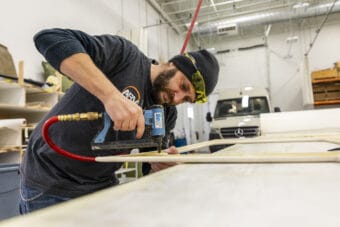
Bill Kowalcic works on wall panels in the finishing department at Advanced RV. After the company went to a four-day workweek, his team figured out how to cut time without cutting corners. (Amber N. Ford for NPR)

When Bill Kowalcic first heard that his company Advanced RV was trying out a four-day workweek, he was filled with questions.

“All of us were a little nervous — like, are we going to be able to get our work done? Are we going to do OK? Is this going to hurt us?” says Kowalcic, a skilled craftsman who works in the finishing department.

A year and a half later, he has answers.

Not only has his team found shortcuts and time savers, he’s happier on the job.

“Gosh, it’s been great,” he says.

“I’ve never had a job where I’ve said this before, but at the end of the three-day weekend, I’m ready to come back in Monday morning.”

The trial has spread globally, but few manufacturers have taken part

Advanced RV builds custom, luxury motorhomes out of Mercedes-Benz cargo vans in Willoughby, Ohio. It is one of more than 200 companies and only a handful of manufacturers that have taken part in an ongoing global trial led by the organization 4 Day Week Global.

Advanced RV takes two years to build custom motorhomes for clients. (Amber N. Ford for NPR)
An Advanced RV employee works on a custom RV that will eventually become a mobile library.
(Amber N. Ford for NPR)

For six months, businesses agree to reduce working hours while maintaining the same pay. The goal is not to do less with less but to maintain 100% productivity by bringing more energy and efficiency to the workplace, while lessening fatigue and burnout.

The success stories coming out of the trial have offered a work-weary public hope that a better work-life balance is achievable. Of the 41 American and Canadian companies that began the trial in 2022, none has reported going back to working 40 hours a week.

A closer look at how Advanced RV has managed to significantly reduce its working hours while keeping up productivity reveals some essential elements: a tolerance for risk, and also trust, creativity, and open-mindedness.

“The most significant thing I could do as a business owner”

The company’s CEO Mike Neundorfer says he first heard about the four-day workweek about two years ago.

In 2021, Iceland reported that two trials involving 2,500 workers, most of them government employees, had found working fewer hours for the same pay led to improved well-being with no loss in productivity. In some places, workers reported being even more productive after cutting back their hours.

The idea resonated deeply with Neundorfer.

“Think about it. What more impact could a person have on a number of people that work for them than giving them 50 holiday days a year, a three-day weekend every weekend?” says Neundorfer. “It just seemed like the most significant thing I could do as a business owner and manager.”

Advanced RV CEO Mike Neundorfer says he first heard about the four-day workweek two years ago and was intrigued. His company joined the global four-day week trial in early 2022 and hasn’t returned to a five-day week since. (Amber N. Ford for NPR)

Neundorfer, who founded Advanced RV in 2012 after leading other successful businesses, had never envisioned the company as a 24/7 kind of operation. His employees don’t work more than 40 hours a week, even though that has meant customers wait two years for their custom RVs.

“We could probably make more money and figure it out if we did overtime, but we never do,” he says.

Instead, in April 2022, he decided to try the opposite, moving everyone to 32 hours a week without any cut in pay.

Neundorfer knew it was a gamble, one he thought had a 50/50 chance of success. The vast majority of other companies in the four-day workweek trial employ office workers. Many of them are nonprofits.

Still, as a small business, he says it was easy for him to experiment. Advanced RV has 50 employees, no shareholders other than Neundorfer and his wife and no formal board.

And he was OK with the odds.

“Everybody won’t feel that way,” he says.

Skeptics in the ranks

In fact, when Neundorfer first talked with his employees about joining the four-day workweek trial, not everyone in the room was thrilled.

Tricia Eller, who handles customer relations for Advanced RV, was initially against cutting the workweek to four days. “This is not going to work,” she insisted at the time. She has since come around. (Amber N. Ford for NPR)

“I raised my hand and I said, I don’t think we should do this. This is not going to work,” says Tricia Eller, who joined the company in 2014 and is primarily responsible for customer relations.

She strongly believed everyone needed to be at the office five days a week.

“This is how business is run,” she insisted at the time.

Assigned to take Mondays off, she simply worked from home to ensure that customers would get the kind of attention they were used to.

A search for efficiencies

Undeterred, Neundorfer began searching for efficiencies.

He asked every department whether there were tools or equipment that could speed up tasks. His upholsterers asked for an industrial sewing machine that would allow them to bind carpets in a quarter of the time.

“This was a no brainer,” he says. “We looked at the cost and we didn’t have to even sit down with a spreadsheet. We knew this was something we should do.”

Master upholsterer Alex LLacsahuanga works on an industrial sewing machine that Advanced RV purchased as part of a push to find efficiencies. The sewing machine helps cut the time it takes to bind carpets. (Amber N. Ford for NPR)
A custom mural made by Chad Fedorovich and Mikey Garcia inside Advanced RV in Willoughby, Ohio. (Amber N. Ford for NPR)

In the finishing department, Kowalcic says he and his two teammates got hyper-focused on what processes they might eliminate, without cutting corners.

“We started making more templates, more little jigs and boxes to help us with things that are repetitive,” he says.

They also got more mindful about who does which tasks the best and fastest, and started dividing up the work accordingly.

Each change might only save them mere minutes.

“But if you save six or seven minutes on six or seven things, then you’re really starting to push the envelope a little bit and get a little bit more done,” Kowalcic says.

Productivity did take an initial hit, but happiness is up

Neundorfer says Advanced RV did see a dip in output as a result of moving to a 32-hour workweek.

“You lose productivity,” he says. “And when you lose productivity, you lose some volume, and you lose profit.”

Now a year and a half into this experiment, he says the company has nearly recovered those productivity losses.

“And I think that at some point, some of the improvements will take us beyond what we were able to do in 40 hours,” he says.

Judging by employee satisfaction, the experiment has already been a resounding success.

Bill Kowalcic in his music room. In his time off, he enjoys performing with his heavy new wave band Public Squares. (Amber N. Ford for NPR)

Kowalcic now spends his Fridays riding his bike, working on his home remodel, and getting ready for evening gigs with his heavy new wave band Public Squares. And then he still has the weekend.

“Spending more time with family, just a little more relaxation, meditation — it really helps keep me centered,” he says.

On her Mondays off, Eller in customer relations still checks her email — she says she just can’t let go — but she’ll also spend time with her mom, who is retired, or go to the movies.

“Talk to me on a Sunday, and you’ll find me in the best mood because I know I have Monday to myself to relax,” she says.

Copyright 2023 NPR. To see more, visit https://www.npr.org.

A flight expert’s hot take on holiday travel: ‘Don’t do it’

Photograph by Reet Talreja/Unsplash; Collage by Kaz Fantone/NPR

It’s stressful to fly around the holidays. Airports are packed, tickets are expensive and bad weather can cause significant flight delays and cancellations.

So, if you have to travel, is there an optimal time to do so? Scott Keyes, founder of the travel site Going.com (formerly known as Scott’s Cheap Flights), shares his recommendations, including days to avoid and the best time of day to fly.

Don’t travel around Thanksgiving and Christmas

“It’s one of the worst times to travel,” he says, due to flight disruptions, crowds at the airport and ticket prices. “My secret, best advice for travel over the holidays is: if at all possible, just don’t do it.”

If you have to fly for the holidays, do it on the day itself

“You just see far fewer people traveling then,” says Keyes. “And with fewer people, you can see lower fares and fewer disruptions,” including delays and cancellations. So think about booking tickets to depart or arrive on Thanksgiving Day, Christmas Day, New Year’s Eve or New Year’s Day.

Avoid peak travel days

For a lot of folks, the whole point of traveling during this time of year is to be with family on the actual holiday, says Keyes. “So the busiest and most crowded times [to travel] are going to be in the few days leading up to the holiday. Think Tuesday and Wednesday before Thanksgiving and December 21st, 22nd and 23rd around Christmas.”

A travel delay that stretches out over a few days, like a snowstorm, can quickly ruin a trip, he adds. “That’s when you’re going to have the most competition with other travelers” for a limited amount of seats if you’re trying to rebook a flight.

To avoid this situation, Keyes recommends flying a few days before or after these peak travel times. So instead of flying on the Tuesday before Thanksgiving, you might consider traveling a few days earlier.

Travel in January — the 8th, to be precise

If you can wait, travel in January, says Keyes. You will probably have a much better flight experience.

Keyes even has a preferred date for that month: Jan. 8, he adds. “It’s my favorite date of the entire year. I circle that date on the calendar because whereas flight prices really get inflated over the Christmas-New Year period, around Jan. 8, they just fall off a cliff from the most expensive time of the entire year to the absolute cheapest.”

Ticket prices, while “extremely volatile,” can drop 75-80%, he says. For example, a nonstop, roundtrip ticket from Los Angeles to Tokyo from Dec. 22-29 costs $1,996, according to Google Flights. But if you took that trip from Jan. 10-17, the fare dips to $427 — a nearly 80% discount. And while a nonstop, roundtrip ticket from New York City to Miami from Dec. 24-Jan. 1 costs $608, it’s only $138 from Jan. 9-16 — a 77% discount.

Take an early and direct flight

“There are two types of flights that have the highest odds of getting you to where you’re going on time or at least without a major delay: early morning flights and nonstop flights,” says Keyes.

According to the U.S. Department of Transportation’s Air Travel Consumer Report for October, flights between 6-7 a.m. had a nearly 90% on-time departure rate, versus 64% for flights between 5-11 p.m.

With morning flights, “your plane [has been] at the airport overnight. It’s sitting there and ready to go when you get there in the morning,” he says. Afternoon flights, on the other hand, depend on planes that are flying in from somewhere else and may be subject to delays.

Direct flights have the advantage of not having layovers. “If you take a connecting flight that gets delayed an hour and a half but you only had a one-hour layover, all of a sudden you’ve missed your connecting flight and you have to get rebooked” — not an easy feat during the holiday season.

Prepare yourself for potential flight disruptions that may keep you at the airport. Keyes likes to pack “noise-canceling headphones and a little snack box, because frankly, airport food is not very memorable,” he says. And he likes to download a few books and movies to his iPad — “just in case I’m having to hang out at the airport longer than expected.”


The audio was produced by Clare Marie Schneider. The digital story was edited by Malaka Gharib. The visual producer is Kaz Fantone.

Want more Life Kit? Subscribe to our weekly newsletter and get expert advice on topics like money, relationships, health and more. Click here to subscribe now.

Copyright 2023 NPR. To see more, visit https://www.npr.org.

Thousands of veterans face foreclosure and it’s not their fault. The VA could help

Army veteran Ray Queen stands with his wife, Rebecca Queen, outside their home in Bartlesville, Okla. An NPR investigation has found that thousands of U.S. military service members and veterans, including the Queen family, are at risk of losing their homes through no fault of their own. (Michael Noble Jr. for NPR)

Becky Queen remembers opening the letter with the foreclosure notice.

“My heart dropped,” she said, “and my hands were shaking.”

Queen lives on a small farm in rural Oklahoma with her husband, Ray, and their two young kids. Ray is a U.S. Army veteran who was wounded in Iraq. Since the 1940s, the federal government has helped veterans like him buy homes through its VA loan program, run by the Department of Veterans Affairs.

But now the VA has put this family on the brink of losing their house.

“I didn’t do anything wrong,” says Ray Queen. “The only thing I did was trust a company that I’m supposed to trust with my mortgage.”

Like millions of other Americans, the Queens took advantage of what’s called a COVID mortgage forbearance, which allowed homeowners to skip mortgage payments. It was set up by Congress after the pandemic hit for people who lost income.

The Queens’ two young children jump on a trampoline in the front yard of their home. (Michael Noble Jr. for NPR)

But an NPR investigation has found that thousands of veterans who took a forbearance are now at risk of losing their homes through no fault of their own. And while the VA is working on a way to fix the problem, for many it could be too late.

For the Queens, this all started in September of 2021, when Becky’s mother died of COVID-19. She had to take an extended leave from work and lost her job.

So last year, with their savings dwindling, the couple says they called the company that manages their mortgage, Mr Cooper, and were told they could skip six months of payments. And once they got back on their feet and could start paying again, the couple says they were told, they wouldn’t owe the missed payments in a big lump sum.

“I very specifically asked ‘how does this work?'” says Becky Queen. “They said we’re taking all of your payments, we’re bundling them, and we’re putting them at the end.”

That is, the missed payments would be moved to the back end of their loan term so they could just start making their normal mortgage payment again.

But that’s not how it worked out.

Becky Queen greets one of her horses outside her home. (Michael Noble Jr. for NPR)

In October 2022, the Department of Veterans Affairs ended the so-called Partial Claim Payment program, or PCP, that enabled homeowners to do that. This happened even though the mortgage industry, housing advocates and veterans groups all warned the VA not to end the program, saying thousands of homeowners needed to catch up on missed payments. Interest rates had risen so much that many couldn’t afford to refinance or get back on track any other way.

Ray Queen says nobody told him about any of this.

“How does that happen?” Queen asked. “This is supposed to be a program that you all have to help people in times of crisis, so you don’t take their house from them.”

The Queens say they tried to come off their forbearance in February of this year and resume paying their mortgage. They were both working again. But they ran into delays with the mortgage company.

Then, in September, the couple says they were told they needed to come up with more than $22,000, which they don’t have, or either sell their house or get foreclosed on.

Their mortgage servicing company, Mr Cooper, said in a statement it “explored every possible avenue to work through a solution for this customer.” But it said the VA needs better loss-mitigation options and referred NPR to a letter from advocates, industry and veteran groups urging the VA to restart the PCP program.

The VA “has really let people down”

“The Department of Veterans Affairs has really let people down,” says Kristi Kelly, a consumer lawyer in Virginia who says she is hearing from a lot of other veterans in the same situation as Ray and Betsy Queen.

“The homeowners entered into COVID forbearances, they were made certain promises, and there were certain representations that were made,” says Kelly. “And the VA essentially pulled the rug out from under everybody.”

The Queens say they tried to come off their forbearance in February of this year and resume paying their mortgage. They were both working again. But they ran into delays with the mortgage company. (Michael Noble Jr. for NPR)

For some homeowners, ending the program may not mean foreclosure, but it still means a financial hardship.

“Many of these people have 2 or 3% interest rate loans,” Kelly says. With the PCP program they could keep that interest rate. But now, she says, the only way they’ll be able to save their home is to enter into a loan modification where the interest rate will be around today’s market rate of 7.5%.

“For most people, their payments will increase by $600 or $700 a month, because the VA has decided to end the partial claim program.”

Many homeowners can’t afford such a huge increase in their monthly payment.

According to the data firm ICE Mortgage Technology, 6,000 homeowners with VA loans who had COVID forbearances are currently in the foreclosure process. And 34,000 more are delinquent.

Kelly says most other homeowners in America — people with FHA loans, for instance, or loans backed by Fannie Mae and Freddie Mac — still have ways to avoid foreclosure by moving missed payments to the back of the loan term.

But homeowners with VA loans don’t, because the VA ended that program. So veterans are being treated worse than most other homeowners, Kelly said.

“Service members are in a position where they’re going to lose their home,” she says. “And for most people, that’s everything they work for — and all their wealth is in their homes.”

VA has a plan to help, but it could be too late

The Department of Veterans Affairs says it had no choice but to end the program.

“We had a short-term authority for that specific program during COVID,” says John Bell, executive director of the Veterans Benefits Administration’s Loan Guaranty Service. “It wasn’t part of our normal authority.”

“Service members are in a position where they’re going to lose their home,” says Kristi Kelly, a consumer lawyer in Virginia. “And for most people, that’s everything they work for — and all their wealth is in their homes.” (Michael Noble Jr. for NPR)

Some in the industry think the VA did, in fact, have the authority to extend the program. But either way, it ended it.

Now, though, the VA is taking the situation seriously.

NPR has learned that the VA is working on a new program to replace the old one. It will work in a different way but to similar effect, to save people from foreclosure. Bell says it’s going to take four to five months to get it up and running.

That’s too long for many of those 6,000 VA homeowners already in the foreclosure process. Not to mention the many more who are delinquent.

Already, data shows that more VA homeowners have been heading into foreclosure since the VA ended its PCP program. The same is not true for FHA loans or loans backed by Fannie Mae or Freddie Mac.

Will the firetruck arrive too late?

With so many homeowners at risk, there’s growing pressure on the VA to stop foreclosing on veterans until it gets its fix up and running.

“There should be a pause on foreclosures,” says Steve Sharpe, a senior attorney at the National Consumer Law Center. “Veterans should really be able to have an ability to access this program when it comes online because it’s been so long since they’ve had something that will truly work.

Sharpe says the VA could also restart the PCP program that it shut down. “They have the authority to do both,” he says.

Pausing foreclosures sounds like a good idea to veteran Ray Queen in Oklahoma.

“Let us keep paying towards our regular mortgage between now and then,” he says. “Then once the VA has that fixed we can come back and address the situation. That seems like the adult, mature thing to do, not put a family through hell.”

The Queens are hoping the VA does pause foreclosures until the new program can offer people help. (Michael Noble Jr. for NPR)

NPR repeated Ray Queen’s plea to John Bell at the VA directly. Bell said the VA is “exploring all options at this point in time.”

“We owe it to our veterans to make sure that we’re giving them every opportunity to be able to stay in the home,” Bell said.

Ray and Becky Queen are hoping the VA does let people keep their homes until the new program can offer them a way to get current on their mortgages. Because if the firetruck shows up after the house has burned down, it’s not going to do much good for the thousands of veterans and service members who need help now.

Copyright 2023 NPR. To see more, visit https://www.npr.org.

Democrats — and abortion rights — dominated the 2023 elections. Here are 5 takeaways

Supporters for a pro-abortion ballot measure cheer as they watch election results come in on Tuesday in Columbus, Ohio. (Sue Ogrocki/AP)

Tuesday’s elections brought victories to Democrats and supporters of abortion rights across multiple states — including in some that voted for former President Donald Trump in 2020.

Democrats won key legislative and gubernatorial races in Virginia and Kentucky. Democratic candidates in both those states campaigned on abortion access.

“I think it speaks to [abortion rights] as an issue, that this isn’t just a Republican or a Democratic issue,” said Jessica Taylor of the Cook Political Report. “You have Republicans that are clearly voting for it, because Ohio is a state that Trump won by 8 points twice.”

Democrats around the country are already focused on the 2024 presidential race and looking to Tuesday’s elections as a possible litmus test on the national mood.

But Taylor cautions against viewing these results as 2024 tea leaves.

Still, many national Democrats were quick to celebrate Tuesday’s victories.

“Tonight, Americans once again voted to protect their fundamental freedoms — and democracy won,” President Biden wrote on X, the platform formerly known as Twitter.

Here’s what else to know:

Ohio voted to protect abortion rights in its constitution

Ohioans voted to amend their state constitution to guarantee the right to abortion and other reproductive rights.

Ohio was the only state voting directly on abortion access this election cycle. The campaigns both for and against the proposed amendment dominated local airwaves and captured national attention.

More than 56% of voters supported the amendment. Various polls consistently show somewhere between 55% and 58% of Ohioans support at least some abortion rights, the Statehouse News Bureau reports.

The state’s Republican governor and GOP-led Congress opposed the amendment, and had tried unsuccessfully to change the state constitution to require a 60% threshold to pass constitutional amendments, as opposed to a simple majority.

The passage of this amendment effectively ends a state law that prohibits abortion once fetal cardiac activity can be detected — as early as six weeks into pregnancy — with no exceptions for rape or incest. It took effect for several months in 2022 but has been on hold as legal challenges worked their way up to the state Supreme Court.

Virginia Democrats regained control of the state legislature

The Virginia Capitol, pictured in Richmond. Democrats won both the state House and Senate on Tuesday. (Steve Helber/AP)

All 140 legislative seats in Virginia were up for grabs this year. Democrats not only maintained control of the state Senate but also won enough seats to flip the House, giving them more power to push back on Republican Gov. Glenn Youngkin and his agenda.

Don Scott, the minority leader of House Democrats — and favored to become the new House speaker — told NPR Democratic candidates had “the message, the candidates, and the momentum to put a stop to the extreme Republicans’ agenda.”

Abortion access played a big role in many of these campaigns, VPM reports. Virginia has become a sort of southern refuge for abortion rights since the U.S. Supreme Court overturned Roe v. Wade last year.

Youngkin led Virginia Republican candidates in pushing for a ban on abortions starting at 15 weeks, with exceptions for rape, incest, and to save the life of the mother. He refrained from using the word ‘ban’, characterizing it instead as a “limit.”

Taylor, of the Cook Political Report, said this was “really a test of whether Republicans could sort of message this differently.”

While abortion rights were no doubt a motivating factor for many Virginia voters, it’s worth noting that there were many other campaign issues at play as well, including crime and the economy.

Kentucky reelected its Democratic governor

Kentucky incumbent Democratic Gov. Andy Beshear is joined by his wife, Britainy Beshear (R), Kentucky Lt. Governor Jacqueline Coleman (L) and his family as he delivers his victory speech in Louisville on Tuesday. (Stephen Cohen/Getty Images)

Democratic Gov. Andy Beshear won a second term in Kentucky, beating out Trump-endorsed Republican state Attorney General Daniel Cameron.

Beshear’s popularity has remained high in a deeply red state, with voters praising him for his leadership during the COVID pandemic, deadly tornadoes, record flooding, and ice storms, Kentucky Public Radio reports.

Incumbent governors rarely lose, Taylor said — but it wasn’t just Beshear’s popularity that worked in his favor. She said he was able to “go on offense” on abortion because of the state’s stringent law, which doesn’t allow exceptions for rape and incest.

There are signs that legislation is out of touch with Kentucky voters, who last year rejected an amendment that would have added language to the state constitution making it harder to challenge abortion restrictions.

Beshear campaigned in part on increasing abortion access, including by running an emotional campaign ad featuring a young woman who was raped by her stepfather at the age of 12.

Democrats celebrated Beshear’s win as bad news for Republicans in 2024. Kentucky Public Radio notes the winning parties of Kentucky’s last six gubernatorial elections have matched those of the following year’s presidential election winners.

Mississippi reelected its Republican governor

Mississippi Gov. Tate Reeves speaks to members of the press in Flowood, Mississippi after winning reelection on Tuesday. (Brandon Bell/Getty Images)

Meanwhile, Republican Gov. Tate Reeves won reelection in Mississippi — which no Democrat has governed in 20 years.

He defeated Brandon Pressley, a Democrat and one of the state’s three public service commissioners (not to mention a second cousin of the rock and roll legend Elvis). Pressley campaigned in part on expanding Medicaid in the state, which Reeves has refused to do.

Reeves’ popularity and fundraising prowess gave him a significant and expected advantage, but the race became more competitive than many had expected, as Mississippi Public Broadcasting reported.

Pressley campaigned in all 82 counties and focused especially on engaging Black voters (which Reeve’s Democratic opponent in 2019 had been criticized for not doing).

Taylor said the Mississippi race underscores how hard it is to beat incumbent governors.

“I think just the state’s dynamics won out in that regard,” she said.

Historic wins in Rhode Island and Pennsylvania

Tuesday night also saw historic victories for several Black Democratic candidates.

Philadelphia elected Cherelle Parker as its 100th mayor. She is the first woman and first Black woman to hold the title.

The 51-year-old has served as a state representative on the Philadelphia City Council (including as the majority leader) and most recently as the chair of the Delaware River Port Authority.

WHYY reports Parker’s victory was expected after she won her party’s primary in May, with a tough-on-crime agenda and the support of labor and the city’s Democratic establishment.

She has promised to hire 300 new police officers, aggressively target low-level crimes, and bring in the National Guard as part of her response to the opioid crisis. She has also floated “year-round” schooling and gradually reducing city wage taxes, among other proposals.

Parker, who has spoken of being born to a single teenage mother and raised by her grandparents on welfare and food subsidies, told her supporters she would use her personal, academic, and professional experience to “make Philadelphia the safest, the greenest big city in the nation with economic opportunity for all.”

Farther north, Gabe Amo won the special election for Rhode Island’s 1st Congressional District seat, becoming the first Black person to represent the state in Congress.

Amo is serving the rest of the term of former Democratic Rep. David Cicilline, who stepped down over the summer to become the president of the Rhode Island Foundation. Amo will be up for reelection again in 2024.

The 35-year-old son of Ghanaian and Liberian immigrants most recently served as the deputy director of the White House Office of Intergovernmental Affairs, working as Biden’s principal liaison to mayors and local elected officials.

Among other issues, Amo has pledged to work to legalize abortion rights nationwide, fight for federal legislation to combat climate change, and promote stronger gun control legislation, the Associated Press reported.

Amo said he would fight against what he described as extremist Republican attempts to slash funding for Social Security and Medicare.

“Undoubtedly, I’m humbled by the real momentous opportunity to serve as the first person of color,” Amo told the AP. “But I didn’t run to make history.”

Copyright 2023 NPR. To see more, visit https://www.npr.org.

Inside the weird and delightful origins of the jungle gym, which just turned 100

A jungle gym in the 1970s — a staple of playgrounds all across the U.S. (H. Armstrong Roberts/ClassicStock/Getty Images)

This story starts in the fourth dimension.

Or, more specifically, with a British mathematician who, in the late 1800s, was intrigued by the fourth dimension and how to teach disinterested children about it.

Charles Hinton wore a lot of hats. He wrote sci-fi stories before there was sci-fi — he called them “scientific romances.” At Princeton, where he worked for a time as mathematics instructor, he invented a baseball pitching machine powered by gunpowder. He also practiced polygamy, which was against both the mores and laws of his native England. And when he was convicted of bigamy in the 1880s, he was forced to move his young family to Japan where he found work teaching mathematics.

We will save all of that for the biopic, because for the purposes of this story, Hinton was the unintentional inspiration behind the jungle gym — the patent for which has just turned 100.

It turns out that the history of the jungle gym, and its sibling the monkey bars, is full of weird and delightful twists and sub-plots that take us from Japan to suburban Chicago and touch on child development theories and, yes, theoretical math.

Imagining dimensions — in bamboo

Hinton was a mathematician who explored the concept of the fourth dimension and how to represent it. His model of a tesseract as a way to represent the fourth dimension in geometrical space has since inspired a long lineage of science fiction writing and movies — from A Wrinkle in Time to Interstellar.

Yet it was while living in Japan that Hinton struggled to get his students to adequately wrestle with the concept of the fourth dimension.

Charles Howard Hinton
Studio of K. Yoshida in Kanazawa, Japan (Papers of Howard Everest Hinton, University of Bristol Archive)

“He said, you know, the reason these students can’t grasp the fourth dimension is because they were never exposed to the third dimension as children,” says Luke Fannin, a primatologist and Ph.D. candidate at Dartmouth College, who became obsessed with finding out where the term “monkey bars” came from (more on that later) and ended up becoming something of a Hinton family expert.

Hinton theorized that since we spend so much of our lives simply walking in straight lines, and not using all of the three-dimensional space around us, we have an even harder time making the mental leap to fourth dimension.

His solution was to train young children, namely his own kids, to internalize the third dimension. To pull this off, Hinton built his children a series of stacked bamboo cubes. He labeled the bamboo in all three directions, Fannin says: “Where the junctions would be, he would put X, Y, Z coordinates.” Then he attempted to turn these stacked cubes into a game. “He would say, ‘X2, Y4, Z3 — go! And all the kids would race each other towards the correct coordinate,'” says Fannin.

If that does not sound like a fun game to you, you are not alone. And those bamboo cubes never amounted to much. But years later, Hinton’s son Sebastian would recall how much fun it was to climb and swing on them.

“And he goes, ‘That’s what I remember. I don’t remember anything about the math, but I remember that it was so fun,'” says Fannin.

By now it was the early 1920s, and the junior Hinton had moved to Winnetka, Illinois where he worked as a patent lawyer. He dreamed of recreating the bamboo climbing structure of his youth — minus the not very fun math games — and he started describing his plans at a dinner party one night.

Winnetka at this time was a hotbed for progressive education. The village was taken with the educational philosophy of John Dewey, which called for “whole child education.” This meant not just teaching reading, writing and arithmetic, but also how to be healthy and active humans.

So, as Hinton was describing his dream climbing structure, the dinner party was stacked with educators, including the superintendent of the Winnetka City Schools, Carleton Washburne. Fannin says he imagines Washburne’s eyes widening before telling Hinton, “We need to build this in the schools!”

Soon after, Hinton began filing his early patents for the design, which he registered to something he called JungleGym Inc. And the rest, as they say, is history.

If that dinner party had taken place anywhere else in the world, this iconic piece of equipment may never have existed. Or, as Fannin says, “It only stays in Hinton’s backyard. It never becomes sort of the cultural mainstay that is now ubiquitous on most playgrounds.”

The difference between monkeys and apes

From the outside, there’s nothing remarkable about the old Victorian home at 411 Linden Street in Winnetka, Illinois, which these days serves as the headquarters for the town’s historical society.

Inside, the 30,000 artifacts range from typewriters to vacuum cleaners. But for visitors who walk through a small gate into the back yard, surrounded by 20-foot tall conifers, there’s a little bit of a hidden treasure, says Mary Treishman, the executive director of the Winnetka Historical Society.

“We currently don’t have a historical plaque on it,” she says. “We just have this laminated sign that says, ‘Please do not climb on this artifact. It’s not safe.'”

That artifact is a 100-year-old jungle gym — the first real version.

Hinton’s original jungle gym, pictured here in the 1930s at the Horace Mann School before it was moved to the Winnetka Historical Society. (Courtesy of Winnetka Historical Society)

To this day, kids sometimes still stumble across it, and Treishman has to politely tell them to stay off.

“I’ve seen adults come back here and really want to climb it because it reminds them of their childhood,” she says, adding that something about the classic bars really animates people. “The memories of this climbing structure are very deep. This is what everyone played on.”

Few things last 100 years. Children’s toys seem particularly fickle. Pet rocks, pogo sticks and scooters have all had full boom and bust cycles while the jungle gym — unflashy, workman-like, no fuss — keeps children coming back. Why is that?

It may be that the act of swinging and climbing in the jungle gym contains just enough risk, says Ellen Sandseter — a professor at the Department of Physical Education and Health at Norway’s Queen Maud University College, and an expert on risky play.

Sandseter says the jungle gym, and its sibling the monkey bars, offer a lot of challenging and also risky play, which is a good thing. She says it helps kids’ physical development — think motor skills — and their mental health, by building courage and self-confidence while reducing anxiety.

What’s more, unlike a lot of newer equipment that tells kids how it’s supposed to be used, Sandseter says the beauty of the jungle gym is in its simplicity.

“A monkey bar could be used in many different ways. And it, therefore, also affords creativity among children,” she says.

This all may help explain why the jungle gym has endured 100 years. But what about Fannin’s original question: how did the monkey bars get their name? Well, in the original 1923 patent for the jungle gym, Hinton seems to imagine children playing on it in language that has an ethereal quality of dreaming, of imagination:

“I have designed a climbing apparatus, so proportioned and constructed that it provides a kind of forest top through which a troop of children may play in a manner somewhat similar to that of a troop of monkeys through the treetops in a jungle.”

Hinton’s plans for the jungle gym, as outlined in his patent application. (United States Patent and Trademark Office, Sebastian Hinton.)

“There’s an illustration of it in the last patent he had approved. It basically is a jungle gym, and then adhered next to it is the ‘Accessory monkey runway,'” says Fannin. AKA, the monkey bars.

It’s worth remembering, Hinton was a patent lawyer, not a primatologist. And that behavior — swinging by your arms — is ape behavior, not what monkeys do. So should they be called ape bars?

“If you want to be pedantic about it,” says Fannin. “But I love the term monkey bars.”

Sadly, Sebastian Hinton never saw his invention get the U.S. Patent Office’s stamp of approval. He died in April of 1923, just six months before his patent was officially approved.

Much has changed since then: safety concerns have softened materials and rounded edges in playgrounds. But Hinton’s simple design that doesn’t dictate behavior, but facilitates it, has endured.

Perhaps it’s precisely because of this freedom that jungle gyms have afforded children the chance to dream for the last century. And maybe some of them will even dream about new dimensions.

Copyright 2023 NPR. To see more, visit https://www.npr.org.
Site notifications
Update notification options
Subscribe to notifications