NPR News

In the battle over books, who gets to decide what’s age-appropriate at libraries?

Parents Against Bad Books co-founder Carolyn Harrison (center) talks with people last month outside the public library in Idaho Falls, Idaho, about what she considers obscene books on the shelves. (Kim Raff for NPR)

For months, Carolyn Harrison and a small band of activists have been setting up folding tables with an array of what they call “bad books” outside the public library in Idaho Falls, Idaho. As Harrison, co-founder of the group Parents Against Bad Books sees it, the best way to convince people that the library is stocking inappropriate books is to show them.

“These two books are in the library, if you don’t believe it!” Harrison says to one passerby.

“It’s very graphic, very detailed,” offers Halli Stone, another member of the group.

They point out depictions of what they call obscene sexual encounters, catching many library patrons by surprise.

“Oooh, the graphic pictures!” exclaims one woman. “They’re taking away children’s innocence. They just don’t care.”

“No, they don’t,” Harrison replies.

Halli Stone (center right) of Parents Against Bad Books watches as Donna Park signs a petition during a rally last month outside the Idaho Falls Public Library in Idaho. Stone’s group was protesting what they see as obscene literature being available at the library. (Kim Raff for NPR)

Another mom, Natasha Stringam, recalls how her 12-year-old son recently came across a book “about a boy kissing another boy and things that really aren’t appropriate at that stage of development for children,” she says. “These ideas are going to affect our children in ways that maybe aren’t good for them.”

As conversations unfold, Harrison offers a pen and asks people to sign a petition supporting her proposal to let parents weigh in on book selections, alongside the library staff whose job it is.

Pushing for a new way to select and classify books

It’s one of many efforts around the U.S. to change how decisions are made about which books libraries should have on shelves and in which section of the library they belong.

The process of classifying books can be somewhat inconsistent. Books usually get an initial designation from authors and publishers. Then, professional book reviewers usually weigh in with their own age-bracket recommendation, and distributors and booksellers can do the same. But ultimately, local library staff make the final call about the books they buy and where they should go.

Parents Against Bad Books has been setting up a table outside the public library in Idaho Falls, Idaho, to raise awareness about books they believe are inappropriate for young readers. The group is also collecting signatures for a petition that would allow parents to have a say in which books get selected, alongside the library staff whose job it is. (Kim Raff for NPR)

Harrison wants to change that process by giving parents a voice in that final decision, along with the library staff. But she says libraries are resistant to the idea.

“They’ve told us here that ‘Oh no, you can’t have parents involved. You must have experts choosing books for the children,'” Harrison says. “That makes no sense. Parents are the primary stakeholders for children.”

Local libraries push back

For their part, local libraries say parents are already involved, since much of the library staff are parents themselves. They’re just not quite on the same page as groups like Parents Against Bad Books, which has so far challenged at least 16 titles, including Flamer, Lawn Boy, What Girls Are Made Of and It’s Perfectly Normal. All of those challenges have failed.

PABB also keeps a list of what they call “52 Bad Books.” It includes George M. Johnson’s memoir, “All Boys Aren’t Blue,” which contains some explicit descriptions of sexual scenes. But as is the case with most books in question, one person’s trash is another’s treasure.

Halli Stone (left) of Parents Against Bad Books persuades Samantha Neis to sign a petition protesting what the group considers obscene books at the Idaho Falls Public Library. (Kim Raff for NPR)

“I found it very enlightening,” says Idaho Falls Public Library Director Robert Wright. As he sees it, “All Boys Aren’t Blue” is critical to young people’s development, especially those struggling with issues around sexual identity.

“To me, it was a story of a young boy who felt maybe different, but the story that came through to me was how much his family supported him and loved him regardless,” Wright says.

Anyway, he adds, that book is already in the library’s adult section. And a new tiered library card system allows parents to restrict which books their child can check out, for example, limiting them only to the children’s collection, Wright says.

Harrison says this doesn’t solve the problem, since kids can read any books while they’re inside the library. But Wright counters that if parents want stricter controls on what their children see at the library, that’s on them to enforce.

A call to label books with age classifications, like movies

To that end, others around the nation are trying another tactic.

A proposal in Washington state would require libraries to use a universal book-rating system, like the one voluntarily used by the movie industry to designate films “G,” “PG,” “PG-13” and “R.”

“We’re not asking for anything unreasonable,” says Lewis County Commissioner Sean Swope, who proposed the plan. “This is a tool to provide parents to be able to tell whether this is appropriate book for your child. I mean, that innocence, once it’s gone, it’s gone.”

In Washington state, Lewis County Commissioner Sean Swope has proposed a mandatory book-rating system that would require libraries to put age classifications on books. He says it’s inspired by the voluntary rating system used by the movie industry. (Kyle Norris)

Dozens came to speak both for and against the idea at a recent meeting of the Lewis County Board of Commissioners. Kyle Pratt, a writer and grandparent in Chehalis, Wash., read aloud from the book “Let’s Talk About It: The Teen’s Guide to Sex, Relationships, and Being a Human,” a graphic novel that contains explicit depictions and descriptions of sexual acts, and is kept in the teen section at the Timberland Regional Library.

“‘There is nothing wrong with enjoying some porn, it’s a fun sugary treat,'” Pratt quoted from the book, noting, “That’s just one book and it’s not the worst. There are some parts that I’m not going to be able to read.”

Under Swope’s proposed plan, librarians would be required to rate books according to criteria that he would set.

“G”-rated books, that are “lighthearted and non-controversial” would be available to anyone, for example, while books with “explicit” or sexual content would be “restricted” to adults only.

Parents Against Bad Books co-founder Tom Harrison grabs a stack of what group members call age-inappropriate books that they checked out from the Idaho Falls Public Library on Oct. 4. (Kim Raff for NPR)

Opponents say government-mandated ratings would be unconstitutional

Opponents argue those categories are far too subjective. And they say ratings are already available nationally from multiple websites, ranging from the conservative BookLooks (which was launched by a member of Moms for Liberty though the website is not affiliated with the group) to the more middle-of-the-road approach from Common Sense Media, a nonprofit advocacy group that rates not only books, but also movies, TV shows, games and more.

But those are private groups. And in the case of movie ratings, it’s the film industry that’s rating itself. Opponents say having the government label books crosses into uncomfortable — if not unconstitutional — territory.

Dozens of people turned out to testify for and against a proposal in Lewis County, Wash., that would require public libraries to classify books according to age categories defined by County Commissioner Sean Swope. He says his plan was inspired by the rating system used voluntarily by the movie industry. (Kyle Norris)

“It is not the place for the government to legislate morality,” Lewis County resident Lori Lawson told the Board of Commissioners at its recent meeting.

As a mother of nine, she says she understands wanting to protect kids, but as a 25-year military veteran, she says she also understands protecting the First Amendment. “I didn’t give up 25 years of my life for certain people to get to decide what other certain people get to do!”

No shortage of other ways to shortcut the book selection process

There are several other ways that people are changing the decision-making process for what books should be in libraries. In Florida, for example, state legislation that critics call the “Don’t Say Gay Law” says when a book is challenged, the decision can be appealed to a special magistrate appointed by the state education commissioner. That means a state political appointee now has the power to overrule a decision made by a local school district.

Even before a book is formally challenged, that same Florida law provides a way for people to get that book effectively banned from a school library. Under the law, if someone reads aloud from a book at a school board meeting and is stopped by the chair because they think the book is too explicit, that book automatically must be removed from schools.

In other words, if it’s too racy for a public meeting, it’s too racy for a school library.

Pastor John K. Amanchukwu speaks at an August school board meeting in Indian River County, Fla. He was just a few words into reading an explicit passage from the book 13 Reasons Why when he was cut off by the board chair — triggering the book’s automatic removal from the school library.
Screenshot by (NPR/School District of Indian River County)

People are already using that law to skirt the formal challenge process, including many in Florida’s Indian River County.

At a recent school board meeting, Pastor John Amanchukwu stood up to read an explicit passage describing a sex act from the book 13 Reasons Why. He had gotten only a few words out before he was cut off.

“Sir, I’ll stop you there,” interjected the school board’s then-Chair Peggy Jones, banging her gavel. “I’ll stop you from reading. It’s going to be removed.”

Dozens of books have been pulled from Florida school libraries that way.

And there’s yet another tactic that some people around nation are using to get around long-standing library book selection policies.

As Carolyn Harrison and Halli Stone from Parents Against Bad books in Idaho Falls have figured out, they can simply check out whatever books they object to, up to a dozen at a time.

“We kept ‘forgetting’ to take them back,” Harrison says. “Somehow, we kept forgetting.”

Halli Stone of Parents Against Bad Books looks at a Banned Book Week display at the public library in Idaho Falls, Idaho. She is among those advocating for more parental involvement in the selection of library books for young readers. (Kim Raff for NPR)

“So many of them are simply not on the shelves right now,” Stone deadpans.

And in case it wasn’t clear, Harrison offers, “We’re looking at this as a positive.”

The immense pressure over books has even led some libraries around the nation to self-censor before any controversy starts.

In Florida, state law now prohibits K-8 classroom instruction on sexual orientation or gender identity and in some cases bars it in high schools. The official word to some schools is to “err on the side of caution.” So libraries have simply removed — at least temporarily — dozens of books dealing with LGBTQ+ themes or characters.

Copyright 2023 NPR. To see more, visit https://www.npr.org.

Here’s what will cost you more — and less — for the big Thanksgiving feast

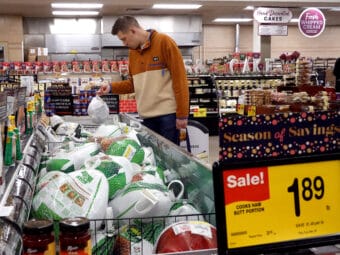
A customer in Chicago looks for turkeys offered for sale on Nov. 20, 2023, ahead of the Thanksgiving holiday. Turkey prices have fallen — but the cost of many groceries are still higher. (Scott Olson/Getty Images)

As friends and families gather around the dinner table later this week, some will be giving thanks for lower inflation.

Grocery prices are still high, but they’re not climbing as fast as they had been. And the cost of a traditional Thanksgiving feast has actually come down a little bit from last year.
The American Farm Bureau Federation estimates the total cost of a Thanksgiving meal for 10 this year is $61.16. That’s 4.5% lower than last year, but still the second highest total since the Farm Bureau began tracking prices in 1986.

Here’s a look at some of the traditional favorites that will cost more — and less — for Thursday’s feast.

Turkey prices have indeed fallen

Turkey, of course, is the at the center of many Thanksgiving traditions — and there’s good news: Prices have fallen.

“There’s a lot of turkey available right now,” says Michael Swanson, an agricultural economist at Wells Fargo. “They just have to price it down to move it.”

The average price of a 16 pound turkey in early November was $27.35, according to the Farm Bureau — a drop of 5.6% from a year ago.

Many stores offer additional discounts on turkey in the days leading up to Thanksgiving.

Cranberries are cheaper — but only if they are fresh

Turkey is not the only relative bargain on the Thanksgiving menu.

Fresh cranberry prices have dropped dramatically this year, thanks to a bumper crop. But people who prefer canned cranberries — the kind where you can still see the ridges of the can even when it’s on the plate — may have to pay more — as a result of higher processing and packaging costs.

“The entire canned market is up, whether you’re talking about beans or cranberries or pumpkins,” Swanson says. “Can prices really shot up.”

The price of canned goods could go even higher next year, if the Biden administration slaps new tariffs on imported steel used in making cans.

“We’ve been pleased that the Department of Commerce has held off on those tariffs for the most part,” says David Chavern, CEO of the Consumer Brands Association. “But there’s going to be a final determination at the beginning of 2024 that we’re watching very closely.”

But groceries are still expensive

Some of the money shoppers save on turkey this year may get gobbled up elsewhere.

Sweet potato prices are slightly higher than last year. And pumpkin pie filling is also more expensive.

Grocery prices overall have risen 2.1% in the last 12 months, according to the Labor Department, following an increase of 12.4% in the previous year.

“That’s the cost of living,” said Angelina Murray, standing outside a supermarket in Washington, D.C., a few days before Thanksgiving. “Nothing we can do until prices come down. We’re just going to have to deal.”

Grocery prices overall are still higher than last year, including for sweet potatoes and pumpkin pie filling. (Scott Olson/Getty Images)

Then again, some things are still worth paying for

Some shoppers told NPR they are cutting corners in preparing for Thursday’s meal — opting for store-branded products, for example, instead of more expensive national brands.

But most said Thanksgiving is a time for counting blessings, not hunting for bargains.

Carrie Murray was pleasantly surprised to find some discounts in the produce department, even if she had to pay more for staples such as olive oil.

“Things that are expensive —it’s the stuff that has been expensive for a while,” Murray said, loading groceries into the back of her car with Colton Parker.

“Looking at the receipt you say, ‘Oh wow,'” Parker agreed. “But you know, it’s for families. It’s for the holidays.”

Copyright 2023 NPR. To see more, visit https://www.npr.org.

A strained US aviation system braces for a record-setting week of holiday travel

United Air Lines planes line up along the busy Newark Liberty International Airport, New Jersey, on the eve of Thanksgiving on November 23, 2022. (Daniel Slim/AFP via Getty Images)

WASHINGTON — Records are likely to fall this week as millions of Americans take to the skies for Thanksgiving.

The annual rush of holiday travelers will test a U.S. aviation system that is straining to keep up with demand. But federal regulators say the system is resilient and ready.

“This year, we are seeing more people flying than ever with fewer cancellations than we have seen in years,” Transportation Secretary Pete Buttigieg said at a press conference on Monday.

The Transportation Security Administration is predicting it will screen more than 30 million people during a 12-day window that started last Friday.

“We’re ready to go,” TSA deputy administrator Holly Canevari said at a travel industry conference in Washington, D.C. last week. “I think the Sunday after Thanksgiving will be our record-breaker” for a single day, Canevari said.

U.S. Secretary of Transportation Pete Buttigieg (left) and FAA Administrator Mike Whitaker at a press conference on Monday in Washington. (Kevin Dietsch/Getty Images)

The Federal Aviation Administration is expecting nearly 50,000 flights on Wednesday alone.

“While we don’t control the weather, we’re doing everything in our power to keep flights safe and keep cancellations and delays low this Thanksgiving,” said Mike Whitaker, the newly-appointed administrator of the FAA, who was unanimously confirmed by the Senate last month.

The FAA responds to a troubling safety warning

Whitaker is confronting deep concerns about safety in his first weeks on the job. An independent safety review board appointed by the FAA is calling for “urgent action” to prevent plane crashes after a series of close calls on runways across the country this year.

The panel’s 52-page report, released last week, raises extensive concerns about the shortage of air traffic controllers, as well as outdated equipment, that are “rendering the current level of safety unsustainable.”

Whitaker says the FAA welcomes the report, and has already announced several new initiatives to speed up the hiring of more air traffic controllers. Those include hiring qualified students directly from aeronautical colleges and universities, and deploying dozens of high-resolution tower simulators across the country to take some pressure off of the agency’s training academy in Oklahoma.

The FAA is also looking at how to lower the attrition rate for aspiring air traffic controllers.

“There’s a fairly high failure rate” at the training academy, Whitaker told reporters on Monday. “My initial focus has been on how to make these numbers go up quickly without lowering standards.”

While troubling, some of the challenges outlined in the independent safety review are not new.

“We have not put the resources we need into funding the air traffic control system — not just this year or last year, but for decades,” said Geoff Freeman, the CEO of the U.S. Travel Association. “We have not prioritized it. We’ve kicked the can down the road on modernization efforts, and we’re paying the price for that today.”

Flight attendants brace for the holiday rush

Full planes and crowded overhead bins could make for a challenging holiday in the flight cabin as well.

“The holidays have always been a time period that flight attendants sort of dread going to work,” said Sara Nelson, the president of the Association of Flight Attendants union.

“The flying is much harder. You have inexperienced people, you’re answering more questions. There’s fewer of us,” she said. “Which then often means that passengers are trying to work things out between each other, and you don’t have a referee there right at the start.”

Nelson says it used to be widespread across the industry for flight attendants to earn more on holiday shifts, but those incentives have been gradually eroding. She urges travelers to keep all of that in mind when flying.

Thankfully, she says, most do.

“The vast majority of people come to the door of our airplane with kindness in their heart and a desire for a safe, uneventful flight.”

Copyright 2023 NPR. To see more, visit https://www.npr.org.

‘It feels like I’m not crazy.’ Gardeners aren’t surprised as USDA updates key map

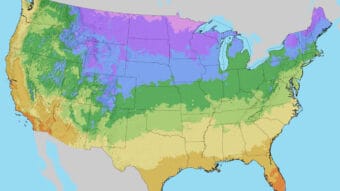
The U.S. Department of Agriculture has updated a map that helps gardeners to figure out which plants are most likely to survive the coldest winter temperatures in their location. About half of the country has shifted into a new half zone. (Robyn Beck/AFP via Getty Images)

A newly updated government map has many of the nation’s gardeners rushing online, Googling what new plants they can grow in their mostly warming regions.

It’s called the U.S. Department of Agriculture’s “plant hardiness zone map,” and it’s the national standard for gardeners and growers to figure out which plants are most likely to survive the coldest winter temperatures in their location.

This week the map got its first update in more than a decade, and the outlook for many gardens looks warmer. The 2023 map is about 2.5 degrees Fahrenheit warmer than the 2012 map across the contiguous U.S., says Chris Daly, director of the PRISM Climate Group at Oregon State University that jointly developed the map with the USDA.

Daly says the new map means about half the country has shifted into a new half zone and half hasn’t. In some locations, people may find they can grow new types of flowers, fruits, vegetables and plants.

The 2012 version of the Plant Hardiness Zone Map. (U.S. Department of Agriculture)
The 2023 version of the Plant Hardiness Zone Map. (U.S. Department of Agriculture)

Many of the nation’s gardeners are not surprised by the change.

“I have been stating all year long, ‘This needs updating!’,” says Megan London, a gardening consultant in Hot Springs, Arkansas, in a video she posted on Facebook. London has been gardening for 26-years, and she’s seen her region warming.

In the new map, London’s region in central Arkansas has moved from zone 7b to zone 8a. What that means for her is that she’s now considering growing kumquats, mandarin oranges, and shampoo ginger, a tropical plant.

But London says that the excitement she and other gardeners have to grow new things is tempered by another feeling: concern about human-caused climate change.

“We’re excited, but in the back of our minds, we’re also a little wary,” London says. “In the back of our mind, we’re like, ah, that means things are warming up. So what does this mean in the long run?”

The scientific community overwhelmingly agrees that humans burning fossil fuels like oil, coal and gas is the primary driver of global warming. The summer of 2023 was the hottest meteorological summer on record for the northern hemisphere, according to the National Oceanic and Atmospheric Administration.

Daly says he is hesitant to explicitly attribute the specific changes from the 2012 map to the 2023 map to climate change because of the volatility of the key statistic they used to create this map. They were mapping “the coldest night of the year, each year, over the past 30 years”, Daly says, and it’s a highly variable figure.

In an email, a press officer for the USDA says, “Changes to plant hardiness zones are not necessarily reflective of global climate change because of the highly variable nature of the extreme minimum temperature of the year.”

But Daly says, in the big picture, climate change is playing a role in changing what grows where in the US: “Over the long run, we will expect to see a slow shifting northward of zones as climate change takes hold.”

Still, for gardeners like Rachel Patterson, in Port St. Joe, Florida, the updated USDA map showing a warming region is validating, if not comforting. “It feels like I’m not crazy,” she says.

Patterson moved to her new community two years ago to help rebuild after a hurricane. She now gardens with her three-year-old and his wheelbarrow, and has seen the impacts of climate change in her Florida gardening community.

“The sweet little grannies here are just heartbroken, they can’t grow their tomatoes,” she says, “It’s so much hotter, the tomatoes burn.”

Patterson has been helping her community adapt to the heat by planting varieties of heirloom tomatoes that are more resilient to fungi that spread more rapidly in warmer climates.

She says the updated map is a reminder of the need for climate action: “It’s just going to keep getting hotter. So the government has to make policy changes to slow climate change down.”

Copyright 2023 NPR. To see more, visit https://www.npr.org.

Only 51 of these U.S. whales remain. Little has been done to prevent their extinction

Rice’s whales are one of the most recently discovered whale species in the world — and already one of the most endangered. But protections for the Gulf of Mexico species have been repeatedly delayed. (KL Murphy for NPR)

Even before they saw one of the rarest mammals in the Gulf of Mexico, the two amateur fishermen were already feeling lucky. They had motored to their favorite spot 35 miles off the coast of Pensacola, Fla., downed a couple Miller Lites, and caught their third mahi mahi when they heard the sound of air escaping a blowhole.

“Then you start looking,” said Ben Renfroe, who grabbed his phone to film it. “Is that a dolphin or a whale?”

But dolphins in the Gulf don’t grow bigger than motorboats, and the dark figure Renfroe spotted just before it sank back into the water looked much larger than his 26-foot craft. Seconds later, the animal appeared above the horizon again, first showing off a small dorsal fin, then gliding its trunk over the waves like a surfacing submarine.

Back on shore, experts reviewed the video and agreed: It was almost certainly a Rice’s whale, one of the most endangered whales in the world. Authorities estimate only around 51 of the animals remain – and they don’t live anywhere but the Gulf. To avoid extinction, the U.S. government has estimated that no more than one can be killed or seriously injured by human activity every 15 years.

Which activities threaten the whales the most is not a mystery. The National Oceanic and Atmospheric Administration, or NOAA, has cited more than 20 risks, including energy exploration in the Gulf, vessel strikes and underwater noise. But although the agency has produced helpful science about the whales, NOAA has repeatedly delayed following rules and adopting measures that could help the whales survive those man-made threats.

“The bureaucratic apparatus is slow to catch up,” said Aaron Rice, an ecologist who studies the whales but is not related to scientist Dale Rice, for whom they are named. “It raises this philosophical question of values, like, how much do we value these animals that live in U.S. waters?”

“Shameful” delays for protections

On April 20, 2010, about 40 miles offshore from Louisiana, the BP drilling rig Deepwater Horizon caught fire. Within two days, 11 workers had died and the rig had sunk. The well that was left behind would gush more than 200 million gallons of oil into the Gulf of Mexico over the next three months. It was the largest marine oil spill in history.

Rice’s whales were some of the animals most harmed by the disaster. About one in five died after the oil slick engulfed their habitat, and those that survived became more likely to get sick or lose pregnancies. Their numbers dropped to fewer than 100.

A boat travels through crude oil leaked from the Deepwater Horizon wellhead near Louisiana. (Chris Graythen/Getty Images)

But the spill also prompted more attention to the whales. Before Deepwater Horizon, the animals were thought to be a type of Bryde’s whale, a kind of whale found everywhere from South Africa to Japan. After the disaster, researchers from NOAA and other groups analyzed bones that washed up on Gulf shores and conducted genetic tests. This was no subgroup, they soon realized. This was a completely new species. The ones in the Gulf were believed to be the last ones left on the planet.

The newest great whale was also one of the most endangered, and it was right in America’s backyard.

“Every animal counts at that point,” said Jane Davenport, a senior attorney at Defenders of Wildlife, a conservation nonprofit. “Every one you kill is another nail in the coffin.”

Losing the species would mean losing an animal that fuels the ocean’s productivity by transferring nutrients from the seafloor to the surface, and back again, with every dive. Great whales also reduce carbon emissions. When they die, they sink an average of about 33 tons of CO2 that they’ve stored in their bodies throughout their life to the bottom of the ocean. That’s more than 1,000 times the carbon a tree captures in a year. Experts say the whales’ extinction would be an ominous indicator of an unhealthy Gulf ecosystem.

And it would be a reflection of slow U.S. action to protect the whales. Federal laws mandate that NOAA list a marine mammal as endangered soon after a species is shown to be at risk with the best scientific data available. Typically no more than one year after the species is listed, the agency must also determine what habitat the animal needs to be protected. That earns both the animals and their physical home special consideration when projects are proposed nearby that could harm them – a constant threat in the Gulf. Nearly all the U.S. oil and gas extracted offshore is pulled from the Gulf of Mexico; industrial activity is a fixture of the area.

But NOAA has been years late meeting its deadlines, and though the whales were eventually added to the endangered species list, it still hasn’t designated the whales’ habitat. Conservation nonprofits have sued the agency three times since 2016 to urge it to comply with the law.

The agency is also required to publish a plan for how the government intends to help the Rice’s whale population recover to healthy numbers. NOAA hasn’t done that yet either, though the agency has released an eight page outline.

The chief of NOAA’s marine mammal branch in the Southeast, Laura Engleby, said the agency is limited by its staff and resources, and is doing the best it can to help the animals. She said the agency is in the middle of several restoration projects and is conducting outreach to spread awareness of the whale’s dwindling numbers. In November, a part of a skeleton that helped scientists determine that Rice’s whales were a new species will be added to a public exhibit at the Smithsonian National Museum of Natural History in Washington, D.C.

But Michael Jasny, a senior policy analyst for Natural Resources Defense Council, one of the nonprofits that has brought the agency to court for missing protection deadlines, said the repeated delays should be considered scandalous.

“It’s an extreme case showing the extent to which an agency will delay,” said Jasny. “And that is really shameful, given that the species that are being managed are on the verge of extinction.”

Ships remain serious threat to whales, NPR analysis shows

In 2021, a group of nonprofits grew tired of waiting for NOAA to act. They petitioned the agency to impose a speed limit to protect the animals from at least one of their immediate man-made threats: ships.

Gulf ports are busy; the port of Houston exports more tons of cargo than any other port in the country. Since 2009, two Rice’s whales have been killed or injured after ships hit them. And research on whales injured by ships over the past few decades shows that the strikes that seriously harm the mammals are often caused by big vessels that are moving quickly.

So the environmental groups recommended that when ships 65 feet or larger cross a portion of the whales’ habitat in the eastern Gulf, they be required to slow down to 10 knots or less. They also asked the agency to prohibit travel in that zone under the Florida panhandle at night, when the whales float near the surface and are harder to spot.

An aerial view of a North Atlantic right whale feeding off the shores of Duxbury, Mass., in 2015. (David L. Ryan/Boston Globe via Getty Images)

Slowing down ships to save whales isn’t a new idea. North Atlantic Right whales are also endangered; around 350 are estimated to remain in the American and Canadian Atlantic. Along the U.S. East Coast, a 10-knot limit has been in place to protect them for more than a decade. Research indicates that lowering speeds to that level works.

“Vessel speed is the low-hanging fruit,” said Davenport, the lawyer for Defenders of Wildlife, one of the nonprofits that petitioned NOAA. “That is the most important thing that we can do right now.”

But after NOAA invited public comments on the proposal this summer, the energy and marine industries pushed back fiercely – and politicians who represent states where those sectors are top employers drafted legislation against it.

On Aug. 18, Rep. Clay Higgins, R-La., proposed a House bill that would block NOAA from passing the speed limit until the government could show it wouldn’t negatively impact commerce. A Senate version of the bill was later introduced by Sen.Bill Cassidy, R-La.

Cary Davis, the president of the American Association of Port Authorities, a seaport industry advocacy group, told NPR that a limit for just a few Rice’s whales in the Gulf didn’t make sense.

“It’s wildly overbroad and ill-conceived to force a blanket slow-down if there’s only so many of them,” Davis said. “And time is money, of course.”

After reviewing the feedback, on Oct. 27, NOAA announced its decision. It denied the nonprofits’ speed limit petition.

In a statement, the agency said it needed to focus on other conservation priorities, and would try to get vessel operators to slow down voluntarily. But without a mandatory limit, the risk of ships injuring the whales is high across the Gulf.

NPR analyzed traffic data for over 6,000 ships that were 65 feet and larger. The data, collected by land and satellite receivers, indicated where the ships went and how fast they were going as they traveled across the 28,000-square-mile swath of the whales’ proposed critical habitat in 2022.

Out of all the journeys the ships took that crossed the whales’ habitat last year, 80% were traveling at an average of more than 10 knots. Without a limit in place, vessel speeds could continue to be a serious threat to the whales.

Environmentalists called NOAA’s denial of the slow-down petition absurd, given that ship strikes had already injured more Rice’s whales in the past 15 years than the government has said the species could afford to lose if it hoped to avoid extinction.

“To engage in yet more delay while the agency pursues paperwork is just an utter failure in conservation,” said Jasny, from NRDC. “I find no way to read this other than as an act of political cowardice.”

When it comes to underwater noise, another established threat to the whales, there are also few limits.

No noise limits

Rice’s whales let out deep, low moans that pulsate underwater for up to a minute.

Scientists say the calls are unique – nothing on the planet sounds like them – and that the whales may make them to survive. Marine mammals use their hearing to find mates and food, to maintain relationships, to navigate and to avoid predators.

But the Gulf is one of the loudest places underwater in the U.S.

Fast ships don’t just hit whales. At speeds of over 10 knots ship propellers start to generate intense cavitation noise. That sound causes most of the underwater sound pollution from the shipping industry, said Andrew Kendrick, a naval architect and consultant for the Canadian government. And when it happens near the whales, “they can’t hear themselves think.”

Scientists have observed that Rice’s whales have sometimes stopped making their own sounds in the presence of ships. But the noise from seismic air gun surveys is still more powerful.

The Maersk Idaho container ship is shown at the Port of Houston Authority in 2021. (Brandon Bell/Getty Images)

Air gun blasts are one of the most prevalent underwater sounds in the Gulf, and they overlap with the low frequency range in which Rice’s whales communicate. Because sound travels faster in water than in air, researchers have picked up the blasts on recorders located more than 400 miles away – about half the length of the Gulf.

“There is just this constant blanket of human noise,” said Rice, the ecologist.

And the air guns are not just noisy. When they’re dragged behind vessels to help identify the location of the oil and gas, they send explosions of compressed air into the water, for weeks at a time. Those blasts, which go off every 10 seconds, send waves of pressure downward powerful enough to penetrate miles beneath the bottom of the seafloor.

Technological alternatives do exist that can be less disruptive. Some air gun technologies that can survey the ocean up to ten times more quietly than conventional guns are on the market now. Brands sell kits that can transform old guns into quieter ones, which is cheaper than replacing every gun on the ship.

Scientists have observed that Rice’s whales have sometimes stopped making their own sounds in the presence of ships. (KL Murphy for NPR)

Upgrading the technology isn’t inexpensive. It can cost up to 10 million dollars, said representatives from Sercel, a company that sells both conventional air guns and alternatives that are friendlier to marine mammals. But that’s a tiny fraction of the income generated by just four of the largest energy companies working in the Gulf. Chevron, ExxonMobil, Shell and BP earned more in 2022 than any other year in history. Collectively, they earned around 160 billion dollars.

Still, the government doesn’t require the industry to use alternatives. Though excessive noise is prohibited on land, there are no limits to the amount of noise that can be sent into the ocean.

“If the regulations aren’t there,” said Robin Ellis, a vice president of sales at Sercel, “they’re not going to do it.”

After reviewing public documents, NPR found that’s the case in the Gulf. Of the 25 seismic survey projects that have cumulatively been approved to blast noise into the ocean for more than 1,000 days over the next three years, all but two energy companies have said they will use conventional airgun systems that stream multiple guns behind their boats.

Harming whales is not the industry’s goal, said Alex Loureiro, the scientific director for EnerGeo Alliance, a trade association that represents oil and gas companies. The alternative technologies are just not as efficient, she said.

“It’s going to take time for the industry to actually be able to use these technologies effectively,” said Loureiro.

When asked whether NOAA was doing anything to encourage industries to switch to quieter technologies that are better for whales, an agency representative pointed NPR to a document that said it wanted to reduce noise, but listed few concrete steps for changing the rules.

The skull used to determine that Rice’s whales were a new species in 2021 is stored at a Smithsonian facility in Maryland. (Catie Dull/NPR)

Environmental groups and scientists think sightings of Rice’s whales may become increasingly rare. In an open letter to the Biden administration they predicted a serious consequence if conservation action is not taken quickly: the first man-made extinction of a great whale species could happen under U.S. watch.

In October, Ben Renfroe and his friend put the prediction to the test. They went looking again for the Rice’s whales, hoping to repeat their summer luck. The two spent almost 10 hours in the mammals’ habitat, motoring more than 100 miles around the Gulf of Mexico. They spotted a few birds and accidentally hooked a shark with their fishing pole.

But this time, they saw little else. No blowholes. No fins. No sign of any whales.


Methodology

NPR downloaded Automatic Identification Systems (AIS) ship transponder data from MarineCadastre.gov, a cooperative effort between the Bureau of Ocean Energy Management and the National Oceanic and Atmospheric Administration (NOAA). This AIS data is collected by approximately 200 land-based receiving stations from the U.S. Coast Guard’s Nationwide Automatic Identification System. As the range of land receivers is usually limited to 40-50 miles off the coast, the data was combined with satellite-collected AIS data from Spire and processed by Global Fishing Watch to provide more comprehensive coverage of the Gulf of Mexico.

In NPR’s analysis of transits through the proposed critical habitat of the Rice’s whales, a transit was defined as an instance when a ship entered or exited the area. A new transit was also started if there was more than a day’s gap between two AIS broadcast points.

The speed of a transit through the critical habitat was calculated using a distance-weighted average speed, as detailed in a vessel speed rule assessment published by NOAA. This method corrects for variations in AIS transmission and reception rates, which can be influenced by the speed and type of the vessel.

Ships measuring less than 65 feet in length as well as law enforcement, search and rescue, and military vessels, were excluded from this analysis.

Access the code here.


NOAA Fisheries encourages all boaters, anglers and others operating in Gulf of Mexico waters to report all suspected sightings of Rice’s whales by calling 877-WHALE-HELP (877-942-5343).


This reporting was supported in part by a grant from the Institute for Journalism & Natural Resources, a nonprofit that supports journalists covering the environment.


Barrie Hardymon edited this story and Noah Caldwell produced it. Robert Little and Graham Smith contributed editing and producing support. Research from Barbara Van Woerkom, and art direction and photo editing by Emily Bogle. Graphic by Daniel Wood.

Copyright 2023 NPR. To see more, visit https://www.npr.org.

Public transit systems try to avoid a ‘death spiral’ as remote work hurts ridership

A Metro train car travels along the Red Line in Washington, D.C. Since the COVID-19 pandemic, riders have slowly returned to taking mass transit. (Chip Somodevilla/Getty Images)

WASHINGTON — In the nation’s capital, Metro trains are filling up again as federal workers come back to the office a few days a week.

But if you ask those riders, they will tell you the trains are less full than they used to be.

“It’s not as crowded as it was before, pre-pandemic,” said Gina Adu of Bowie, Md., while waiting for a train at the L’Enfant Plaza station. Damien Doyle of Cheverly, Md. agrees. “This is about it now — maybe the new normal,” Doyle said.

The new normal is ridership that’s back to about 80% of what it was before the pandemic nationwide — though it’s not distributed the same way. Public transit systems are seeing higher volume in the middle of the week. But rush hour peaks are smaller, with more trips at other times of the day and evening.

“We’ve seen that the normal workweek has changed fundamentally,” said Robert Puentes, president of the non-profit Eno Center for Transportation in Washington, and a regular Metro commuter.

The rise of remote work since the pandemic is changing the way Americans commute. And that’s prompting a crisis for big public transit systems, which were mostly designed to get lots of commuters downtown all at once, and are now scrambling to adjust to this new reality.

Congress spent tens of billions of dollars to get these agencies through the pandemic. But that money is set to run out next year.

Now a combination of ridership declines and inflation has left some major transit agencies with massive budget deficits — including systems in Chicago, San Francisco, Los Angeles and Philadelphia.

Public transit ridership declines since the COVID-19 pandemic are forcing many transit agencies, like in San Francisco, to weigh making cuts to service. (Justin Sullivan/Getty Images)

“The irony with transit is, for years the ones that were generating most of their revenue through passenger fares were the ones that were deemed to be the most successful,” Puentes said. “But those agencies are having a more difficult financial challenge because they relied on those passenger fares.”

The Washington Metropolitan Area Transit Authority, which runs the Metro system, is projecting a deficit of $750 million next year. General manager Randy Clarke says WMATA is weighing some deep cuts to service.

“If we do that, you’re talking, draconian. Like service, as we know it does not exist,” Clarke said in an interview. “Which then leads to less revenue for the system… Which then leads to more cuts, more cuts. And the whole thing falls apart.”

That’s known in the industry as a “death spiral.” But Clarke is hopeful that Metro will find the money to avoid that catastrophic scenario — and he’s not the only one who’s optimistic.

“There is a bit of a doom cloud that is hard to ignore, but I think things are better than we think,” said Lindiwe Rennert, a researcher at the non-profit Urban Institute who co-authored a new report on how public transit agencies can overcome the financial challenges they’re facing.

Transit systems that have a stable funding stream, often from local sales taxes, are doing better, Rennert says. And she argues there’s a strong case for that kind of funding, because mass transit benefits everybody — even if you never use it.

“The more other folks take the train, take the bus, the fewer cars are in your way as a driver. And that is simply a fact,” Rennert said.

Heavy afternoon traffic moves along the I-5 freeway in Los Angeles. The more people that take mass transit, the less-crowded roads like this one can become. That benefits motorists and transit riders alike. (Mario Tama/Getty Images)

Rennert notes that bus ridership is roughly back to where it was before the pandemic. And that the most nimble transit agencies — in systems in Richmond and Cincinnati and Tucson — have more riders now than before.

So does the light rail system in the Seattle area.

“We expanded the service. We’re reaching more people in more places. And so therefore, we have more riders,” said Julie Timm, the CEO of Sound Transit, one of the few rail systems in the country that’s seen a jump in ridership since 2019.

In fact, Sound Transit set ridership records over the summer when Seattle hosted Major League Baseball’s All-Star Game, and a stop on the Taylor Swift tour.

“What I think we’re seeing as a victory here in Seattle [is] a virtuous cycle of you put the funding in, you keep a reliable service and you see people use the service,” Timm said. “When they have those good experiences riding, they come back, they ride again.”

Copyright 2023 NPR. To see more, visit https://www.npr.org.

Site notifications
Update notification options
Subscribe to notifications