NPR News

Tribes celebrate historic deal with White House that could save Pacific Northwest salmon

FILE – This Oct. 24, 2006 file photo shows file photo shows the Ice Harbor dam on the Snake River in Pasco, Wash. (Jackie Johnston/AP)

BOISE, Idaho — The White House has reached what it says is an historic agreement over the restoration of salmon in the Pacific Northwest, a deal that could end for now a decades long legal battle with tribes.

Facing lawsuits, the Biden administration has agreed to put some $300 million toward salmon restoration projects in the Northwest, including upgrades to existing hatcheries that have helped keep the fish populations viable in some parts of the Columbia River basin.

The deal also includes a five year stay on litigation and a pledge to develop more tribally run hydropower projects and study alternatives for farmers and recreators should Congress move to breach four large dams on the Snake River, a Columbia tributary, which tribes say have long been the biggest impediment for the fish.

“Many of the Snake River runs are on the brink of extinction. Extinction cannot be an option,” says Corrine Sams, chair of the wildlife committee of the Confederated Tribes of the Umatilla Indian Reservation.

The agreement stops short of calling for the actual breaching of those four dams along the Lower Snake in Washington state. Biden administration officials insisted to reporters in a call Thursday that the president has no plans to act on the dams by executive order, rather they said it’s a decision that lies solely with Congress.

A conservation bill introduced by Idaho Republican Congressman Mike Simpson to authorize the breaching of the dams has been stalled for more than a year, amid stiff opposition from Northwest wheat farmers and utility groups.

When the details of Thursday’s salmon deal were leaked last month, those groups claimed it was done in secret and breaching the dams could devastate the region’s clean power and wheat farming economies that rely on a river barge system built around the dams.

“The agreement announced by the Biden Administration commits the U.S. Government to spending hundreds of millions of dollars that will ultimately end up being paid by electricity consumers in communities throughout the West,” said Heather Stebbings, interim executive director of Northwest RiverPartners in a statement.

Copyright 2023 NPR. To see more, visit https://www.npr.org.

Broken wings: Complaints about US airlines soared again this year

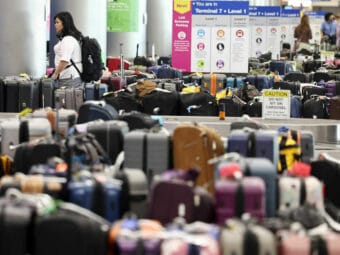
A traveler looks for baggage amid rows of unclaimed luggage at Los Angeles International Airport in June. (Mario Tama/Getty Images)

If you’re unhappy about the state of air travel in the U.S., you’re in good company.

Complaints about U.S. airlines climbed sharply in the first half of the year, consumer advocates say, as passengers remain deeply dissatisfied despite some improvements in performance.

“The complaint data is pretty jaw-dropping,” said Teresa Murray, a consumer advocate with U.S. Public Interest Research Group, which published a new report based on data released by the Department of Transportation.

Flight cancellations were down significantly in the first nine months of the year, according to the DOT. Murray called that trend encouraging but said delays and mishandled luggage remain major problems.

“People are still ticked off and unhappy with their airline experience,” she said in an interview. “The complaints are continuing to pour in.”

Travelers filed more than 26,000 formal complaints about U.S. airlines in the first five months of 2023 — more than double the number filed during the same period last year, according to the report, and on pace to break the annual record set in 2022.

The aviation system has struggled to keep pace with a surge in demand, as travel volumes rebounded quickly to pre-pandemic levels. That’s left both the airlines and many air traffic control centers short-staffed.

“We are seeing more people flying than ever with fewer cancellations than we have seen in years,” Transportation Secretary Pete Buttigieg said at a news conference last month.

The biggest U.S. airlines canceled about 1.6% of flights from January through September of this year — down from 2.8% during the same period last year.

Buttigieg called that “a clear improvement in the numbers” and said airlines deserve some of the credit, “both in terms of the realism of their schedules and in terms of having the staffing and the preparation to meet the demand that’s come in.”

But at the same time, the number of delays has grown.

The largest U.S. airlines had an on-time performance of 76.2% during the first nine months of the year, down from 76.6% last year. That figure has fallen below 77% only one other time in the past 15 years, Murray said.

The aviation system was largely able to avoid major service disruptions during the recent Thanksgiving holiday. But many travelers haven’t forgotten the meltdown of 2022, when winter storms and a software glitch at Southwest Airlines caused thousands of canceled flights and chaos across the country.

Murray said travelers should brace for another challenging holiday travel season.

“We know that the flights are going to be absolutely jam-packed here in the next couple of weeks,” she said. “We definitely recommend that you do the old thing of getting to airports early because you have less of a chance of getting bumped. You have more of a chance of getting where you want to get.”

Copyright 2023 NPR. To see more, visit https://www.npr.org.

Most Americans with mental health needs don’t get treatment, report finds

Americans with mental health conditions often can’t get treatment, a new report finds. (SDI Productions/Getty Images)

Roughly two-thirds of Americans with a diagnosed mental health condition were unable to access treatment in 2021, though they had health insurance. And only a third of insured people who visited an emergency department or hospital during a mental health crisis, received follow-up care within a month of being discharged.

These are among the findings of a new report by the actuary firm Milliman, released Wednesday. The mental health advocacy group, Inseparable, commissioned the report and also released an accompanying brief offering policy solutions to address the gaps in mental health care.

“We kept hearing nightmare stories about Americans not getting the treatment that they needed because insurance companies were denying them care,” says Bill Smith, founder of Inseparable. “But we didn’t have enough data to show just how extensive and deep the problem was.”

The report is “illuminating” and timely, says Meiram Bendat, a psychotherapist and an attorney, who wasn’t involved in writing it. “We’re dealing with an issue that [is] on top of mind for nine out of ten people.”

While the overall findings aren’t surprising, “it is striking that the access impediments remain what they are,” adds Bendat who founded PsychAppeal, a law firm focused on mental health insurance advocacy. Those barriers include a workforce shortage, poor reimbursement rates for providers, and “substandard enforcement” of consumer protections and laws requiring that insurance companies cover mental health conditions.

“The data confirm what so many families and our friends know, which is that mental health access is a problem,” says psychologist Benjamin Miller, one of the authors of the accompanying policy solutions brief. “It’s very clear that there are people who have identifiable conditions, who are not able to find providers to help them.”

The Milliman report, which used a range of publicly available surveys as well as proprietary health insurance claims data, found that nearly a quarter of people with insurance – Medicaid, commercial insurance and Medicare – had at least one mental health diagnosis in 2021.

Many of those people don’t get treatment. Among the roughly half of Americans who are covered with commercial insurance, only about 30% of those with a mental health or addiction diagnosis got connected to a behavioral health specialist.

People on Medicaid with such diagnoses were the most likely to see a mental health care provider, with about 44% getting care. Only about 15% of those on Medicare got care for their diagnoses.

That’s an “astonishing gap” in mental health coverage, says Smith. “Across the board, the numbers aren’t great.”

The gap in mental health treatment, “won’t close unless private insurance companies” take steps to increase access to mental health care, he says. “We have a long way to go.”

The report also finds that over half of the U.S. population lives in areas designated as Mental Health Professional Shortage Areas, and that the country has less than a third of the psychiatrists needed to meet those provider shortages.

“We have not moved the needle on increasing availability of our workforce,” says Miller. “I’ve been using the same data point for about ten years that half the country lives in a mental health provider shortage area. And it hasn’t changed.”

In their report, Miller and his colleagues offer concrete policy solutions to address the workforce shortage and coverage gaps in insurance plans, including expanding the use of telehealth and use of peer support specialists.

The authors also suggests providing “competitive reimbursement rates” for mental health care professionals

Another report by Milliman published in 2019 had found that mental health care providers are reimbursed at lower rates than physical health providers. “We’ve known for a long time that there is under-reimbursement of care,” says Bendat.

Addressing that disparity in payment would help prevent health care worker burnout and ensure more mental health providers are in-network to care for the growing number of people in need.

The Inseparable solutions report also recommends that insurance companies be mandated to provide up-to-date accurate directories for in-network providers.

“The problem with these in-network directories is that when you begin to call around and you begin to ask people, ‘Can you see me? Are you accepting new patients?’ The answer to a lot of them is no, they’re not accepting new patients,” says Miller. “Some provider directories are old enough that you might even have people on there that are not practicing anymore.”

But requiring health plans to cover out-of-network care is also crucial, say Miller and his colleagues.

“The insurance company should pay that cost to cover your care regardless of whether or not it’s in their network or not,” says Smith. “It’s a huge problem when you have people that are making decisions about their health and the safety of their families and doing that from a place of scarcity.”

As the Milliman report finds, the average out-of-pocket cost for an hour-long psychotherapy session in 2021 was $174, which is a huge barrier to access.

Copyright 2023 NPR. To see more, visit https://www.npr.org.

With bison herds and ancestral seeds, Indigenous communities embrace food sovereignty

Sophia Moreno (Apsáalooke/Laguna Pueblo/Ojibwe-Cree) plants crops in the Indigenous gardens outside American Indian Hall on the Montana State University campus in Bozeman, Montana. (Adrian Sanchez-Gonzalez/Montana State University)

BOZEMAN, Mont. — Behind American Indian Hall on the Montana State University campus, ancient life is growing.

Six-foot-tall corn plants tower over large green squash and black-and-yellow sunflowers. Around the perimeter, stalks of sweetgrass grow. The seeds for some of these plants grew for millennia in Native Americans’ gardens along the upper Missouri River.

It’s one of several Native American ancestral gardens growing in the Bozeman area, totaling about an acre. Though small, the garden is part of a larger, multifaceted effort around the country to promote “food sovereignty” for reservations and tribal members off reservation, and to reclaim aspects of Native American food and culture that flourished in North America for thousands of years before the arrival of European settlers.

Restoring bison to reservations, developing community food gardens with ancestral seeds, understanding and collecting wild fruits and vegetables, and learning how to cook tasty meals with traditional ingredients are all part of the movement.

“We are learning to care for plant knowledge, growing Indigenous gardens, cultivating ancestral seeds, really old seeds from our relatives the Mandan, Hidatsa, and Arikara: corn, beans, squash, and sunflowers,” said Jill Falcon Ramaker, an assistant professor of community nutrition and sustainable food systems at Montana State. She is a member of the Turtle Mountain Band of Anishinaabe.

“A lot of what we are doing here at the university is cultural knowledge regeneration,” she said.

But it also has a very practical application: to provide healthier, cheaper, and more reliable food supplies for reservations, which are often a long way from supermarkets, and where processed foods have helped produce an epidemic of diabetes and heart disease.

Many reservations are food deserts where prices are high and processed food is often easier to come by than fresh food. The Montana Food Distribution Study, a 2020 paper funded by the U.S. Department of Agriculture, found that the median cost in the state of a collection of items typically purchased at a grocery store is 23% higher on a reservation than off.

“With food sovereignty we are looking at the ability to put that healthy food and ancestral foods which we used to survive for thousands of years, putting those foods back on the table,” Ramaker said. What that means exactly can vary by region, depending on the traditional food sources, from wild rice in the Midwest to salmon on the Pacific coast.

Central to the effort, especially in Montana, are bison, also referred to as buffalo. In 2014, 13 Native nations from eight reservations in the U.S. and Canada came together to sign the Buffalo Treaty, an agreement to return bison to 6.3 million acres that sought “to welcome BUFFALO to once again live among us as CREATOR intended by doing everything within our means so WE and BUFFALO will once again live together to nurture each other culturally and spiritually.”

Nearly a decade later, dozens of tribes have buffalo herds, including all seven reservations in Montana.

The buffalo-centered food system was a success for thousands of years, according to Ramaker. It wasn’t a hand-to-mouth existence, she wrote in an article for Montana State, but a “knowledge of a vast landscape, including an intimate understanding of animals, plants, season, and climate, passed down for millennia and retained as a matter of life and death.”

Ramaker directs both the Montana Indigenous Food Sovereignty Initiative and a regional program, the Buffalo Nations Food Systems Initiative, or BNFSI — a collaboration with the Native American Studies Department and College of Education, Health and Human Development at Montana State.

With bison meat at the center of the efforts, the BNFSI is working to bring other foods from the northern Plains Native American diet in line with modern palates.

The BNFSI has received a $5 million grant from the U.S. Department of Agriculture to carry out that work, in partnership with Nueta Hidatsa Sahnish College in New Town, N.D.

Life on reservations is partly to blame for many Native people eating processed foods, Ramaker said. Food aid from the federal government, known as the Commodity Supplemental Food Program, has long been shipped to reservations in the form of boxes full of packaged foods.

“We were forced onto the reservations, where there was replacement food sent by the government — white flour, white sugar, canned meat, salt, and baking powder,” she said.

From left to right, James Vallie (Apsáalooke/Anishinaabe), Angela Bear Claw (Apsáalooke), and Jill Falcon Ramaker (Anishinaabe) plant Native seeds in the Indigenous gardens at Montana State University on June 4, 2021. (Adrian Sanchez-Gonzalez/Montana State University)

Processed foods contribute to chronic inflammation, which in turn leads to heart disease, cancer, and diabetes, which occurs at three times the rate in Native Americans as it does in white people.

Studies show that people’s mental and physical health declines when they consume a processed food diet. “In the last decade there’s a growing amount of research on the impact of good nutrition on suicide ideation, attempts, and completion,” said KayAnn Miller, co-executive director of the Montana Partnership to End Childhood Hunger in Bozeman, who is also involved with the BNFSI.

All Native American reservations in Montana now have community gardens, and there are at least eight different gardens on the Flathead Reservation north of Missoula, home to the Confederated Salish and Kootenai Tribes. The tribe is teaching members to raise vegetables, some of it made into soup that is delivered to tribal elders. This year members grew 5 tons of produce to be given away.

Ancestral seeds are part of the effort. Each year the BNFSI sends out 200 packets of seeds for ancestral crops to Indigenous people in Montana.

Creating foods that appeal to contemporary tastes is critical to the project. The BNFSI is working with Sean Sherman, the “Sioux Chef,” to turn corn, meat, and other Native foods into appealing dishes.

Sherman founded the award-winning Owamni restaurant in Minneapolis and in 2020 opened the Indigenous Food Lab, through his nonprofit, North American Traditional Indigenous Food Systems. The lab, in downtown Minneapolis, is also a restaurant and an education and training center that creates dishes using only Indigenous foods from across the country — no dairy, cane sugar, wheat flour, beef, chicken, or other ingredients from what he calls the colonizers.

“We’re not cooking like it’s 1491,” Sherman said last year on “Fresh Air,” referring to the period before European colonization. “We’re not a museum piece or something like that. We’re trying to evolve the food into the future, using as much of the knowledge from our ancestors that we can understand and just applying it to the modern world.”

Among his signature dishes are bison pot roast with hominy and roast turkey with a berry-mint sauce and black walnuts.

In consultation with Sherman, Montana State University is building the country’s second Indigenous food lab, which will be housed in a new $29 million building with a state-of-the-art kitchen, Ramaker said. It will open next year and expand the ongoing work creating recipes, holding cooking workshops, feeding MSU’s more than 800 Native students, and preparing cooking videos.

Angelina Toineeta, who is Crow, is studying the BNFSI at Montana State as part of her major in agriculture. “Growing these gardens really stuck out to me,” she said. “Native American agriculture is something we’ve lost over the years, and I want to help bring that back.”

KFF Health News, formerly known as Kaiser Health News (KHN), is a national newsroom that produces in-depth journalism about health issues and is one of the core operating programs at KFF — the independent source for health policy research, polling, and journalism.

Copyright 2023 KFF Health News. To see more, visit KFF Health News.

With ChatGPT turning 1, Americans wonder whether AI is coming for their jobs

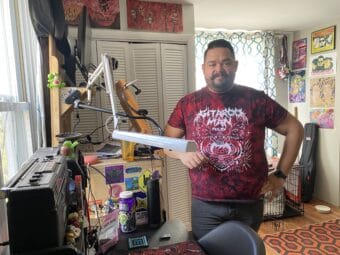
Baltimore illustrator John de Campos isn’t happy that AI is being used to create images for commercial purposes, supplanting artists whose real life experience is reflected in their work. (Andrea Hsu/NPR)

Baltimore illustrator John de Campos was irate when he discovered that some of his original work had been used to train an artificial intelligence chatbot — without his permission.

“It’s so gross,” he says.

In just the past year, AI-powered programs like Midjourney and DALL-E have made it possible for anyone to create highly sophisticated images with just a few clicks of the keyboard.

For de Campos, that’s an outrage.

“The fact that human expression and art is now at risk and on the chopping block is super duper scary to me,” he says.

At the same time, de Campos, who aspires to make a living as a board game designer, has found ChatGPT to be a very effective helper when it comes to marketing his games on social media.

“I’ll say, these are the qualities of the game that we’re selling. Take all of this information, melt it down into 15 words or less. Give me five different versions written to sell this product on Instagram,” he says.

De Campos acknowledges the hypocrisy that this presents and says he’s trying to decide whether he should divorce himself from using any AI tool.

“I feel so strongly about the art side and not so much about the text side, but I’m kind of figuring it out,” he says.

John de Campos says he spent 50 or 60 hours on illustrations for his latest board game Black Mold, which he describes as a survival horror escape. Some of his competitors in the board game space are turning to AI for art. (Andrea Hsu/NPR)

A year after the launch of ChatGPT, people in all kinds of occupations are figuring out where to draw the line with AI. Attitudes toward the new technology vary widely, with little consensus over which tasks can and should be handed over to bots.

The fastest writing assistant

In Michigan, Ethan Kissel has been turning to AI for help with his job producing television commercials for local businesses.

“It’s really good for spitballing ideas,” he says.

In the past, Kissel would spend an hour or more writing a 15- or 30-second script, with the hardest part being the tagline — the last, most memorable sentence. He discovered ChatGPT can deliver dozens of taglines in just a matter of seconds.

“Most of them are probably trash,” he says. “But you take a bit from one and a couple words from another and fashion them all together, and suddenly you have something that you actually kind of like.”

Kissel can easily can envision a future in which copywriters become dispensable, along with voice actors who do narration. His company already uses an AI tool to fix mispronunciations if they’re short on time.

For now, though, Kissel is less worried about his own job. In addition to writing scripts, he also shoots and edits video and meets with clients. Being a jack-of-all-trades, he says, offers some protection.

“I don’t think it’s as scary of a problem for ‘the right now.’ But it is one that we need to discuss and plan for,” he says.

Change is coming fast

Across professions, there are hints of what the future holds. Newspapers have used AI to write recaps of high school sports matches. Video game companies are using AI to create new characters. Software developers are using AI to write code.

Karin Kimbrough, chief economist for LinkedIn, which is owned by Microsoft, doesn’t see AI coming for everyone’s jobs right away. But she says AI will undoubtedly change how most people spend time on the job.

“You might spend less time on routine tasks,” she says. “You might spend more time on things… that are really using your human-powered skills, your skills of empathy and ethical judgment, your skills of managing and leading people.”

Ultimately, Kimbrough says, the hope is that AI will make people more efficient and productive.

But there are lots of pitfalls to avoid along the way. The internet is filled with stories of AI chatbots confidently delivering complete fabrications.

A New York lawyer was sanctioned this year after being caught citing bogus cases in a lawsuit against an airline. In court, he admitted he had used ChatGPT for legal research and hadn’t bothered to double check the bot’s work.

Such cases make it easy to see how irresponsible use of AI could end up harming people and society.

Learning the shortfalls and potential

Jeffrey Garcia, a program manager for a tech company, has taken it upon himself to figure out what AI is good at and what it’s not, partly for fun but also to stay on top of developments that could shape his future employment.

His experimentation over the past year has given him a glimpse into the technology’s shortfalls and potential.

As a child, Garcia was always frustrated with his inability to replicate on paper beautiful images conjured up in his mind.

“I have a deep love for art,” he says. “But I suck at it.”

This past spring, he wondered, could he open an Etsy store with a few products created with Midjourney? His first undertaking: a vintage-style poster of a favorite bird, the Baltimore oriole.

The program delivered a fairly sophisticated image of an oriole in front of a Baltimore skyline, but there were a few problems. Garcia’s wife, a biologist, found extra toes on the bird’s feet. The skyline did include a few recognizable landmarks but wouldn’t hold up for anyone who knows the city.

Garcia didn’t go on to sell any of his posters but concluded it would be fairly easy to commoditize such a product, especially given the rapid advancements AI image-generating tools have made. This fall, he tried using the newly-released DALL-E 3 to create the same poster and got a much-improved image, though still not free of anatomical errors.

Jeffrey Garcia with an image of a Baltimore oriole he created using DALL-E 3 in October 2023. (Andrea Hsu/NPR)

“It’s getting better, but still not good enough to pass the snuff of someone who knows what’s going on,” he says.

Experiments like this have informed how Garcia uses AI for work. He thinks of ChatGPT as a naïve assistant who can fairly effectively write first drafts, but whose work must be verified and edited.

And there are still some parts of his job that he’s not ready to relinquish. Correspondence is one of them.

“I don’t feel comfortable handing off this thing that I view as essential and deeply human to an automated system,” he says.

Copyright 2023 NPR. To see more, visit https://www.npr.org.

This 3-year cruise around the world is called off, leaving passengers in the lurch

When the Life at Sea cruise line failed to purchase the German cruise ship AIDAaura, seen here in 2020, its plans for a worldwide cruise embarking in November began to unravel. (Marit Hommedal/NTB Scanpix/AFP via Getty Images)

They were promised the world. But cruise company Life at Sea recently told customers who bought passage on a three-year voyage that rather than visiting 140 countries, their trip was called off.

Those customers are now scrambling to make new plans for where they will live for the next three years — and to extract refunds from the cruise line. The intense fallout is drawing comparisons to infamous debacles such as the Fyre Festival — the “luxury” music festival that was more like a “disaster relief area.”

Here’s what to know about the cruise around the world that was called off

What was promised? The world.

The original itinerary mapped 1,095 days of travel, heading from Istanbul to Europe and then to South America and the Caribbean. Passengers would then pass through the Panama Canal before seeing the U.S. West Coast, Hawaii and Alaska — including Juneau — and then head west across the Pacific.

“We are going to be following summer the entire time that we go around the world,” then-Life at Sea CEO Kendra Holmes told prospective passengers in a Zoom webinar in September.

Voyagers were to see seven continents, visiting 140 countries. They would spend roughly 300 days at sea, 795 days at port and have 413 overnight port stays, Chief Operating Officer Ethem Bayramoglu of Miray Cruises, the Turkish parent company of Life at Sea, said in that online session.

Along the way, they would explore wonders of the world, visit UNESCO World Heritage sites and have plentiful chances to go diving and snorkeling, the company said.

The three-year voyage was to begin on Nov. 1, departing from Istanbul. Some passengers reportedly only learned of the cancellation after arriving in Turkey.

What are customers saying?

“Some people read the headlines and think, ‘Oh, that was a scam,’ but I really did my homework before I put a deposit down,” Keri Witman of Cincinnati told NPR. She had attorneys check the company’s background, for instance.

Witman, who owns a marketing agency named Clever Lucy, was planning to work remotely aboard the ship, using its Starlink internet service. And as a single woman, she had been looking forward to exploring the world with a group.

“Having a like-minded community of people that all were interested in travel at the ready was really appealing to me,” she said.

When the cruise missed its planned departure date, the company promised to resolve lingering issues. But after further delays, the trip was canceled.

Witman says the company has begun the refund process, accepting her requests for other expenses to be paid, from airfare to the costs of foreign visas. But some of her fellow customers seem more frustrated.

“Still waiting for my refund. And now you’ve gone belly up?” a woman who identified herself as a Life at Sea customer said recently on the company’s Instagram account. The woman, a retired educator, did not respond to NPR’s message seeking further comment.

Former flight attendant Meredith Shay was looking forward to the trip as a centerpiece of her retirement.

“How did I feel about it?” Shay said in an interview on ABC’s Good Morning America. “Devastated, disappointed, sad. I packed up my belongings, put them in storage, sent four boxes to Miray Cruises.”

Witman says she also shipped boxes to have on the cruise, back in early October.

“I’m following them along on my AirTags today,” she said. “They’re on their way back.”

How much did the Life at Sea cruise cost?

The cheapest packages started at $196,000 for a single traveler, and $231,000 for couples, according to the company’s website. Costs ranged much higher for guests staying in premium rooms.

In exchange, passengers — or residents, as the company called them — were promised a long list of amenities, including an onboard hospital and doctor. Some cabins could host cats; travelers were also promised high-speed internet, free dining, alcohol and laundry service, and “enrichment seminars.”

Terms of the deal help illuminate the would-be passengers’ financial and logistical plight. Life at Sea set initial deposits at 30% of the overall cost. Under its 12-month payment plan, the first draw came due one month ahead of the sail date.

And rather than portioning the cruise for sale in smaller stages, the company required customers to commit to the full three years.

“Our residents are changing their lives for this opportunity, and we are honored to be a part of their personal journeys,” Holmes said in June.

A wide range of passengers had booked cabins.

“The age group is split pretty much between 35 and 85” years old, and the passengers included a large number of Americans, Holmes said.

Did the cruise line actually have a ship?

“In two days’ time, we own this vessel,” Life at Sea itinerary planner Robert Dixon said in late September, speaking in a promotional video from the bridge of a ship he called the “MV Lara.”

But the company wasn’t able to close that deal, and the ship in question — the 20-year-old AIDAaurawas instead sold in November to Celestyal, which specializes in Mediterranean cruises.

Miray’s attempts to purchase the ship dragged on for weeks, and it eventually stalled after investors balked, according to a company message obtained by CNN and other outlets.

“If you’re focused on the ship, this is not the journey for you,” Holmes said in the September webinar. But two months later, she would leave her leadership post at Life at Sea and Miray, as plans for the ambitious cruise unraveled.

Holmes was trying to allay concerns about the quality of the vessel. But it seems that it was the company’s focus, not the public’s, that was the problem.

Warning flags went up earlier this year, when the company changed course from its initial plan to refit one of its ships, the MV Gemini. For the lengthy worldwide voyage, it planned to deploy the larger “MV Lara” — a ship that never materialized.

What does the cruise company say now?

It’s complicated. On Sunday, Miray Cruises issued a statement in Turkish, denying that the cruise is canceled. Instead, the company said the voyage is postponed — and it blamed a lack of enough passenger bookings, rather than problems finding an appropriate ship.

But responding to a social media comment about that same statement, the company sought to clarify that its other operations are unaffected — and in doing so, it stated, “The cancellation in question is related to our 3-year world tour project.”

The company said that anyone requesting a refund will get one, and that it will reimburse travel expenses related to the cruise. Miray also says it plans to mount a similar trip next year.

Witman, for one, says she’s still interested in a worldwide cruise.

“There are two other companies that have been working on a similar concept” that have also run into delays, she said.

“I think one of them will make it happen in 2024,” Witman said. “And I’m hopeful that it will, because I’d like to be on it. I still believe in the concept. I think it’s a really perfect opportunity for me.”

Despite the setback, Witman says she’s been able to form connections with other would-be passengers, who have been keeping in touch via apps and group texts. Some of them are even making plans to travel together this winter.

“I don’t regret at all going down this path,” Witman said. “It moved me forward in a way that I wouldn’t have done without this instigation. And I’m really thankful for it. I’m disappointed, but I’m ready to go for whatever opportunity comes up next.”

Copyright 2023 NPR. To see more, visit https://www.npr.org.
Site notifications
Update notification options
Subscribe to notifications